Scuba Diving Terms Explained: Gear, Signals and Slang (2026)
Divers have a language of their own. This glossary groups the scuba terms, acronyms, hand signals and slang you'll hear on courses and dive boats, with short definitions checked against training agency and DAN sources.
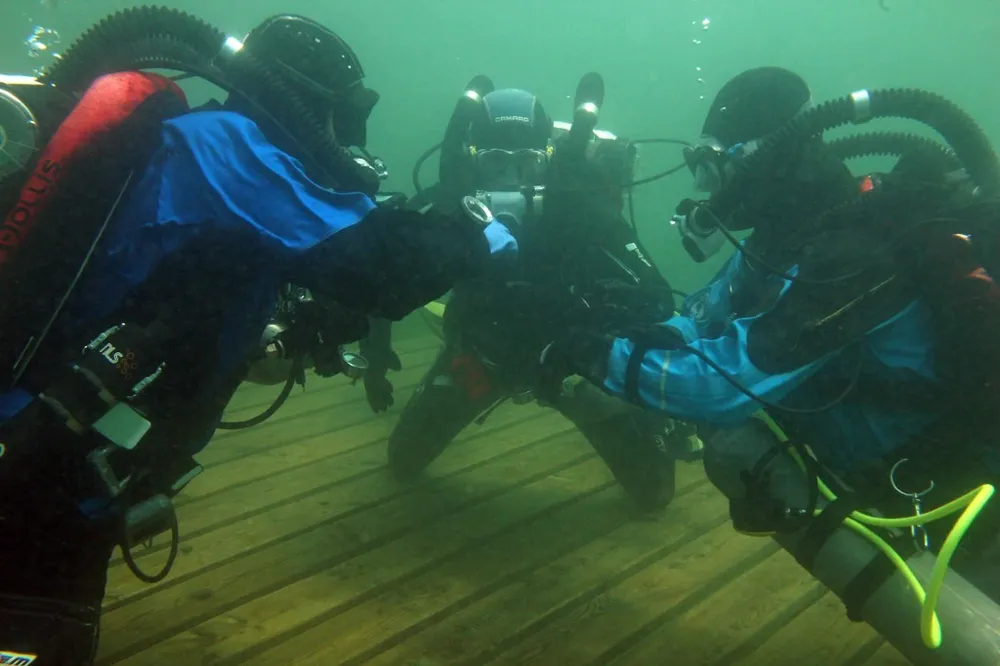
Scuba Diving Terms: How This Glossary Works
Scuba has a lot of vocabulary. Some of it is technical (partial pressure, no-decompression limit), some is training-course shorthand (BWRAF, OW, AOW) and some is boat-deck slang (air hog, viz, getting narced). This glossary collects the terms new and returning divers run into most, grouped by category so related words sit together:
- Acronyms at a glance
- Gear terms
- Breathing gas terms
- Physics terms
- Physiology and dive medicine terms
- Procedures and dive planning terms
- Hand signals
- Training agencies and certification terms
- Slang and lingo, plus a few words divers avoid
Within each group, terms run A–Z. Definitions are short on purpose; where we have a full guide on a topic, we link to it. Definitions follow the training agencies (PADI, SSI) and the Divers Alert Network (DAN). This glossary is general information, not a substitute for a scuba course or medical advice. If scuba itself is new to you, start with what is scuba diving.
Common Scuba Acronyms at a Glance
These are the abbreviations you'll see on dive computers, course materials and dive-shop forms. Each one is explained in more detail in its category below.
| Acronym | Stands For | Category |
|---|---|---|
| SCUBA | Self-Contained Underwater Breathing Apparatus | General |
| AGE | Arterial gas embolism | Medicine |
| AOW | Advanced Open Water (Diver) | Certification |
| ATA | Atmospheres absolute | Physics |
| BC / BCD | Buoyancy compensator / buoyancy control device | Gear |
| BWRAF | BCD, Weights, Releases, Air, Final OK | Procedure |
| CCR | Closed-circuit rebreather | Gear |
| CMAS | Confédération Mondiale des Activités Subaquatiques | Agency |
| DAN | Divers Alert Network | Organization |
| DCI | Decompression illness | Medicine |
| DCS | Decompression sickness (the bends) | Medicine |
| DPV | Diver propulsion vehicle (scooter) | Gear |
| DSD | Discover Scuba Diving (PADI try-dive) | Training |
| EAN / EANx | Enriched air nitrox | Gas |
| FSW | Feet of seawater | Physics |
| MOD | Maximum operating depth | Gas |
| NAUI | National Association of Underwater Instructors | Agency |
| NDL | No-decompression limit | Planning |
| OOA | Out of air | Procedure |
| OW | Open Water (Diver) | Certification |
| PADI | Professional Association of Diving Instructors | Agency |
| PFO | Patent foramen ovale | Medicine |
| PO2 / ppO2 | Partial pressure of oxygen | Physics |
| PSI / bar | Pounds per square inch / bar (pressure units) | Physics |
| SMB | Surface marker buoy | Gear |
| SPG | Submersible pressure gauge | Gear |
| SSI | Scuba Schools International | Agency |
| WRSTC | World Recreational Scuba Training Council | Agency |
Scuba Gear Terms
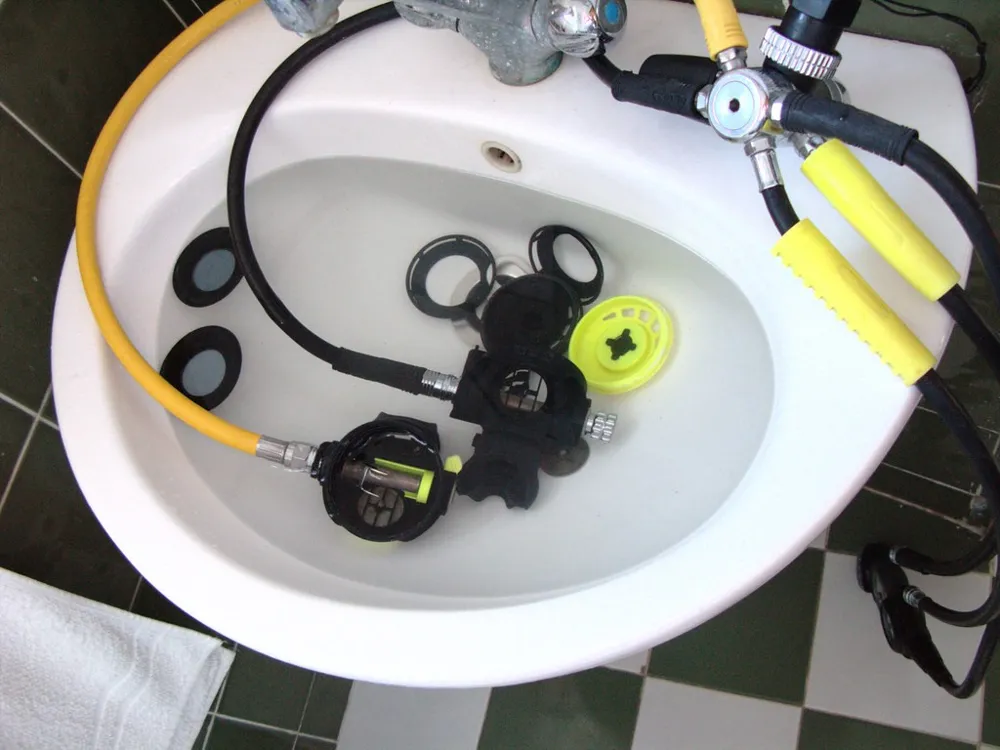
For what to buy versus rent, and how each piece fits together, see our scuba diving equipment list.
- Alternate air source (octopus, octo, occy): a spare second stage on your regulator, usually on a longer, brightly colored hose, that you hand to a buddy who runs out of air. In some regions "octopus" means the whole regulator set.
- Backplate and wing: a BCD style with a rigid plate on your back and an inflatable bladder (the wing) behind the tank.
- BC / BCD: the buoyancy compensator or buoyancy control device. An inflatable vest or wing that holds the tank, inflated from the tank through a low-pressure inflator and vented with deflate valves. Compare styles in our BCD guide.
- Booties: neoprene boots worn with open-heel fins.
- Cylinder (tank): the high-pressure container for your breathing gas. A common aluminum tank holds about 80 cubic feet of air at 3,000 psi. Cylinders must pass periodic visual inspections and hydrostatic tests ("hydros").
- DIN and yoke: the two main ways a regulator's first stage connects to a cylinder valve. A yoke adaptor lets a DIN regulator attach to a yoke-style (international) valve.
- Dive computer: a wrist or console instrument that tracks depth, time and ascent rate and calculates your no-decompression limit in real time. See dive computers.
- DPV (scooter): a handheld diver propulsion vehicle that pulls you through the water.
- Drysuit: a sealed suit that keeps you dry, insulating with a layer of gas and undergarments. Used in cold water. See wetsuit vs drysuit.
- First stage: the part of the regulator that attaches to the tank valve and reduces cylinder pressure to an intermediate pressure.
- Full-foot and open-heel fins: full-foot fins enclose the foot like a shoe; open-heel fins have a strap and are worn with booties. See scuba fins.
- Hood: a neoprene head covering for warmth.
- Inflator: the button-operated valve on the BCD or drysuit hose that adds air from the tank.
- Mask: tempered glass lenses plus an enclosed nose pocket, so you can equalize and clear water. Divers wear masks, not goggles. See scuba masks.
- O-ring: a small rubber ring that seals connections such as the tank valve.
- Pony bottle: a small, independent backup cylinder with its own regulator.
- Rebreather (CCR): equipment that recycles your exhaled gas, scrubs out carbon dioxide and adds oxygen back, so it makes few or no bubbles. Requires specialist training. The opposite is open circuit, where every breath goes into the water.
- Regulator (reg): the system that delivers breathing gas from the tank at the surrounding pressure when you inhale. See regulators.
- Second stage: the mouthpiece part of the regulator, which drops intermediate pressure to ambient pressure on demand. Pressing its purge button blows water out.
- Sidemount: a configuration where cylinders are worn along your sides instead of on your back.
- SMB (safety sausage): a surface marker buoy, an inflatable tube you raise to show boats where you are.
- SPG: the submersible pressure gauge, which shows how much gas is left in your tank, in bar or psi. Some computers show this wirelessly.
- Weights and weight belt: lead that offsets the buoyancy of your body and exposure suit, worn on a belt or in integrated BCD pockets with quick releases.
- Wetsuit: a neoprene suit that insulates you, sold in thicknesses such as 3mm, 5mm and 7mm. A shorty has short arms and legs; a full suit is sometimes called a steamer.
Breathing Gas Terms
- Air: what most recreational tanks hold. It is about 21% oxygen and 79% nitrogen, not pure oxygen.
- Enriched air nitrox (EAN, EANx, nitrox): a mix with more oxygen and less nitrogen than air, often around 32–36% oxygen. EAN32 means 32% oxygen. It extends no-decompression time at moderate depths but lowers your maximum depth. Divers need nitrox training, and they analyze each tank before use.
- Heliox: a helium and oxygen mix used for very deep diving.
- Maximum operating depth (MOD): the deepest you can safely breathe a given mix before its oxygen partial pressure reaches the limit you've set. DAN's example: a 40% mix reaches 1.4 ATA at about 25 meters (82 feet). Our scuba depth limits guide explains why.
- Reserve gas: gas you plan never to use, kept for emergencies and the ascent.
- Trimix: a mix of oxygen, nitrogen and helium for deep technical dives. Helium doesn't cause narcosis.
Diving Physics Terms
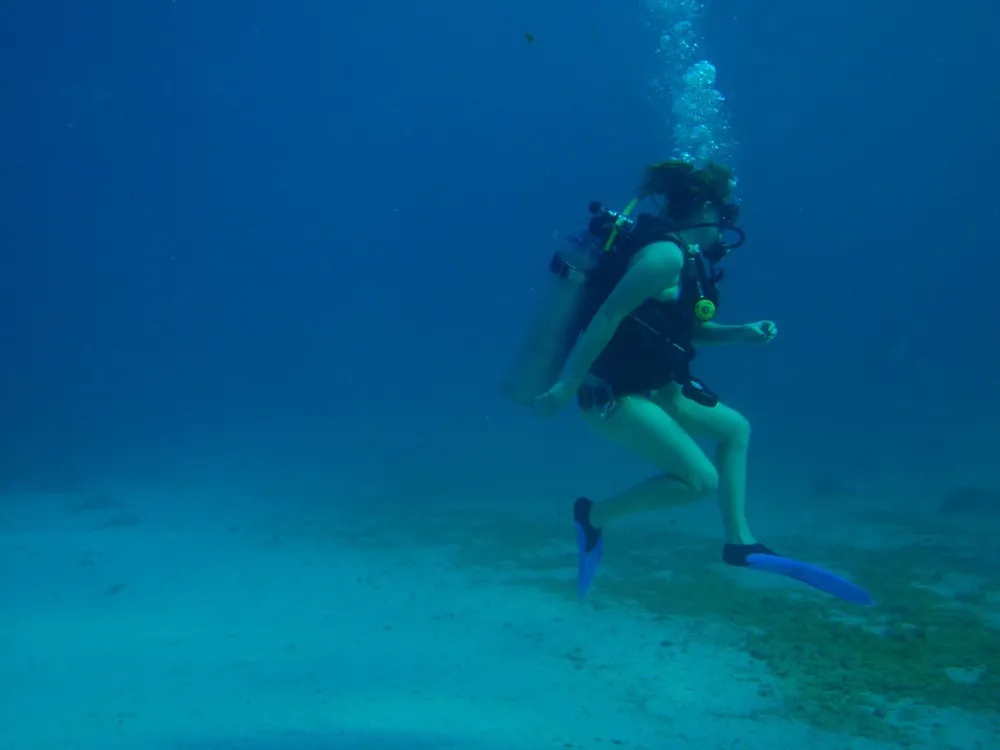
Every scuba course teaches a little physics because pressure explains almost every diving rule. PADI's summary is the basis for these definitions.
- Ambient pressure: the total pressure around you, from the air above plus the water.
- Archimedes' principle: an object in water is pushed up by a force equal to the weight of the water it displaces. It explains why you need weights, and why salt water (denser) usually needs more weight than fresh water.
- ATA and bar: atmospheres absolute. At the surface you're at 1 ATA (about 1 bar). Seawater adds about 1 ATA for every 10 meters (33 feet), so you're at 2 ATA at 10 m and 4 ATA at 30 m.
- Boyle's law: at a constant temperature, a gas's volume falls as pressure rises. Air in your lungs, ears, mask and BCD shrinks to half its volume at 10 m and expands again as you rise. That's why divers never hold their breath while ascending.
- Buoyancy: whether you float (positive), sink (negative) or hover (neutral). Neutral buoyancy is the goal for most of a dive.
- Charles's law: gas pressure drops as temperature drops, so a tank's pressure reading can fall when it cools in cold water.
- Dalton's law and partial pressure: the total pressure of a gas mix is the sum of each gas's partial pressure. In air at 20 m (3 ATA), oxygen's partial pressure is 0.63 ATA and nitrogen's is 2.37 ATA.
- FSW: feet of seawater, a depth-based pressure unit used in dive tables and chamber treatment.
- Henry's law: the amount of gas that dissolves in a liquid is proportional to the pressure. It is why your body absorbs nitrogen at depth and why it can form bubbles if you ascend too fast, like a soda when you open the bottle.
- Thermocline: a layer where the water temperature changes sharply, usually colder below.
- Visibility (viz): how far you can see underwater.
Physiology and Dive Medicine Terms
These definitions match our longer guides to the bends and scuba risks. If you have symptoms after a dive, stop diving, contact emergency services and call the DAN Emergency Hotline at +1-919-684-9111.
- Alternobaric vertigo: dizziness caused when your two ears equalize at different rates, usually on ascent (DAN).
- Arterial gas embolism (AGE): air from overexpanded lungs entering the arteries, usually after a fast or breath-held ascent.
- Barotrauma (squeeze): injury from a pressure difference between an air space in the body and the surroundings. A mask squeeze happens when you don't add air to your mask through your nose on descent. A reverse squeeze (reverse block) is the same problem on ascent, when expanding air can't escape.
- Carbon dioxide (CO2) buildup: too much CO2 in the blood, which in severe cases can lead to blackout.
- Decompression illness (DCI): the umbrella term for decompression sickness and arterial gas embolism.
- Decompression sickness (DCS, the bends): nitrogen absorbed under pressure forms bubbles as pressure drops. Symptoms usually appear within 15 minutes to 12 hours of a dive, according to DAN.
- Equalizing (clearing): adding air to your middle ears and sinuses so their pressure matches the water's. DAN advises equalizing gently every few feet during the first 10 to 15 feet of descent. Common methods, per DAN:
- Valsalva: pinch your nose and blow gently through it.
- Toynbee: pinch your nose and swallow.
- Frenzel: pinch your nose, close the back of your throat and make a "k" sound.
- Edmonds: push your jaw forward, then use Valsalva or Frenzel.
- Eustachian tube: the passage from the middle ear to the back of the throat that equalizing opens.
- Hypothermia: body temperature dropping below normal. Water draws heat from the body quickly.
- Nitrogen narcosis (narced, rapture of the deep): an alcohol-like impairment from breathing nitrogen at high pressure. PADI notes some divers feel it at about 30 meters (98 feet). Symptoms ease as you ascend slowly.
- Off-gassing (outgassing): dissolved nitrogen leaving your tissues and being exhaled after a dive. On-gassing is the uptake during the dive.
- Oxygen toxicity: harm from breathing oxygen at too high a partial pressure. DAN considers 1.4 ATA generally safe and advises recreational divers never to exceed 1.6 ATA.
- Patent foramen ovale (PFO): a small opening between the heart's upper chambers that can let bubbles cross from veins to arteries. It is one factor doctors check after an unexplained case of DCS.
- Recompression (chamber ride): treatment in a hyperbaric chamber, breathing oxygen under pressure.
Dive Planning and Procedure Terms
- Ascent rate: how fast you rise. DAN notes agency recommendations range from 30 to 60 feet (about 9 to 18 meters) per minute, and that the US Navy and NOAA use 30 feet per minute. Your computer warns you if you go too fast.
- Back roll entry: sitting on the side of a small boat and rolling backward into the water while holding your mask.
- Bottom time: how long a dive lasts, used for planning. It can also mean your total underwater time as a diver.
- Buddy system: diving with a partner who plans the dive with you and stays close enough to help.
- BWRAF (buddy check): PADI's pre-dive safety check, done with your buddy before every dive:
PADI's memory aid is "Begin With Review And Friend," though divers trade jokier ones such as "Because We Really Are Friends."
Letter Check What You Confirm B BCD Inflator and dump valves work; BCD is connected W Weights Weights are secure and the belt or pockets release R Releases Straps and buckles are fastened, and your buddy knows how to open them A Air Valve fully open, gauge working, air tastes normal, alternate air source secured F Final OK Mask, fins and accessories in place; head-to-toe check - Confined water: a pool or calm, pool-like area where you practice skills before your open water training dives. Open water dives on a course are often called checkout dives.
- Decompression stop (deco): a required pause during ascent once you've gone beyond your no-decompression limit. Planned decompression is technical diving.
- Dive profile: your depth over time. A multilevel dive spends time at several depths.
- Drift dive: a dive where you let a current carry you and the boat picks you up downstream.
- Giant stride entry: stepping off a boat or dock with one big step while holding your mask.
- Mask clearing: blowing water out of a flooded mask by exhaling through your nose.
- No-decompression limit (NDL): the maximum time at a depth before decompression stops become required. On PADI's Recreational Dive Planner it is 56 minutes at 18 meters and 20 minutes at 30 meters.
- No-fly time: how long to wait before flying after diving. DAN recommends at least 12 hours after a single no-decompression dive and 18 hours after repetitive dives or multiple days of diving. More in our guide to flying after scuba diving.
- Overhead environment: any place where you can't swim straight up to the surface, such as a cave or wreck interior. See cave diving.
- Repetitive dive: a dive made while nitrogen from an earlier dive is still in your body, so it must be accounted for in planning.
- Safety stop: a voluntary pause near the end of every dive, usually 3 minutes at about 5 meters (15 feet), to give nitrogen more time to leave your body.
- Shore dive: a dive you walk into from land, as opposed to a boat dive.
- Surface interval: the time you spend at the surface between dives.
- Thumb the dive / call the dive: to end a dive early by signaling to ascend.
- Turn pressure: the tank pressure at which you start heading back, agreed before the dive.
Scuba Hand Signals
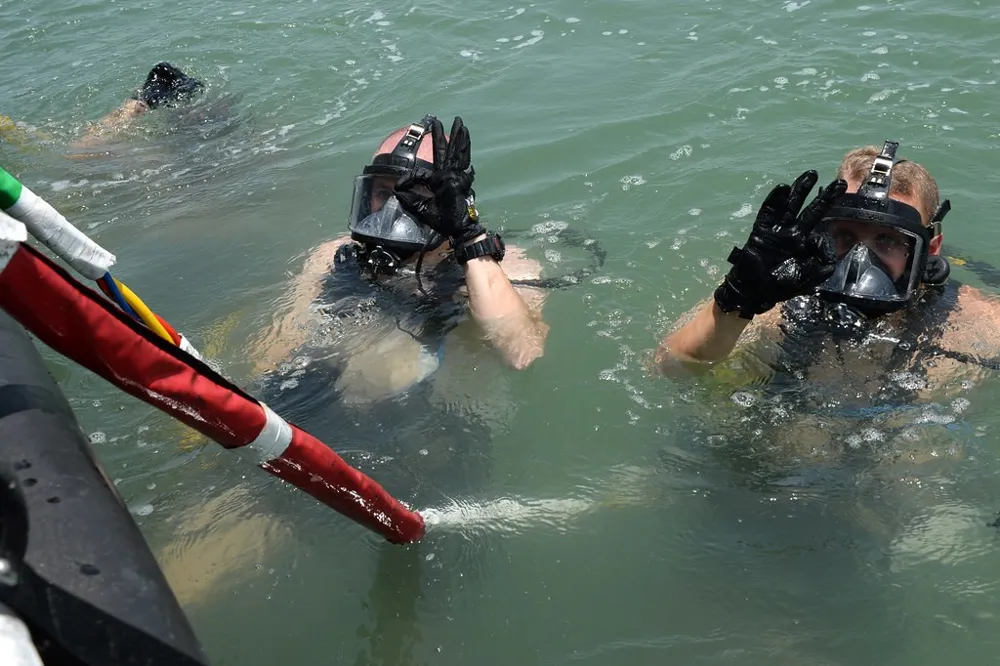
Divers can't talk underwater, so they use hand signals. In the US, the Recreational Scuba Training Council has developed standard signals, and the core set is taught on every entry-level course. Local variations exist, so review signals with your buddy and guide before each dive. These descriptions follow SSI and PADI.
| Signal | How to Make It | Meaning |
|---|---|---|
| OK | Thumb and index finger form a circle, other three fingers up | "Are you OK?" and "I'm OK." Always answer it |
| OK at the surface | Touch the top of your head with one hand | "I'm OK," visible from the boat |
| Problem | Flat hand rocked side to side, then point to the problem | "Something's wrong" (for example, "my ear") |
| Up | Fist with the thumb pointing up | Ascend or end the dive. Not "OK" |
| Down | Fist with the thumb pointing down | Descend |
| Come to my level | Up or down thumb with the other hand held flat across it | Come up or down to my level |
| How much air? | Two fingers tapping the palm of the other hand | Show your gauge or signal your pressure |
| Low on air | Fist held to the chest | Reserve reached; time to head up |
| Out of air | Flat hand moved side to side across the throat | Emergency: I need your alternate air source |
| Stay together | Index fingers of both hands side by side | Buddy up, get closer |
| Turn around | Index finger up, circled | Turn the dive back |
| Cold | Hand rubbing the opposite upper arm | I'm cold, often a reason to end the dive |
| Look | Two fingers pointed at your eyes, then at something | Look at that |
| Safety stop | Varies by region; agree on it in the dive briefing | 3-minute safety stop |
| Feeling unwell | Point fingers at yourself, then trace a large oval in front of your head and body | "I don't feel well" (a signal PADI added in 2023) |
Divers also share informal marine life signals, such as a flat hand held upright on the head for "shark." The single most important rule: a thumbs up means go up, so use the circle sign for OK.
Training Agencies and Certification Terms
A certification agency writes course standards, trains instructors and issues certification cards. Many agencies follow shared minimum standards, but check that your dive operator accepts your card. For a full breakdown of course levels, see scuba certification levels and how to get scuba certified.
Agencies and Organizations
- PADI (Professional Association of Diving Instructors): one of the largest recreational training and certification agencies.
- SSI (Scuba Schools International): a recreational scuba and freediving training agency.
- NAUI (National Association of Underwater Instructors): a non-profit association of scuba instructors and one of the oldest certifying agencies.
- CMAS (Confédération Mondiale des Activités Subaquatiques): the world underwater federation, which trains divers and governs underwater sports.
- BSAC (British Sub-Aqua Club): a UK diving club that also trains and certifies divers.
- SDI/TDI, IANTD, GUE and RAID: agencies known for technical and rebreather training (SDI is TDI's recreational side), though most also teach recreational courses.
- WRSTC (World Recreational Scuba Training Council): founded in 1999, it develops worldwide minimum training standards. Its members are regional councils (RSTCs) made up of agencies such as PADI, SSI, NAUI and SDI.
- DAN (Divers Alert Network): a non-profit diver safety organization that runs a 24-hour emergency hotline, offers dive accident insurance and collects dive accident data.
Certification Terms
| Term | What It Means |
|---|---|
| C-card | Your certification card, proof of training that dive shops ask to see |
| Discover Scuba Diving (DSD) / try dive | A supervised introductory experience with an instructor; not a certification |
| Scuba Diver | A partial certification (PADI and SSI): 12 m (40 ft), with a dive professional |
| Open Water Diver (OW) | The first full certification: 18 m (60 ft) with a buddy |
| Advanced Open Water (AOW) | Builds experience with adventure or specialty dives: 30 m (100 ft) |
| Deep Diver | Specialty for dives to the recreational limit of 40 m (130 ft) |
| Rescue Diver | Training to prevent and manage emergencies; PADI requires first aid and CPR training (Emergency First Response) first |
| Divemaster (DM) | A professional level: leads certified divers and assists instructors |
| Instructor | Teaches and certifies divers; see how to become a scuba instructor |
| Specialty | A focused course such as nitrox, night, wreck, drysuit or deep |
| Logbook | Your record of dives: date, site, depth, time and notes |
| Recreational vs technical | Recreational diving stays within no-stop limits and 40 m; technical diving goes beyond, with decompression and special gases. See types of scuba diving |
Scuba Diving Slang and Lingo
Dive boats have their own vocabulary. Much of it is regional (bommie, for example, is used mainly in Australia, Fiji and the South Pacific), and some of it is affectionate teasing. Most of these appear in PADI's own roundup of diver slang.
- Air hog (air sucker): a diver who uses gas faster than others. Training and practice can improve it.
- Bait ball: a tight, swirling school of fish bunched together for defense.
- Bent / getting bent: having decompression sickness.
- Bommie: a coral outcrop or pinnacle.
- Bottle: a scuba tank.
- Chamber ride: treatment in a recompression chamber.
- Doubles: two tanks worn together, common in technical diving.
- Egg beater: a diver who swims upright, kicking up sand and ruining the viz.
- Fart bag: a drysuit.
- Feeding the fish: being seasick over the side or vomiting underwater.
- Hookah: breathing from an air supply on the surface through a long hose.
- Hydro: a cylinder's hydrostatic test.
- Into deco: past your no-decompression limit, so stops are now required.
- Narced: feeling the effects of nitrogen narcosis.
- Nasal nudibranch: mucus escaping your nose into your mask during a dive.
- Six-pack: a small dive boat that carries up to six divers.
- Skin / stinger suit: a thin full-body suit for sun and sting protection, with little warmth.
- Stroke: an insulting term for a careless or reckless diver.
- Swimmers, bathers, cozzie: regional words for swimwear worn under gear.
- Viz: visibility.
- Zodiac: an inflatable boat used to ferry divers.
Words Divers Avoid
A few everyday words mark a speaker as new to diving. PADI lists these swaps:
| Avoid | Say Instead | Why |
|---|---|---|
| Oxygen | Air or breathing gas | Recreational divers breathe air, about 21% oxygen |
| Oxygen tank | Tank or cylinder | Pure oxygen is used at the surface for first aid, not for normal dives |
| Flippers | Fins | Flippers belong to marine animals |
| Goggles | Mask | A dive mask encloses your nose so you can equalize it and clear water |
One more: "scuba" is now usually written in lowercase, even though it began as an acronym.
Keep Learning
Terms stick fastest once you use them. A course turns this vocabulary into habits. Start with getting certified, then read our scuba diving tips for beginners, how to equalize your ears and snorkeling vs scuba diving. Browse everything in our snorkeling and diving guides.
Sources for these definitions include PADI (dive physics, BWRAF, hand signals, slang and terminology), SSI (hand signals), the Divers Alert Network (ascent rates, ear equalization, oxygen limits and no-fly guidance) and Wikipedia's entry on the World Recreational Scuba Training Council.
Frequently Asked Questions
What does BCD stand for in scuba diving?
Buoyancy control device, also called a buoyancy compensator (BC). It is the inflatable vest or wing that holds your tank and lets you add or release air to float, sink or hover.
What does NDL mean in diving?
No-decompression limit: the longest time you can stay at a given depth and still ascend directly to the surface without required decompression stops. Your dive computer or dive table tracks it.
What does BWRAF stand for?
It is PADI's pre-dive buddy check: BCD, Weights, Releases, Air and Final OK. A common memory aid is "Begin With Review And Friend."
What is the scuba hand signal for OK?
Join your thumb and index finger in a circle with the other three fingers pointing up. It is both a question and an answer. A thumbs up means ascend, not OK.
What do divers call a scuba tank?
Divers say tank or cylinder, and "bottle" is common slang. PADI advises against calling it an oxygen tank, because recreational tanks hold compressed air, which is only about 21% oxygen.
What does it mean to get bent?
It is slang for decompression sickness, often called the bends. It happens when nitrogen absorbed under pressure forms bubbles in the body after a dive.
What is a safety sausage?
Slang for a surface marker buoy (SMB): a tall, brightly colored inflatable tube a diver raises at the surface so boats and the crew can see them.