What Is Scuba Diving? A Plain-English Guide for Beginners (2026)
Scuba diving means carrying your own air supply underwater. Here's what the word stands for, how the gear works, where it came from and the different kinds of diving people do.
What Is Scuba Diving? The Short Answer
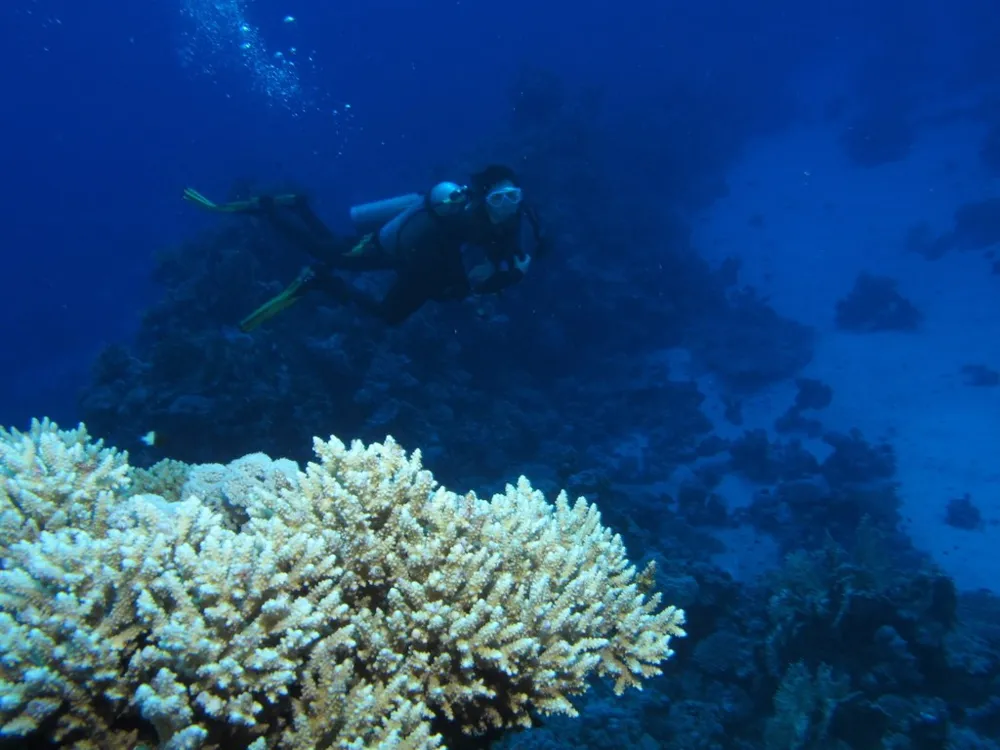
Scuba diving is underwater diving in which you carry your own breathing gas, usually a cylinder of compressed air on your back, and breathe it through a mouthpiece called a regulator. Because you don't depend on a hose to the surface or on holding your breath, you can swim freely and stay underwater for many minutes at a time.
Most people scuba dive for fun, to explore reefs, wrecks, kelp forests and lakes. Others dive for work, science or the military. Whatever the reason, the basic idea is the same: a portable air supply, a way to control buoyancy and the training to use both safely.
What Does SCUBA Stand For?
SCUBA is an acronym for Self-Contained Underwater Breathing Apparatus. Strictly speaking, "scuba" is the equipment and "diving" is the activity, so scuba diving means diving with that equipment.
The term is credited to Dr. Christian J. Lambertsen, an American physician who designed oxygen rebreathers for military divers. He used it in the early 1950s for his own breathing unit; Wikipedia ties the name to a patent he filed in 1952, while PADI gives 1954. The word caught on so widely that it's now usually written in lowercase as an ordinary word and pronounced "SKOO-buh."
| Letter | Stands For | What It Means |
|---|---|---|
| S | Self | You carry the gas yourself; no hose to the surface |
| C | Contained | |
| U | Underwater | Designed for use below the surface |
| B | Breathing | Supplies gas you breathe normally |
| A | Apparatus | The equipment as a whole |
How Does Scuba Diving Work?
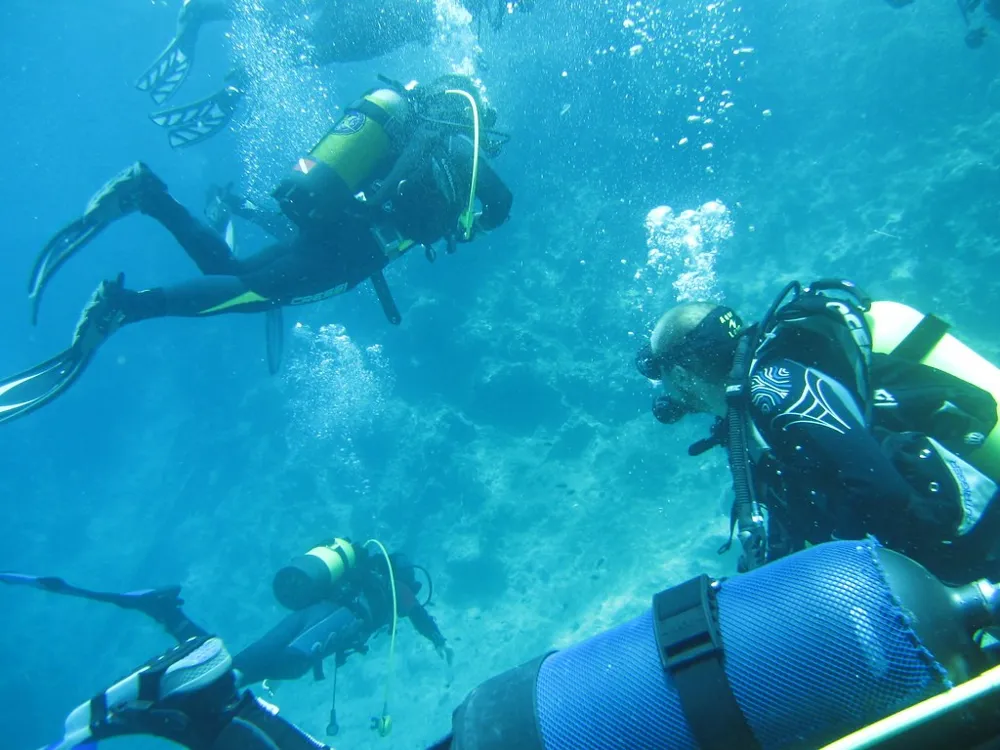
Scuba solves two problems: breathing underwater and staying at the depth you want.
Breathing at Depth
Water is heavy. According to NOAA, pressure rises by one atmosphere for every 33 feet (about 10 meters) of seawater. Your lungs can't pull air from the surface against that pressure, which is why a long snorkel doesn't work (see how a snorkel works). Scuba gets around this by delivering air at the same pressure as the water around you.
- The cylinder stores air at very high pressure. A common aluminum tank holds about 80 cubic feet of air at 3,000 psi, according to HowStuffWorks.
- The first stage of the regulator screws onto the tank valve and drops that pressure to an intermediate level, roughly 140 psi.
- The second stage, the part in your mouth, lowers it again to the surrounding water pressure and releases air only when you inhale. Your exhaled breath leaves through a one-way valve as bubbles.
This "on demand" delivery is what made modern scuba practical: you breathe normally, and no air is wasted between breaths.
What's in the Tank
Not pure oxygen. Most recreational tanks hold ordinary compressed air, about 21% oxygen and 79% nitrogen, as PADI explains. Trained divers may use enriched air nitrox, which has a higher share of oxygen and less nitrogen, mainly to extend time at moderate depths. Technical divers may add helium for very deep dives.
Staying Weightless
Divers wear lead weights to sink and a buoyancy control device (BCD), a vest that holds the tank and can be inflated from it. Adding a little air makes you rise; letting it out makes you sink. The goal is neutral buoyancy, where you neither float up nor sink, so you can hover over a reef without touching it.
Open Circuit vs. Rebreathers
Almost all recreational divers use open-circuit scuba, where every exhaled breath goes into the water. Rebreathers (closed or semi-closed circuit) recycle exhaled gas, remove carbon dioxide and add oxygen back. They make few or no bubbles and use gas very efficiently, but they're more complex and need specialized training.
The Basic Scuba Kit
A typical recreational diver uses the gear below. For what each item does in detail and what to buy or rent first, see our full scuba diving equipment list.
| Item | Job |
|---|---|
| Cylinder (tank) | Stores the breathing gas |
| Regulator | Reduces tank pressure and delivers air when you inhale; includes a spare mouthpiece (the "octopus") for a buddy |
| BCD | Holds the tank and controls buoyancy |
| Weights | Offset the buoyancy of your body and wetsuit |
| Mask and fins | Let you see clearly and swim efficiently |
| Dive computer or gauges | Track depth, time, remaining air and no-decompression limits |
| Wetsuit or drysuit | Keeps you warm; water draws heat from the body quickly |
A Short History of Scuba Diving
People have dived on a single breath for thousands of years to gather food, sponges and pearls. Carrying air underwater took much longer to solve. These are the milestones that led to modern scuba:
| Year | Milestone |
|---|---|
| 1864 | Benoît Rouquayrol and Auguste Denayrouze build a working demand regulator system in France |
| 1878 | Henry Fleuss builds the first commercially practical rebreather in London |
| 1925 | Yves Le Prieur introduces an open-circuit system, but it flows continuously and wastes air |
| 1939 | Christian Lambertsen develops a free-swimming oxygen rebreather, later used by the US Office of Strategic Services |
| 1943 | Jacques-Yves Cousteau and engineer Émile Gagnan introduce the Aqua-Lung, an open-circuit unit with a demand regulator (design work began in 1942; it was patented in 1945) |
| Early 1950s | Lambertsen coins the name SCUBA; in 1952 Ted Eldred in Australia develops a single-hose open-circuit regulator, a design approach that became the common layout for recreational regulators |
| 1971 | ScubaPro introduces the stabilizer jacket, the forerunner of today's BCD |
| 1990s | Nitrox enters mainstream recreational training: NAUI sanctions it in 1992 and PADI in 1996 |
The Aqua-Lung was the turning point. According to the Cousteau Society, Gagnan had designed a regulator for cooking gas, and the pair adapted it so divers received air only when they inhaled, fixing the wasted-air problem of earlier designs. Cousteau's undersea films in the 1950s and 1960s then helped turn scuba into a popular pastime, and training agencies such as PADI, NAUI and SSI made standardized courses widely available.
Types of Scuba Diving
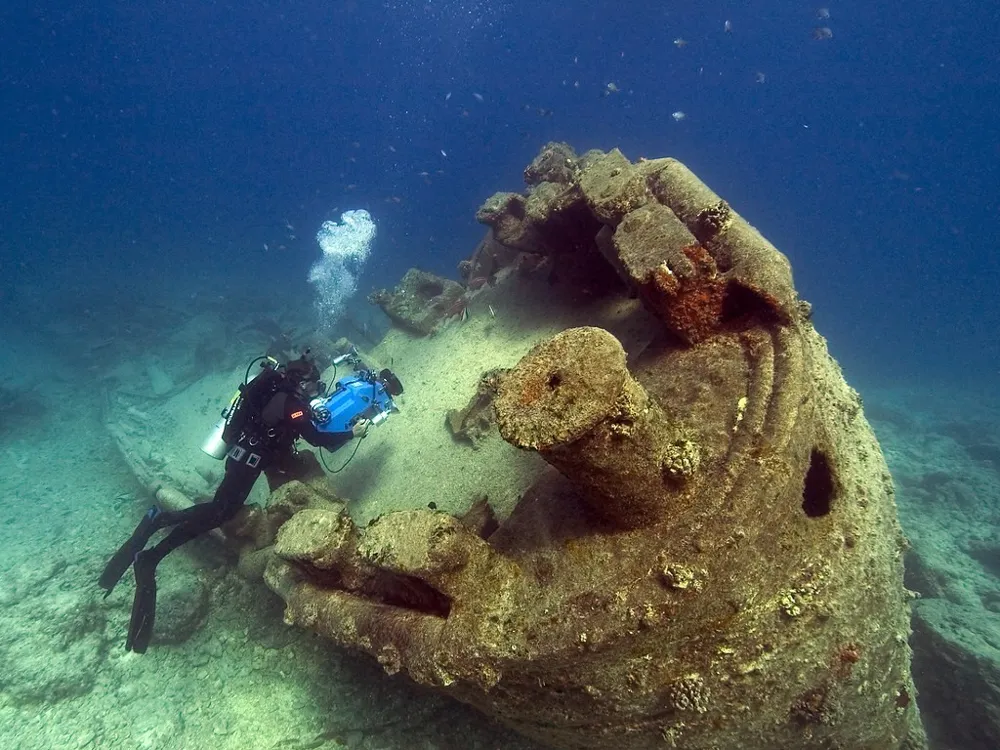
"Scuba diving" covers several quite different activities. The main split is between diving for fun and diving for work.
| Type | What It Is | Typical Limits or Training |
|---|---|---|
| Recreational | Diving for enjoyment: reefs, wrecks, marine life, photography | No required decompression stops, direct ascent to the surface possible, maximum 40 m (130 ft) |
| Technical | Going beyond recreational limits: deeper dives, planned decompression stops, overhead environments | Extra gas supplies, mixes such as trimix, rebreathers and specialist training |
| Commercial | Paid underwater work such as construction, inspection and salvage | Often uses surface-supplied gear rather than scuba; regulated as workplace diving |
| Scientific | Research by marine biologists, archaeologists and other scientists | Run under scientific diving programs and standards |
| Public safety and military | Search, rescue and recovery; military operations | Specialized training; military divers often use rebreathers |
Within recreational diving there are many styles: wreck, night, drift, deep, ice and cave diving, to name a few. See our guide to the types of scuba diving for each one. For why the line sits at 40 meters, see how deep you can scuba dive.
Scuba vs. Snorkeling, Freediving and Surface-Supplied Diving
Scuba is one of several ways to go underwater. The key difference is where your air comes from.
| Activity | Air Source | Where You Spend Your Time | Certification |
|---|---|---|---|
| Snorkeling | Surface air through a tube | Floating at the surface | Not required |
| Freediving | One breath held | Short dives below the surface | Courses recommended |
| Scuba diving | Tank you carry | Underwater for the whole dive | Required to dive independently |
| Surface-supplied diving | Hose from the surface | Underwater, tethered to a boat or platform | Mostly professional training |
For full side-by-side comparisons, see snorkeling vs scuba diving and scuba diving vs freediving.
Is Scuba Diving a Sport?
It depends on what you mean by sport. Everyday recreational diving has no scores, races or winners, so many divers describe it as a recreational activity rather than a sport. It's also commonly called "sport diving," and it is physical: you swim, carry gear and work against currents.
There are also genuinely competitive scuba events. The world underwater federation, CMAS, governs underwater orienteering, a navigation race on open-circuit scuba with world-level championships since 1973, and sport diving, a pool competition testing scuba skills that became an official CMAS sport in 2008. So scuba can be a sport, but most people who dive never compete.
What Does Scuba Diving Feel Like?
New divers often describe a few things:
- The gear feels unfamiliar at first. Breathing through a regulator and moving with a tank on your back take some getting used to, and PADI notes it gets easier with practice. You'll hear your own breathing and bubbles more than anything else.
- Weightlessness. Once your buoyancy is right, you hover in mid-water, a sensation PADI likens to floating among treetops.
- Ear pressure. As you descend, you need to equalize your ears, much like on a plane. See how to equalize your ears when diving.
- Time to look. Unlike snorkeling on a held breath, you can stay beside a turtle or coral head for minutes.
- Color and temperature change with depth. Water absorbs light and heat, so reefs lose red and orange tones as you go deeper, and you can feel cooler water below a thermocline.
A dive usually lasts somewhere around 30 minutes to an hour, depending on depth, tank size and how fast you breathe.
Where Do People Scuba Dive?
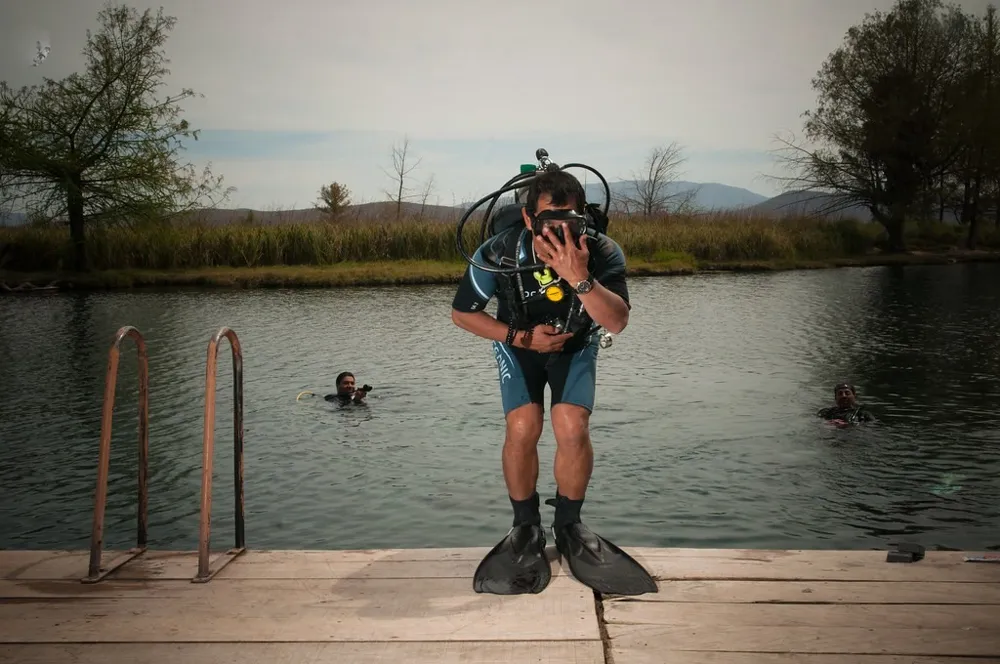
Anywhere with enough water, visibility and safe access. Common settings include:
- Coral reefs in tropical seas, the classic vacation dive.
- Shipwrecks, from intentionally sunk artificial reefs to historic wrecks.
- Kelp forests in cooler coastal water, such as California.
- Lakes, quarries and springs, often used for training and local diving.
- Pools, where nearly everyone takes their first breaths underwater.
For trip ideas, see our best scuba diving destinations, the best destinations for beginners and the best scuba diving in the Caribbean.
Who Can Scuba Dive?
Most reasonably healthy people who are comfortable in the water can learn. PADI says children can start in kids' programs from age 8, Junior Open Water certification begins at 10 and there is no upper age limit. Training agencies also adapt courses for divers with physical disabilities.
The usual requirements are basic swimming ability and a medical questionnaire. Some conditions, including certain heart and lung problems, need a doctor's sign-off before you dive. For ages, the swim test and the medical form in detail, see how to get scuba certified.
Is Scuba Diving Safe?
Scuba diving has real risks, and training exists to manage them. The main ones are running low on gas, ascending too fast, decompression sickness (the bends), nitrogen narcosis on deeper dives and lung injury from holding your breath while ascending. The most important rule new divers learn is simple: breathe continuously and never hold your breath on scuba.
Diving with a buddy, planning your dive, checking your gear, watching your air and staying within your training all lower the risk. For an honest look at accident causes and how to avoid them, read is scuba diving dangerous? This page is general information, not medical advice; if you have health concerns, ask a doctor familiar with diving.
How to Start Scuba Diving
- Try it first. Introductory programs such as PADI Discover Scuba Diving let you breathe underwater in a pool or calm water with an instructor, no certification needed.
- Get certified. An entry-level Open Water course teaches theory, pool skills and open-water dives. Our certification guide walks through it, and scuba certification levels explains what comes after.
- Learn the language. BCD, NDL, safety stop: our scuba diving terms glossary decodes it.
- Build skills. Practice buoyancy and air management; see our scuba diving tips for beginners.
- Gear up gradually. Many new divers buy a mask, fins and maybe a dive computer first and rent the rest.
Not ready for tanks? Snorkeling is an easy way to get comfortable in the water first. Browse all our snorkeling and diving guides for more.
Frequently Asked Questions
What does SCUBA stand for?
Self-Contained Underwater Breathing Apparatus. It is usually written as an ordinary lowercase word today and pronounced "SKOO-buh."
Is scuba diving the same as snorkeling?
No. Snorkelers float at the surface and breathe through a tube. Scuba divers carry a cylinder of compressed gas and breathe through a regulator, so they can stay underwater and go deeper.
Do scuba divers breathe pure oxygen?
No. Most recreational cylinders hold ordinary compressed air, which is about 21% oxygen and 79% nitrogen. Some trained divers use enriched air nitrox, which has more oxygen.
Is scuba diving a sport?
Recreational diving is a leisure activity with no winners or scores. Competitive events do exist, though: the world underwater federation CMAS governs scuba-based sports such as underwater orienteering and sport diving.
Do you need a license to scuba dive?
To dive on your own with a buddy, you need a certification from a training agency such as PADI, SSI or NAUI. You can try scuba without one on a supervised introductory dive with an instructor.
How long can you stay underwater on scuba?
It depends on depth, tank size and how fast you breathe. Many recreational dives last roughly 30 minutes to an hour, and deeper dives are shorter because you use gas faster and reach no-decompression limits sooner.