Surfing the Great Lakes, From Lake Superior to Lake Erie (2026)
Freshwater, wind-driven waves and ice on the shore: here's how Great Lakes surf works, when it happens, where people ride it and how to stay safe in near-freezing water.
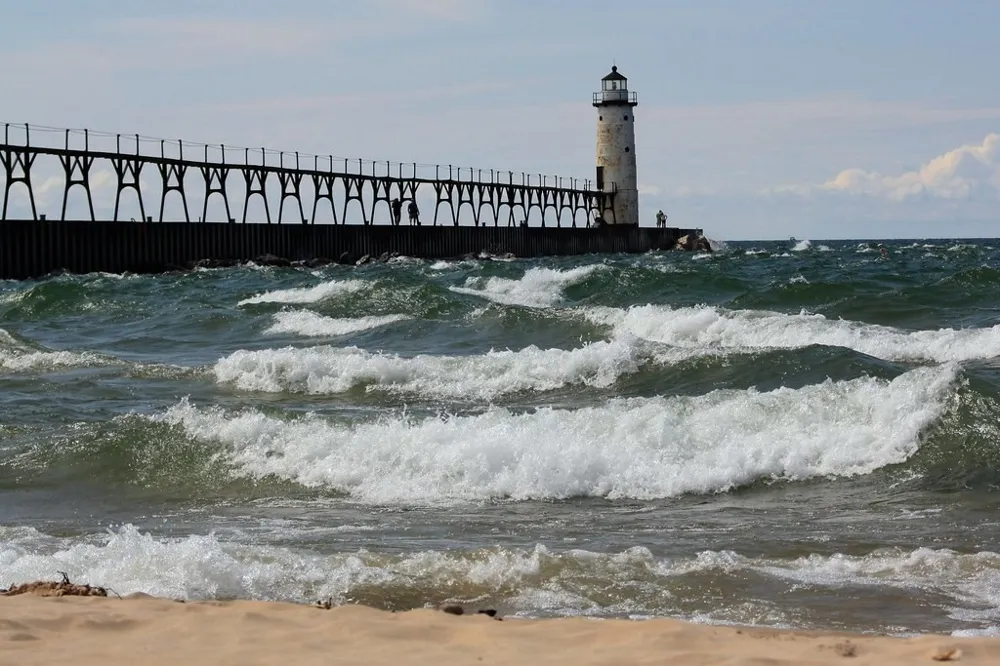
Can You Really Surf the Great Lakes?
Yes. The Great Lakes are big enough to make real, rideable waves, and small surf communities have grown up around them from Duluth to Cleveland. Sheboygan, Wisconsin, on Lake Michigan calls itself the "Malibu of the Midwest," and Travel Wisconsin says surfing has been a local pastime there for more than fifty years. Lake Superior, the biggest and coldest lake, gets the largest waves of all.
Lake surfing is different from the ocean, though. There are no tides and no long-distance groundswell, so every rideable day depends on a strong wind blowing in the right direction for long enough. The best waves usually come in fall and winter, when the water is near freezing and the beach may be covered in ice. This guide covers how lake waves form, when and where to surf each lake, the cold-water gear you need and the safety rules that matter most. For ocean spots, see our guide to the best surf spots in the US.
Great Lakes Surfing at a Glance
| Lake | Surf Notes | Spots Named in Surf Guides |
|---|---|---|
| Superior | Largest waves in the system; fewer known spots; very cold water | Stoney Point near Duluth, MN; Marquette and Grand Marais, MI |
| Michigan | Over 300 miles long north to south; the most established surf scene | Sheboygan, WI; Grand Haven, MI; Whiting, IN; Evanston, IL |
| Erie | Shallowest lake; quick-building, short-period waves | Presque Isle State Park, PA; Edgewater Park, Cleveland, OH |
| Huron | Waves on the Michigan and Ontario shores | Lexington and Burtchville, MI; Kincardine, ON |
| Ontario | Surf mainly on the Canadian side near Toronto | Toronto's western shore and Ashbridges Bay; the Niagara River mouth |
Spots come from published guides by Islands, Great Lakes Now, Travel Wisconsin and local news reports (as of November 2026). Conditions and access change, so treat this as a starting list and confirm with local shops or surf groups.
How Lake Waves Form: Wind, Fetch and Short Periods
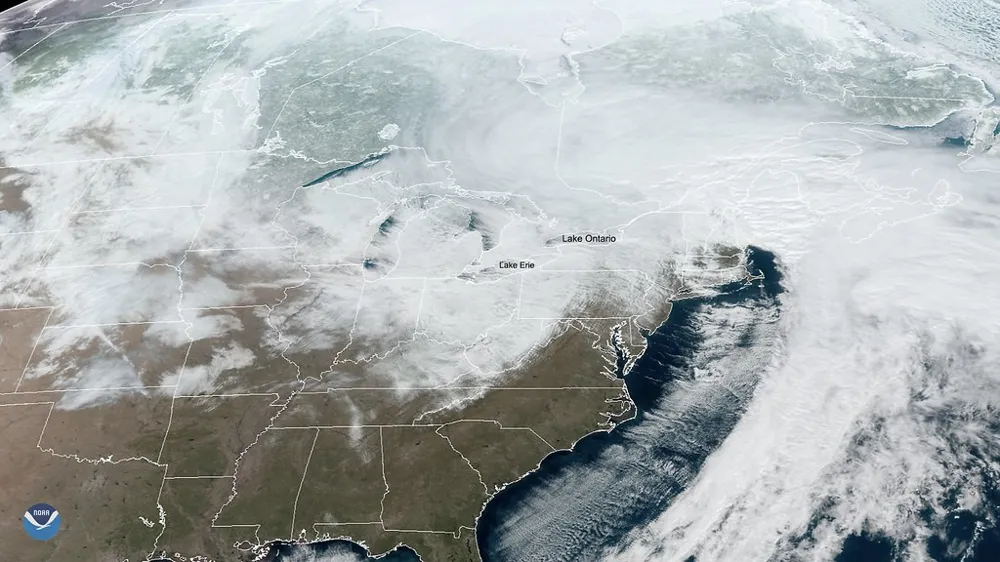
All Great Lakes surf is wind swell. Wind blowing across open water passes energy into it, and the waves grow with three things: how hard the wind blows, how long it blows and how far it travels over open water. That distance is called fetch. The longer the fetch, the bigger and more powerful the waves, which is why the largest lakes, and the shores at the far end of a long stretch of water, get the best surf.
- Wind direction decides where the waves land. On Lake Michigan, which runs over 300 miles north to south, a north wind builds waves at the south end and a south wind builds waves at the north end. East and west winds don't add much size, but they change quality: an offshore breeze cleans up wave faces, while an onshore wind makes them messy.
- Duration matters. One Lake Michigan surf guide says a north wind of at least 15 knots sustained for about six hours can produce good waves near Chicago's north shore, and that the window may last only a few hours.
- Periods are short. The National Weather Service says Great Lakes waves arrive about every 3 to 4 seconds on average in summer, and surfers on Lake Superior and Lake Erie describe periods around 4 to 5 seconds. Waves stack up close together, so a wipeout is often followed by several more waves in quick succession.
- Storms come and go fast. Swell lasts from a few hours to a few days, then the lake goes flat again.
- Fresh water is less buoyant than salt water, so boards float lower and lake waves feel softer than ocean waves of the same height.
Piers, jetties and breakwalls also shape lake surf. They block wind and can organize the waves next to them, which is why several well-known spots sit beside harbor structures. Those same structures create dangerous currents, covered below.
When to Surf: Great Lakes Surf Seasons
Fall and winter are the main surf seasons on every lake. Autumn storms and winter cold fronts bring the strongest, most persistent winds, and the best winter waves often arrive just before the lakes ice over. Summer usually has few or no surfable waves.
| Season | What to Expect |
|---|---|
| Summer | Mostly flat or small; warmest water; rip-current season for swimmers runs from Memorial Day weekend through summer, per the NWS |
| Late summer to early fall | Swell starts to return; the gentlest time for first lake sessions in a full wetsuit; Travel Wisconsin suggests beginners start in Sheboygan in August or September |
| Late fall | Strong storms and the most frequent surf on many shores; Lake Erie surfers report a peak around October to January |
| Winter | Some of the biggest swell, especially with Arctic north winds, plus ice, snow and dangerous air temperatures |
| Early spring | Sheboygan's peak season runs into early April; water is still near freezing |
A Lake Michigan guide describes water temperatures from about 55°F down to 35°F through the surf season, with most surf days at or below 40°F air temperature. Lake Erie surfing usually stops once ice dunes form along the shore.
Surfing Lake Superior
Lake Superior has fewer known surf spots than Lake Michigan, but it produces the largest waves in the Great Lakes. During the October 24, 2017 storm, the National Weather Service in Marquette reported wave heights of 25 to 30 feet at times along the shore from Big Bay to Grand Marais, using Great Lakes Observing System data, with wind gusts of 77 mph at Stannard Rock. News reports at the time described a 28.8-foot reading as the highest wave recorded on Lake Superior. Days like that are for watching, not surfing; the rideable swell comes on the edges of strong systems.
Stoney Point and the Duluth Area, Minnesota
Stoney Point (also spelled Stony Point), a rocky bay about 15 miles up the North Shore from Duluth, is the best-known surf spot on the Minnesota side. A 2013 MPR News report described surfers waiting for strong north winds blowing over roughly 300 miles of open water, with waves arriving about every five seconds. The best waves often come on the coldest days, and big swells may show up only every few weeks. Access can mean walking over ice-covered rocks and through deep snow, so plan your entry and exit before you suit up. The Lake Superior Surf Club was set up to share wave and weather conditions among local surfers.
Marquette and Grand Marais, Michigan
On Michigan's Upper Peninsula, Marquette and Grand Marais are named as Lake Superior surf areas by Islands, citing American Surf Magazine. They face long stretches of open water and see big storm waves, but they are remote in winter, so go with experienced local surfers.
What Makes Superior Different
- Frigid water through the surf season, so the thickest wetsuit, hood, boots and gloves are standard.
- Rocky shorelines at many spots, often iced over in winter.
- Remote access, with fewer people around to help if something goes wrong.
- Short, powerful windows: storms build fast, so surfers track wind forecasts closely and drive to wherever the wind lines up.
Other Great Lakes Surf Spots by Lake
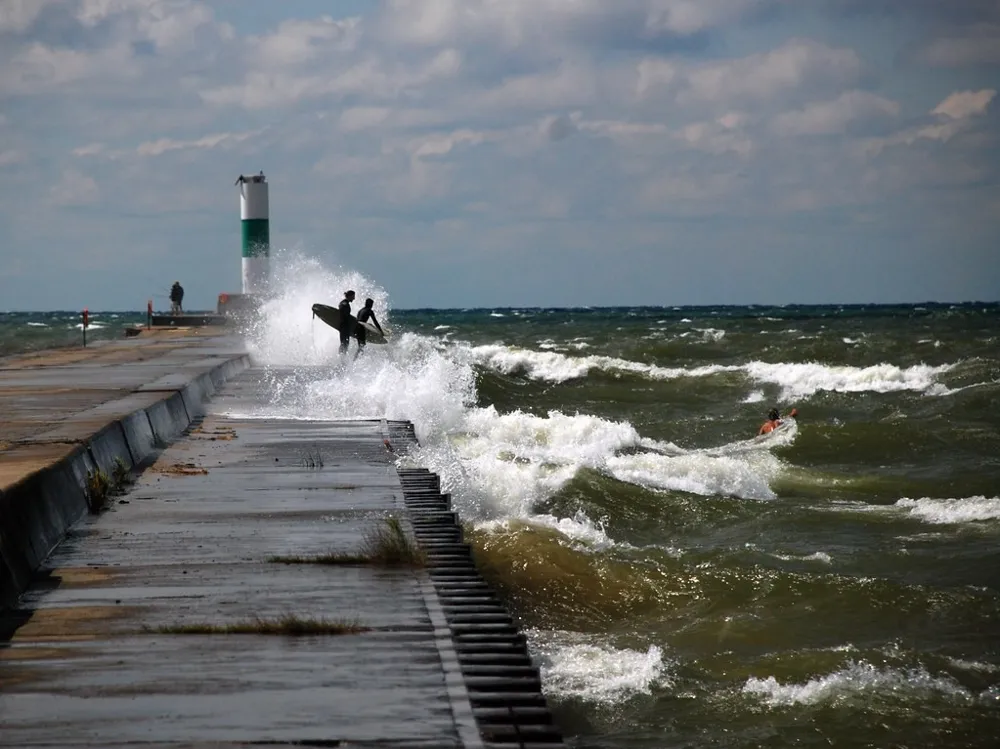
Lake Michigan
- Sheboygan, Wisconsin: the "Malibu of the Midwest." Travel Wisconsin names Deland Beach and King Park, both in coves, as the city's surf areas, with peak season from late August through early April. A Lake Michigan surf guide notes Sheboygan can work on both north and south winds. EOS Surf & Revolution Board Shop offers lessons and rentals.
- Grand Haven, Michigan: on the east shore, where the pier is reported to block both north and south winds and produce waves on either side.
- Whiting, Indiana: at the south end, where north winds and multiple jetties can build bigger waves; one guide flags questionable water quality from nearby industry.
- Evanston, Illinois: a jetty at Dempster Street is reported to block strong north winds and create a left-hand break.
Lake Erie
Erie is the shallowest Great Lake, and its waves build quickly. The Erie Reader reports that local surfers see waves up to about 12 feet when winds reach roughly 30 knots, with periods around 4 to 5 seconds.
- Presque Isle State Park, Pennsylvania: catches wind from many directions, but surfing is limited to certain beaches (see Local Rules below).
- Cleveland, Ohio: Edgewater Park on the west side and the east end of the Cleveland Harbor breakwall are named surf spots.
- Other Erie spots named by local surfers include Hamburg Beach in New York, Sterling State Park and Luna Pier in Michigan, and Point Abino and Port Maitland in Ontario.
Lake Huron
Islands names Lexington and Burtchville in Michigan, and Kincardine, Ontario, as Lake Huron surf spots. Great Lakes Now lists Kincardine and Georgian Bay among good places to start, and Georgian Bay has its own surf club.
Lake Ontario
Most Lake Ontario surfing happens near Toronto, including the western shoreline and Ashbridges Bay Park. On the US side, Islands mentions surfing near the mouth of the Niagara River.
Many lake surfers keep their best spots quiet to avoid crowds of inexperienced visitors in dangerous conditions. Joining a local surf group or shop community is the most reliable way to learn where and when a spot works.
Cold-Water Gear: Wetsuits, Hoods, Gloves and Boots
Gear is not optional on the Great Lakes. Outside the warmest weeks, you need a thick full wetsuit plus hood, boots and gloves.
| Gear | Cold-Season Recommendation |
|---|---|
| Wetsuit | 5/4 mm or 6/5 mm hooded full suit for water below about 47°F (EOS Surf Shop, via Islands); in milder early-fall water our chart suggests a 4/3 |
| Hood | Built-in or separate; protects against heat loss and cold-water headaches when duck-diving |
| Gloves | At least 5 mm, or mitts, in winter |
| Boots | About 6.5 to 7 mm, with grippy soles for icy rocks |
| Changing kit | Thermos of hot water, changing robe or towel, hand warmers, warm dry layers |
These numbers line up with the very-cold-water row of our wetsuit thickness chart. Fit matters as much as thickness: any loose spot lets cold water flush through. See what to wear under a wetsuit for base layers, and wetsuit vs drysuit for why surfers stay in wetsuits while paddlers often choose drysuits.
Wetsuits insulate well in water but poorly in freezing air, so the most dangerous part of a winter session is often getting changed. Ice can coat your suit, hood and face; pour warm water from a thermos over zippers and seals before you try to get out of the suit, and change fast out of the wind.
Boards for Lake Waves
Because lake waves are weaker and fresh water is less buoyant, local surfers recommend more length and volume than you'd ride in the ocean. Beginners do best on foam boards, funboards and longboards; see our soft-top surfboards and surfboard size chart. Experienced surfers often ride thick fish and groveler shapes on bigger days, and stand-up paddle boards suit crumbly lake waves. Use a solid leash, since chasing a loose board in near-freezing water is dangerous. Compare shapes in surfboard types.
Rip Currents, Piers and Breakwalls
The NWS says rip currents can occur at any beach with breaking waves, including the Great Lakes, and that they often form at gaps in sandbars and near piers, groins and jetties. On the lakes, structures add extra dangers:
- Structural currents: piers channel water out along the structure, and these currents are often too strong to swim against. The NWS advises staying at least 100 yards from piers, especially on the side with incoming waves.
- Chaotic waves near piers: waves bounce off piers and combine with incoming waves into steeper, larger waves that are very hard to swim in.
- Don't jump off piers. The NWS warns you may land in a structural current.
- Longshore currents push you along the beach and can carry you into piers or rocks.
- Outlet currents where rivers enter the lake stay strong for a while after they reach open water.
The NWS says 80% of Great Lakes current incidents happen with waves of 3 to 6 feet, which is ordinary surf size. If a current pulls you out, stay calm and keep hold of your board. NWS advice is to flip, float and follow: float to save energy, then go parallel to the shore until you're free, then head in. Near a pier, try to reach a ladder and signal for help. Our how to surf guide covers spotting rip currents.
Ice, Cold Shock and Hypothermia
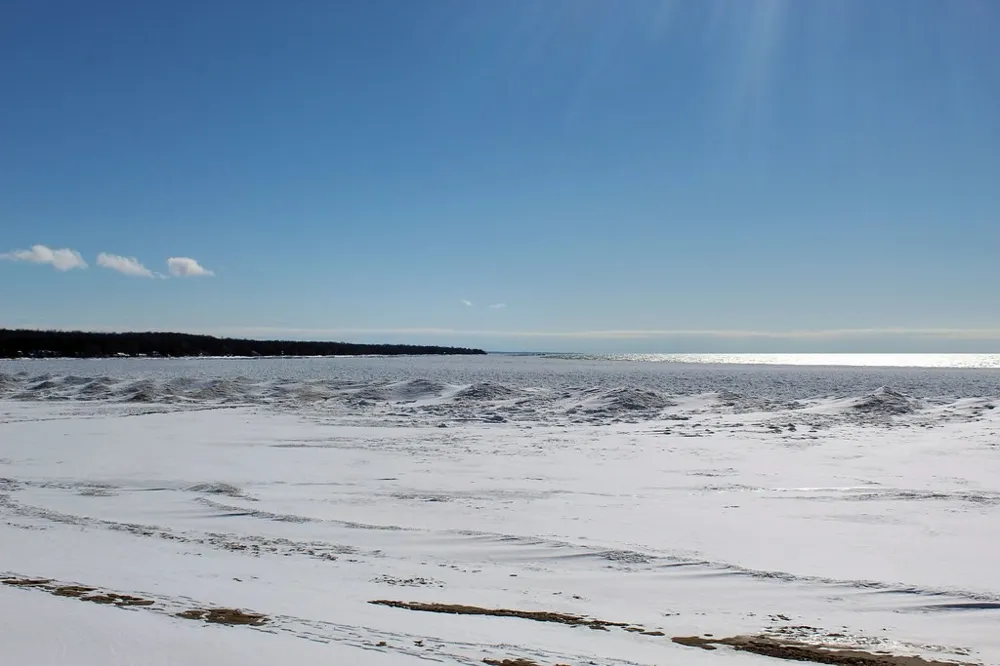
Cold water is the main hazard on the Great Lakes, and it affects strong swimmers too. According to the National Weather Service:
- Cold shock causes involuntary gasping and rapid breathing for roughly the first 2 to 3 minutes after sudden immersion. It can be triggered by water as warm as 77°F and can be as severe at 50 to 60°F as at 35°F.
- Swimming failure: loss of muscle control in the hands, arms and legs can start quickly, and even experienced swimmers can lose the ability to hold a board or climb out.
- Hypothermia begins when core temperature drops to 95°F, and body temperature can keep falling after you leave the water, so get somewhere warm and dry quickly.
Winter adds ice hazards. Shelf ice along the shore can be weak enough to break through yet thick enough to stop you climbing out, and floating ice can drift into the lineup quickly and trap surfers. Ice-covered rocks and frozen eyelids are other reported problems on Lake Superior.
- Never surf alone. Every lake surf source we found says this.
- Plan your entry and exit, and have a backup exit if ice builds or the wind shifts.
- Tell someone your plan and when you'll be back.
- Get out early if your hands stop working well or you start shivering hard.
- If someone is hypothermic, the NWS advises calling 911, moving them somewhere warm, removing wet clothing and warming the core first, not too quickly.
This is general safety information, not medical advice. For more, see the cold-water section of our wetsuit vs drysuit guide.
Forecasting Great Lakes Surf
Because lake swell depends entirely on wind, forecasting is mostly about wind speed, direction and duration over open water. Useful free sources include:
- NWS nearshore marine forecasts and the NWS Great Lakes beach hazards page, which give wind, wave heights and rip-current risk. Lakeshore and beach hazard statements flag dangerous days.
- NOAA buoy and shore-station data (National Data Buoy Center and Great Lakes stations) for real-time wind and waves.
- NOAA GLERL model forecasts from the Great Lakes Environmental Research Laboratory, which publishes wave forecast maps for each lake.
- Water temperature from NOAA CoastWatch and the Great Lakes Observing System's Seagull platform.
- Wind apps such as Windy and Windfinder, which lake surfers commonly use.
- Local groups, such as the Lake Superior Surf Club and lake surf communities on social media, and local surf shops.
Look for a strong onshore wind blowing the length of the lake toward your shore for several hours, then a shift toward lighter or offshore winds to clean up the waves. Check again just before you go, since windows are short. See how to read a surf forecast for the basics.
Local Rules and Etiquette
We could not find a single rule covering surfing across the Great Lakes. Rules are set by cities, counties and state parks, and they change (last checked November 2026):
- At Presque Isle State Park, board surfing was reported to be officially allowed only at Beach 1 and the far east end of Beach 10, with the park saying the rule could be reviewed. Confirm with the park office before you go.
- Many beaches post closures, red flags or swimming bans in high waves, and piers may be closed. Follow posted signs and lifeguard instructions, and remember the NWS notes that most Great Lakes beaches are unguarded.
- Respect private property and parking rules when reaching remote spots.
The lake surf community is small, and many locals have surfed the same spots for decades. Be friendly, wait your turn and follow standard surf etiquette. Don't post exact spot details online if locals ask you not to. This is general information, not legal advice.
Planning Your First Lake Session
- Build ocean or wave-pool basics first. Learn to paddle, pop up and handle whitewater in friendlier conditions; see how to surf and surf parks and wave pools.
- Start in late summer or early fall, when water is warmest, at a sandy beach away from piers.
- Take a local lesson or go with an experienced lake surfer; shops in Sheboygan and Milwaukee are reported to offer lessons year-round.
- Get the right gear: thick wetsuit, hood, boots, gloves and a high-volume board.
- Watch first. Spend time on the beach looking at currents, sets and where others paddle out before you go in.
- Keep sessions short and leave the water before you get too cold to change safely.
Related Guides
Explore more surfing guides, compare US surf spots and surf spots around the world, and gear up with wetsuits, beginner surfboards and surf wax.
Frequently Asked Questions
Can you surf on Lake Superior?
Yes. Strong, long-lasting winds over Lake Superior's open water build surfable waves, mostly in fall and winter. Stoney Point near Duluth, Minnesota, and Marquette and Grand Marais in Michigan are among the spots named in surf guides, and the water is cold enough to require a thick hooded wetsuit, boots and gloves.
When is the best time to surf the Great Lakes?
Fall and winter. Storms and cold fronts bring the strong winds that make waves, while summer is often flat. Sheboygan's peak season is described by Travel Wisconsin as late August through early April, and Lake Erie surfers report a peak around October to January.
What wetsuit do you need to surf the Great Lakes?
For cold-season surfing, a 5/4 mm or 6/5 mm hooded wetsuit with boots and gloves is the usual recommendation. One Sheboygan surf shop advises that setup for water below about 47°F, with gloves of at least 5 mm and boots around 6.5 to 7 mm.
Are Great Lakes waves good for beginners?
Sometimes, in milder late-summer or early-fall water at sandy beaches with small waves, ideally with a local lesson. Winter storm surf, ice and piers make many sessions experts-only, and you should never surf the lakes alone.
Why are Great Lakes waves so choppy?
Lake waves are wind swell made by nearby storms, not long-traveled groundswell. They arrive close together, every 3 to 5 seconds in the reports we found, and fresh water gives less buoyancy, so lake waves feel weaker and choppier than ocean waves of the same height.
How big do waves get on Lake Superior?
Very big in major storms. During the October 24, 2017 storm, the National Weather Service in Marquette reported wave heights of 25 to 30 feet at times off Michigan's Upper Peninsula. Surfable days are much smaller.
Is surfing allowed everywhere on the Great Lakes?
No single rule covers the lakes. Cities and state parks set their own rules; for example, Presque Isle State Park in Pennsylvania was reported to allow board surfing only at Beach 1 and the east end of Beach 10. Check posted rules and ask the park or city before you paddle out.