What Is Para Surfing? Adaptive Surfing Explained (2026)
Para surfing, also called adaptive surfing, opens the waves to surfers with physical and vision impairments. Here's how the classes work, where the world titles are decided and how to find a program near you.
Para Surfing at a Glance
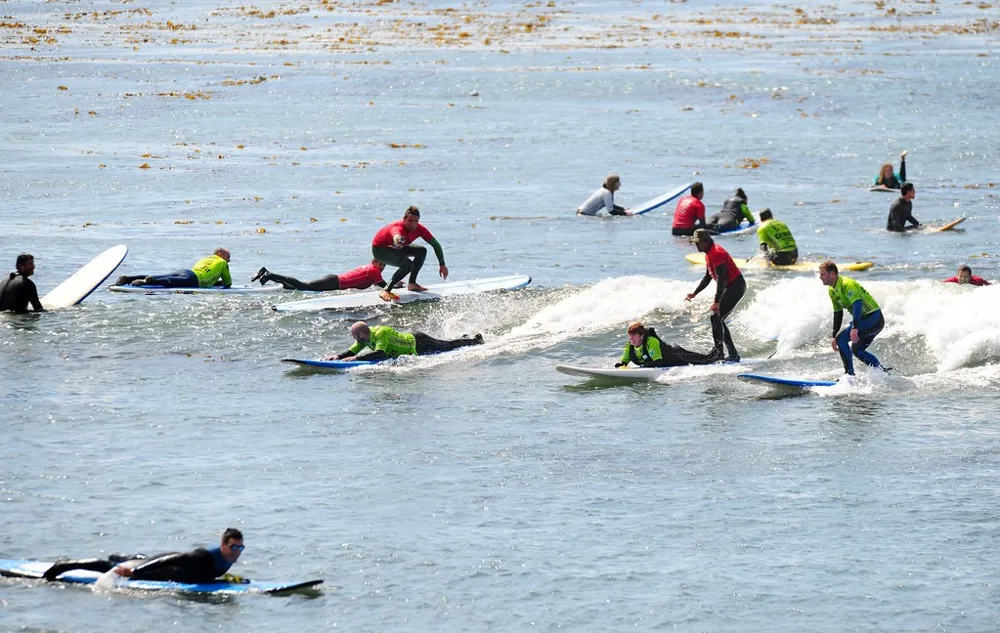
Para surfing is surfing by people with a physical or vision impairment. Riders may stand, kneel, sit on a waveski or lie prone, and some use prosthetics, straps or in-water helpers. It is also called adaptive surfing. At the competitive level it is run by the International Surfing Association (ISA), the world governing body that also runs the World Surfing Games. Details below are current as of November 2026.
| Key Fact | Details |
|---|---|
| Also called | Adaptive surfing |
| World governing body | International Surfing Association (ISA) |
| Competition classes | Nine: Stand 1, 2 and 3; Kneel; Sit; Prone 1 and 2; Vision Impairment 1 and 2 |
| World championship | ISA World Para Surfing Championship, first held in 2015 |
| 2026 world championship | November 19 to 22, 2026, DSRT Surf, Palm Desert, California (11th edition) |
| Recent team champion | France (2023, 2024 and 2025) |
| Paralympic status | Not a Paralympic sport; not on the LA 2028 program; ISA targeting Brisbane 2032 |
| Pro tour | Association of Adaptive Surfing Professionals (AASP), formed in 2022 |
Para Surfing vs Adaptive Surfing
The two names describe the same activity. Adaptive surfing is the older, broader term, and many nonprofits and surf schools still use it for lessons and clinics. The ISA called its first world event the World Adaptive Surfing Championship. After surfing became an Olympic sport, the ISA moved to para surfing, matching the naming and classification structure of Paralympic sport as it works toward Paralympic inclusion.
Both terms use person-first framing: a para surfer is a surfer first. Programs usually describe participants as surfers with disabilities, surfers who use wheelchairs or surfers with vision impairment, and the competition classes are based on how a person rides a wave, not on a diagnosis.
A Short History of Adaptive Surfing
Adaptive surfing grew from small community programs into a world championship sport in about 15 years. The timeline below covers the main milestones; for the wider story of the sport, see our history of surfing.
| Year | Milestone |
|---|---|
| 2001 | Life Rolls On, described as the first adaptive surfing organization, is founded and starts its "They Will Surf Again" events. |
| 2006 | Duke's OceanFest in Hawaii adds an adaptive surfing heat with help from AccesSurf Hawaii. |
| 2007 | Hawaii's adaptive surfing championship begins as an annual event. |
| 2015 | The ISA holds its first world championship for adaptive surfers, with 69 competitors from 18 nations. |
| 2017 | The US Open Adaptive Surfing Championships are founded; held annually in Oceanside, California, they offer prize money to all podium finishers. |
| 2020 | The ISA adopts the current classification system, developed with researcher Dr. Maureen Johnson and the Stoke for Life Foundation. |
| 2022 | The Association of Adaptive Surfing Professionals forms to run a pro tour. The ISA world championship at Pismo Beach draws 181 athletes from 28 nations. |
| 2023 | The ISA championship moves to Huntington Beach, with a record 183 competitors from 27 countries. |
| 2024 | LA 2028 organizers decide not to propose para surfing for the Paralympics. |
| 2025 | France wins a third straight team title at Oceanside, California. |
| 2026 | The 11th world championship is held at DSRT Surf, the first ISA world championship in a surf lagoon. |
The Nine ISA Para Surfing Classes
To keep competition fair, para surfers are grouped into sport classes by how they ride and how their impairment affects surfing. The ISA says the aim is to place each athlete in the class that best limits the impact of impairment on the result, following the International Paralympic Committee (IPC) Athlete Classification Code. Each class crowns a men's and a women's world champion.
| Class | Riding Position | Who It Covers |
|---|---|---|
| Stand 1 | Standing | Surfers with an upper body impairment |
| Stand 2 | Standing | Surfers with a lower body impairment below the knee |
| Stand 3 | Standing | Surfers with a lower body impairment above the knee |
| Kneel | Kneeling or upright | Surfers who ride on their knees |
| Sit | Seated (usually on a waveski) | Surfers who ride sitting down and paddle themselves |
| Prone 1 | Lying down | Surfers who ride prone without paddling help |
| Prone 2 | Lying down | Surfers who need help to paddle into waves and while in the water |
| Vision Impairment 1 (VI1) | Standing | Surfers with IBSA B1 vision impairment (blind or near blind) |
| Vision Impairment 2 (VI2) | Standing | Surfers with IBSA B2 or B3 vision impairment (partial sight) |
Older articles may list eight classes, use codes such as "PS-S1" or call Prone 2 "Prone Assist." The nine names above are the ones the ISA used for its 2025 and 2026 world championships.
How Classification Works
Classification decides whether a surfer is eligible for para surfing competition and which class they enter. Under the ISA system:
- Eligible impairments are impaired muscle power, impaired passive range of motion, coordination impairments (hypertonia or spasticity, ataxia and athetosis or dyskinesia), limb deficiency, leg length difference and vision impairment (IBSA B1 to B3).
- Not used in para surfing: intellectual impairment and short stature, plus conditions such as pain, hearing impairment, low muscle tone, hypermobility, joint instability and poor endurance. Surfers with these conditions can still enjoy adaptive programs; they just can't enter ISA para classes.
- Paperwork first: athletes submit a medical diagnostics form from their health provider, supporting medical records, surfing photos or video and a photo of their equipment.
- Assessment: a panel of two trained classifiers assesses national athletes, and two panels assess international athletes. A physical assessment takes about 20 to 30 minutes and may test strength, flexibility, limb length, coordination and balance; a vision assessment takes about 15 to 20 minutes. Classifiers may also watch the athlete surf.
- Outcome: the athlete gets a class with a status of Confirmed (no reclassification needed unless things change) or Review (reclassify in a set year), or is found not eligible for now.
The ISA reports it had classified more than 550 para surfers by 2025. National federations such as USA Surfing and Surfing Australia run para events and can point athletes to classification opportunities. Check the ISA site for the current classification rules and schedule.
How Para Surfing Competitions Work
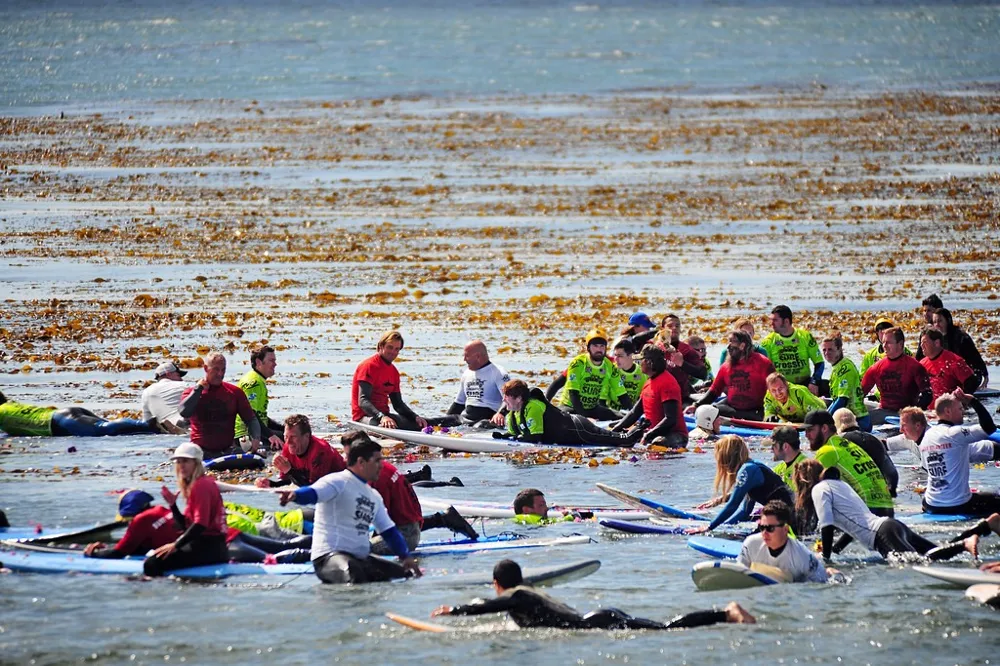
Para surfing contests use the same heat-and-judging model as other surfing events: judges score each wave out of 10, and a surfer's best waves make up the heat total. Our guide to surf competitions explains heats, priority and scoring in detail. What changes is how much help each class may get and what counts as a scored ride. According to published summaries of the ISA rules:
- Standing and kneeling classes must paddle into waves on their own. Help is allowed only for getting into and out of the water and onto or off the board, and a ride is scored only in the class position (standing for Stand classes, kneeling for Kneel).
- Prone classes may have a helper paddle them out and push them into waves, but the surfer must ride the wave alone, lying prone.
- Vision Impairment classes may use one in-water guide who calls out verbal cues while the surfer paddles and catches waves. The guide does not paddle or push the surfer, and rides count only when the surfer stands.
- Equipment: electric-powered boards and swim fins are banned. Prosthetics, orthotics and essential safety equipment are allowed if they don't add performance, and prone surfers may use gear that helps them stay on the board.
Rules are updated over time, so treat this as an overview and check the current ISA rulebook before you compete. Medals at ISA para events go four deep: gold, silver, bronze and copper for fourth place.
The ISA World Para Surfing Championship
The ISA World Para Surfing Championship is the sport's top international event. Surfers compete for their country, so results count toward both individual world titles in each class and a team world title. It started in 2015 as the World Adaptive Surfing Championship, and early editions were held in the San Diego area before moving to Pismo Beach (2022), Huntington Beach (2023) and Oceanside (2025).
Recent Editions
| Year | Venue | Field | Team Result |
|---|---|---|---|
| 2022 | Pismo Beach, California | 181 athletes, 28 nations | See ISA results |
| 2023 | Huntington Beach, California | 183 athletes, 27 countries (a record) | France gold, USA silver |
| 2024 | Huntington Beach, California | See ISA results | France gold, USA silver |
| 2025 | Oceanside, California, November 2 to 7 | 137 athletes, 24 national teams | France gold, USA silver, Brazil bronze, Australia copper |
| 2026 | DSRT Surf, Palm Desert, California, November 19 to 22 | About 140 athletes, 24 national teams (as announced) | Check isasurf.org for results |
The 2025 team title was France's third in a row, and the USA's silver was its third straight runner-up finish, according to the ISA. France took 12 medals in 2025, including five golds. Belgium became the 33rd nation to take part, and women made up more than a third of the field. At the same event, Canada's Victoria Feige equaled Bruno Hansen's record of six world titles.
The 2026 Championship in a Surf Lagoon
The 2026 event moved from the ocean to DSRT Surf in Palm Desert, California, making it the first ISA world championship held in a surf lagoon. The ISA describes the venue as a 5.5-acre lagoon that can produce up to 1,000 waves an hour, giving every class controlled, repeatable waves. The ISA planned a live stream on isasurf.org. Results were not yet confirmed in our sources when this page was published, so check the ISA site for the new world champions. Learn more about man-made waves in our guide to surf parks and wave pools.
Is Para Surfing in the Paralympics?
No, not yet. As of November 2026, para surfing is not part of the Paralympic Games. Here's where the bid stands:
- Paris 2024: an earlier bid for inclusion fell short.
- January 2023: the IPC Governing Board confirmed that para surfing had shown competitive viability and integrity, a step the ISA counts as progress.
- June 2024: the LA 2028 organizing committee decided not to propose para surfing as a new Paralympic sport. The LA28 Paralympics are set to feature 22 sports, with para climbing added. Surfing itself stays on the LA 2028 Olympic program at Lower Trestles; see Olympic surfing.
- Brisbane 2032: the ISA says its goal is inclusion at the Brisbane 2032 Paralympic Games. As of November 2026, the Brisbane 2032 Paralympic sport program had not been finalized, and reports indicate a decision is expected in 2027.
Until a decision is made, the ISA World Para Surfing Championship remains the top title in the sport. We will update this section when the Brisbane 2032 program is announced.
Adaptive Surfing Equipment
Much of adaptive surfing uses everyday gear: big, stable soft-top surfboards, a leash and a good wetsuit. On top of that, programs and riders use specialist equipment to suit each surfer's body and riding position. The Challenged Athletes Foundation lists these common pieces (the last column is our general guide, not a rule):
| Equipment | What It Does | Often Used By |
|---|---|---|
| Adaptive surfboard | Adds a harness and soft padding on the deck to position the body for paddling and riding | Surfers of a range of abilities |
| Tandem surfboard | A larger board for two riders, with straps and grips for stability | Riders surfing with a partner or instructor |
| Waveski | A sit-on board with an adjustable seat, seat belt and foot straps, paddled with a paddle or by hand | Sit class surfers |
| Leg straps | Velcro straps that hold the legs together and keep them on the board | Prone and seated surfers |
| Helmet | Protects the head from impacts in the water | Any surfer, especially in shallow water |
| Booties | Keep feet warm and protect them from rocks and rough ground | Surfers at rocky or cold beaches |
| Carry straps and board carts | Shoulder slings, back straps and wide-wheeled carts move boards across sand | Surfers carrying their own gear |
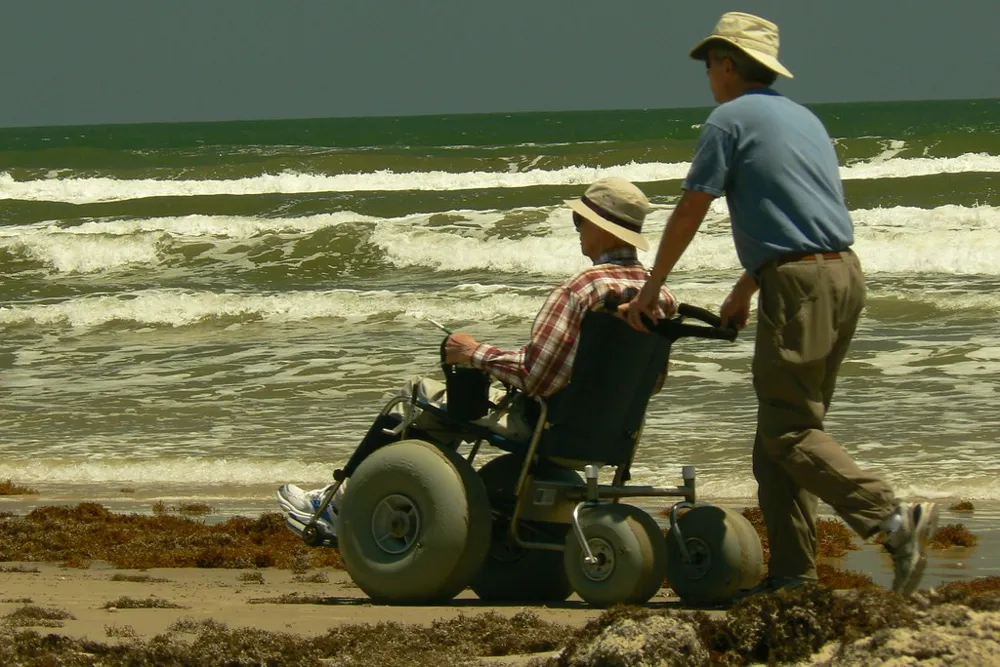
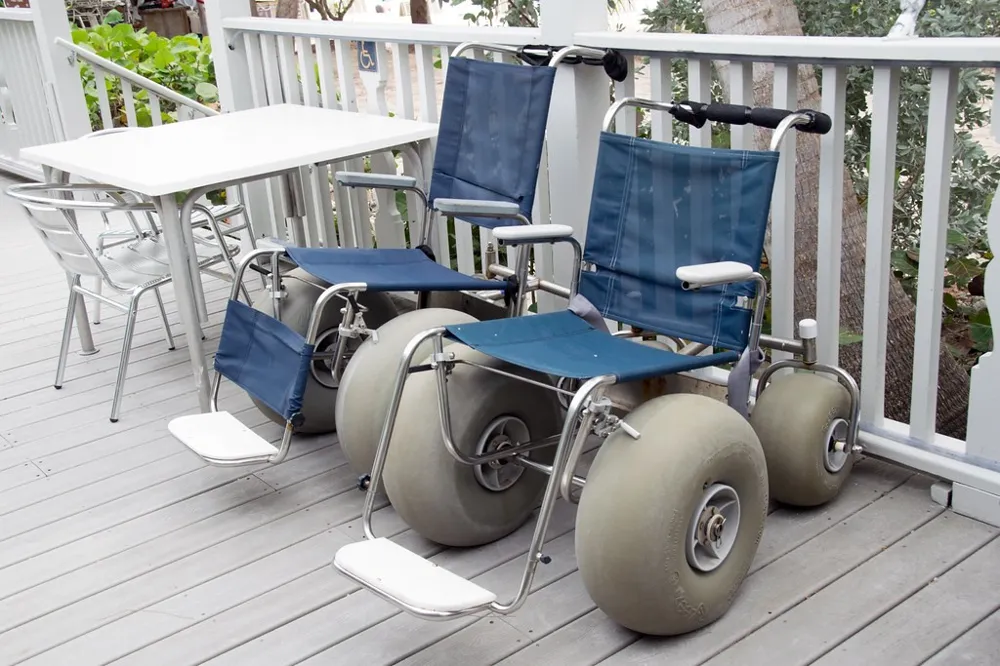
Prosthetics and orthotics are part of the picture too. Many surfers who use a prosthetic leg ride in the Stand classes, and ISA rules allow prosthetics and orthotics in competition as long as they don't enhance performance. Getting to the water is often the first hurdle, so ask a program or local beach authority whether beach wheelchairs or other access aids are available.
How to Get Started With Adaptive Surfing
You don't need classification, your own board or past surfing experience to try adaptive surfing. Many people start at a clinic run by a nonprofit, where trained staff and volunteers handle the gear and stay close in the water.
- Find a program. Search for adaptive surf clinics near you, or start with the organizations below. Many run events through the warmer months.
- Talk to the organizers first. Share your mobility, transfer needs, medical considerations and swimming comfort so they can plan the right board, position and helpers. Check with your doctor or therapist if you're unsure what's safe for you.
- Expect a beach briefing. Clinics usually start on land with board position, safety signals and how the helpers will work with you, much like the land practice in our how to surf guide.
- Start in whitewater. First rides are usually in small broken waves close to shore, often with helpers pushing the board into the wave.
- Build from there. As confidence grows, surfers try paddling themselves, new positions or their own board. Some go on to local contests, national championships and ISA classification.
Adaptive Surfing Organizations to Know
- Life Rolls On: founded in 2001 by a surfer with a spinal cord injury, it runs "They Will Surf Again" events that teach people with disabilities to surf.
- AccesSurf (Hawaii): runs adaptive surf programs and produces the Hawaii Adaptive Surfing Championships in Waikiki.
- AmpSurf (California): a nonprofit for surfers with disabilities that also runs VetSurf programs for veterans and the Para Surf League.
- Stoke for Life Foundation (California): produces the US Open Adaptive Surfing Championships in Oceanside.
- Challenged Athletes Foundation: runs adaptive surf clinics, including its Operation Rebound surf clinics.
- Wounded Warrior Project (US): has run surf events for injured veterans.
- USA Surfing and Surfing Australia: national governing bodies that run para surfing championships and select national para teams.
Outside the US and Australia, ask your national surfing federation for its para surfing contact. Program details change, so check each group's site for current dates and locations.
Safety and Getting Involved
Adaptive surf programs build safety in with trained instructors, in-water helpers and calm, small waves, but the ocean still has the usual risks: rip currents, shorebreak, cold water and other surfers. Our guides to whether surfing is dangerous and rip currents cover what to watch for, and our surf etiquette guide explains how to share the lineup. Surfers with medical conditions should get advice from their own healthcare team before going in; this page is general information, not medical advice.
Not a surfer with a disability? You can still help. Adaptive clinics rely on volunteers in the water and on the beach, and competent surfers and strong swimmers are often in demand as in-water helpers. Many programs ask volunteers to attend a briefing or training first.
Related Guides
Explore more in our surfing guides, including surf competitions, Olympic surfing, the benefits of surfing, surfing workouts and the best surfboards for beginners. Planning a trip? See the best surf spots in the US.
Frequently Asked Questions
What is para surfing?
Para surfing is surfing by people with a physical or vision impairment, often with adapted boards, positions or in-water helpers. It is also called adaptive surfing, and the International Surfing Association runs it as a competitive sport with nine classes.
Is para surfing in the Paralympics?
No. As of November 2026, para surfing is not a Paralympic sport. It was not proposed for the LA 2028 Paralympic Games, and the ISA says it is now aiming for Brisbane 2032, whose Paralympic sport program had not been set as of November 2026.
What are the para surfing classes?
The ISA uses nine classes: Stand 1, Stand 2 and Stand 3 for standing surfers, Kneel, Sit, Prone 1 and Prone 2, and Vision Impairment 1 and 2. Each class crowns a men's and a women's world champion.
What is the difference between adaptive surfing and para surfing?
They describe the same activity. Adaptive surfing is the older, broader term used by many programs, while para surfing is the term the ISA uses for its competitions, in line with Paralympic sport.
Do you need to be classified to try adaptive surfing?
No. Classification is only needed for competition. Adaptive surf clinics and lessons are open to beginners, and the program staff will help choose a board and position.
Who has won the most ISA World Para Surfing Championship team titles?
France won the team title in 2023, 2024 and 2025, its third in a row. Check the ISA site for the results of the 2026 event, held November 19 to 22 at DSRT Surf in California.