Surfing Workout: Train Your Paddle, Pop-Up and Balance on Land (2026)
Exercises that target what surfing actually asks of you, from paddling endurance to a faster pop-up, with sample weekly plans, safe breath training and a warm-up for the beach.

What Surfing Asks of Your Body
Surfing looks like it is all about riding waves, but most of a session is spent doing something else. A review of surfing physiology in Sports Medicine (Mendez-Villanueva and Bishop, 2005) reported that surfers spend about half their time paddling, around 40% sitting or waiting, and only about 4 to 5% actually riding waves. A later GPS and video study of competitive surfers in the Journal of Strength and Conditioning Research (Farley and colleagues, 2018) found a similar split: about 44% paddling and 42% stationary. Recreational sessions will differ, but the pattern is the same: paddling fitness decides how many waves you catch, and short bursts of power decide what you do with them.
A good surf workout therefore trains several qualities at once, not just big muscles.
| What Surfing Needs | Where You Feel It | How to Train It |
|---|---|---|
| Paddling endurance | Long paddle-outs, holding position, getting back to the peak | Swimming, band pulls, prone back and shoulder work |
| Sprint paddling power | The few hard strokes that get you into a wave | Swim sprints, interval training, explosive pulls |
| Pop-up power | Getting from lying down to standing in one motion | Pop-up drills, push-ups, plyometric push-ups, burpees |
| Leg strength and stability | Holding a low stance, absorbing chop, turning | Squats, split squats, single-leg work, jumps |
| Balance and core control | Staying centered on a moving board | Balance board, single-leg drills, anti-rotation core work |
| Mobility | Arching while paddling, a clean pop-up, a compressed stance | Hip, ankle, thoracic spine and shoulder mobility, yoga |
| Calm under water | Wipeouts and hold-downs | Aerobic fitness, relaxed breathing, safe dry-land breath work |
The Farley study also found that the type of break changes the demands. Point breaks involved longer continuous paddling and longer rides, while the beach break produced shorter, more intense bursts of work. If you mostly surf one kind of wave, lean your training toward it. Wondering whether surfing itself counts as exercise? That question has its own page: the benefits of surfing. This guide is about training for it.
Before You Start: Safety and Frequency
This is general fitness information, not medical advice. Check with a doctor before starting a new exercise program, especially if you have a heart or lung condition, a past shoulder, back or knee injury, or any pain during exercise, and see a physical therapist or another qualified professional if a movement hurts.
A practical starting point for most recreational surfers:
- Two or three strength and conditioning sessions a week, each 25 to 45 minutes, with at least one easy day between hard sessions.
- Five to ten minutes of mobility and pop-up practice on most days. These are low intensity and add up quickly.
- One or two swims a week if you have pool access and are a confident swimmer.
- Count surf sessions as training. On weeks with lots of water time, cut back on gym work rather than stacking both.
The sets and reps below are examples, not prescriptions. Start at the low end, use body weight before adding load, and progress only when every rep looks and feels controlled.
Paddling Endurance and Upper-Back Exercises
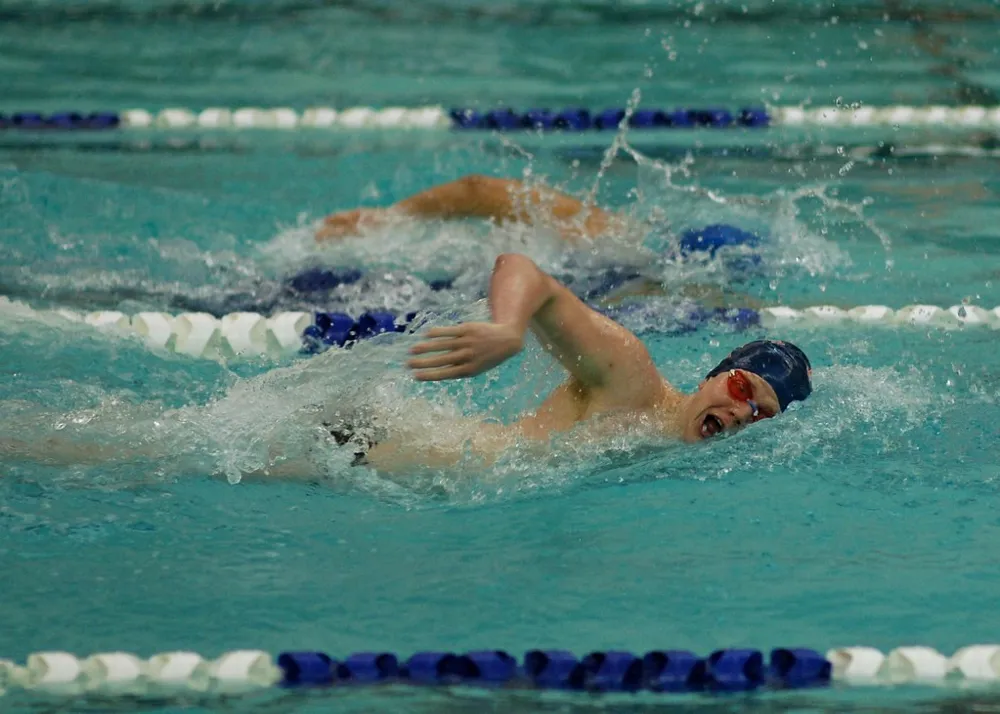
Paddling relies mainly on the lats, shoulders and upper back, while the lower back and neck hold your chest and head up. These exercises target that chain.
Swimming Intervals
Swimming is the closest common substitute for paddling, because it trains a similar overhead pulling motion while you breathe under load. Freestyle is the usual choice. Two example sessions:
- Endurance: after an easy 5 to 10 minute warm-up, swim 6 to 10 lengths of 50 meters or yards at a steady pace with 20 to 30 seconds of rest between each.
- Sprint paddling: 8 to 10 fast 25s with 30 to 45 seconds of rest, which copies the hard strokes needed to catch a wave.
Swim where a lifeguard is on duty, and build distance gradually if you are new to lap swimming. No pool? Paddling a board on flat water, or a paddle board session done kneeling or lying down, trains the same muscles.
Band Pull-Aparts and Straight-Arm Pulldowns
Hold a light resistance band at shoulder height with straight arms and pull it apart until it touches your chest, squeezing your shoulder blades together. For straight-arm pulldowns, anchor a band high (a door anchor or a sturdy post) and sweep it down to your hips with nearly straight arms, which mimics the paddle stroke. Example: 2 to 3 sets of 12 to 20 reps each.
Prone Y-T-W Raises
Lie face down on the floor or a bench, lift your chest slightly and raise your arms into a Y, then a T, then a W shape, holding each for a second or two. These build the small shoulder-blade muscles that support long paddling sessions. Example: 2 sets of 8 to 10 of each letter, with no weight or very light weight.
Back Extension Holds (Prone Cobra)
Lying face down, lift your chest and arms a few inches off the floor and hold, keeping your neck long. Coaches use this to build the arched position that keeps your chest up while paddling, and the American Council on Exercise (ACE) includes a prone cobra in its surfing-inspired circuit. Example: 3 holds of 20 to 30 seconds.
Pull-Ups or Rows
Pull-ups, inverted rows under a sturdy table or bar, or band rows add general pulling strength. Example: 3 sets of as many controlled reps as you can do while stopping a rep or two short of failure.
A small set of loop bands covers pull-aparts, shoulder external rotations and the hip work later in this guide:
Fit Simplify Resistance Loop Exercise Bands
A set of five natural-rubber loop bands, each 12 by 2 inches, in five color-coded resistance levels from extra light to extra heavy. It comes with a carry bag and an illustrated instruction guide. The lighter bands suit pull-aparts and shoulder external rotations; the heavier ones suit glute bridges and band walks.
Good to Know
- Five resistance levels in one set
- Small enough to pack in a surf trip bag
Watch Out For
- Loops are too short for anchored straight-arm pulldowns; use a longer band for those
- Natural rubber; not for people with latex allergies
Pop-Up Drills and Pressing Strength
The pop-up is the movement most beginners struggle with, and it rewards daily practice. Our how to surf guide explains the technique step by step; the drills below build the strength and speed behind it.
- Slow-motion pop-ups: lie on the floor with your hands beside your chest, press up and bring your feet through to your stance as slowly as you can control. Example: 5 reps, focusing on landing with your feet in the same place each time.
- Explosive pop-ups: the same movement as fast as possible, landing low and balanced. Example: 2 sets of 8 to 10. A strip of tape on the floor shows whether your feet land in line.
- Push-ups: the base of pressing strength. Keep your elbows close to your body, as in a pop-up. Example: 3 sets of 8 to 15; use an incline (hands on a bench) if full push-ups are too hard.
- Plyometric push-ups: push hard enough for your hands to leave the floor. Coaches cited by Coach magazine and ACE both use explosive push-ups for pop-up power. Add these only once regular push-ups are easy. Example: 3 sets of 5 to 8.
- Burpee to surf stance: drop to the floor, do a push-up, then pop up into your surf stance instead of standing square. Example: 3 sets of 6 to 10.
Hip flexor and ankle tightness are common reasons a front foot will not reach between the hands, so the mobility section below helps your pop-up as much as the strength work does.
Core Exercises for Surfers
For surfing, a strong core means controlling rotation and keeping the trunk steady while the arms and legs move, not just doing crunches. Pick three or four of these per session.
| Exercise | How to Do It | Example Target |
|---|---|---|
| Dead bug | On your back, arms up and knees bent at 90 degrees; slowly lower the opposite arm and leg while keeping your lower back on the floor | 2 to 3 sets of 6 to 10 per side |
| Plank with shoulder taps | From a high plank, tap each shoulder with the opposite hand without letting your hips rock | 2 to 3 sets of 10 to 20 taps |
| Side plank | On one forearm with hips lifted and body straight | 2 to 3 holds of 20 to 30 seconds per side |
| Band or cable chop | Pull a band diagonally across your body from high to low, rotating through the torso | 2 sets of 10 to 12 per side |
| Stability ball jackknife | Shins on a ball in a push-up position; pull the knees toward the chest and push back out | 2 to 3 sets of 8 to 10 |
| Turkish get-up | Hold a light weight overhead and move from lying to standing and back down, step by step | 2 to 3 slow reps per side |
Learn the Turkish get-up without weight first, or with a shoe balanced on your fist, before adding a kettlebell or dumbbell.
Leg Strength and Plyometrics
Your legs hold a compressed stance, absorb bumps and drive turns. Single-leg work matters because you never stand evenly on a surfboard.
Strength
- Squats or goblet squats: 3 sets of 8 to 15. Pause at the bottom for a couple of seconds to copy a low stance.
- Split squats or reverse lunges: 2 to 3 sets of 8 to 10 per leg. Add a twist toward the front leg for a rotational challenge.
- Single-leg Romanian deadlifts: 2 to 3 sets of 6 to 8 per leg, for hamstrings, glutes and balance.
- Cossack squats: shift side to side into a deep single-leg squat with the other leg straight. 2 sets of 6 to 8 per side, for hip and adductor mobility under load.
- Single-leg glute bridges: 2 sets of 8 to 10 per side, with your foot on the floor or a low step.
Plyometrics
Add jumps only after a few weeks of strength work, land softly with bent knees, and keep sets short so form stays sharp. Skip them if you have knee or back problems.
- Jump squats: 3 sets of 5 to 8.
- Lateral bounds (skater hops): 3 sets of 6 to 8 per side, sticking each landing for a second.
- Alternating jump lunges: 2 to 3 sets of 6 to 10 per leg.
The same strength and power base shows up in our exercises for skating and ski workout guides, so a board-sports athlete can rotate between them through the year.
Balance Training and Balance Boards
Balance training teaches your feet and ankles to react to an unstable surface. Progress through these levels, moving on only when the current one feels easy.
- Single-leg stand: 30 seconds per leg. Then close your eyes or turn your head side to side.
- Surf stance holds on a cushion or folded towel: 30 seconds in your surf stance, knees bent, arms relaxed.
- Single-leg squats to a chair: 2 sets of 5 to 6 per leg, lowering slowly until you lightly touch the seat.
- Wobble board work: squats, surf stance holds and push-ups on a round wobble board, which tilts in every direction.
- Rocker-roller boards: a deck on a cylinder roller that slides side to side, closer to the rail-to-rail feel of a surfboard. Practice weight shifts, slow squats and pop-ups onto the deck once you are steady.
Safety first: start next to a wall or a sturdy counter, on carpet or a mat, with the roller set on a soft surface or a cushion that slows it down. Clear the space around you, keep sessions short (5 to 10 minutes is plenty), and step off before you are tired. Roller boards can throw you quickly, so build up gradually.
Indo Board Original (Deck and Roller)
A rocker-roller balance board from a surf-training brand. The maker lists a 30 by 18 inch maple deck with a non-slip textured coating and a 6.5-inch-diameter roller, with a 350-pound weight limit for its Original deck. Indo also sells a separate inflatable cushion that makes the board easier for beginners; check the listing for exactly which parts are included.
Good to Know
- Side-to-side rolling motion suits surf stance practice
- Deck long enough for pop-up drills
Watch Out For
- The roller moves fast; start beside a wall and on a soft surface
- Needs a clear space larger than the deck
Yes4All Wooden Wobble Balance Board
A round wooden wobble board, 15.75 inches across, with an anti-slip top and 360-degree rotation. The maker lists a 300-pound weight capacity and says it can be used for standing balance drills, squats, push-ups and planks.
Good to Know
- Tilts in every direction, a gentler start than a roller board
- Compact and easy to store
Watch Out For
- Does not copy the side-to-side roll of a surfboard
- Start next to a wall or sturdy support until you are steady
Surf Training on Land With a Surfskate
A surfskate is a skateboard with a front truck that pivots and swings, so you can pump for speed and carve tight turns the way you would on a wave. Surf coaches often use them to rehearse rotation, compression and timing between sessions. It is skill practice as well as exercise, and our how to surfskate guide covers stance, pumping, carving and a table of surf moves to practice on pavement.
- Example session: 20 to 30 minutes on a smooth, empty lot or a gentle bank, mixing linked pumps with bottom-turn and cutback shapes.
- Wear a helmet and wrist guards while learning, and avoid traffic and steep hills.
- Know the limits: wheels grip pavement while a surfboard slides on water, so not every movement transfers exactly.
Not sure what one is? Start with what a surfskate is, then compare models in our best surfskates guide. Skating also has fitness benefits of its own, covered in is skateboarding good exercise.
Mobility and Yoga for Surfing

Paddling holds you in an arched position with your neck extended, and a good pop-up and stance need open hips and ankles. A short daily mobility routine helps on both fronts. This example takes about six minutes:
| Move | What It Targets | Example Amount |
|---|---|---|
| Cat-cow | Spine flexion and extension | 10 slow reps |
| World's greatest stretch | Hips, hamstrings and upper-back rotation | 5 per side |
| Half-kneeling hip flexor stretch | Front of the hip, often tight in a crouched stance | 30 to 45 seconds per side |
| Wall ankle stretch (knee to wall) | Ankle bend for a low stance | 30 seconds per side |
| Open book rotation | Thoracic (mid-back) rotation for turning | 5 to 8 per side |
| Shoulder circles or band dislocates | Overhead shoulder range for paddling | 10 slow reps |
Yoga is widely recommended for surfers because it combines flexibility, balance and breath control. Poses such as low lunge, pigeon, cobra or upward dog, child's pose and tree pose fit naturally. A beginner class is a good way to learn alignment. If you also paddle board, paddle board yoga adds a wobbly surface to the same poses.
Breath Training: Do It Safely
Being held under by a wave is stressful, and many surfers want to feel calmer under water. The single most useful step is better aerobic fitness: a fitter body uses oxygen more efficiently and recovers faster between waves. Relaxed, slow breathing between sets helps too.
Breath-hold training needs real caution. The American Red Cross, YMCA of the USA and USA Swimming have jointly warned that hyperventilating and extended breath-holding are dangerous because they can lead to hypoxic blackout, a sudden loss of consciousness with little or no warning. They also note that water depth is not a factor, which is why they prefer "hypoxic blackout" to the older term "shallow water blackout." Read more in our guide to shallow water blackout.
- Never practice breath-holds in water, including pools and bathtubs, and never alone.
- Never hyperventilate (rapid, deep breathing) before holding your breath.
- Keep breath work on dry land, seated or lying down, never while standing, driving or near water. Slow nasal breathing and box breathing (equal counts in, hold, out, hold) are gentle starting points.
- Stop if you feel dizzy, tingling or lightheaded.
- Surfing bigger waves? Take a breath-hold or water-safety course run by qualified instructors, where training is supervised.
Sample Weekly Surf Workout Plans
These plans combine the sections above. Warm up for 5 to 10 minutes before each session, start at the low end of every range and swap in surf sessions whenever there are waves.
Beginner Plan (Two to Three Sessions a Week)
| Day | Focus | What to Do |
|---|---|---|
| Monday | Strength A | Squats, push-ups, band pull-aparts, dead bugs, back extension holds |
| Tuesday | Mobility and pop-ups | Six-minute mobility routine, slow-motion and explosive pop-ups |
| Wednesday | Swim or cardio | 20 to 30 minutes of easy swimming, or a brisk walk or bike ride |
| Thursday | Rest or surf | Rest, or an easy surf session |
| Friday | Strength B and balance | Reverse lunges, single-leg bridges, side planks, Y-T-W raises, balance board |
| Weekend | Surf or play | Surf if there are waves; otherwise surfskate, swim or rest |
Intermediate Plan (Three to Four Sessions a Week)
| Day | Focus | What to Do |
|---|---|---|
| Monday | Strength and core | Goblet squats, single-leg Romanian deadlifts, pull-ups or rows, chops, Turkish get-ups |
| Tuesday | Swim intervals | Warm-up, then endurance or sprint-paddling sets |
| Wednesday | Mobility and balance | Mobility routine, roller-board work, pop-ups |
| Thursday | Power | Plyometric push-ups, burpees to surf stance, jump squats, lateral bounds, straight-arm pulldowns |
| Friday | Rest | Rest or gentle yoga |
| Weekend | Surf and surfskate | Surf sessions; surfskate on flat days |
20-Minute Home Circuit (No Gym)
For flat spells or busy weeks: work for 40 seconds and rest for 20 seconds, going through the list twice or three times.
- Explosive pop-ups
- Squats
- Prone paddle simulation (lie on your stomach, chest up, alternate arm strokes)
- Reverse lunges, alternating legs
- Plank with shoulder taps
- Lateral bounds
- Back extension hold
Recovery and Tracking Progress
Sleep, regular meals and enough water are part of the plan, not extras; tired surfers paddle less and fall more. Track a few simple markers every few weeks: push-up reps, how long you can hold a stable surf stance on a balance board, or your time for a set swim distance. In the water, the signs are easier paddle-outs and getting to your feet more consistently. In the week before a surf trip, ease off so you arrive fresh.
How to Warm Up Before a Surf Session
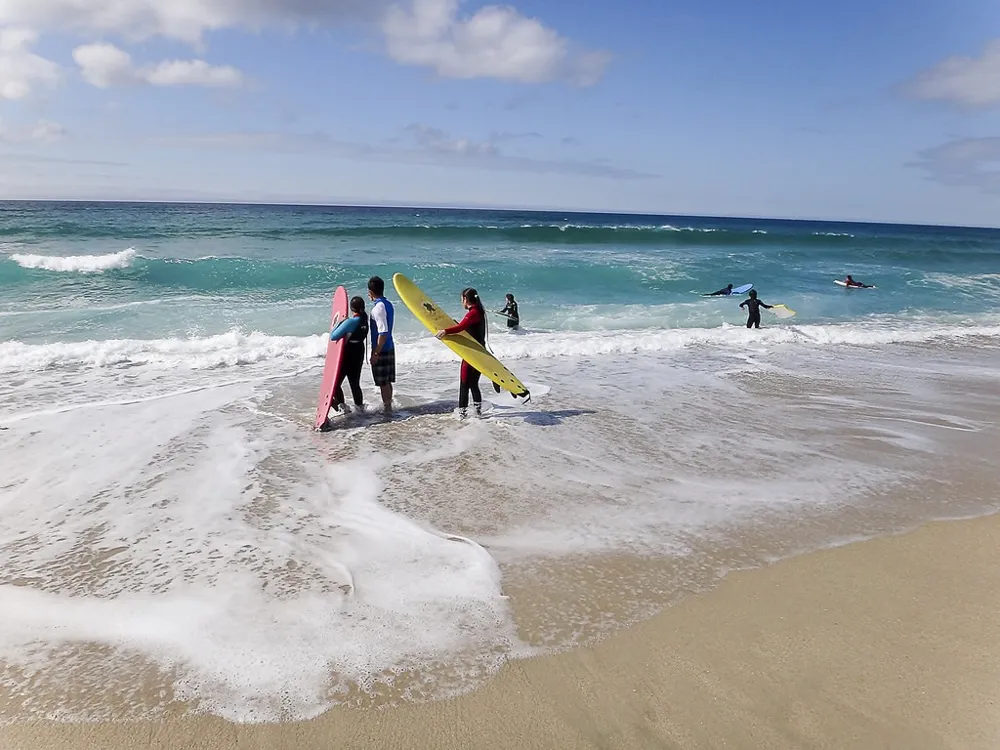
Plenty of surfers run straight from the car into the water, but cold shoulders and hips are a poor match for a hard paddle-out. Five minutes on the sand is enough:
- Raise your heart rate (1 to 2 minutes): a jog along the beach, jumping jacks or skipping.
- Shoulders (1 minute): arm circles forward and back, then big swimming-style arm swings.
- Hips and legs (1 to 2 minutes): leg swings, walking lunges with a twist, and a few bodyweight squats.
- Spine (30 seconds): standing trunk rotations and a gentle back arch.
- Pop-ups (30 seconds): three to five on the sand to rehearse the movement.
Use the time to watch the water too: look for sets, the channel and any rip currents before you paddle out. Keep long static stretches for after the session, when muscles are warm.
Injury Prevention: Shoulders and Lower Back
A 2021 systematic review of chronic and gradual-onset surfing injuries (Hanchard and colleagues, Sports) found that the spine and back and the shoulders were the most commonly reported areas, and that paddling was the most common mechanism, linked to about 37% of these injuries. The authors noted that most data came from self-reported surveys, so the figures are a guide rather than a precise risk. The review also pointed to the prolonged neck extension of paddling as a possible factor in neck problems.
Ways to lower the load:
- Balance your pulling and pressing. Paddling is all pulling with rounded-forward shoulders, so Y-T-W raises, band pull-aparts and external rotations with a light band help the small stabilizing muscles keep up.
- Build back endurance, not just strength. Back extension holds and side planks train the muscles that hold you in the paddling arch for long periods.
- Keep your hips and mid-back mobile, so your lower back does not take all the extension and rotation.
- Use enough board. A board with too little volume sits low in the water and makes every paddle harder; check our surfboard size chart.
- Build water time gradually after a long break, and stop if pain is sharp, located in a joint, or gets worse during a session.
Acute injuries such as cuts from fins and reef, or impact with the board, are a separate topic; see is surfing dangerous for those risks. Persistent pain is a reason to see a sports medicine doctor or physical therapist.
Common Surf Training Mistakes
- Training only the mirror muscles: big chest and biceps work does little for paddling; the upper back and shoulders matter more.
- Skipping the pop-up practice: a few minutes a day on the floor beats an occasional long session.
- Too much, too soon: jumping straight into plyometrics or roller boards without a base leads to soreness or falls.
- Ignoring mobility: tight hips and ankles show up as a slow pop-up and a tall, stiff stance.
- Unsafe breath-hold training: never in water, never alone, never with hyperventilation.
- Treating the gym as a replacement for surfing: wave reading, positioning and timing only come from time in the water. Our how to surf guide and how to duck dive cover technique.
Keep Exploring
Pair your training with the right equipment: a board you can actually paddle from our best surfboards for beginners list, a well-fitting suit from our best wetsuits guide and a reliable surfboard leash. Learn the rules of the lineup in surf etiquette, plan sessions with how to read a surf forecast, or find consistent practice waves at surf parks and wave pools. Other board sports have their own routines in our exercises for skating and ski workout guides. For more on the sport, visit our surfing hub.
Frequently Asked Questions
What is the best exercise for surfing?
There is no single best one. Swimming and band pulling work build paddling endurance, pop-up drills and push-ups train getting to your feet, and single-leg and balance work help you ride. Time in the water still matters most.
How can I improve my surf paddling out of the water?
Swim regularly, especially freestyle intervals, and strengthen your upper back and shoulders with band pull-aparts, straight-arm pulldowns and prone Y-T-W raises. Back extension holds help you keep your chest up on the board.
How do I make my pop-up faster?
Practice it on the floor every day, slowly at first and then explosively, and build pressing strength with push-ups. Hip and ankle mobility help your front foot land between your hands.
How often should surfers work out?
Two or three strength and conditioning sessions a week, plus short daily mobility and pop-up practice, is a common target. Surf days count as training, so lighten gym work around big sessions.
Is a balance board good for surfing?
It trains balance, foot awareness and stance in a way many surfers find useful, especially when they cannot get in the water. It does not copy a wave exactly, so treat it as a supplement to surfing.
Should surfers do breath-hold training?
Only on dry land, seated or lying down, and never in water, alone or after hyperventilating. Breath-holding in water can cause sudden blackout. Anyone training for big waves should learn from a qualified instructor.
Can I train for surfing at home without equipment?
Yes. Push-ups, pop-ups, squats, lunges, planks, dead bugs, prone back raises and mobility work need only floor space. A resistance band and a balance board add variety.