Paddle Board Yoga for Beginners: Poses, Gear and Safety (2026)
SUP yoga turns a calm lake into your studio and every pose into a balance challenge. Here's how to pick a board, anchor it, choose beginner poses and stay safe on the water.
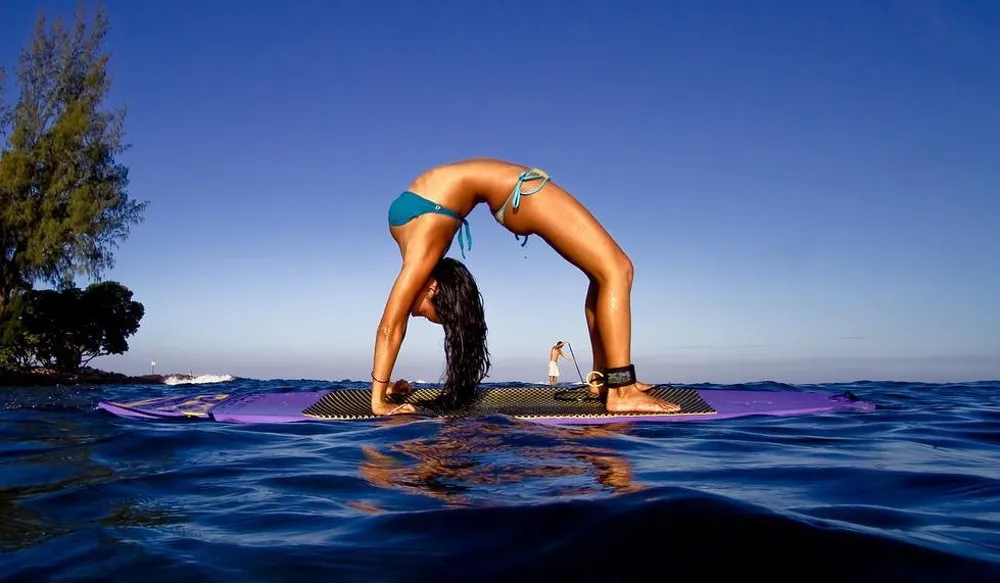
What Is Paddle Board Yoga?
Paddle board yoga, or SUP yoga, is yoga practiced on a stand up paddle board floating on the water. You paddle out to a calm spot, anchor or drift, and flow through poses on the board's deck. Because the board moves with every shift of your weight, even simple poses demand more balance and core control than they do on a mat.
You don't need to be an expert at either sport. Some yoga or paddling experience helps, but most beginners start in a class with simple kneeling and seated poses. New to paddling? Read our beginner's guide to paddle boarding first.
Why Try SUP Yoga?
- Core and balance challenge: the moving surface makes your stabilizing muscles work constantly.
- Focus: you have to move slowly and pay attention to your breath and body, or you'll end up in the water.
- Relaxation: many people find practicing on the water calming, and a floating savasana is a highlight of most classes.
- Something new: it adds variety to both a yoga practice and a paddling routine.
Benefits like these are described by instructors and paddling publications rather than measured in SUP yoga studies. For the research on paddle boarding in general, see the benefits of paddle boarding.
Choosing a Board for Yoga
| Feature | What Sources Recommend | Why |
|---|---|---|
| Width | About 32–34 inches | More width means more stability; much wider boards paddle poorly |
| Length | About 10–11 feet (one brand's guidance) | Room for longer poses without losing maneuverability |
| Deck pad | Full-length or near full-length | Grip and cushioning for hands and knees |
| Inflation (iSUP) | Full recommended PSI; one brand says at least 15 PSI | A soft deck flexes and feels unstable |
| Fin | A larger fin, about 9–10 inches (one source) | Helps the board stay steady when anchored |
| Attachment points | Nose leash plug or D-ring and bungees | For anchoring and stowing water and gear |
Hard or inflatable? Both work. Inflatables are easy to store and transport; hard boards are rigid and very stable. If you choose an inflatable, pump it to its full pressure. Compare options in inflatable vs. hard paddle boards and find the right size with our paddle board size chart.
iRocker All Around 11
An 11-foot inflatable all-around board with a removable center handle, a length that falls within the range commonly suggested for SUP yoga. Check the listing for its exact width.
Check Price on AmazonBOTE Breeze Aero 11'6"
A premium inflatable all-around board with a roomy deck for both paddling and yoga. Check the listing for its width and deck pad coverage.
Check Price on AmazonSee more in the best inflatable paddle boards.
What to Bring
- Life jacket: a low-profile inflatable belt pack is comfortable for yoga, but it must be worn to count under Coast Guard rules. See PFD options.
- Whistle or other sound signal.
- Leash for paddling out.
- Anchor kit (optional), with floating line and a carabiner.
- Water, sunscreen and sunglasses on a retainer strap.
- Phone in a waterproof pouch so you can call for help.
- Clothing: fitted, quick-dry layers like swim tights, shorts and rash guards that won't ride up in inverted poses.
How to Anchor Your Paddle Board
Anchoring keeps you from drifting into the shore, other paddlers or boat traffic and keeps a group together. It's optional on very calm, small lakes.
- Choose an anchor. A small folding grapnel anchor designed for kayaks and SUPs works, as does a mushroom anchor, which Paddling Magazine notes is less likely to scratch your board. Sources suggest about 3 to 5 pounds.
- Use floating line, about 15 to 20 feet, with a carabiner at the board end and a small buoy if you like.
- Attach it to the leash plug at the nose or tail, or a D-ring.
- Pick your spot. REI suggests water about 10 to 15 feet deep; Paddling Magazine says at least 4 feet. Your line must be long enough to reach the bottom.
- Lower the anchor until it touches bottom, let out a few more feet and tie off. Pile extra line on the tail so it doesn't tangle.
- Handle your leash. Once anchored, many instructors suggest taking the leash off your ankle and securing it to the paddle so it doesn't tangle around your legs during poses. If you aren't anchored, keep the leash on.
Gradient Fitness Kayak Anchor Kit
A 3.5-pound folding grapnel anchor with a four-fluke cast-iron body and twist lock, sized for kayaks and paddle boards.
Check Price on AmazonWhere and When to Practice
- Calm, flat water: sheltered lakes, ponds, coves and bays are ideal.
- Light wind: early mornings are often calmest.
- Away from boats: stay clear of channels, high-speed boat traffic and wakes.
- Avoid offshore wind. Wind blowing from land out to sea can push you away from shore quickly; the RNLI advises avoiding it.
- Warm water for beginners: you'll likely fall in. Water below 70°F is considered cold, and cold water shock can cause gasping and panic in the first 2 to 3 minutes.
- Clear of hazards: make sure there are no rocks, docks or debris within your drift range.
Basic Principles on the Board
- Stay centered over the carry handle, the board's balance point.
- Keep a wide base, about hip width, with hands and knees near the rails for stability.
- Favor poses with two or more points of contact, such as hands and knees or both feet.
- Face across the board. Poses with your body perpendicular to the board are steadier than poses that run along its length.
- Move slowly, slower than on land, and transition with control.
- Start kneeling on your first session before standing.
- Use the paddle as a prop for balance in standing poses.
Beginner SUP Yoga Poses
| Pose | Level | Tip on the Board |
|---|---|---|
| Easy seated pose | Beginner | Sit centered and breathe to settle the board |
| Child's pose | Beginner | Knees wide over the handle; rest your forehead on the deck |
| Tabletop | Beginner | Hands under shoulders, knees under hips, near the rails |
| Cat-cow | Beginner | Move slowly with your breath from tabletop |
| Seated twist | Beginner | Hold for 3 to 5 breaths each side |
| Cobra | Beginner | Keep hips on the deck and lift gently |
| Downward dog | Beginner to intermediate | Hands and feet wide, across the center of the board |
| Chair | Intermediate | Feet wider than hip width for stability |
| Bridge | Intermediate | Feet flat and wide on the pad |
| Savasana | Everyone | Lie flat and float; start with about 5 minutes |
A Simple Beginner Flow
- Paddle out and anchor, then sit in an easy seated pose for a few breaths.
- Move to tabletop and flow through cat-cow five or six times.
- Rest in child's pose.
- Return to tabletop, then press back into downward dog if you feel steady.
- Lower down for cobra, then back to child's pose.
- Sit for a seated twist on each side.
- Finish lying in savasana, covering your face with a towel or hat to stay cool.
Falling In and Getting Back On
Falling in is part of SUP yoga, so plan for it rather than fight it. Leaning back as you move into a pose is one of the most common ways to go over.
- If you feel yourself going, fall to the side, away from the board, not onto it.
- Surface, grab the board and check that your paddle hasn't drifted off.
- From the side, hold the center handle and kick to slide onto the deck on your belly.
- Come back to kneeling, take a few breaths to let the board settle, then carry on.
Getting back on is the same as in regular paddle boarding; see our beginner's guide for more.
Common Beginner Mistakes
| Mistake | Fix |
|---|---|
| Practicing on a narrow board | Use a wide, stable all-around or yoga board; narrow boards are built for speed |
| Skipping the warm-up | Paddle out and start seated or kneeling before any standing poses |
| Ignoring wind and boat wakes | Check the forecast and pause until wakes pass |
| Leaning back in side poses | Keep your weight centered over the handle |
| Trying advanced poses too soon | Practice inversions on land first, and protect your head and neck |
Poses to Save for Later
| Pose | Why It's Harder on a Board |
|---|---|
| Tree and eagle | Only one point of contact |
| Warrior I and II | Stance runs along the board, which feels less stable |
| Side plank, triangle, side angle | Leaning back can tip the board |
| Headstand and crow | Inversions and arm balances need solid balance first |
| Wheel and dancer's | Advanced backbends and balances |
When you're ready for these, try them on the calmest days, use the paddle as a third support, and wait for any boat wakes to pass. Other ways to progress include longer sessions, smoother transitions between poses and a longer floating savasana; Paddling Magazine suggests working up to 10 to 15 minutes.
Safety and the Rules
Outside the narrow limits of a swimming, surfing or bathing area, the US Coast Guard considers a stand up paddle board a vessel. That means:
- A wearable, Coast Guard–approved life jacket for each person on board.
- Children under 13 must wear a life jacket while under way under federal rules, though state rules may differ.
- Inflatable life jackets have age and weight limits (the Coast Guard says generally over 16 and over 80 pounds to count), and belt packs must be worn.
- A sound-signaling device, such as a whistle; your voice doesn't count.
- A light if you're out between sunset and sunrise.
Check your state's boating rules too, as some go further. Beyond the law, tell someone your plans, carry a way to call for help and never practice alone in cold or rough water.
Sun and Hydration
Water reflects sunlight, so you can burn faster than you expect. Use broad-spectrum sunscreen of at least SPF 15, reapply after falling in, wear sunglasses on a strap and a hat, and bring plenty of water.
Class or On Your Own?
| Class | On Your Own | |
|---|---|---|
| Gear | Board, paddle and anchor often included | You need your own board and anchor |
| Instruction | Guided poses, safety briefing, warm-up paddle | Self-guided |
| Length | Often about 60 to 75 minutes | Whatever you like |
| Cost | Varies by location; check local studios | No class fee once you own gear |
A class is the easiest way to start. Many studios require an intro session, which usually begins with a short paddling warm-up. SUP yoga instructor certifications exist and typically include water safety training.
Related Guides
Learn more about paddling in our paddle boarding hub, choose a SUP paddle, and read kayak vs. paddle board if you're deciding between the two.
Frequently Asked Questions
Do you need a special paddle board for yoga?
Not necessarily. Almost any wide, stable board with a flat deck and a large deck pad works. Yoga-specific boards add extra width and full-length padding, which makes poses more comfortable.
How wide should a paddle board be for yoga?
Sources commonly recommend about 32 to 34 inches wide. Paddling Magazine suggests the 33- to 34-inch range, noting that much wider boards are harder to paddle.
How do you anchor a paddle board for yoga?
Clip a small kayak or SUP anchor to the board's leash point or nose ring with floating line, lower it until it reaches the bottom, let out a little extra line and tie it off. Sources suggest 3- to 5-pound anchors and 15 to 20 feet of line.
What PSI should an inflatable paddle board be for yoga?
Inflate it fully to the manufacturer's recommended pressure so the deck feels stiff. One board brand suggests at least 15 PSI for yoga.
Do you need yoga experience to try SUP yoga?
No. Yoga or paddle board experience helps, but beginner classes start with simple kneeling and seated poses. Taking a class first is a good idea.
Do I need a life jacket for paddle board yoga?
Outside swimming, surfing and bathing areas, the US Coast Guard treats a paddle board as a vessel, so you need a wearable life jacket for each person and a whistle. Children under 13 must wear one under federal rules, and state laws may add more.
Will I fall in during SUP yoga?
Probably, at least occasionally. Falling in is part of the experience, which is why calm, warm water, a life jacket and a leash or anchor matter.
How long should a beginner SUP yoga session be?
One board brand suggests starting with 20- to 30-minute sessions and building up to 45 to 60 minutes. Many classes run about 60 to 75 minutes.
How much does a SUP yoga class cost?
Prices vary by location, class length and studio, so check local listings. Many classes include a board rental.