The History of Surfing: A Timeline From Hawaii to the Olympics (2026)
Surfing grew from an ancient Polynesian practice into a global sport. Here's how it nearly disappeared, came back and went all the way to the Olympics.
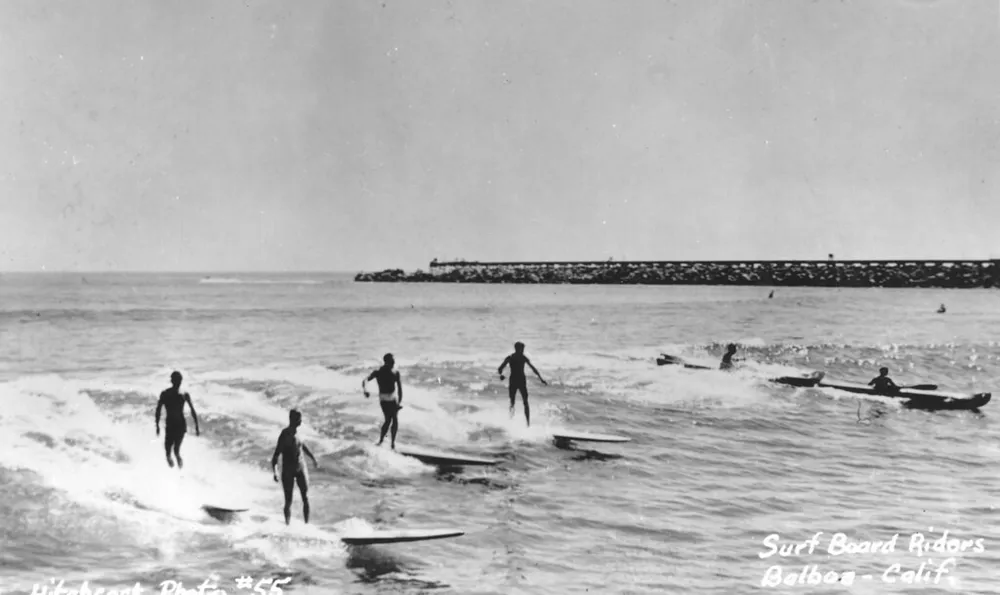
Surfing History at a Glance
| Era | Key Moments |
|---|---|
| Ancient times | Wave riding is part of Polynesian life, especially in Hawaii (he'e nalu) |
| 1769–1779 | First European written accounts (Banks in Tahiti, King in Hawaii) |
| 1820s–1890s | Missionaries arrive; surfing declines in Hawaii |
| 1885 | Hawaiian princes surf in Santa Cruz, California |
| 1907–1915 | Revival at Waikiki; George Freeth and Duke Kahanamoku spread surfing to California and Australia |
| 1930s | Tom Blake's hollow boards and the first fin (1935) |
| Late 1940s–1950s | Balsa, fiberglass and foam boards; first neoprene wetsuits |
| 1959–1960s | Gidget, surf music and a global boom |
| 1967–1970 | The shortboard revolution |
| Early 1970s | Leashes come into wide use |
| 1976 | First professional world tour (IPS) |
| 1983/84 | ASP world tour begins |
| 1990s–2000s | Tow-in and big-wave surfing |
| 2015 | ASP becomes the World Surf League |
| 2018 | First pro contest in a wave pool |
| 2021–2028 | Olympic surfing: Tokyo 2020, Paris 2024, LA 2028 |
Ancient Origins: He'e Nalu
Surfing's roots lie in ancient Polynesia. In Hawaii, wave riding, called he'e nalu ("wave sliding"), was woven into society, religion and status. Chiefs and commoners both surfed, but the best breaks and longest boards were often reserved for royalty. Boards were carved from local woods such as koa and wiliwili:
- Olo: very long, heavy boards associated with chiefs.
- Alaia: thinner, shorter boards ridden by many people.
- Paipo: small bellyboards, the ancestors of bodyboards.
Other coastal cultures rode waves too; for example, fishermen in Peru used reed craft called caballitos de totora. But it was Polynesian, and especially Hawaiian, surfing that grew into the modern sport.
First European Accounts
European explorers first wrote about surfing in the late 1700s. Joseph Banks, sailing with Captain Cook on HMS Endeavour, described wave riding in Tahiti in 1769. On Cook's third voyage, Lieutenant James King wrote the first detailed European description of Hawaiian surfing in 1779, after Cook's death. Recalling his first sight of it, he wrote: "On first seeing this very dangerous diversion I did not conceive it possible."
Decline in the 1800s
Calvinist missionaries began arriving in Hawaii in 1820. They discouraged surfing, partly objecting to men and women surfing together, and Hawaiian traditions were suppressed as Western influence grew. Introduced diseases devastated the population. By the end of the 1800s, surfing survived only in pockets.
Revival at Waikiki
In the early 1900s, a group of Waikiki surfers and promoters revived the sport. Writer Jack London published his surfing essay "A Royal Sport" in 1907, and Alexander Hume Ford helped found the Outrigger Canoe and Surfing Club around 1908. The Hawaiian club Hui Nalu formed in 1911.
George Freeth
George Freeth, a Hawaiian surfer, arrived in Southern California in 1907 and gave surfing and lifesaving demonstrations at Venice and Redondo Beach, helping to spark California surf culture. Even earlier, in 1885, three Hawaiian princes had surfed at the mouth of the San Lorenzo River in Santa Cruz.
Duke Kahanamoku
Duke Kahanamoku (1890–1968) is widely called the father of modern surfing. A champion swimmer, he won five Olympic medals (three gold, two silver) between 1912 and 1924. He used his fame to spread surfing, giving a celebrated demonstration at Freshwater Beach in Sydney in December 1914, with more demonstrations in 1915, and surfing regularly in California. He also proposed surfing for the Olympics, a dream realized a century later.
Boards Get Lighter: 1930s–1950s
In the 1930s, Tom Blake built hollow boards that were much lighter than solid wood and, in 1935, added the first stabilizing fin, which transformed how boards turned. From the mid-1940s, lighter balsa replaced redwood, and fiberglass and later polyurethane foam transformed board building. The lighter, maneuverable "Malibu" boards of this era made surfing far more accessible.
The Wetsuit
In 1951, physicist Hugh Bradner developed an early neoprene wetsuit, and Jack O'Neill went on to develop the first mass-produced surf wetsuits in California, opening up cold-water surfing. See wetsuit vs drysuit.
The Surf Boom: 1950s and 1960s
Surfing exploded in popularity after the 1959 film Gidget, surf music and beach movies. Contests grew too: the first international championships were held at Makaha, Hawaii, in 1953, and the first world championships in Sydney in 1964. Big-wave pioneers rode Waimea Bay for the first time in 1957, and Greg Noll rode the outside reef at Pipeline in 1964.
The Shortboard Revolution
In the late 1960s, shapers such as Bob McTavish cut boards down dramatically, adding vee bottoms and new shapes. Within a few years, many surfers had gone from 9-foot-plus boards to boards around 6 feet, enabling the sharp, vertical surfing that defines modern performance. Learn about modern shapes in types of surfboards.
The Leash
Around 1969–1971, several surfers experimented with tethering boards to their ankles, and the surf leash came into widespread use in the early 1970s. It kept boards from washing ashore and made crowded lineups safer. See surf leashes.
Professional Surfing
- 1976: International Professional Surfers (IPS), founded by Fred Hemmings and Randy Rarick, ran the first professional world circuit; Peter Townend was its first world champion.
- Late 1970s: women's professional surfing grew, with a women's pro circuit by 1977.
- 1983/84: the Association of Surfing Professionals (ASP) took over, with its first world tour season in 1983/84.
- 2015: the ASP was renamed the World Surf League (WSL).
Sources give different founding dates for the ASP, but its world tour began with the 1983/84 season. Meet the champions in the greatest surfers of all time.
Women's Surfing
Women surfed in ancient Hawaii and were part of the Waikiki revival. In the professional era, Margo Oberg is often cited as the first female pro in 1975, a women's pro circuit followed in the late 1970s, and champions such as Lisa Andersen, Layne Beachley, Stephanie Gilmore and Carissa Moore drove the sport's growth. Carissa Moore won the first women's Olympic surfing gold in 2021.
Big Waves and Tow-In Surfing
From the 1980s and especially the 1990s, surfers began using personal watercraft to tow each other into waves too big and fast to paddle into. Tow-in surfing opened up giant outer-reef waves in Hawaii and beyond, and later inspired a return to paddling into huge waves with better boards and safety gear such as inflatable vests.
Wave Pools
Artificial waves have been tried for decades, but modern wave pools can now produce high-quality, repeatable waves. The first professional contest in a wave pool was held at Kelly Slater's Surf Ranch in California in 2018. Wave pools are bringing surfing to inland cities around the world.
Surfing at the Olympics
The International Surfing Association gained IOC recognition in the 1990s, and in 2016 the IOC added surfing to the Tokyo 2020 program. Surfing debuted in 2021 at Tsurigasaki Beach, Japan, returned at Paris 2024 at Teahupo'o in Tahiti, and is set for LA 2028 at Lower Trestles in California. See Olympic surfing.
Surfing Today
Surfing is now a global sport and lifestyle, from beginner beach breaks to big-wave events and wave pools. Modern challenges include crowded lineups, coastal access and environmental issues such as water quality and the materials used in boards and wetsuits. Want to be part of the story? Start with how to surf.
Related Guides
Explore the surfing hub, the best surf spots in the US and surf etiquette.
Frequently Asked Questions
Where did surfing originate?
Surfing is most closely linked to ancient Polynesia, especially Hawaii, where it was a central part of culture known as he'e nalu, or wave sliding. Other coastal cultures, such as in Peru, also rode waves on reed craft.
How old is surfing?
No one knows exactly. It was well established in Polynesian culture long before Europeans first wrote about it in the 1760s and 1770s.
Who first wrote about surfing?
Joseph Banks described wave riding in Tahiti in 1769, and Lieutenant James King wrote the first detailed European account of Hawaiian surfing in 1779, during Captain Cook's third voyage.
Who is the father of modern surfing?
Duke Kahanamoku, the Hawaiian Olympic swimming champion, is widely called the father of modern surfing for spreading the sport to Australia and California.
Why did surfing almost disappear in Hawaii?
After the arrival of missionaries in the 1820s, surfing was discouraged and Hawaiian culture was suppressed, while disease reduced the population. By the late 1800s surfing was practiced only sporadically.
When did surfing come to California?
Hawaiian princes surfed in Santa Cruz in 1885, and George Freeth popularized surfing in Southern California with demonstrations starting in 1907.
When was the surf leash invented?
Several people experimented with leashes around 1969–1971, and leashes came into widespread use in the early 1970s.
When did surfing become an Olympic sport?
The IOC added surfing in 2016 for the Tokyo 2020 Games, held in 2021. It returned at Paris 2024 in Tahiti and is scheduled for Los Angeles 2028 at Lower Trestles.