The Hardest Tricks in Skateboarding and Who Landed Them First (2026)
From flatground flips that take years to dial in to the record spins of the vert and mega ramp era, here are skateboarding's hardest tricks and the skills each one demands.
What Makes a Skateboard Trick Hard?
"Hardest" means different things depending on where you skate. A flatground trick is hard when the board has to turn on two axes at once and still land under your feet. A ledge or rail trick is hard when you have to lock into an awkward position at speed, or flip in and out of the grind. A vert or mega ramp trick is hard because of the speed, the height, the blind rotations and what happens when it goes wrong.
This page groups the hardest skateboard tricks by terrain, gives the documented milestones behind the record spins and explains the skills you need before trying anything on the list. If you're still learning the basics, start with our skateboard tricks list and the trick learning order.
The Hardest Skateboard Tricks at a Glance
| Trick | Terrain | What Makes It Hard |
|---|---|---|
| Laser flip | Flatground | Heelflip plus frontside 360 shove-it; two axes, awkward scoop |
| Hardflip | Flatground | Kickflip plus frontside shove-it; the board flips up between your legs |
| Nightmare flip | Flatground | Varial double kickflip; extra flip and spin to track |
| 360 flip (tre flip) | Flatground | Kickflip plus 360 shove-it; needs a strong, level scoop |
| Impossible | Flatground | Board wraps vertically around your foot |
| Flip-in and flip-out grinds | Ledge and rail | Flip, catch and lock in, or pop out, in one motion |
| Bluntslides and overcrooks | Ledge and rail | Precise pop and balance on the far edge |
| McTwist (540) | Vert | Inverted spin and a blind landing |
| 900 | Vert and mega ramp | Two and a half spins at the top of a ramp |
| 1080 and 1260 | Mega ramp (and vert for the 1080) | Three or more spins at high speed |
Hardest Flatground Tricks
Flatground tricks are where most skaters meet their first "impossible" moment. Many of the foundational flips were invented or refined by Rodney Mullen during his freestyle years; Wikipedia credits him with the kickflip and heelflip in their modern form (1982), the 360 flip (1983), the impossible (1982) and the laser flip.
Laser Flip
A laser flip is a heelflip combined with a frontside 360 shove-it. Your back foot scoops the board a full turn frontside while your front foot flicks a heelflip, so the board flips and spins at the same time in a direction that feels unnatural to most skaters. It shows up on almost every "hardest flip trick" list because it's hard to keep the board level and under you.
Hardflip
The hardflip is a kickflip combined with a frontside pop shove-it. The board flips up vertically between your legs, which makes the catch awkward and the bail painful. Most skaters find it much harder than the varial kickflip, which pairs a kickflip with a backside shove-it.
Nightmare Flip and Multiple Flips
A nightmare flip is a varial double kickflip: a varial kickflip with an extra flip. Double and triple kickflips follow the same idea. Each extra rotation needs more pop, a faster flick and more time in the air, so the timing window shrinks quickly.
360 Flip (Tre Flip)
The 360 flip combines a kickflip with a backside 360 shove-it. It's a common goal for intermediate skaters rather than a true pro-level trick, but a clean, level tre flip takes most people a long time. Our planned how to tre flip guide covers it step by step.
The Impossible
Search for "impossible tricks on a skateboard" and you'll find this one. In an ollie impossible, the board wraps vertically around your back foot, like a baton around a hand. Mullen is credited with inventing it in 1982, and older skaters reportedly called the rotation impossible. Learn it in how to ollie impossible.
Gazelle Flips and Big-Spin Combos
Tricks that add body rotation to a big board rotation, such as bigflips (a kickflip with a 360 board spin and a 180 body turn) and gazelle flips (the board flips and spins 540 degrees while your body turns too), stack two hard skills: a big scoop and a committed body spin. Names for the bigger variations vary between sources.
Hardest Ledge and Rail Tricks
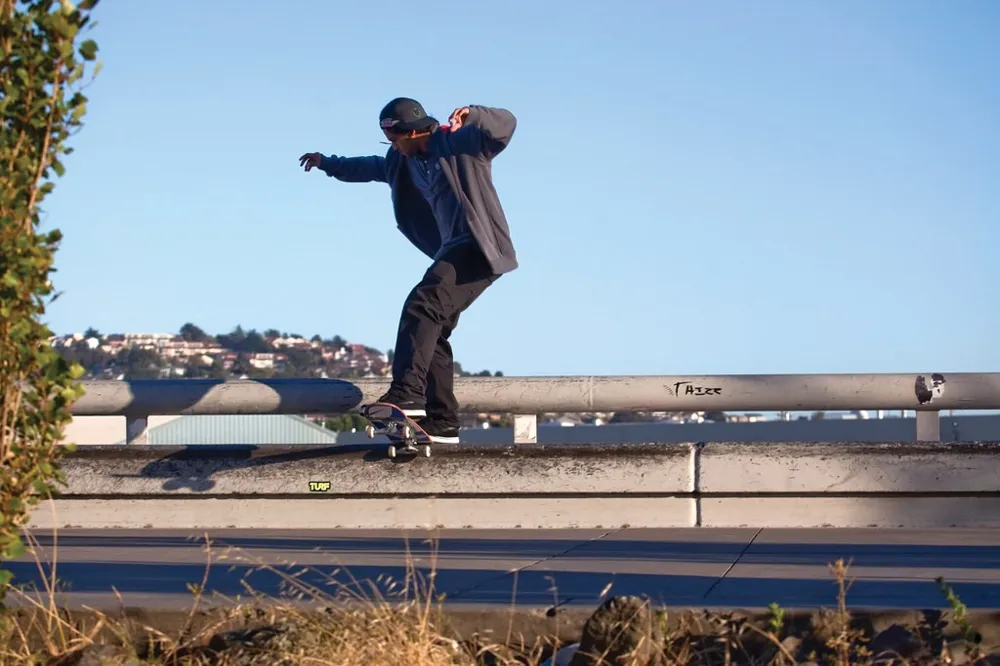
Grinds and slides get harder in three ways: the position is harder to lock into, the obstacle is bigger or steeper, or there's a flip trick on the way in or out. Our types of skateboard grinds guide explains each position; these are the ones most skaters find hardest.
| Trick | Position | Why It's Hard |
|---|---|---|
| Nosegrind and crooked grind | Front truck only (crook: nose edge too) | More pop and balance than a 5-0; easy to sink or slip out |
| Overcrook | Front truck with the nose over the far side | Committed angle; you can't see much of the obstacle |
| Smith and feeble | Back truck, front of the board dipped or hanging | Hard to lock in and pop out cleanly |
| Bluntslide and noseblunt slide | Tail or nose with the wheels on top | Precise pop onto the top of the ledge, then a pop out |
| Flip into a grind | Kickflip or heelflip, then lock into a grind or slide | Catch and lock in at the same instant |
| Flip out of a grind | Grind or slide, then kickflip or shove-it off | Pop off a moving board with your weight forward |
| Handrail tricks | Any grind or slide down stairs | Speed, height and a hard landing if you miss |
On handrails and big ledges, even a basic 50-50 becomes hard because the consequences rise with the size of the obstacle. Get the position on a low curb or flat bar first; see how to grind on a skateboard.
Hardest Vert and Bowl Tricks
On vert ramps (halfpipes with walls that go fully vertical at the top), difficulty comes from rotation, inverts and the blind landings that go with them.
McTwist (540)
Mike McGill first performed the McTwist, an inverted 540-degree mute-grab air, on a wooden halfpipe in Rättvik, Sweden, in 1984. Spinning one and a half times while upside down, then landing back in the ramp, made it one of the defining vert tricks of the 1980s.
720
The 720 adds another half spin. Tony Hawk is widely credited with pioneering it on vert. In June 2023, Arisa Trew became the first woman to land a 720 in competition, at Tony Hawk's Vert Alert in Salt Lake City.
The 900
The 900 is two and a half spins. Tony Hawk landed it at X Games V in San Francisco on June 27, 1999, after ten failed attempts, and it became the most famous trick in skateboarding. Danny Way has been said to land one in a 1989 video, but Hawk has disputed that, saying the clip was cut before the fall. In May 2024, Arisa Trew landed a 900, widely reported as a first for a female skater, though Wikipedia also records a 900 by a young girl in 2022, so how the "first" is counted varies.
Inverts and Flip Variations
Handplants, inverts and flip tricks to fakie on vert add a different kind of difficulty: you're upside down or flipping the board several feet above the coping. If you ride bowls and pools, see our bowl and pool setup guide.
Mega Ramp Milestones: The 1080 and 1260
The MegaRamp is Danny Way's concept: a tall roll-in, a gap jump and a giant quarter pipe. According to Wikipedia, the setup was named the MegaRamp in the 2003 DC Shoes film The DC Video, where Way set records for the longest jump (75 feet) and highest air (23.5 feet) at the time. Mega ramps typically have roll-ins of 40 feet or more and gaps of about 25 to 70 feet, and the X Games has run skateboard Big Air on a MegaRamp since 2004. In 2005, Way became the first person to clear the Great Wall of China on a skateboard.
The extra speed from the roll-in gives riders more time in the air than a vert ramp, which opened the door to bigger spins:
- First 900 on a mega ramp: Bob Burnquist, September 4, 2010, in Vista, California.
- First 1080: Tom Schaar, age 12, at Woodward West in Tehachapi, California, in March 2012 (sources give March 26 or March 30). He landed another at X Games Asia in April 2012 to win gold.
- First 1260: Mitchie Brusco, three and a half spins, at X Games Minneapolis in August 2019.
- First 1080 on a vert ramp: Gui Khury, age 11, in May 2020, on a regular vert ramp with no mega ramp roll-in. He landed one in competition at the 2021 X Games.
Milestone Timeline
| Year | Milestone | Terrain |
|---|---|---|
| 1982 | Rodney Mullen adapts the ollie to flat ground and is credited with the ollie impossible | Flatground |
| 1983 | Mullen credited with the 360 flip | Flatground |
| 1984 | Mike McGill's McTwist (inverted 540) | Vert |
| 1999 | Tony Hawk lands the first 900 at the X Games | Vert |
| 2003 | Danny Way's MegaRamp records in The DC Video | Mega ramp |
| 2005 | Way clears the Great Wall of China | Mega ramp |
| 2010 | Bob Burnquist lands the first mega ramp 900 | Mega ramp |
| 2012 | Tom Schaar lands the first 1080 | Mega ramp |
| 2019 | Mitchie Brusco lands the first 1260 | Mega ramp |
| 2020 | Gui Khury lands the first vert ramp 1080 | Vert |
| 2023 | Arisa Trew lands the first women's 720 in competition | Vert |
| 2024 | Trew lands a 900, widely reported as a women's first | Vert |
For the bigger picture, see our skateboarding history timeline, skateboarding facts and best skateboarders of all time.
Why Some "Firsts" Are Disputed
Skateboarding records rarely have an official referee. A trick counts when it's landed cleanly and, ideally, filmed. Arguments start when footage is edited, when a landing is sketchy, or when a trick was done in a private session years before someone did it on camera or in a contest. That's why the 900 is usually credited to Hawk's 1999 landing even though earlier attempts are discussed, and why we list the vert and mega ramp 1080 separately. Where sources give different dates, we note both.
Why These Tricks Are So Hard
- Two axes at once: flip tricks like the laser flip and hardflip make the board flip and spin together, so a tiny error in your flick or scoop sends it off line.
- The catch: you have to find the grip tape with both feet while the board is still moving, then absorb the landing.
- Timing windows: extra flips and spins need more air time, and the window to catch and land gets shorter.
- Blind landings: on big spins you lose sight of the ramp for part of the rotation and land by feel.
- Speed and height: mega ramp tricks happen at speeds and heights where a mistake can mean a serious fall, so commitment matters as much as skill.
- Fear: committing fully is often the last barrier. Half-committed attempts tend to cause the worst falls.
Want a broader take on the learning curve? Read is skateboarding hard and how long it takes to get good.
Prerequisites: What to Learn First
| Goal Trick | Learn These First |
|---|---|
| 360 flip | Kickflip, pop shove-it, 360 shove-it, varial kickflip |
| Hardflip | Kickflip, frontside pop shove-it, a high ollie |
| Laser flip | Heelflip, frontside 360 shove-it, varial heelflip |
| Nightmare flip | Varial kickflip and a consistent double kickflip |
| Impossible | Ollie, pop shove-it, a solid scoop with the back foot |
| Flip-in grinds | The grind on its own, plus the flip trick over a similar-height gap |
| Bluntslides | Tailslides, nose and tail stalls, a precise ollie onto the ledge |
| 540 and bigger spins | Drop-ins, kickturns, backside and frontside airs, 360 airs on vert |
Two skills underpin almost everything on this list: a high, level ollie (see how to ollie higher) and comfort riding fakie and switch (see how to revert and ollie vs nollie). Check heelflip vs kickflip if you're not sure which flip direction suits you.
How to Progress Safely Toward Advanced Tricks
- Wear protection: a certified helmet and pads, especially on ramps. See skateboard safety gear and skateboard helmets.
- Learn to fall: rolling out of a bail protects your wrists and head. Read how to fall on a skateboard.
- Break tricks into parts: learn each component on its own, then combine them.
- Go small first: try flips on flat ground before stairs, and grinds on curbs before rails.
- Use the right setup: a board that suits your terrain helps; see our street setup guide.
- Know your limits: vert and mega ramp tricks belong in supervised settings with experienced riders around. Read is skateboarding dangerous before you push your limits.
Where to See the Hardest Tricks Landed
Contests are where many records happen. The X Games has hosted most of the big spin milestones on this page, while street contests and the Olympics showcase the hardest ledge and rail tricks. See skateboarding competitions, Olympic skateboarding, best female skateboarders and skateboarding documentaries for more.
Frequently Asked Questions
What is the hardest skateboard trick?
There's no single answer, because difficulty depends on terrain. On flat ground the laser flip, hardflip and nightmare flip are often named; on ramps the 900, 1080 and 1260 are the rarest spins ever landed.
What is the hardest flip trick on a skateboard?
Many skaters name the laser flip, a heelflip combined with a frontside 360 shove-it, because the board turns on two axes in an awkward direction. The hardflip and the nightmare flip are close behind on most lists.
Who landed the first 1080 on a skateboard?
Tom Schaar, in 2012, on a mega ramp at Woodward West in California. Gui Khury later landed the first 1080 on a regular vert ramp, in 2020.
Has anyone landed a 1260 on a skateboard?
Yes. Mitchie Brusco landed the first 1260, three and a half spins, on the mega ramp at X Games Minneapolis in August 2019.
Why is it called the impossible?
Rodney Mullen is credited with inventing it in 1982, and the name came from older skaters who thought the board's wrap-around rotation was impossible. Today it's a well-known intermediate to advanced trick.
What should I learn before trying hard skateboard tricks?
A consistent ollie while rolling, both shove-its, the kickflip and heelflip, and solid fakie and switch riding. On ramps, drop-ins, kickturns and confident airs come first.