Surf Slang Dictionary: Speak Like a Surfer (2026)
From kooks and groms to glassy, blown out and getting pitted, here's the surfer vocabulary you'll hear in the lineup, grouped by topic and explained in plain English.
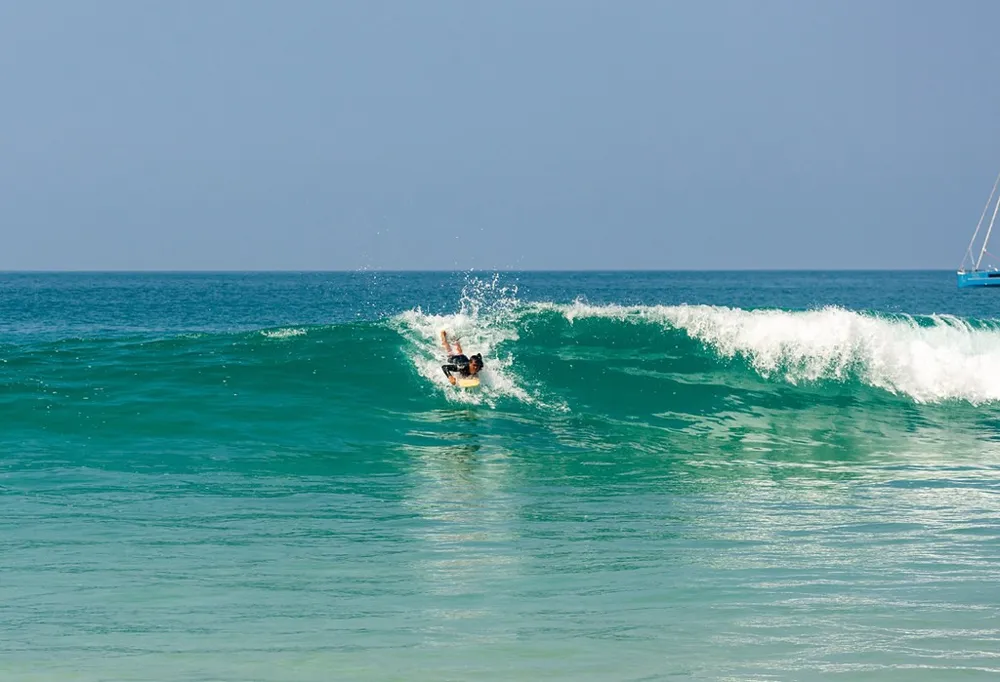
Surf Slang at a Glance
Surfing has a vocabulary all its own. Some of it is practical (you need to know what a closeout or a set is to stay safe), some describes your board, and some is pure culture. Words also change from coast to coast, and plenty of old movie slang is rarely heard in real lineups today. This glossary sticks to terms that appear across established surf glossaries and dictionaries, grouped so you can find what you need fast.
If you only learn a dozen words before your first session, make it these:
| Term | What It Means | Why It Matters |
|---|---|---|
| Lineup | The area just outside the breaking waves where surfers wait | Where you sit and take turns |
| Set | A group of larger waves arriving together | Sets can catch you inside |
| Peak | The point where a wave first starts to break | The surfer closest to it has priority |
| Drop in | Taking off on a wave someone with priority is already riding | The biggest etiquette mistake |
| Closeout | A wave that breaks all at once along its length | Nowhere to ride; often a pounding |
| Whitewater | Broken, foamy wave rolling toward shore | Where beginners learn |
| Glassy | Smooth water with no wind texture | Usually the best conditions |
| Blown out | Waves ruined by wind chop | Usually not worth paddling out |
| Goofy / regular | Right foot forward / left foot forward | Tells you your forehand direction |
| Wipeout | Falling off or being knocked off while riding | Everyone does it |
| Kook | An unskilled or clueless surfer | What nobody wants to be called |
| Stoked | Extremely happy or excited | The goal of every session |
Learning to surf from scratch? Our how to surf guide covers the basics, and surf etiquette explains the lineup rules behind many of these words.
What Is a Kook in Surfing?
"Kook" is probably the most searched surf word, and it carries more weight than most. Definitions vary a little between glossaries: some describe a kook simply as an inexperienced or incompetent surfer, others as a wannabe of limited skill, and others focus on behavior, a surfer who disrupts or endangers people around them through poor etiquette.
In practice, behavior is what earns the label. Being a beginner doesn't make you a kook; everybody starts somewhere, and young beginners are called groms. Behavior most likely to earn the label includes:
- Dropping in on someone who has priority, or paddling straight into their path.
- Letting go of your board in the impact zone so it flies at the surfers behind you.
- Paddling out at a break that's beyond your ability, especially a crowded reef or point.
- Snaking and wave hogging.
- Ignoring the lineup's vibe, such as shouting, crowding the peak or parking yourself where everyone is trying to ride.
Between friends, "kook" can be light teasing; from a stranger in a crowded lineup, it's a real insult. A related older word, barney, means an inexperienced, untalented or uncool surfer, and hodad is a non-surfer who hangs around the beach acting like one.
The cure is simple: learn the priority rules, hold on to your board and pick waves that match your level. Our surf etiquette guide covers all of it.
Waves and Conditions
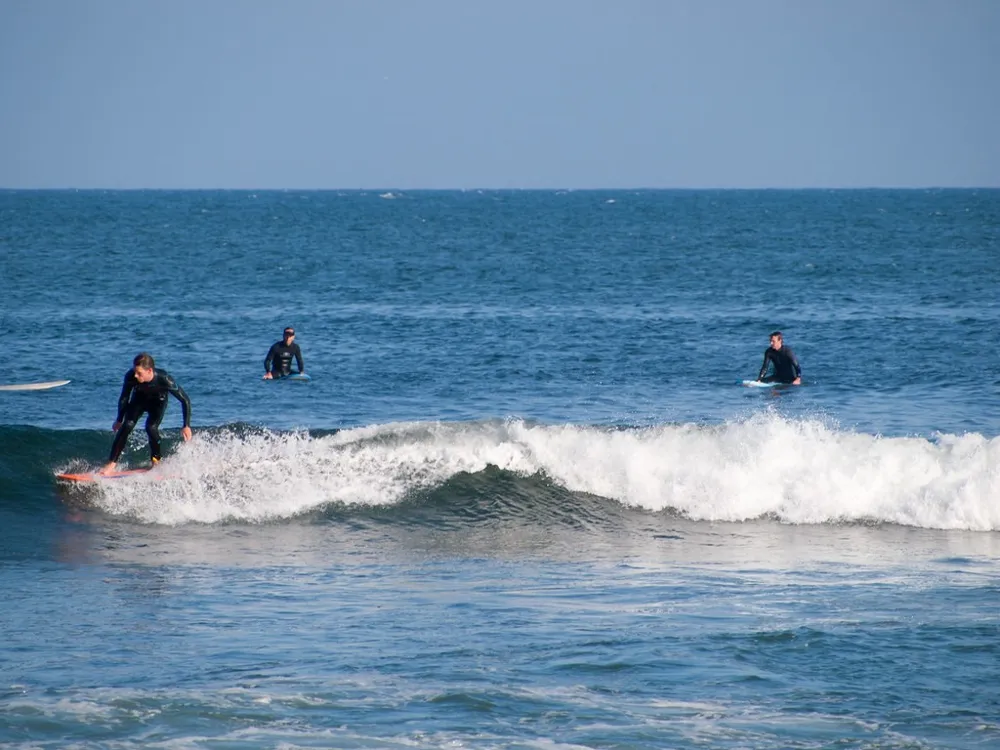
Most surf talk is about the waves themselves: how big, how clean and how they break. For maneuver-level terms like the pocket, lip and section, see our surfing tricks and maneuvers guide.
| Term | Meaning |
|---|---|
| Swell | Waves that have traveled from a distant storm before breaking in shallow water |
| Set / set waves | A group of larger waves within a swell |
| Lull | The calm period between sets |
| Bomb (bomber) | An exceptionally large set wave |
| Peak | The highest point of a wave, where it starts to break |
| A-frame | A peak shaped like an A, with clean shoulders to ride both left and right |
| Face | The unbroken, forward-facing slope you ride |
| Wall | A long, steep section of face between the shoulder and the breaking part |
| Shoulder (green) | The unbroken, gentler part of the wave away from the peak |
| The steep part of the face just ahead of the breaking section; the energy zone | |
| Lip / curl | The top edge of the wave that pitches forward as it breaks |
| Barrel (tube, green room, keg, pit) | The hollow tunnel formed when a wave curls over |
| Hollow | A wave that curls over to form a tube |
| Section / sectioning | A part of the wave; a wave is "sectiony" when parts break ahead of you |
| Closeout | A wave that breaks all at once along its length, leaving no open face |
| Wedge | Two converging waves that merge into a harder-breaking peak |
| Double-up (humpback) | Two waves combining into one bigger, heavier wave |
| Reformer | A wave that breaks, reforms and breaks again closer to shore |
| Pounder | An unusually hard-breaking wave |
| Mushy / mushburger | Soft, slow waves with little power |
| Whitewater (soup, whitewash, foam) | The turbulent foam left after a wave breaks |
| Shore break (shorey) | Waves dumping right on the sand; can be powerful |
| Flat | No surf |
| Ankle busters / snappers | Waves too small to ride well |
| Pumping / off the hook | Excellent, powerful, consistent waves |
| Gnarly | Big, intense or dangerous; can be praise or a warning |
| Surf's up | There are waves worth surfing |
Types of Surf Breaks
A beach break breaks over sand or sandbars, so peaks shift as the sand moves. A point break wraps around a point of land or a rocky headland and often peels in one direction for a long ride. A reef break breaks over rock or coral, which usually means a more consistent shape and a harder bottom. You may also hear bommie (short for bombora), a submerged rock or reef shelf that can throw up powerful waves offshore.
How Surfers Talk About Wave Size
Wave size is famously inconsistent. Many surfers describe it against the body: knee-high, waist-high, head-high, overhead. In Hawaii, waves have traditionally been measured from the back, which produces much smaller numbers than measuring the face; a "3-foot" Hawaiian wave is often described as roughly double that by face height. When a local calls the surf "small," ask what it looks like on a person.
Wind, Swell and Current Talk
Wind decides whether a good swell is fun or a mess, so surfers have plenty of words for it. To put these into practice, see how to read a surf forecast.
| Term | Meaning |
|---|---|
| Offshore | Wind blowing from land to sea; grooms waves and holds up the face, so usually the best wind |
| Onshore | Wind blowing from sea to land; creates choppy, messy waves |
| Glassy | No wind texture at all; water like glass |
| Chop / choppy | A rough surface caused by wind; waves don't break cleanly |
| Blown out | Conditions ruined by strong onshore wind |
| Messy | Irregular, choppy waves, often from onshore wind |
| Whitecaps | Foam crests on waves out at sea from wind |
| Swell period | The time between wave crests; longer periods usually mean better waves |
| Big sea | Large, unbroken surf |
| Dawn patrol (dawny) | Surfing at first light, when it's often glassy and less crowded |
Currents matter for safety. A channel is a deeper area where waves don't break, often formed by a rip current, which surfers use to paddle out. A rip is a strong current flowing away from shore. You'll also hear undertow, a current pulling seaward as waves approach the beach. For the safety side, read is surfing dangerous?
Surfers and People in the Lineup
Surfers have a word for almost everyone in the water, from beginners to the crew that "owns" the peak.
| Term | Meaning |
|---|---|
| Grom (grommet, gremmie) | A young surfer |
| Kook | An unskilled or clueless surfer; see above |
| Barney | An inexperienced, untalented or uncool surfer |
| Hodad | A non-surfer who hangs around surf beaches acting like a surfer |
| Local | A surfer who regularly surfs a particular break |
| Waxhead | Someone who surfs every day |
| Ripping / shredding | Surfing very well and aggressively ("she rips") |
| Goofy foot | A surfer who rides right foot forward |
| Regular (natural) foot | A surfer who rides left foot forward |
| Switchfoot | Someone equally comfortable riding regular or goofy |
| Wahine | A woman; in surf talk, a female surfer (from Hawaiian) |
| Dilla | A relaxed, low-maintenance surfer who's comfortable being different |
Not sure whether you're goofy or regular? Our goofy vs regular stance guide has simple tests that work for surfing and skating alike.
Boards, Fins and Gear
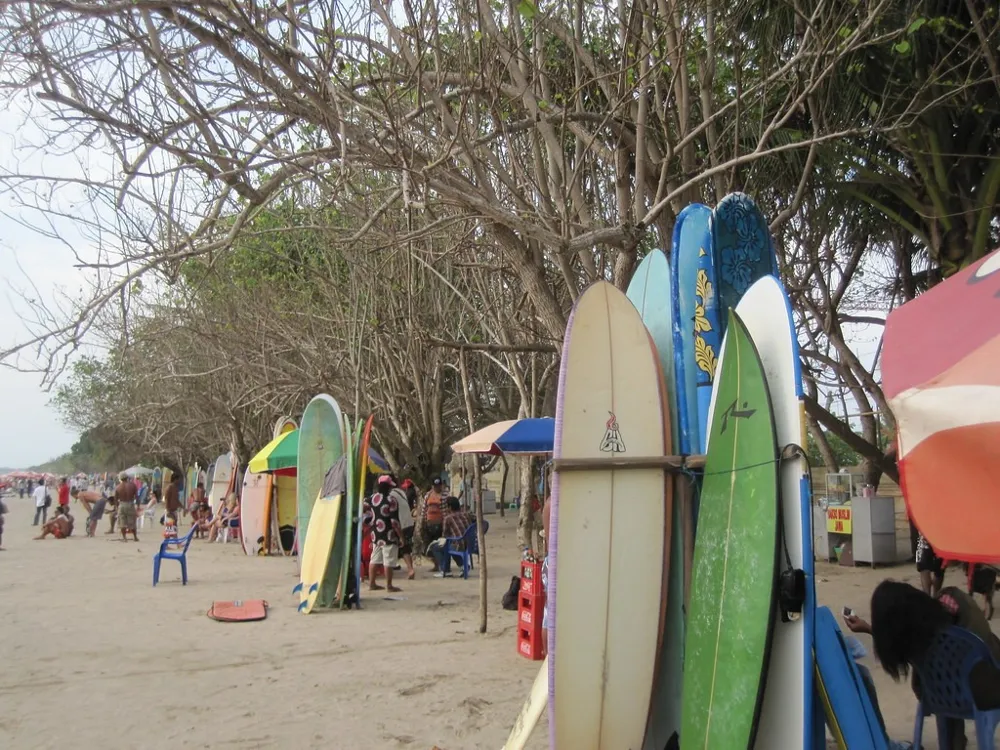
Board talk overlaps with shaping terms. For full explanations of shapes, tails, rails and fin setups, see types of surfboards; the quick version is below.
| Term | Meaning |
|---|---|
| Quiver | A surfer's collection of boards for different conditions |
| Longboard (mal, Malibu) | A long, round-nosed board, generally 9 feet or more |
| Mini-mal / funboard | A shorter longboard shape, often about 7 to 8 feet |
| Fish | A short, wide, thick board, often with a swallow tail, for small waves |
| Gun | A long, narrow board built for big waves |
| Soft-top (foamie) | A board with a foam deck; the standard learner board |
| Thruster | A three-fin setup; the all-round standard since the early 1980s |
| Twinny / twin fin | A two-fin board, loose and fast in small surf |
| Deck / bottom | The top surface you stand on / the underside on the water |
| Nose / tail | Front tip / back end |
| Rails | The side edges of the board |
| Rocker | The board's curve from nose to tail |
| Stringer | The thin strip, usually wood, down the center of many boards |
| Blank | The foam block a board is shaped from |
| Ding | A dent, crack or hole in a board |
| Leash (leggie, legrope) | The cord connecting the board's tail to your ankle |
| Wax | Sticky surf wax rubbed on the deck for grip |
| Wettie / rubber | A wetsuit |
| Rash guard | A shirt that protects against sunburn and board rash |
| Boardshorts (baggies) | Surf shorts |
Shopping for any of the above? See our guides to the best surfboard leash, best surfboard wax, surfboard fins and the best wetsuits.
Moves and Maneuvers
These are the words for what surfers actually do on a wave. Each is explained in more depth, with progression tips, in our surfing tricks and maneuvers guide.
| Term | Meaning |
|---|---|
| Pop-up | Going from lying on the board to standing in one motion |
| Takeoff / drop | Catching the wave and dropping down the face to start the ride |
| Trim | Riding a steady line across the face in the fastest part of the wave |
| Pump | Rocking rail to rail and compressing to build speed |
| Bottom turn | The first turn at the base of the wave after the drop |
| Top turn / off the top | A turn on the upper face, back down the wave |
| Carve | A long, powerful arc on the rail |
| Cutback | A turn back toward the breaking part of the wave from the shoulder |
| Snap (slash) | A quick, sharp turn in the pocket or near the lip |
| Re-entry / hitting the lip | Hitting the lip vertically and coming back down with it |
| Floater | Riding over the top of a breaking section and dropping back down |
| Fins out / tail slide | A turn where the fins release and slide across the top of the wave |
| Fade | Angling toward the breaking part on takeoff before turning to go the other way |
| Stall | Slowing down, often to wait for the barrel |
| Getting barreled (pitted, tubed, shacked, kegged) | Riding inside the hollow curl of a wave |
| Air (aerial, punt) | Launching above the lip and landing back on the wave |
| Ramp | The steep section a surfer uses to launch an air |
| Cross-step | Walking along a longboard by crossing one foot over the other |
| Hang five / hang ten | Five or ten toes over the nose of a longboard |
| Hang heels | Standing backward on the nose with heels over the edge |
| Soul arch | Arching the back while trimming, a classic relaxed style move |
| Drop knee | A longboard turn with the back knee bent low toward the deck |
| Kick-out | Pushing on the tail to exit the wave over its back |
| Duck dive | Pushing the board's nose under an oncoming wave to dive beneath it |
| Turtle roll | Flipping a longboard upside down to let a wave pass over |
| Backhand / forehand | Riding with your back to the wave / facing it |
What Does "Throwing Spray" Mean?
"Throwing spray" (or "throws spray") describes the fan of water flung off the rail and tail during a hard turn, especially a carve, snap or slash. A big, high spray is generally read as a sign that the surfer pushed real power through the turn, which is why surf photographers love it. Related praise words: a surfer who rips or shreds is surfing powerfully and aggressively, and a ride or turn that's especially good gets called sick or rad.
Duck diving gets its own walkthrough in how to duck dive.
Lineup and Etiquette Terms
These words describe the unwritten rules of who gets which wave. The full rules, with examples, are in our surf etiquette guide; here's the vocabulary.
| Term | Meaning |
|---|---|
| Priority | The right to a wave; usually the surfer closest to the peak |
| Drop in (dropping in on someone) | Taking off on a wave someone with priority is riding or about to ride; the most serious etiquette mistake |
| Snaking (back-paddling) | Paddling around someone to get inside them and steal priority |
| Burn / cut off | Taking off in front of someone closer to the peak |
| Paddle battle | Two or more surfers racing to catch the same wave |
| Wave hog | Someone who takes far more than their share of waves |
| Backing out | Pulling back from a wave you could have caught |
| Inside / outside | Closer to shore / farther out to sea than the main breaking zone |
| Out the back | The calmer water beyond the breaking waves |
| Caught inside | Stuck in the breaking zone with waves landing on you |
| Crash zone (no man's land) | The zone between the shore and the breaking waves where you get pounded on the way out |
| Localism | Hostility from regular local surfers toward visitors |
Wipeouts and Mishaps
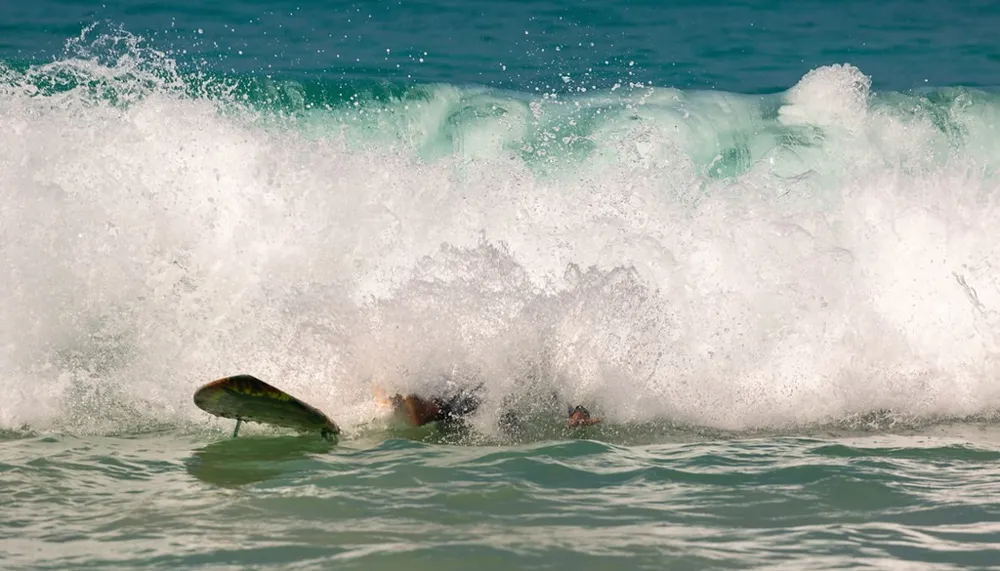
Every surfer falls, so there are plenty of colorful ways to describe it.
| Term | Meaning |
|---|---|
| Wipeout | Falling off or being knocked off the board while riding |
| Pearl (pearling) | The nose digs underwater on takeoff, usually ending the ride |
| Over the falls | Getting sucked up the face and thrown down with the lip (also "sucked over," "pitched over" or the "wash cycle") |
| Rag-dolled | Being thrown around underwater by a wave's power |
| Tombstone | When you're held under and your leash pulls the board upright, poking out of the water |
| Bail | Deliberately getting off the board to avoid getting hit or knocked off |
| Ding | Damage to the board, often after a wipeout |
| Bogging | Weight too far back so the nose lifts and the board slows |
The word "bail" deserves a safety note: in crowded water, ditching your board can send it into someone behind you. Hold on to it whenever people are near, as our etiquette guide explains.
Hawaiian and Hawaiʻi Pidgin Words in Surfing
Modern surfing traces back to Hawaii (see our history of surfing), and Hawaiian words are part of surf culture worldwide. Two different things often get lumped together:
- Hawaiian (ʻŌlelo Hawaiʻi) is the Native Hawaiian language. Words like aloha, mahalo and wahine come from it.
- Hawaiʻi Pidgin (also called Hawaiian Pidgin English or Hawaii Creole English) is a separate language spoken by many people in Hawaii, mixing English with words from Hawaiian, Japanese and other languages. Words like howzit, brah and da kine are Pidgin.
Both are living languages with their own grammar and history, not costume slang, so use them with the same respect you'd want for your own language.
| Word | Language | Meaning |
|---|---|---|
| Aloha | Hawaiian | A greeting; the "aloha spirit" stands for friendship, understanding and compassion |
| Mahalo | Hawaiian | Thank you |
| Wahine | Hawaiian | Woman or female |
| Kāne | Hawaiian | Man or male |
| Keiki | Hawaiian | Child or children |
| Pau | Hawaiian | Finished, done ("I'm pau" after a session) |
| Makai / mauka | Hawaiian | Toward the ocean / toward the mountains, used for directions |
| Kapu | Hawaiian | Taboo, forbidden or sacred; respect any kapu sign |
| Kamaʻāina | Hawaiian | A long-time resident of Hawaii |
| ʻOhana | Hawaiian | Family, including close friends |
| Howzit | Pidgin | A greeting, like "how is it?" |
| Brah | Pidgin | Casual word for a person, short for brother |
| Da kine | Pidgin | A placeholder for anything you can't name, like "whatchamacallit" |
| Shoots | Pidgin | Okay, sounds good |
| Choke | Pidgin | A lot, plenty ("choke people out today") |
| Talk story | Pidgin | Chatting and catching up at length |
| Grinds | Pidgin | Food, a meal |
| Slippahs | Pidgin | Flip-flops |
The Shaka and "Hang Loose"
The shaka is made by extending the thumb and pinky and curling the three middle fingers, often with a small twist of the wrist. In Hawaii it expresses the aloha spirit, friendliness and thanks (drivers use it to say thanks for letting them merge), and in 2024 Hawaii made it the state's official gesture. Surfers around the world use it to mean "hang loose." Its origin is uncertain: the best-known local story credits Hamana Kalili, a man from Lāʻie, but that account is lore rather than documented fact, and other origin stories exist.
A Note on "Haole"
Haole is an old Hawaiian word that originally meant any foreigner. Today it usually refers to a white person or someone from the mainland, and it can also describe mainland habits or accents. Its tone depends entirely on context: it can be neutral and descriptive, or it can be an insult. Visitors are better off not using it to describe others. The popular claim that it means "without breath" isn't supported by documentation, according to linguists.
Classic Surf Slang and Pop Culture Words
A lot of what people think of as "surfer talk" comes from films and TV rather than lineups. The 1957 novel Gidget and its 1959 film adaptation helped launch a wave of surf movies (see our best surf movies), and Californian surf slang spread with them. Language guides note that many of these pop-culture expressions now sound dated, though some, like stoked, remain in everyday use.
| Term | Meaning |
|---|---|
| Stoked | Extremely happy or excited |
| Froth / frothing | Overflowing eagerness to surf |
| Gnarly | Intense, dangerous or impressive |
| Rad | Excellent, impressive |
| Sick | Amazing |
| Hang loose | Relax, chill; signaled with the shaka |
| Surf's up | There are waves worth surfing |
| Cowabunga | An exclamation of excitement |
| Far out | Great, amazing |
| Beach bunny | A dated stereotype of a young woman in the beach scene |
Surf slang also travels with surfers. Glossaries list place nicknames like "Indo" (Indonesia) and "Nica" (Nicaragua), and "pura vida," a Costa Rican expression about contentment, has become common among traveling surfers. Expect each region to add its own words.
How to Use Surf Slang Without Sounding Like a Kook
The fastest way to stand out in a lineup is to overdo the lingo. A few practical tips:
- Learn the safety words first. Set, closeout, inside, channel, rip and drop in are the terms that keep you and others safe. The fun slang can come later.
- Listen before you talk. Every break has its own words and nicknames. Pick them up from locals rather than a movie.
- Use calls, not speeches. In the water, short calls like "going left" or "going right" do more than any slang.
- Be careful with cultural words. Aloha and mahalo are welcome when meant sincerely; treat Pidgin and words like haole with care.
- Let your surfing do the talking. Holding your board, sharing waves and apologizing after a mistake earn more respect than knowing what "shacked" means.
Many surf terms cross over to other boardsports. If you also skate, compare this list with our skateboard terms glossary; words like goofy, regular, carve and pump mean much the same thing.
Related Guides
- Surfing hub: every surf guide in one place
- How to surf for complete beginners
- Surf etiquette and lineup rules
- Surfing tricks and maneuvers
- Types of surfboards
- History of surfing
- Skateboard terms and slang
Frequently Asked Questions
What is a kook in surfing?
A kook is a surfer with limited skill or, more pointedly, one who gets in other people's way through poor etiquette, such as dropping in or letting a board fly loose. It can be playful teasing between friends or a real insult in a crowded lineup.
What does it mean when a surfer throws spray?
Throwing spray describes the fan of water flung off the board's rail and tail during a hard turn, such as a carve or snap. A big spray is generally read as a sign the surfer put real power through the turn.
What does glassy mean in surfing?
Glassy means the water surface is smooth and undisturbed by wind, so waves look like glass. It often happens early in the morning, which is why dawn patrol is popular.
What is a grom?
A grom, or grommet, is a young surfer. Gremmie is an older version of the same word.
What does stoked mean?
Stoked means extremely happy or excited, usually about the waves or a good ride.
What does the shaka mean?
The shaka is the hand sign with the thumb and pinky extended and the middle fingers curled. In Hawaii it expresses the aloha spirit, friendliness and thanks, and surfers worldwide use it to mean hang loose.
What does goofy foot mean?
Goofy foot means surfing with your right foot forward. Regular foot means left foot forward.
Is it OK to use Hawaiian words if you're not from Hawaii?
Common words like aloha and mahalo are widely used and welcomed when said sincerely. Use Pidgin and words like haole with care, since their meaning depends heavily on who says them and how.