Ski Mountaineering Explained: From Backcountry Peaks to the Olympics (2026)
Skin up, bootpack, rip skins and ski down: here's what ski mountaineering involves, the gear you need, how skimo races work and how to get started safely.
What Is Ski Mountaineering?
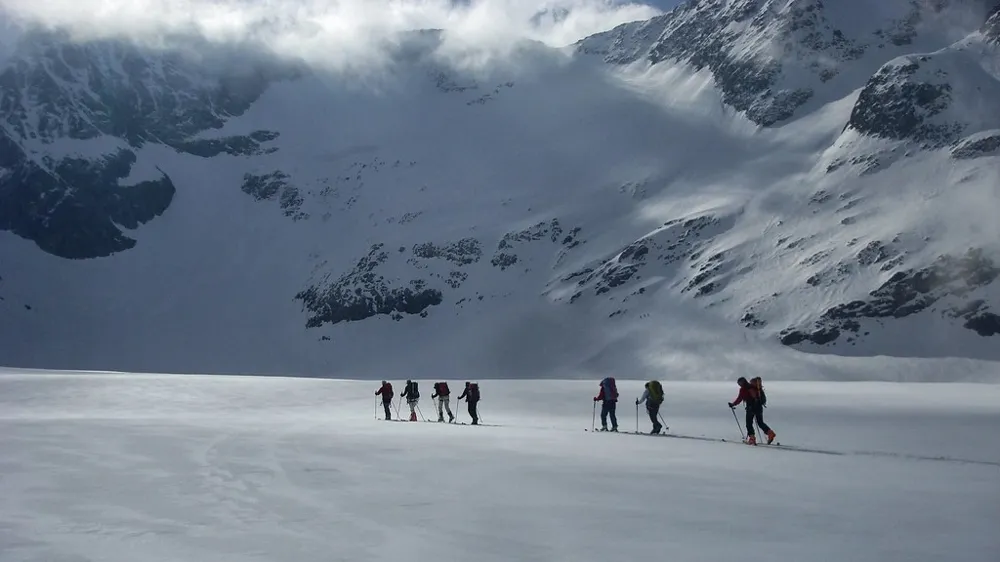
Ski mountaineering is climbing a mountain on skis, or on foot with skis on your back, and then skiing down. There's no chairlift: you attach climbing skins to your skis, free your heels and walk uphill, then lock your heels and ski the descent.
The term covers two related worlds:
- Recreational ski mountaineering: touring into backcountry and alpine terrain to ski peaks, couloirs and glaciers, sometimes with crampons, ice axes and ropes.
- Skimo racing: the competitive sport, where athletes race up and down marked courses on featherweight gear. Skimo made its Olympic debut at Milano Cortina 2026.
Modern ski mountaineering is often traced to Wilhelm Paulcke's 1897 ski traverse of the Bernese Oberland in Switzerland.
Ski Mountaineering vs. Ski Touring vs. Backcountry Skiing
| Backcountry Skiing | Ski Touring | Ski Mountaineering | |
|---|---|---|---|
| Meaning | Skiing outside ski area boundaries | Climbing on skis with skins, then skiing down | Touring plus technical alpine climbing |
| Terrain | Anything off-resort | Mostly non-technical slopes | Steep faces, couloirs, glaciers, summits |
| Extra gear | Avalanche rescue gear | Skins, touring bindings and boots | Crampons, ice axe, harness, rope |
| Skills | Avalanche awareness | Uphill technique, transitions | Mountaineering and rope skills |
The terms overlap, and many people use "ski touring" and "ski mountaineering" interchangeably. Our guide to types of skiing covers alpine touring (AT), backcountry and freeride in more detail.
How a Ski Mountaineering Day Works
- Skin up: with skins attached and heels free, you walk uphill, setting a skin track with zigzag kick turns on steeper slopes.
- Bootpack: when it's too steep or rocky to skin, you strap skis to your pack and climb on foot, sometimes with crampons and an ice axe.
- Transition: at the top, you rip off your skins, lock your heels and switch your boots to ski mode. Racers practice getting this down to about 30 seconds.
- Ski down: descend in whatever snow you find, from powder to crust to ice.
Ski Mountaineering Gear
| Gear | What It Does |
|---|---|
| Touring skis | Lighter than resort skis; race skis are extremely light and narrow |
| Tech (pin) bindings | Pins at the toe let the heel lift for climbing; the heel locks for skiing |
| Touring boots | A walk mode for climbing and a ski mode for descending |
| Climbing skins | Nylon, mohair or blend strips that grip the snow uphill |
| Poles | Light, often adjustable for long climbs |
| Avalanche beacon, shovel, probe | Essential rescue gear in avalanche terrain |
| Helmet | Required in races; recommended always |
| Pack | Carries skis on bootpacks plus layers, food and rescue gear |
| Avalanche airbag pack (optional) | Designed to help keep you near the surface in a slide; an increasingly popular add-on, not a substitute for rescue gear |
| Crampons, ice axe, harness, rope | For technical alpine objectives and glaciers |
Skins: Mohair vs. Nylon
Nylon skins grip well and are durable; mohair glides better and is popular for racing and cold snow; blends try to offer both. Choose skins sized to your ski's length and width, then trim them to fit.
Black Diamond Ascension Nylon Skins
Durable nylon climbing skins in fixed length ranges with an adjustable tail strap, a common choice for new ski tourers.
Check Price on AmazonPomoca Climb 2.0 Skins
Mohair-blend climbing skins from Swiss maker Pomoca, aimed at backcountry touring with a balance of glide and grip.
Check Price on AmazonBindings
Ski mountaineers use tech bindings, which save weight, or hybrid bindings like the Atomic Shift that tour with pins but ski with a more traditional alpine heel. Our guide to the best skis covers ski options for touring and resort skiing.
Avalanche Rescue Gear
Every person in the group needs a beacon, shovel and probe, and needs to know how to use them. See our guide to the best avalanche beacons.
BCA T4 Rescue Package
Bundles the Tracker4 avalanche beacon, a Stealth 300 probe and a Dozer 2H-S shovel with a saw.
Check Price on AmazonBCA Dozer 1T Shovel
Backcountry Access's popular-size avalanche shovel, with a low-profile blade designed for digging and building snow-pit walls.
Check Price on AmazonSkimo Racing: How It Works
Skimo races are governed by the International Ski Mountaineering Federation (ISMF), which became IOC-recognized in 2016. The first World Championships were held in France in 2002, and France, Switzerland and Italy have traditionally been the strongest nations.
| Format | How It Works |
|---|---|
| Sprint | A short course of roughly 3 to 4 minutes with about 80 m of climbing: skin, bootpack, skin, then a gated descent; raced in heats |
| Individual | A mass-start endurance race with several climbs and descents |
| Vertical | An uphill-only race |
| Team | Partners race a long course together |
| Mixed relay | A man and a woman alternate laps, each with climbs, a bootpack and descents |
Race Equipment Rules
ISMF sets minimums so racers can't use dangerously flimsy gear:
- Skis: at least 160 cm long for men and 150 cm for women, with minimum widths of 80 mm at the tip, 60 mm at the waist and 70 mm at the tail.
- Ski plus binding weight: at least 780 g per ski for men and 730 g for women.
- Boots: at least 500 g for men, with a lower minimum for women.
- Skins: must cover at least 40% of the ski's contact length.
- Mandatory safety kit: avalanche transceiver, shovel, probe, survival blanket and whistle, with a helmet worn throughout.
Ski Mountaineering at the 2026 Olympics
Skimo was the only new sport at Milano Cortina 2026, held at the Stelvio Ski Centre in Bormio. It had earlier appeared at the Lausanne 2020 Youth Olympic Games.
| Event | Gold | Silver | Bronze |
|---|---|---|---|
| Men's sprint | Oriol Cardona (ESP) | Nikita Filippov (AIN) | Thibault Anselmet (FRA) |
| Women's sprint | Marianne Fatton (SUI) | Emily Harrop (FRA) | Ana Alonso (ESP) |
| Mixed relay | France (Harrop, Anselmet) | Switzerland (Fatton, Kistler) | Spain (Alonso, Cardona) |
For the French Alps 2030 Games, skimo is confirmed and is planned to grow from three to five events by adding men's and women's individual races, held in the Briançonnais region. See Olympic skiing for every ski event.
Safety: Avalanches and Mountain Hazards
Recreational ski mountaineering takes you into avalanche terrain with no ski patrol. Hazards include avalanches, falls on steep or icy slopes, crevasses on glaciers, cornices, rockfall and fast-changing weather.
- Take an avalanche course before your first backcountry tour, and practice beacon searches regularly. REI's backcountry guide suggests starting with a free avalanche awareness class, then a Level 1 course on decision-making in avalanche terrain and an avalanche rescue course.
- Check the avalanche forecast for your region; in the US, avalanche.org links to local centers. The North American danger scale runs from Low (1) to Extreme (5).
- Never go alone. Tour with partners who carry rescue gear.
- Start in safer conditions, like a stable spring snowpack, and on low-angle terrain.
- Hire a guide. In the US, AMGA-certified guides lead ski mountaineering trips and courses.
- Build skills over years. Technical ski mountaineering combines skiing, climbing and decision-making that takes time to learn from experienced mentors.
Tree wells and deep snow are hazards too; see the safety section of how to ski powder.
Fitness and Training
Skimo is one of the most demanding endurance sports in skiing. Climbing thousands of feet requires aerobic fitness, while descents demand leg strength on tired legs. Hiking, trail running, cycling, uphill skinning at resorts and leg and core strength work all help. Practicing transitions at home, like putting on and ripping skins, saves time and energy on the mountain.
How to Get Started
- Be a confident resort skier on varied terrain and snow. See how to ski.
- Try uphill skiing at a resort. Many ski areas allow uphill travel on designated routes and times; check each resort's uphill policy.
- Rent or borrow touring gear before buying.
- Enter a local uphill race. Informal weeknight "beer league" races are a friendly introduction, and standard touring gear is fine.
- Get avalanche training before leaving the resort.
- Learn mountaineering skills like crampon and ice axe use from a guide or club before tackling technical routes.
What to Wear
Layer for big swings in effort: a light base layer and breathable shell for climbing, then an insulated jacket for the summit and descent. Our guide to what to wear skiing explains layering.
Related Guides
Learn the sport's roots in the history of skiing, compare disciplines in types of skiing, and find big mountains in the highest ski resorts.
Frequently Asked Questions
What is ski mountaineering?
Ski mountaineering means climbing mountains under your own power and skiing down them. Recreationally it combines ski touring with mountaineering skills like crampons, ice axes and ropes; as a race sport, called skimo, athletes race up and down courses on lightweight gear.
What is the difference between ski touring and ski mountaineering?
Ski touring is climbing on skis with skins and skiing down, usually on non-technical terrain. Ski mountaineering adds steeper, more technical alpine terrain that can require crampons, an ice axe, a harness and rope skills.
What does skimo stand for?
Skimo is short for ski mountaineering and usually refers to the competitive, race version of the sport.
What are climbing skins?
Skins are strips of nylon, mohair or a blend that attach to the bottom of your skis. Their angled fibers grip the snow so you can walk uphill without sliding back, and you remove them, or 'rip' them, before skiing down.
What gear do you need for ski mountaineering?
Touring skis, bindings that free your heel for climbing and lock it for descending, touring boots with a walk mode, skins, poles, a helmet, and avalanche rescue gear: a beacon, shovel and probe. Technical routes add crampons, an ice axe, a harness and rope.
What are the ski mountaineering events at the Olympics?
At Milano Cortina 2026, there were men's and women's sprints and a mixed relay for teams of one man and one woman. Individual races are planned to be added at the French Alps 2030 Games.
Who won ski mountaineering at the 2026 Olympics?
Oriol Cardona of Spain won the men's sprint, Marianne Fatton of Switzerland won the women's sprint, and France's Emily Harrop and Thibault Anselmet won the mixed relay.
What avalanche course should I take for ski mountaineering?
Start with a free avalanche awareness class, then take a Level 1 course focused on decision-making in avalanche terrain and a separate avalanche rescue course covering beacon, shovel and probe use.
Is ski mountaineering dangerous?
It can be. Backcountry and alpine terrain carry avalanche, fall, crevasse and weather hazards. Take an avalanche course, carry rescue gear, check the forecast, go with experienced partners and consider hiring a certified guide.
How do I get started in skimo?
Start with uphill routes at a ski area that allows them, try a local uphill or 'beer league' race, practice transitions and take an avalanche safety course before heading into the backcountry.