Best Backcountry Touring Skis Worth the Climb (2026)
Light enough to skin uphill all morning and solid enough to enjoy the run down: nine touring skis, how to choose width and weight, and the setup and safety gear that go with them.
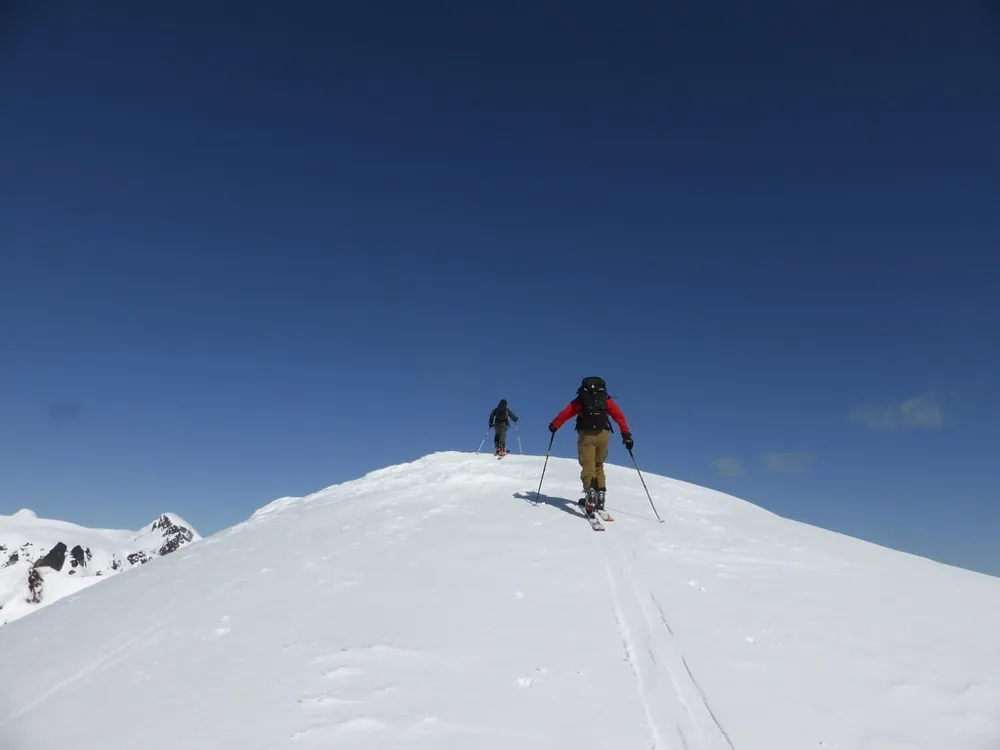
What Makes a Ski a Backcountry Ski?
A backcountry ski has to do two jobs that pull in opposite directions. On the way up, every gram is lifted with each step, so light weight matters more than on any resort ski. On the way down, the same ski has to handle untracked powder, wind crust, spring corn and the occasional icy traverse with no groomer in sight. Touring skis solve this with light wood cores (paulownia, poplar or caruba), carbon or fiberglass laminates instead of heavy metal, rockered tips for float and features like tail notches that hold climbing skins in place.
You'll see the terms backcountry, alpine touring (AT) and ski touring used for the same skis. Backcountry describes where you ski: outside resort boundaries with no avalanche control and no ski patrol. Touring describes how you get there: climbing on skins with your heel free. Our guide to ski mountaineering explains how the terms overlap.
Before anything else: backcountry terrain is avalanche terrain. New skis don't change that. Every person in your group needs an avalanche beacon, a probe and a shovel, the training to use them and the day's avalanche forecast. We cover this in detail below.
Blizzard Zero G 105
Best for freeride-minded tourers
- 105 mm waist for soft snow
- Paulownia core with Carbon Drive 3.0
- Rockered tip and tail
Atomic Backland 102
Best for freeride touring
- 130.5/102/121 mm at 179 cm
- 1,430 g per ski listed at 179 cm
- Powder Rocker with camber underfoot
Blizzard Zero G 96 (Men's and Women's)
Best lighter all-rounder
- 96 mm waist
- Men's and women's versions
- Built for touring weight
Backcountry Skis Compared
| Ski | Waist | Lengths (cm) | Core and Build | Best For |
|---|---|---|---|---|
| Blizzard Zero G 105 | 105 mm | 164–188 | Paulownia, Carbon Drive 3.0 | Freeride touring, soft snow |
| Black Diamond Helio Carbon 95 | 95 mm | 155–183 | Paulownia, pre-preg carbon | Light all-round touring |
| Rossignol Escaper 97 Nano | 97 mm | 161–185 | Paulownia, Nano titanal underfoot | Value freetouring |
| Atomic Backland 102 | 101–102.5 mm | 164–186 | Poplar and caruba, fiberglass | One-ski touring quiver |
| K2 Wayback 106 | 106 mm | 165–186 | Paulownia, carbon and titanal laminate | Powder touring |
| Atomic Backland 95 | 93–96 mm | 161–185 | Poplar, fiberglass | Mixed snow, spring, long days |
| Blizzard Zero G 96 (M and W) | 96 mm | From 164 | Paulownia and poplar, ash insert | Efficient all-round touring |
| Atomic Backland 108 W | 108–109 mm | 158–176 | Poplar and caruba, fiberglass | Women's freeride touring |
| Dynafit Blacklight 88 W | 85–88 mm | 151–172 | Paulownia, unidirectional carbon | Women's speed touring |
Specs are from each maker's or retailer's listing and change between model years. Some brands list waist width per length, which is why a range appears. All of these skis are sold without bindings.
The Best Backcountry Skis
1. Blizzard Zero G 105
The Zero G 105 is Blizzard's wider touring ski for skiers who climb to ski aggressively. It pairs an ultralight paulownia core with Carbon Drive 3.0, a carbon frame that runs the length of the ski, with two layers of bidirectional carbon in the binding area for screw retention and torsional strength. Tip and tail are rockered for flotation, and it has a flat tail. REI lists it at 133/105/119 mm with a 23 m radius in the 180 cm length, and a pair weight of about 6 lb 11 oz at 180 cm. Lengths run 164, 172, 180 and 188 cm.
Good to Know
- Wide enough for powder-focused touring
- Long radius suits open, fast terrain
- Advanced to expert ski
Watch Out For
- Heavier than narrow touring skis
- Premium price tier
2. Black Diamond Helio Carbon 95
Black Diamond's Helio Carbon line is built for efficient uphill travel. The 95 uses paulownia cores with a pre-preg carbon fiber layup, E-glass for damping and full-perimeter ABS sidewalls. Its early-rise tip helps with flotation and trail-breaking, and the ABS tail protector has a notch for securing skin clips. Titanal mounting plates reinforce the binding area. REI lists 124/95/113 mm and a pair weight of about 5 lb 14 oz in the 169 cm length, with five lengths from 155 to 183 cm. The 95 mm waist sits in the all-round range for mixed snow.
Good to Know
- Light for its width
- Wide size range, including 155 cm
- Skin-clip tail notch
Watch Out For
- Light skis feel less damp on hard, chopped snow
Not sold new on Amazon when we checked; see the maker's site or a ski shop.
3. Rossignol Escaper 97 Nano
The Escaper 97 Nano is Rossignol's freetouring ski and one of the more affordable models here. Rossignol lists a paulownia core, "Nano" fiberglass and a 0.4 mm titanal layer underfoot for binding retention and edge grip, plus tip and tail rocker. The 126/97/116 mm shape is the same in every length (161 to 185 cm), and the radius grows from 15 to 21 m with length. A V-Skin anchor in the tip helps hold climbing skins. Its mid-width makes it a sensible first touring ski for mixed conditions.
Good to Know
- Value price tier
- Mid-width for mixed snow
- Skin anchor built in
Watch Out For
- Older stock may be the main option; check the model year
Not sold new on Amazon when we checked; see the maker's site or a ski shop.
4. Atomic Backland 102
Atomic calls the Backland 102 a freeride touring ski for big-mountain days, and it was developed with Austrian backcountry skier Matthias Haunholder. It uses an Ultra Light Woodcore of poplar and caruba with fiberglass layers, a Duracap sidewall and Atomic's HRZN 3D tip, a thin, perforated tip shape that adds surface area for float. Atomic lists 130.5/102/121 mm and a 19 m radius at 179 cm, a weight of 1,430 g per ski at 179 cm and a Powder Rocker profile (pronounced tip and tail rocker with camber underfoot). Lengths are 164, 172, 179 and 186 cm.
Good to Know
- Balanced width for a one-ski touring quiver
- Published per-length dimensions
- Same construction as the wider Backland 109
Watch Out For
- Not the lightest choice for very long days
5. K2 Wayback 106
The Wayback 106 is K2's powder touring ski for skiers who want a wider platform without a heavy build. K2 lists a paulownia core, Carbon Overdrive and a Ti SpYne titanal laminate that adds damping and edge grip, plus an All-Terrain Rocker profile (gradual tip rocker with camber underfoot) and a Snophobic topsheet to limit snow buildup. Dimensions are 132/106/121 mm, and lengths run 165, 172, 179 and 186 cm. K2 rates it for advanced and expert skiers.
Good to Know
- Wide waist for soft snow
- Titanal strip adds stability for a light ski
Watch Out For
- More ski than you need for spring missions
Not sold new on Amazon when we checked; see the maker's site or a ski shop.
6. Atomic Backland 95
The narrower Backland is Atomic's all-round touring ski. It has a poplar Light Woodcore, fiberglass, a Duracap sidewall, the HRZN 3D tip and an All Mountain Rocker profile. Atomic lists 128/95/116 mm and an 18 m radius at 177 cm and 1,370 g per ski at 177 cm, with lengths of 161, 169, 177 and 185 cm. Its narrower waist suits firm spring snow, long approaches and skiers who value efficiency over deep-snow float.
Good to Know
- Lighter than the wider Backlands
- Good edge grip on firm snow
Watch Out For
- Less float in deep powder
7. Blizzard Zero G 96 (Men's and Women's)
The Zero G 96 replaced the Zero G 95 with a redesigned build that uses less carbon and a slightly softer flex. It has Blizzard's Trueblend Touring Core 2.0 (paulownia combined with poplar), a glass and carbon layup and a dense ash insert under the bindings in place of metal. The profile is early-rise tip and tail with camber, and it has a partial sandwich sidewall. It comes in men's and women's versions, so it's a good option for couples or groups who want the same ski.
Good to Know
- Men's and women's versions
- Mid-width for all-round touring
Watch Out For
- Check the length range for each version
8. Atomic Backland 108 W (Women's)
A women's freeride touring ski with the same Ultra Light Woodcore, HRZN 3D tip and FreeTour construction as the men's Backland 102 and 109. Atomic lists 133.5/109/122.5 mm at 176 cm, a Powder Rocker profile and 1,310 g per ski at 167 cm, in lengths of 158, 167 and 176 cm. The shorter radius (14.5 to 17.5 m depending on length) makes it quick to turn in trees and tight terrain.
Good to Know
- Women-specific lengths and flex
- Light for a 108 mm ski
Watch Out For
- Only three lengths
9. Dynafit Blacklight 88 W (Women's)
Dynafit calls the Blacklight 88 W "the lightest all-rounder just for women." It's a speed touring ski with a Paulownia Speed Core, a unidirectional carbon top layer and a full ABS sidewall. Dynafit lists weights from 970 g per ski at 151 cm to 1,120 g at 172 cm, and it scales the waist (85 to 88 mm), sidecut and rocker to each of the four lengths. It suits fitness-minded tourers, spring couloirs and long days with lots of vertical.
Good to Know
- Very light for long climbs
- Size-specific shape and flex
Watch Out For
- Narrow for deep powder
- Light skis need good technique on hard snow
Also Worth a Look
Several touring skis that appear on many reviewers' lists are sold mainly through specialist shops rather than Amazon: the Salomon QST Echo 106, Voile touring skis such as the HyperDrifter and Hyper Manti, the DPS Pagoda Tour CFL and the Armada Locator. Check the maker's site for current specs and stockists.
Avalanche Safety Comes First
Choosing a ski is the easy part. Outside resort boundaries, nobody controls avalanche hazard, and no ski patrol is coming. This page is a gear guide, not avalanche training, so treat the points below as where to start, not as a substitute for a course.
| Must-Have | Why |
|---|---|
| Avalanche beacon (transceiver) | Worn on your body, switched to transmit; lets partners find you if you're buried |
| Probe | Pinpoints the exact location and depth of a buried person |
| Metal-blade shovel | Digging out a buried person takes most of the rescue time |
| Trained partners | You can't rescue yourself; your group does, so everyone needs the gear and the skills |
| The day's avalanche forecast | In the US, avalanche.org links to the regional forecast centers |
Get Trained Before Your First Tour
The American Avalanche Association describes a recreational course progression that starts with a short Avalanche Awareness class (usually 1 to 3 hours), then a Recreational Level 1 course (at least 24 hours, with field time) on avalanche terrain, weather, snowpack and go/no-go decisions, and an Avalanche Rescue course (at least 8 hours) on beacon searches, probing and shoveling. Level 2 is for experienced backcountry users who lead groups. AIARE (the American Institute for Avalanche Research and Education) runs a widely used version of this progression through guide services and schools.
- Read the forecast before every tour. The North American danger scale runs from Low (1) to Extreme (5).
- Do a beacon check at the trailhead so everyone is confirmed transmitting.
- Practice rescues each season, ideally with your regular partners.
- Start on low-angle terrain and in stable conditions, or hire a certified guide for your first tours.
- Never tour alone in avalanche terrain.
See our avalanche beacon guide for transceivers and the full rescue kit, and backcountry skiing for beginners for how a first season usually unfolds.
Types of Touring Skis
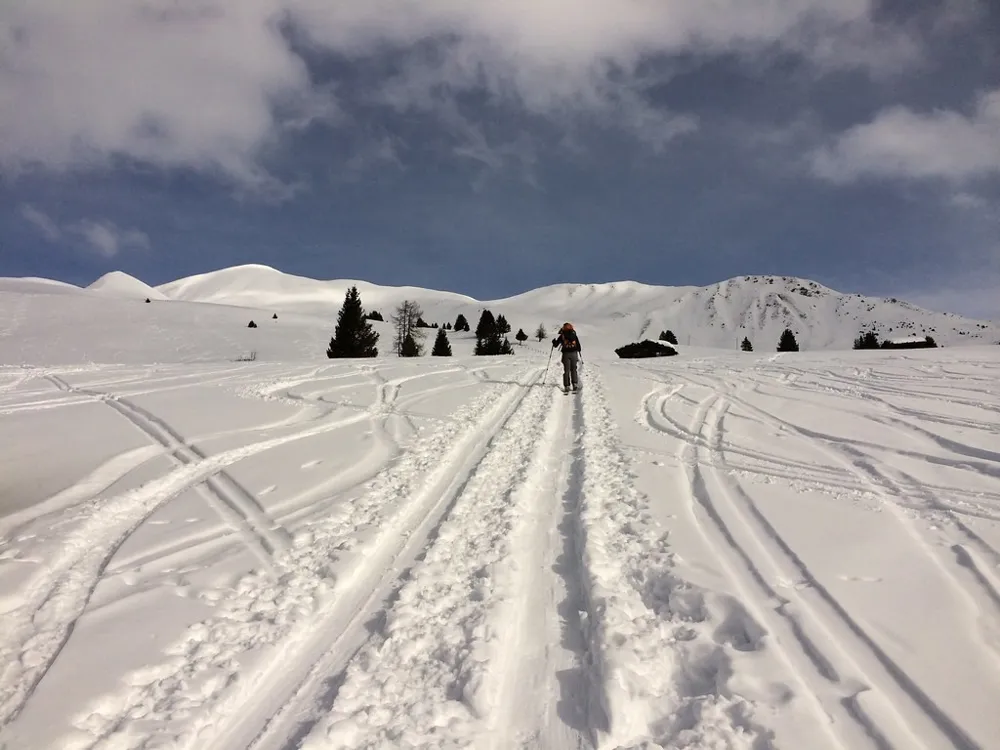
Touring skis fall on a spectrum from "fast uphill" to "fun downhill." Knowing where you sit narrows the list quickly.
| Category | Typical Waist | Weight | Who It Suits |
|---|---|---|---|
| Skimo race | Narrowest | Lightest; built to race rules | Racers and fitness tourers on set tracks |
| Light or speed touring | About 80–90 mm | Very light | Long days, spring corn, couloirs, big vertical |
| All-round touring | About 90–100 mm | Light to moderate | Mixed snow, most tourers' first ski |
| Freetouring | About 100–110 mm | Moderate | Skiers who climb to ski hard; resort crossover |
| Powder touring | 110 mm and up | Heavier | Deep, consistent snowpacks |
| Freeride ski with touring bindings | 100 mm and up | Heaviest | Lift-accessed sidecountry and short hikes |
If you'll tour mostly in midwinter powder with some resort days, a freetouring ski around 100 to 106 mm is the most versatile choice. If your tours are long or you ski mostly in spring, go narrower and lighter. Racing skis are a niche of their own, covered in our ski mountaineering guide. Splitboarders follow the same logic; see types of snowboards for splitboards.
Waist Width: How Wide Should Touring Skis Be?
Width is the single biggest trade-off between float and weight. Wider skis stay on top of soft snow and feel more stable in variable conditions, but they weigh more, need wider (and heavier) skins and are slower to put on edge on firm, icy traverses.
- 85–95 mm: efficient and light; best for spring, firm snow, long approaches and steep couloirs. Switchback Travel suggests about 85 mm is the narrowest most backcountry skiers need.
- 95–105 mm: the all-round sweet spot for mixed winter conditions.
- 100–110 mm: what several reviewers call the "quiver killer" range for freetouring.
- 110 mm and up: for regular deep-powder days; heavier and harder work on firm snow.
Snow climate matters too. Light, deep snowpacks reward width, while maritime snow, wind-affected slopes and spring corn favor something narrower. Our resort ski guide explains waist width for lift-served skiing.
Weight: Uphill Efficiency vs Downhill Fun
The touring skis on reviewers' lists weigh roughly 1.1 to 1.8 kg per ski in mid lengths. Weight on your feet is the hardest weight to carry, because you lift it with every step of the climb, so a few hundred grams per ski adds up over thousands of feet of vertical.
- Light skis (paulownia cores, lots of carbon) climb easily, but they can deflect and feel nervous in crud, wind crust and chopped snow at speed.
- Heavier skis (poplar or ash, titanal strips) are damper and more predictable on the descent and are the better choice if downhill performance is your priority or you'll use the skis at the resort.
- Shorter and narrower skis weigh less too, so length and width affect weight as much as materials.
Makers often quote weight for one ski at one length, while some retailers list the pair. Check which one you're reading before you compare.
Rocker, Camber and Turn Radius
Nearly every touring ski combines tip rocker for float and trail-breaking with camber underfoot for edge grip on firm snow and on icy skin tracks. Some add a little tail rocker for easier pivoting in trees and powder. A flat, notched tail helps skins stay attached and lets you plant the skis upright in the snow.
Turn radius describes the natural arc of the sidecut. Many touring skis sit around 18 to 22 m, which feels stable on open slopes. Shorter radii make tighter turns easier in trees and couloirs but can feel twitchy at speed; longer radii suit big, fast faces. Many brands, including Atomic and Rossignol, change the radius with each length.
Touring Bindings: Tech, Hybrid and Frame
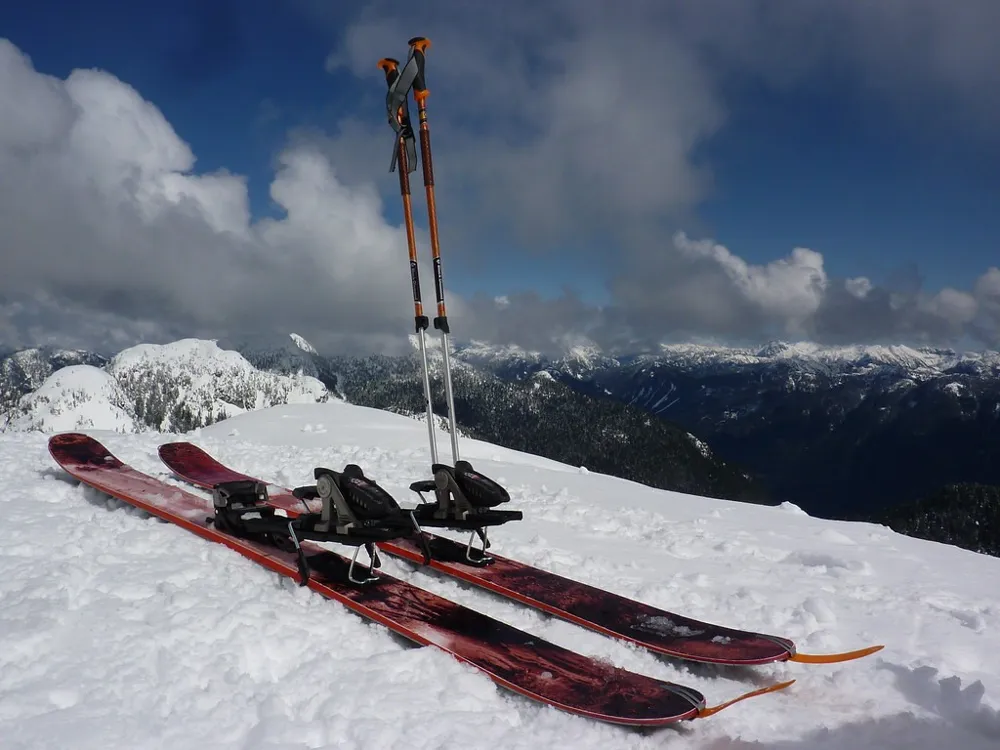
Touring bindings let your heel lift for climbing, then lock down for the descent. The three main types:
| Type | How It Works | Pros | Cons |
|---|---|---|---|
| Tech (pin) | Toe pins clip into metal inserts in the boot; a separate heel piece locks for skiing | Lightest; walks naturally | Needs tech-insert boots; learning curve |
| Hybrid | Pin toe for touring that converts to a more alpine-style toe for skiing | Lighter than frames, more alpine-like descent | Heavier than pure tech; needs tech-insert boots |
| Frame | The whole binding pivots on a rail under the boot | Works with most alpine and touring boots; skis like an alpine binding | Heavy and less efficient on long climbs |
A few practical points:
- Choose boots first, then bindings that fit them. Tech and hybrid bindings need boots with tech inserts.
- Brake width should equal the ski's waist or be no more than about 15 mm wider. Some light bindings use leashes instead of brakes.
- Release settings should be set and tested by a certified ski technician. Some touring bindings are certified by an independent body such as TÜV to release like alpine bindings; check the binding's own documentation.
- Ski crampons (harscheisen) clip into many touring bindings for icy climbs; check compatibility with your binding width.
Hybrid bindings such as the Atomic Shift are popular for one setup that does both resort and backcountry. See ski bindings for the Shift and alpine options.
Touring Boots
Boots matter as much as skis for comfort on the way up. Touring boots have a walk mode that frees the cuff for a natural stride, tech inserts for pin bindings and usually a rubber, rockered sole. They range from very light, soft boots for long tours to stiff freeride touring boots that ski much like alpine boots. Fit is everything over a long day; heel lift and pressure points that you'd tolerate on a few resort runs turn into blisters on a 3,000-foot climb. Our guide on how to choose ski boots and the ski boot size chart cover shell fit, and ski boot flex explains stiffness ratings.
What Length Touring Skis Do You Need?
Touring skis are usually sized a little shorter than the resort ski you'd choose. Shorter skis weigh less, make kick turns on steep skin tracks easier and are easier to manage in tight trees.
| Skier and Use | Length Guide |
|---|---|
| All-round touring | About 5 cm under your height (Atomic's guide) |
| Freeride touring, advanced or heavier skier | Your height to about 5 cm longer |
| Freeride touring, lighter or less experienced skier | Your height to about 5 cm shorter |
| Lots of tip rocker | Can size up slightly, since less of the ski touches firm snow |
Switchback Travel's general rule is within 5 to 10 cm of your height. For a full chart by height and weight, see the ski size chart.
Climbing Skins
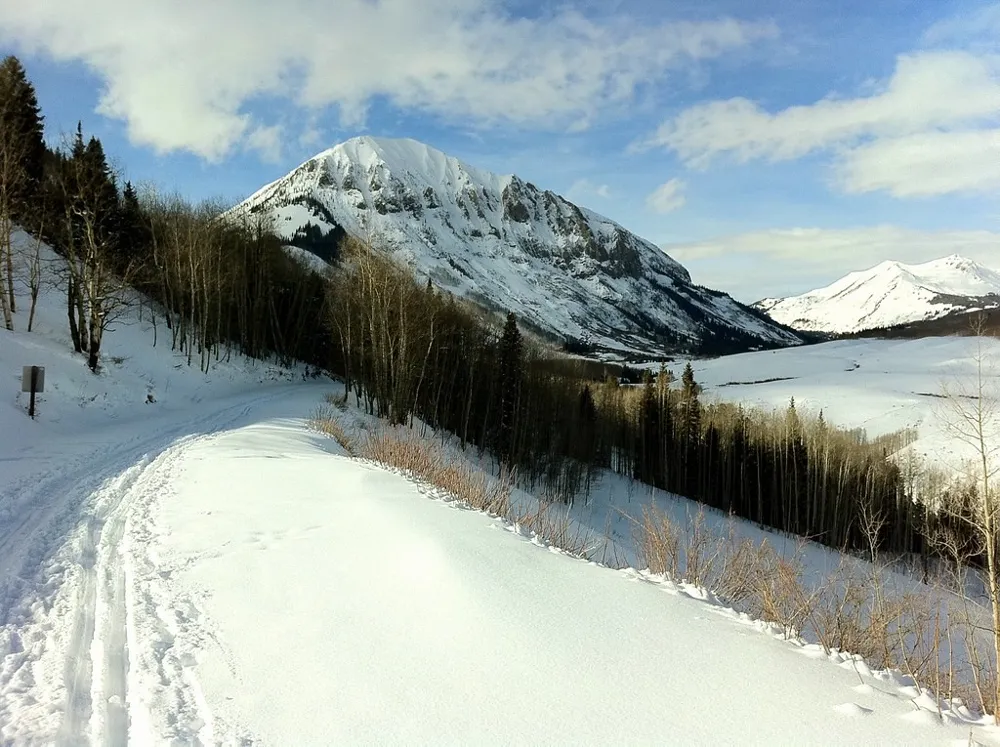
Climbing skins stick to the base of your skis and grip the snow so you can walk uphill without sliding back. They come in three main materials:
- Nylon: durable with the best grip, but slower glide.
- Mohair: the best glide and lightest weight, with less grip and durability.
- Mohair-nylon blends: a middle ground that many tourers choose.
Skins should cover the base edge to edge, leaving the metal edges exposed for grip on traverses. Many brands sell pre-cut skins matched to specific models (Atomic recommends its PreFit skins for the Backland, for example); otherwise you buy a width slightly wider than the widest part of your ski and trim them with the included cutter. Check that the tip and tail clips suit your ski's shape and notches. Our climbing skins guide covers glue vs glueless skins and care, and ski mountaineering compares two popular skins.
Women's Touring Skis
Women's touring skis are often offered in shorter lengths with a softer flex and sometimes a lighter build, which helps lighter skiers bend and control the ski. The Atomic Backland 108 W, Blizzard Zero G 96 W and Dynafit Blacklight 88 W above are examples. Many unisex touring skis also come in short lengths (the Helio Carbon 95 starts at 155 cm), so women can choose from both ranges by length, weight and width rather than by label. Our women's ski boots page covers fit for narrower heels and lower calves.
Can You Use Touring Skis at the Resort?
Yes, with some trade-offs. Freetouring skis around 100 to 110 mm are often used as one-ski quivers for resort and backcountry, especially with hybrid or frame bindings. Very light touring skis and pin bindings, however, are less stable on firm, chopped resort snow at speed, and they wear faster with daily lift-served use.
Many resorts allow uphill travel (skinning up the slopes) under a published policy, which often covers hours, routes and whether you need a pass. It's a good place to practice skinning, kick turns and transitions before your first tour. Check each resort's uphill policy before you go. Resort uphill routes are inside a controlled area; terrain beyond the boundary ropes is backcountry, with all the avalanche hazard that implies.
Building Your First Backcountry Setup
| Item | What to Look For |
|---|---|
| Touring skis | About 95–105 mm for most first setups |
| Bindings | Tech, hybrid or frame, matched to your boots; brake width to suit the ski |
| Boots | Walk mode, tech inserts if using pin bindings, good fit |
| Climbing skins | Pre-cut or trimmed to your skis |
| Adjustable poles | Shorter on climbs, longer on traverses; see ski poles |
| Beacon, probe and shovel | For every person in the group |
| Backpack | Room for rescue gear, layers, water and food; ski carry straps help on bootpacks |
| Helmet and goggles | A ski helmet for the descent; sunglasses for the climb |
| Layers | Breathable shell, light insulation and spare gloves; see what to wear skiing |
Buying in order of importance usually means rescue gear and training first, then boots (fit), then skis, bindings and skins together so the widths and boot compatibility match. Some shops sell touring skis with bindings and skins as a package, which takes the guesswork out of matching.
Caring for Touring Skis
- Wax regularly. Wax helps glide and stops snow sticking to the base. Scrape and brush thoroughly afterward so the base is smooth before you apply skins.
- Keep skins clean and dry. Fold them glue to glue and dry them at room temperature after each tour.
- Check binding screws and edges before each season, and have a shop look at bindings after any hard crash.
- Store skis dry with a light storage coat of wax, away from direct heat.
Our step-by-step guide to waxing and tuning skis covers base care and edges.
Keep Exploring
Learn deep-snow technique in how to ski powder, compare disciplines in types of skiing, or see guided options in cat skiing and heli skiing. For more gear, browse our skiing guides.
Frequently Asked Questions
What is the difference between backcountry skis and regular skis?
Backcountry or touring skis are built lighter, usually with paulownia or poplar cores and carbon or fiberglass, because you carry them uphill on every climb. Most have tip rocker for soft snow and many have notches or anchors for climbing skins. Resort skis are heavier and use metal for stability at speed.
Can you use regular skis for backcountry skiing?
Yes, if you mount touring-capable bindings and use skins that fit, but a heavy resort ski makes long climbs much more tiring. Many people start on a lighter all-mountain ski with hybrid bindings and move to a dedicated touring ski later.
Can you ski backcountry skis at the resort?
Yes. Freetouring skis around 100 to 110 mm wide handle resort snow well, though very light skis can feel less stable on hard, chopped-up groomers at speed. Many skiers also use their touring setup for resort uphill laps where the resort allows it.
How wide should backcountry skis be?
About 95 to 105 mm underfoot suits most mixed-condition touring. Narrower skis around 85 to 95 mm save weight for spring and long days, and 110 mm or more is for regular deep-powder touring.
What length touring skis should I get?
Touring skis are often a few centimeters shorter than the resort ski you'd choose, which saves weight and helps on kick turns. Atomic suggests about 5 cm under your height for all-round touring and around your height for freeride touring, with stronger and heavier skiers going longer.
What gear do I need besides skis for backcountry skiing?
Touring bindings, boots with a walk mode, climbing skins cut to your skis, adjustable poles and a pack. Everyone in the group also needs an avalanche beacon, probe and shovel, plus avalanche training and the current forecast.
Do I need an avalanche course before backcountry skiing?
It's strongly recommended. The American Avalanche Association lists an awareness class, a Recreational Level 1 course and an Avalanche Rescue course as the starting points for recreational backcountry travelers.