Tandem Fishing Kayaks That Fit Two Anglers and Their Gear (2026)
Seven two-person fishing kayaks from Vibe, Brooklyn Kayak Company, Lifetime, Feelfree, Hobie and Sea Eagle, with a guide to capacity, rigging and fishing safely as a pair.
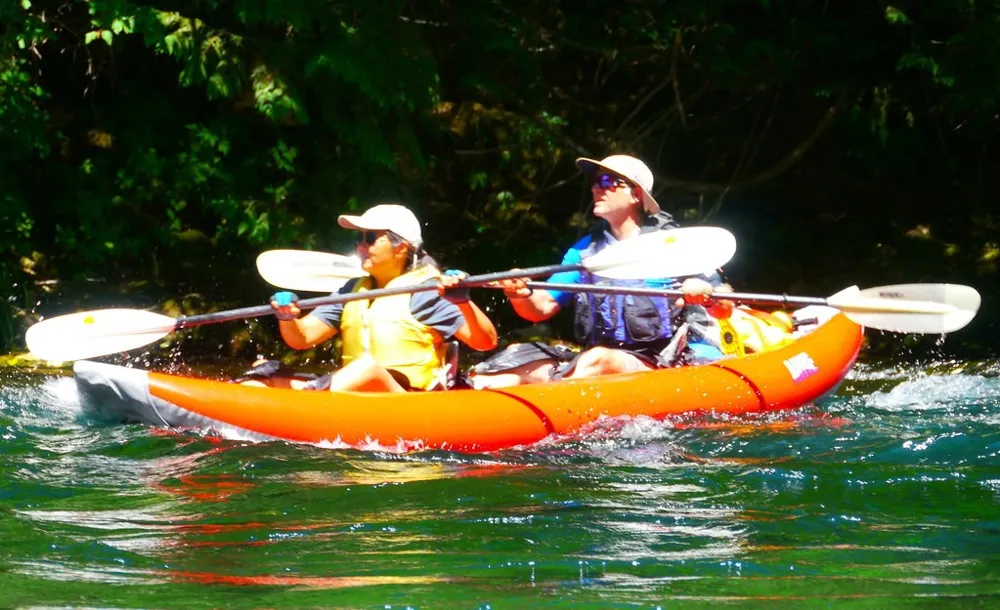
Why Fish From a Tandem Kayak?
A tandem fishing kayak puts two anglers in one hull: one boat to buy, store, load and launch. It's a simple way to fish with a partner, take a new angler or older child along, or let one person paddle and position while the other fishes. Tandems are usually wider than solo boats, so many feel steady, and the longer hull glides and tracks well once it's moving.
The trade-offs are real, though. Two anglers share one deck, so casting needs coordination, and the boat goes wherever the pair goes. A loaded tandem is long and heavy to carry, and it's less nimble than a solo boat when you're alone. The picks below are rigged for fishing with rod holders, tracks or mounts. For general solo boats, see the best fishing kayaks; for two-seaters built for touring rather than fishing, see tandem kayaks.
Brooklyn 13.0 Pro Tandem (TK122)
Best value with paddles included
- Listed at 800 lb capacity
- Multiple rod holders, four accessory rails
- Two adjustable fiberglass paddles
Lifetime Sport Fisher
Best compact tandem for families
- 10 ft long, 36 in wide
- Three flush-mount rod holders
- Center spot for a small third rider
Sea Eagle 385fta FastTrack Angler
Best inflatable tandem for fishing
- Inflatable with drop-stitch floor
- Listed for up to three people or 635 lb
- Packs down for car-trunk transport
Tandem Fishing Kayaks Compared
Specs are from each maker's product page. Weights are bare hull unless noted, and capacity is the maker's listed maximum.
| Kayak | Length | Width | Weight | Capacity | Propulsion | Solo Option |
|---|---|---|---|---|---|---|
| Vibe Yellowfin 130T | 13 ft | 35 in | 77 lb | 500 lb | Paddle | Center seat |
| Brooklyn 13.0 Pro Tandem (TK122) | 12 ft 9 in | 34.25 in | 85 lb | 800 lb | Paddle | Center seat |
| Lifetime Sport Fisher | 10 ft | 36 in | About 60 lb | 500 lb | Paddle | Center seat |
| Feelfree Lure II Tandem | 14 ft 2 in | 36 in | 105 lb (no seats) | 500 lb | Paddle; pedal or motor optional | Rear seat, front seat out |
| Brooklyn 14.0 Pro Tandem Pedal (PK14) | 14 ft | 35 in | Almost 100 lb | Check listing | Twin propeller pedal drives | Yes |
| Hobie Mirage Compass Duo | 13.5 ft | 35 in | 92 lb (127 lb rigged) | 475 lb | Two MirageDrive pedal drives | Crew of 1–2 |
| Sea Eagle 385fta FastTrack Angler | 12 ft 6 in | 3 ft | 45 lb | 635 lb (3 persons) | Paddle; motor mount optional | Solo or tandem setups |
The Best Tandem Fishing Kayaks
1. Vibe Yellowfin 130T
The Yellowfin 130T is a 13-foot, 35-inch-wide rotomolded sit-on-top that Vibe lists at 500 pounds of capacity and 77 pounds bare (99 pounds fully loaded). It has three seating positions, so two anglers can sit fore and aft or one paddler (or a parent with a child) can use the center. The package includes two Vibe Hero framed seats. Fishing features include built-in gear tracks, two rear flush-mount rod holders, two sealed 8-inch hatches, a rear tankwell for a crate and a small front storage area, and the hull is rudder-ready for an optional Vibe rudder.
Good to Know
- Gear tracks for rod holders and electronics
- Center position for solo or child use
- Rudder-ready
Watch Out For
- Only two rod holders, both at the stern
- No motor mount mentioned by Vibe
Not sold new on Amazon when we checked (November 2026); Vibe sells it direct and through dealers.
2. Brooklyn 13.0 Pro Tandem (TK122)
Brooklyn Kayak Company's 13.0 Pro Tandem, formerly the TK122, is a single-piece HDPE sit-on-top designed for two adults and a child. BKC's spec table lists it at 12 feet 9 inches (the description says 12 feet 11 inches), 34.25 inches wide and 85 pounds. BKC says this updated version raised capacity to 800 pounds; older TK122 listings show a lower figure, so check the listing you buy from. It comes with two aluminum-frame seats with 2 inches of height adjustment, two adjustable fiberglass paddles, adjustable footrests, accessory rails, dual dry hatches, tackle trays and several rod holders, and the stern holds a 20-liter cooler. One seat can move to the center for solo trips. BKC lists a 5-year hull warranty.
Good to Know
- Paddles and framed seats included
- Highest listed capacity here
- Seat moves to center for solo use
Watch Out For
- Specs differ between BKC's spec list and older listings
- 85 lb is a two-person lift
3. Lifetime Sport Fisher
The Sport Fisher is a short, wide tandem: 10 feet long and 36 inches wide with a 500-pound capacity. Its tunnel hull is designed for stability, including stand-up and side-saddle fishing. It has two padded seat backs with multiple positions, a center spot for a smaller third rider, three flush-mount rod holders, a 6-inch rear hatch, a front cargo area with shock cords, paddle clips and two included paddles. Retailers list its weight anywhere from about 55 to 73 pounds, so check the current listing. Its short length makes it easy to store and fit in a pickup bed, but it won't glide or track like a 13-foot boat.
Good to Know
- Compact for storage and short carries
- Three rod holders and paddles included
- Room for a small third rider
Watch Out For
- Slower on big water
- Basic seats; no gear tracks
4. Feelfree Lure II Tandem
The Lure II brings Feelfree's Lure fishing layout to a two-angler hull. Feelfree lists it at 14 feet 2 inches, 36 inches wide, 105 pounds without seats and 500 pounds of capacity. Each cockpit has a patented Gravity seat, a removable sonar and electronics pod and a standing platform, and there are front, middle and rear Uni-Track rails, flush-mounted rod holders, a front hatch, a molded crate recess and stand-up leashes. The Wheel in the Keel lets you roll it to the water. Solo anglers paddle from the rear seat with the front seat removed, and the hull is ready for Feelfree's Overdrive pedal drive, Motordrive and rudder (sold separately). Paddles are not included.
Good to Know
- Two sonar pods, one per angler
- Standing platforms in both cockpits
- Pedal, motor and rudder ready
Watch Out For
- Heaviest paddle tandem here
- Paddles and drives cost extra
5. Brooklyn 14.0 Pro Tandem Pedal Kayak (PK14)
The PK14 is a 14-foot, 35-inch-wide tandem with two propeller pedal drives, so both anglers can pedal and keep their hands free for rods. A hand-operated rudder steers, and BKC says it can be paddled solo. It has a large watertight bow hatch, a spacious rear cargo area, three flush-mounted rod holders, four built-in handles and scupper holes. BKC describes it as almost 100 pounds and suitable for stand-up fishing. Compare drive types in the best pedal kayaks.
Good to Know
- Pedal drives for both seats
- Hands-free trolling
- Hand-controlled rudder
Watch Out For
- Nearly 100 lb to load
- Capacity not stated on BKC's page
6. Hobie Mirage Compass Duo
The Compass Duo is Hobie's two-seat pedal kayak, sold through Hobie dealers. Hobie lists it at 13.5 feet and 35 inches wide, with a 475-pound total capacity, 275 pounds per seat, a 92-pound fitted hull and a 127-pound fully rigged weight. It pairs a MirageDrive 180 in one cockpit with a MirageDrive GT in the other, both with Kick-Up Fins, plus a Kick-Up Rudder and molded-in tracking keel. For fishing, it has four molded-in rod holders, four H-Track mounts, two 8-inch hatches and a built-in transducer mount with through-hull cable plugs.
Good to Know
- Kick-up fins and rudder for shallow water
- Transducer-ready
- Four rod holders
Watch Out For
- Premium tier
- Lower capacity than some paddle tandems
7. Sea Eagle 385fta FastTrack Angler
For anglers without room for a hard shell, the 385fta is an inflatable that Sea Eagle lists at 12 feet 6 inches long, 3 feet wide and 45 pounds, for up to three people or 635 pounds. It has a removable high-pressure drop-stitch floor, an external drop-stitch keel at the bow to help tracking, and 1000-denier fabric with reinforced sections. Rod, tool, hook and lure holders are built into the front and rear spray skirts. Seating depends on the package, from a solo setup to a Pro Angler package with tall-back seats, and a separate motor mount accepts a small electric motor. More options are in the best inflatable fishing kayaks.
Good to Know
- Packs down for car-trunk transport
- Drop-stitch floor for stiffness
- Motor mount available
Watch Out For
- Seats and setup vary by package
- Wind affects it more than a hard shell
Also consider: the Brooklyn 12.5 Tandem (formerly the TK219 and TK181), which BKC lists at 12.5 feet, 34 inches wide, 75 pounds and 600 pounds of capacity, with two memory-foam seats, a center seating area, multiple rod holders, two 86-inch paddles and trolling-motor readiness. For a family-sized inflatable rather than a kayak, see the best inflatable boats.
Tandem vs Two Solo Fishing Kayaks
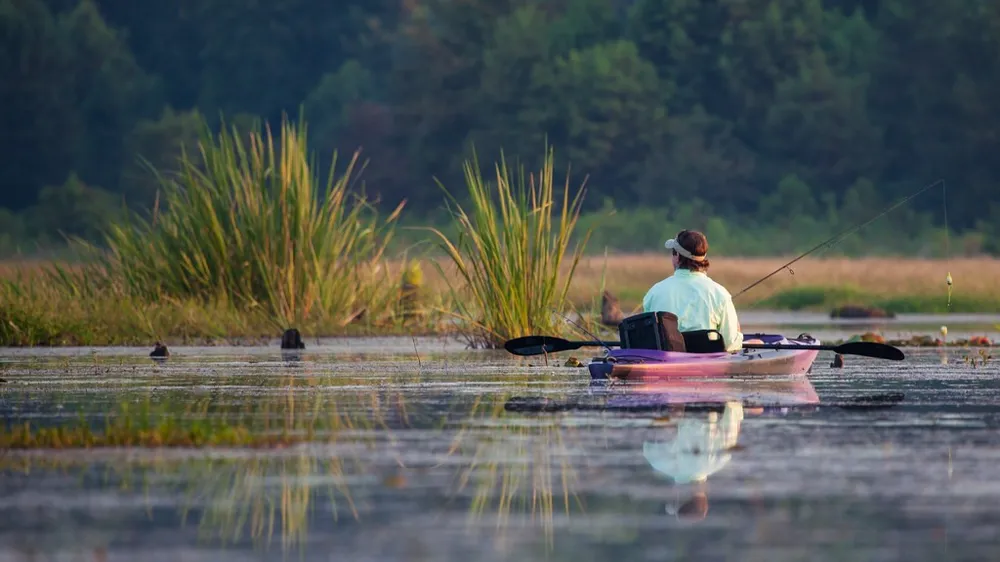
Before buying a two-seater, decide whether one shared boat really fits how you fish.
| One Tandem | Two Solo Kayaks | |
|---|---|---|
| Cost and storage | One boat, one rack spot | Two of everything |
| Positioning | Both anglers fish the same spot | Each angler picks a line and spot |
| Casting room | Shared; needs coordination | Plenty |
| Weak or new paddler | Stronger partner does the work | Each must paddle themselves |
| Rescue backup | No second boat | One boat can help the other |
| Going alone | Long, heavy boat for one | Easy |
A tandem makes most sense for couples, parent-and-child anglers, and pairs where one person is newer to paddling. If you both fish hard and want to cover different water, two solo boats from the best fishing kayaks or a budget pair from the best cheap fishing kayaks may serve you better.
How to Choose a 2-Person Fishing Kayak
Capacity for Two Anglers Plus Tackle
Capacity is the most important number on a tandem. Two adults use up much of a boat's rating before any gear goes on, so look for a listed capacity that leaves room for tackle, a crate, a cooler and any electronics. The next section shows how to work it out.
Width and Stability
Most tandem fishing kayaks are about 34 to 36 inches wide. Wider hulls feel steadier at rest, which matters when two people shift weight to cast, net fish or turn around. Flat, tunnel or pontoon-style hulls add primary stability; narrower hulls are faster but feel more tippy at rest. If you want to stand, look for a model the maker describes as standable and a flat standing area. See the kayak size chart for how width and length trade off.
Length and Tracking
Around 12 to 13 feet balances room, speed and ease of transport for lakes and slow rivers. Fourteen feet and longer glides and tracks better across open water but is harder to turn, carry and store. A 10-foot tandem like the Sport Fisher fits small water and short carries but is slower.
Seating and Solo Conversion
Check how the seats work before you buy. Framed, raised seats keep anglers drier and make casting easier than low molded seats. Many tandems have a center seat position so one angler can paddle with the boat sitting level; others are paddled solo from the rear seat with the front seat removed. Some also suit a child or dog in the middle. For seat upgrades, see the best kayak seats.
Rod Holders, Tracks and Mounts
Count rod holders per angler, not per boat. Flush-mount holders behind the seats are good for trolling and storing rods, while gear tracks let each angler add adjustable rod holders, a fish finder or a camera within reach. Sonar pods or a transducer mount for each cockpit make it easier to add electronics without drilling.
Paddle, Pedal or Motor
Paddle tandems are lighter and simpler. Pedal tandems keep both anglers' hands free and help hold position in wind or current, but they're heavier and cost more. Some hulls are motor-ready, which adds range but usually brings registration requirements. See the best kayak trolling motors for options.
Hard-Shell or Inflatable
Rotomolded hard shells are durable, track well and are ready to launch, but they need a roof rack, trailer or truck. Inflatable tandems pack into a car trunk and closet, but take time to inflate and dry and are pushed around more by wind. Compare more inflatables in 2-person inflatable kayaks.
Doing the Capacity Math
A kayak's maximum capacity is the most it can carry while floating safely, not the load it handles best at. Paddling guides commonly suggest staying around 60 to 70 percent of the maximum for good handling. Here's a simple example for two anglers:
| Item | Example Weight |
|---|---|
| Angler 1 (with clothes and PFD) | 200 lb |
| Angler 2 (with clothes and PFD) | 160 lb |
| Crate with tackle and rods | 25 lb |
| Cooler with ice, water and food | 30 lb |
| Anchor, fish finder and battery | 15 lb |
| Total load | 430 lb |
At 430 pounds, a 500-pound tandem is near its limit and will sit low and feel sluggish. A 600- to 800-pound rating leaves more margin. Weigh your loaded crate and cooler on a bathroom scale, and keep heavy items low and centered so the boat trims level. Note that brands don't all state capacity the same way. Learn more in kayak weight limits.
Rigging a Kayak for Two Anglers
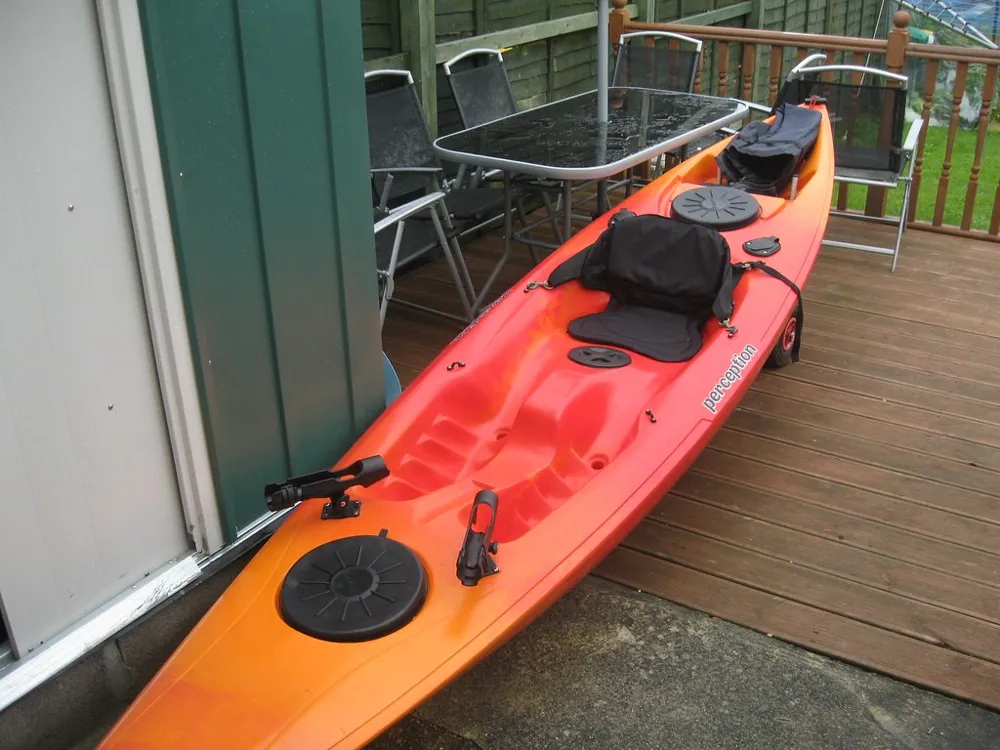
Good rigging keeps two sets of rods, lines and tools from tangling and keeps each angler's essentials within reach.
- Give each angler a zone. The bow angler uses the front tracks and hatch; the stern angler uses the rear tracks and tankwell. Decide who carries the shared items, such as the net, anchor and first-aid kit.
- Point rods away from your partner. Mount rod holders so rods angle outward and back, not across the other cockpit. Stand-up rod holders in a rear crate keep spare rods clear of both paddlers.
- Split the electronics. One fish finder mounted where both can see it is often enough. If you add two, run each transducer cable to its own cockpit and secure the battery low in the hull or tankwell.
- Use short, simple setups. Fewer rods per person and shorter rods reduce tangles in a shared space. Leash rods, paddles and expensive gear.
- Plan the anchor. An anchor trolley lets you anchor from the bow or stern instead of the side, which can tip a kayak in current. Never anchor in moving water you can't handle. See kayak fishing tips and the best kayak anchors.
- Test it on land first. Sit in both seats on the lawn and cast the motion, reach the hatches and check that the paddle stroke clears the rod holders.
For electronics, see the best kayak fish finders. For a full checklist of add-ons, see kayak accessories.
Casting Safely From a Tandem
Most tandem mishaps involve hooks, not capsizes. A few habits keep both anglers safe:
- Call your casts. Say "casting" before each cast so your partner can duck or pause.
- Cast to your own side. The bow angler casts forward and to one side; the stern angler casts to the other side or behind. Avoid overhead casts that swing across the boat.
- Use sidearm and underhand casts to keep lures low and away from your partner's head.
- Wear sunglasses and a hat. Polarized glasses also help you see fish and structure.
- Take turns with big moves. Only one person should stand, net a fish or lean out at a time, while the other stays seated and centered.
- Handle hooks carefully. Use a lip grip and pliers, consider barbless hooks, and keep a hook remover in the first-aid kit.
Transport and Storage
Tandem fishing kayaks are long and heavy: the hard shells here run from about 60 pounds to over 100 pounds before gear. Plan for:
- Two-person carries. Lift together using the side handles and carry it unloaded. Remove seats and crates first.
- A kayak cart for solo moves from car to water; some boats, like the Feelfree Lure II, have a wheel built into the keel. See the best kayak carts.
- A rack rated for the weight and length. Check your roof and crossbars' load limits and use bow and stern lines on longer boats. See how to transport a kayak and the best kayak roof racks.
- A truck bed with an extender or a small trailer for 13- to 14-foot boats.
- Storage on its side or upside down on padded supports, out of direct sun. See the best kayak storage racks.
For typical weights by type, see how much a kayak weighs.
Rules, Registration and Licenses
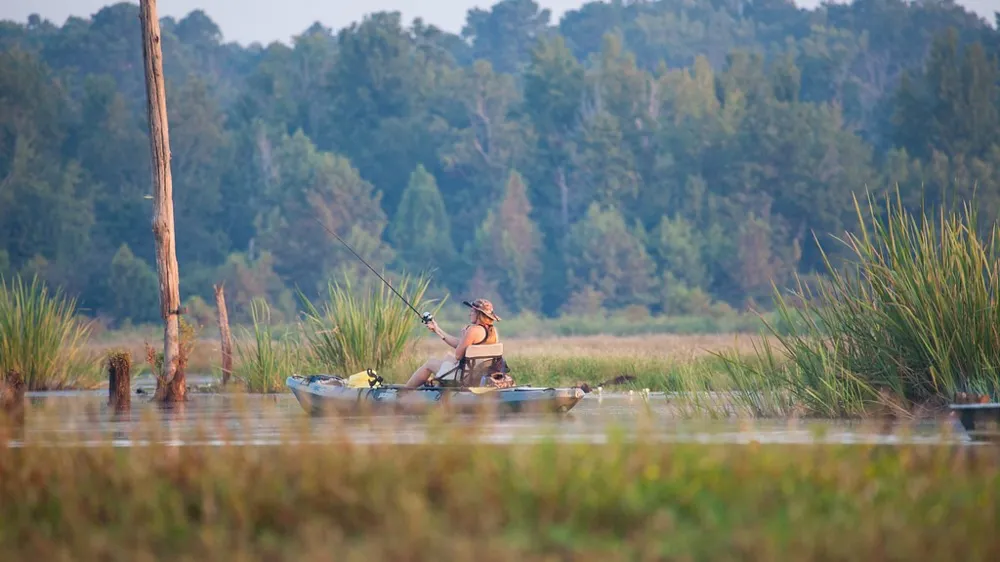
Kayaks are vessels, and both paddlers need to follow federal and state boating rules. Florida's wildlife agency, for example, lists these requirements for canoes and kayaks, which mirror the common baseline:
- One U.S. Coast Guard-approved wearable life jacket for each person on board.
- A bell, horn or whistle audible for at least half a nautical mile.
- A white light (lantern or flashlight) between sunset and sunrise or in restricted visibility.
States add their own rules. Pennsylvania requires unpowered boats launched at state boating and park access points to display a registration or launch permit, and from November 1 through April 30 everyone in a canoe or kayak must wear a life jacket. Florida doesn't require registration for nonmotorized vessels under 16 feet, but any motorized kayak needs registration and a title. Many states treat electric trolling motors the same way, so a motor-ready tandem may need registration once a motor is fitted.
Each person fishing generally needs their own fishing license for the state and water, with age exemptions that vary. Check your state's wildlife and boating agency before you go, and read kayak registration laws for more. Rules last checked November 2026. This is general information, not legal advice.
Safety Checklist for Two Anglers
- Both anglers wear PFDs the whole time. A fishing-specific vest has pockets for tools. See the best kayak PFDs.
- Dress for the water temperature, not the air. See what to wear kayaking.
- Agree on roles before launching: who steers, who handles the anchor and who calls turns.
- Practice re-boarding together in shallow, warm water so you both know how the loaded boat behaves before you need it. See getting in and out of a kayak.
- Watch the wind. A long tandem catches more of it, and a 2-person crew still has only one boat if something goes wrong.
- Leave a float plan with someone on shore and carry a phone in a dry case.
For more, see kayak safety.
More Kayak Fishing Guides
Learn the basics in kayak fishing tips, size a paddle with the kayak paddle length guide, and explore every type in types of kayaks and the kayaking hub.
Frequently Asked Questions
Is a tandem fishing kayak a good idea?
It can be, if you usually fish with the same partner and have one place to store and one vehicle to carry a boat. Two solo kayaks give each angler more room, independent positioning and a second boat for rescues, but cost and storage double.
Can you fish solo from a 2-person fishing kayak?
Many tandems let you move one seat to a center position so the boat trims level with one person, including the Vibe Yellowfin 130T and Brooklyn 13.0 Pro Tandem. Others, like the Feelfree Lure II, are paddled solo from the rear seat with the front seat removed. Expect a long, heavy boat to feel slower and catch more wind alone.
How much weight can a tandem fishing kayak hold?
The models here are listed from about 475 to 800 pounds, and capacity usually covers paddlers, tackle and anything else on board. For good handling, plan to load well below the maximum, often around 60 to 70 percent of it.
Can you stand up in a tandem fishing kayak?
Some wide tandems have standing pads or flat decks, such as the Feelfree Lure II, and the Lifetime Sport Fisher's tunnel hull is designed for stand-up fishing. Only one angler should stand at a time, in calm water, while the partner stays seated and centered.
Can you put a trolling motor on a tandem kayak?
Some are built for it, such as the motor-ready Brooklyn 12.5 Tandem and the Feelfree Lure II with its optional Motordrive. Adding a motor usually means the kayak must be registered in your state, so check the rules first.
Do both people need a fishing license on a tandem kayak?
In general, every person who is fishing needs their own valid license for the state and water they're on, though age exemptions vary. Check your state wildlife agency's rules before the trip.
What is the best length for a 2-person fishing kayak?
Most tandem fishing kayaks are about 12 to 14.5 feet. Around 12 to 13 feet balances room, transport and maneuverability on lakes and rivers, while 14 feet and up tracks better on big water but is harder to carry and store.