2-Person Inflatable Kayaks That Pack Small and Paddle Well for Two (2026)
Blow-up tandem kayaks from Sea Eagle, Driftsun, Intex, Advanced Elements and Aquaglide, with a guide to capacity, floors, inflation and paddling together.
Why Choose a 2-Person Inflatable Kayak?
A 2-person inflatable kayak gives you a tandem that rolls up into a bag. You can keep it in a closet, carry it in a car trunk and inflate it at the water's edge, with no roof rack, trailer or garage space needed. That makes a blow-up tandem a practical choice for couples, a parent paddling with a child, friends sharing one boat, and anyone in an apartment or a small home.
The trade-offs are real, though. Inflatables catch more wind, most are slower than a hard-shell kayak of the same length, and you'll spend time pumping up and drying out the boat. Quality varies hugely, from thin vinyl pool-style kayaks to tough PVC and fabric boats with high-pressure drop-stitch floors that are rated for whitewater. This guide covers nine two-person inflatables across that range. If you'd rather have a rigid boat, see our best tandem kayaks; for solo inflatables, see best inflatable kayaks.
Sea Eagle 380x Explorer
Best for lakes to whitewater
- 12 ft 6 in, 750 lb listed capacity
- Removable drop-stitch floor up to 10 psi
- Self-bailing, rated to Class IV
Driftsun Rover 220
Best lightweight drop-stitch tandem
- 28 lb hull, 600 lb capacity
- 6 PSI drop-stitch floor
- Paddles, pump and seats included
Intex Challenger K2
Best budget tandem
- 11 ft 6 in, 400 lb capacity
- Removable skeg for tracking
- Paddles and pump included
2-Person Inflatable Kayaks Compared
| Kayak | Length | Listed Capacity | Hull Weight | Construction | Best For |
|---|---|---|---|---|---|
| Sea Eagle 380x Explorer | 12 ft 6 in | 3 persons / 750 lb | 40 lb | 1000-denier reinforced PVC, drop-stitch floor | Lakes, rivers, whitewater to Class IV |
| Driftsun Rover 220 | 12.5 ft | 600 lb | 28 lb | 1000D PVC tubes, drop-stitch floor | Light weight, rivers to Class III–IV |
| Intex Challenger K2 | 11 ft 6 in | 2 persons / 400 lb | 36.41 lb | Vinyl, I-beam floor | Budget, calm water |
| Advanced Elements AdvancedFrame Convertible | 15 ft | 550 lb | 52 lb | Multi-layer with bow and stern rib frames | Lakes, touring, solo conversion |
| Sea Eagle 420x Explorer | 14 ft | 3 persons / 855 lb | 44 lb | Reinforced PVC, drop-stitch floor | Big paddlers, gear, longer trips |
| Aquaglide Chinook 120 | 12 ft | 550 lb | 29 lb | Ripstop polyester cover over bladders | Light weight, smaller paddlers |
| Sea Eagle 370 Pro | 12 ft 6 in | 3 persons / 650 lb | 32–33 lb | 36-gauge PolyKrylar PVC | Value Sea Eagle, rivers to Class III |
| Intex Excursion Pro K2 | About 12 ft 7 in | 2 persons / 400 lb | Check listing | Laminate with polyester core | Budget fishing |
| Intex Explorer K2 | 10 ft 3 in | 2 persons / 400 lb | 36.96 lb | Vinyl, I-beam floor | Short, calm-water outings |
Specs come from each maker's product page or the retailer listing. Packages, seats and paddles change from year to year, so check the current listing before you buy.
The Best 2-Person Inflatable Kayaks
1. Sea Eagle 380x Explorer
The 380x is a heavy-duty inflatable built for everything from flat lakes to rapids. Sea Eagle lists it at 12 ft 6 in long and 3 ft 2 in wide, with a 40 lb hull and a capacity of 3 persons or 750 lb, although the maker describes it as designed for one or two riders. The hull is 1000-denier reinforced PVC with three independent chambers (two sides and the floor). The floor is a removable 4-inch drop-stitch panel that inflates to up to 10 psi, which gives a much stiffer standing and sitting platform than a low-pressure floor. Sixteen self-bailing floor drains can be opened for whitewater or closed for dry flatwater paddling, a large removable rear skeg helps it track on open water, and Sea Eagle rates it for up to Class IV. Deflated, it packs to about 31 x 20 x 9 inches.
Good to Know
- Very high listed capacity for two paddlers plus gear
- Self-bailing drains you can open or close
- Rated for whitewater as well as lakes
Watch Out For
- Heavier and bulkier than vinyl tandems
- Wide, open design catches wind on big lakes
2. Driftsun Rover 220
The Rover 220 is a tandem that's easy to carry. The listing gives it a 28 lb weight, 12.5 ft length, 38 in width and 600 lb capacity, enough for two adults plus a child, gear or a pet. The side tubes are 1000D reinforced PVC over a PVC tarpaulin bottom, and the drop-stitch floor runs at 6 PSI while the side tubes run at 3 PSI. It has eight self-bailing ports with drain plugs and a removable rear tracking skeg, which you take off for whitewater and leave on for flatwater. Driftsun lists it for Class III and IV rapids. The package includes two adjustable aluminum paddles, two EVA-padded high-back seats, adjustable footrests, a double-action hand pump and a travel bag.
Good to Know
- Light enough for one person to carry
- Drop-stitch floor and self-bailing ports
- Complete package with paddles and pump
Watch Out For
- Lower floor pressure than the Sea Eagle Explorer floors
- Short, wide river shape may feel slow on long flatwater trips
3. Intex Challenger K2
The Challenger K2 is a low-cost way to get two people on the water. Intex lists it at 11 ft 6 in x 2 ft 6 in x 1 ft 3 in inflated, with a 400 lb maximum load for two people and a weight of 36.41 lb. It's made of vinyl, with high-buoyancy side chambers, an inflatable I-beam floor and Boston valves. A removable skeg helps it track, and the package includes two 86-inch aluminum paddles, a high-output hand pump, a cargo net, a repair patch kit and grab lines at each end. Its sporty, low-profile shape sits lower than the Explorer K2, but like other vinyl kayaks it's best on calm lakes and slow rivers.
Good to Know
- Budget package with paddles and pump
- Removable skeg and cargo net
- Narrower shape than the Explorer K2
Watch Out For
- Vinyl is less abrasion-resistant than PVC or fabric
- 400 lb limit leaves little room for gear with two adults
4. Advanced Elements AdvancedFrame Convertible
The AdvancedFrame Convertible is the longest boat here and the most like a touring kayak. The maker lists it at 15 ft long and 32 in wide, with a 52 lb weight and a 550 lb capacity. Rib frames in the bow and stern give it a sharper, more rigid shape for tracking, and it's a sit-inside design with an open deck. It converts from tandem to solo in minutes, and optional single or double decks turn it into a closed-deck kayak for cooler or splashier days. It ships with two folding seats, a duffel bag and a repair kit, but no pump. The Elite version adds a drop-stitch floor and high-back lumbar seats. We cover it in more depth in our best inflatable kayaks guide.
Good to Know
- Long, framed hull for tracking on lakes
- Converts to a solo kayak
- Optional decks for cold or windy water
Watch Out For
- Heaviest pick, and the pump is sold separately
- Not a whitewater boat
5. Sea Eagle 420x Explorer
The 420x is the longer sibling of the 380x. Sea Eagle lists it at 14 ft, 44 lb and 3 persons or 855 lb, the highest capacity in this guide, and rates it for up to Class IV. The Amazon listing for the Pro package describes a 10 PSI drop-stitch floor and 16 self-bailing valves, the same features as the 380x. The extra length gives two tall paddlers more legroom and more space for camping gear, a cooler or a dog, and longer kayaks generally glide and track better on flatwater.
Good to Know
- Most capacity and legroom here
- Drop-stitch floor and self-bailing drains
- Suits overnight trips with gear
Watch Out For
- Long boat to turn in tight rivers
- Bigger packed bundle to carry and store
6. Aquaglide Chinook 120
The Chinook 120 is a light, fabric-covered tandem. The retailer listing gives it a 12 ft length, 41 in width, 29 lb weight and 550 lb capacity for 1–2 people. A 600-denier ripstop polyester shell covers three chambers: the side tubes run at 2.0 psi and the inflatable floor at 1.0 psi. It uses Boston valves, a quick-release tracking fin and a cockpit drain. The same listing notes that it fits smaller paddlers best, so taller pairs may want a longer model such as the 420x.
Good to Know
- Light for its capacity
- Fabric cover protects the air chambers
- Removable fin for tracking
Watch Out For
- Low-pressure floor is softer than drop-stitch
- Tight fit for tall paddlers
Look for the Chinook 120 at paddling retailers or on Aquaglide's site.
7. Sea Eagle 370 Pro
The 370 is Sea Eagle's entry-level sport kayak and a common choice for couples. It's listed at 12 ft 6 in long and 2 ft 9 in wide, with a hull weight of 32–33 lb and a capacity of 3 persons or 650 lb, although Sea Eagle notes it fits two adults most comfortably. It's made of 36-gauge PolyKrylar, has three independent air chambers, two molded rear skegs and an open-and-close drain valve, and it's rated for up to Class III. Sea Eagle lists an inflation time of about 8 minutes and a packed size of 31 x 18 x 7 inches.
Good to Know
- Light and quick to inflate
- Rated for mild whitewater
- Higher capacity than budget vinyl tandems
Watch Out For
- Molded skegs only, no large removable skeg
- Low-pressure floor flexes more than drop-stitch
8. Intex Excursion Pro K2
The Excursion Pro K2 is Intex's step up from its sport vinyl kayaks, with features aimed at anglers. Intex lists it as a 2-person kayak with a 400 lb capacity and a length of about 151 inches (about 12 ft 7 in). It uses a laminate with a polyester core for durability, high-pressure spring-loaded valves and two removable skegs, one for deep water and one for shallow water. It also has two adjustable bucket seats, floor-mounted footrests and two recessed fishing rod holders, and it comes with 86-inch aluminum paddles, a high-output pump and a carry bag. For more fishing-focused boats, see best inflatable fishing kayaks.
Good to Know
- Tougher material than basic Intex vinyl
- Rod holders and two skeg options
- Complete package
Watch Out For
- 400 lb limit with two adults and fishing gear
- Not rated for whitewater
9. Intex Explorer K2
The Explorer K2 is the best-known budget blow-up kayak for two. Intex lists it at 10 ft 3 in long and 3 ft wide, with a 400 lb capacity and a weight of 36.96 lb. It's vinyl with an I-beam floor, a removable skeg and two inflatable seats with backrests, and it comes with paddles and a pump. Its short, wide shape makes it stable but slow, so it suits short outings on calm, sheltered water. Read our full Intex Explorer K2 review for setup tips and its limits in wind.
Good to Know
- Very easy entry point
- Stable, wide shape
Watch Out For
- Shortest boat here, slow and wind-prone
- Not for rivers with rocks or rapids
Types of 2-Person Inflatable Kayaks
Most of the price and performance gap between inflatable tandems comes from how they're built. These are the main types, from simplest to most rigid.
| Type | How It's Built | Strengths | Limits | Examples |
|---|---|---|---|---|
| Vinyl recreational | Welded vinyl chambers with an I-beam or tube floor | Light on the budget, simple, stable | Lower abrasion resistance, soft floor, wind-prone | Intex Challenger K2, Explorer K2 |
| Laminated or heavy PVC | Thicker PVC or laminate, often with spring or recessed valves | Tougher skin, higher pressures, better shape | Heavier than vinyl | Intex Excursion Pro K2, Sea Eagle 370 |
| PVC with drop-stitch floor | Side tubes plus a high-pressure drop-stitch floor panel | Stiff, flat floor; often self-bailing and whitewater-rated | Bulkier and heavier packed | Sea Eagle 380x and 420x, Driftsun Rover 220 |
| Coated fabric cover | Air bladders inside a polyester or nylon shell | Shell protects the bladders; light for the size | Must dry fully inside the cover | Aquaglide Chinook 120 |
| Frame-insert hybrid | Inflatable hull with rigid ribs or frame sections | Sharper bow and stern, better tracking and glide | Heaviest, longer setup, flatwater focus | Advanced Elements AdvancedFrame Convertible |
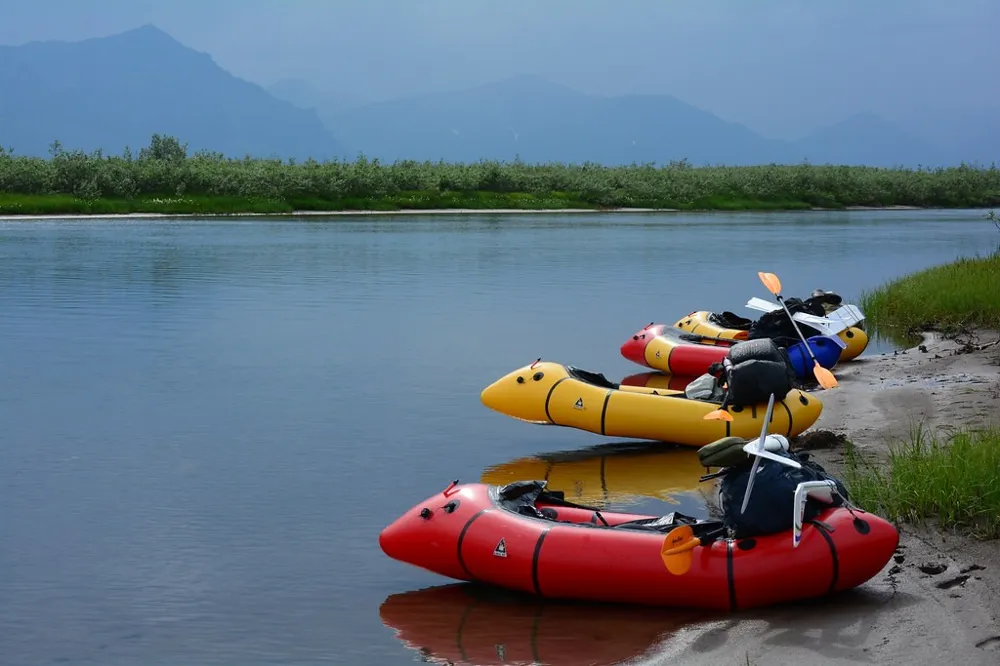
| Tandem packraft | Very light coated nylon tubes, small packed size | Can be carried in a backpack | Specialist and costly; not covered in detail here | Two-person packrafts |
Drop-stitch means thousands of threads connect the top and bottom layers of a panel, so it can hold much higher pressure and stay flat, like an inflatable paddle board. A drop-stitch floor makes a tandem feel far more solid underfoot and helps it keep its shape with two adults aboard.
Sit-on-top or sit-inside? Most inflatable tandems are open designs that feel like a sit-on-top, which are easy to get in and out of and simple to drain. Framed models like the AdvancedFrame Convertible are sit-inside kayaks with optional decks that keep you warmer and drier. Our sit-in vs sit-on-top guide and types of kayaks explain the differences.
How to Choose a Two-Person Inflatable Kayak
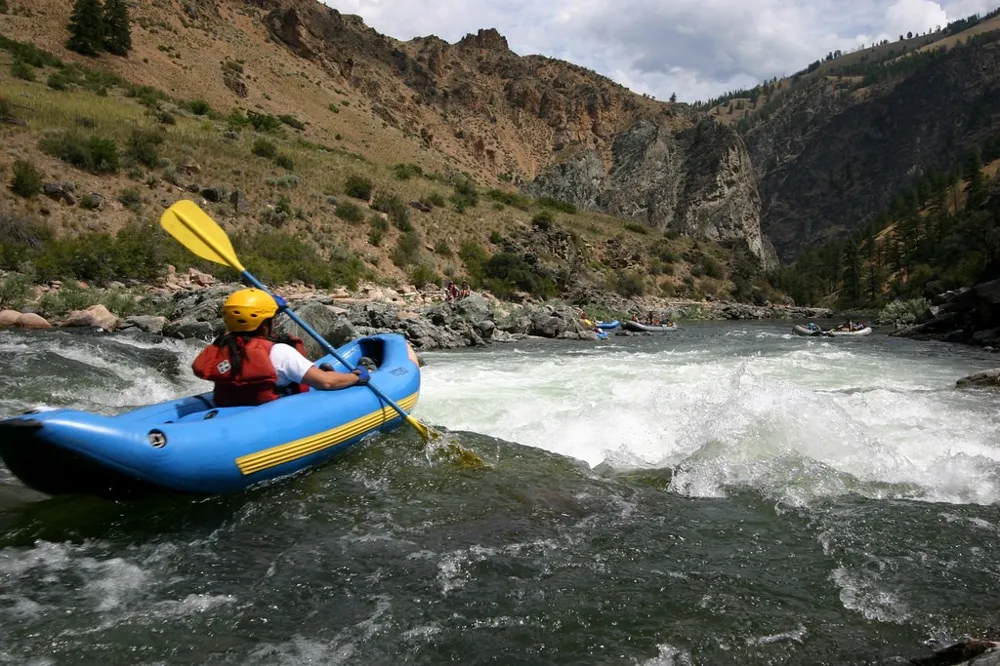
Start with where you'll paddle. Calm ponds and small lakes suit almost any tandem. Big lakes and coastal bays call for a longer boat with a skeg and good tracking. Rocky rivers and rapids call for heavy PVC, self-bailing drains and a whitewater rating. Then work through these points.
Capacity, Including Gear
Add up both paddlers, then add a cooler, dry bags, a dog and anything else you'll carry. Listed capacity is a maximum, not a comfortable working load, and an overloaded inflatable sits low, feels sluggish and ships water. A common rule is to stay well below the limit, which rules out many 400 lb budget kayaks for two large adults. Our kayak weight limit guide explains how capacity works.
Length and Width
For two people, about 12 to 13 feet is a practical middle ground. Shorter tandems around 10 feet turn easily but are slow and cramped, while 14- to 15-foot models give more legroom, glide farther per stroke and track better. Wider boats feel more stable but are slower and harder to reach over with a paddle.
Tracking Skeg or Fin
Flat-bottomed inflatables tend to spin a little with each stroke. A removable skeg or fin under the stern helps the kayak go straight on open water. Take it off for shallow, rocky rivers and whitewater so it doesn't catch or tear.
Air Chambers
Look for at least three separate chambers (two sides and the floor). If one chamber leaks, the others keep you afloat long enough to reach shore. All of our picks list multiple chambers or a separate floor.
Valves
Boston valves are common on budget kayaks and work with most pumps. Recessed one-way or spring-loaded valves seal better, are less likely to be knocked open and suit the higher pressures of drop-stitch floors. Make sure your pump has the right adapter.
Floor Type
A low-pressure tube or I-beam floor is fine for calm-water fun. A drop-stitch floor gives a firmer platform, better posture and stiffer handling, and it matters more as paddlers get heavier.
Seats and Solo Conversion
Inflatable seats are basic. High-back padded seats that clip into D-rings are more comfortable for longer trips (see kayak seats if you want to upgrade). Check whether the seats can move: sliding one seat to the middle lets a single paddler use the kayak, and models like the AdvancedFrame Convertible are designed to switch between tandem and solo.
Self-Bailing Drains
Self-bailing floors let water drain out instead of sloshing around your feet, which is essential in rapids and surf. On flatwater, closable drains keep you drier.
What's Included, Weight and Packed Size
Budget packages usually include paddles and a pump; premium boats may sell them separately. Check the total carry weight with accessories, and whether the packed bag fits your trunk, closet or plane luggage. Our guide to how much kayaks weigh compares inflatables with hard shells.
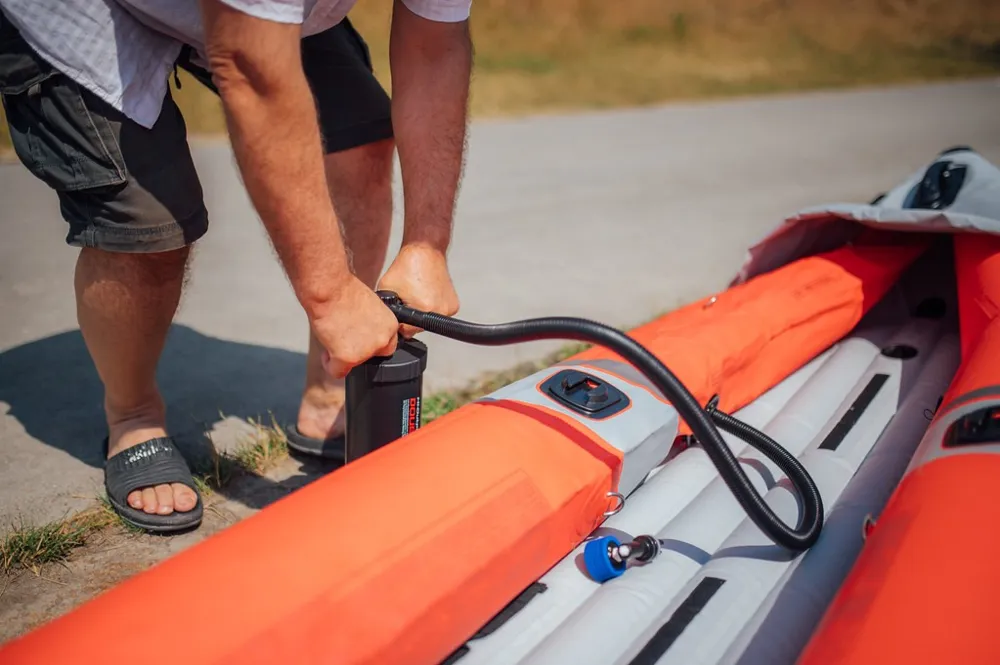
Inflation and PSI: Getting the Pressure Right
Pressure makes a bigger difference to how an inflatable paddles than almost anything else. An underinflated kayak sags in the middle, flexes with each stroke and wanders. An overinflated one strains its seams, especially in hot sun.
- Follow the maker's numbers. Pressures vary widely. The Aquaglide Chinook 120 lists 2.0 psi for the tubes and 1.0 psi for the floor, the Driftsun Rover 220 lists 3 PSI tubes and a 6 PSI drop-stitch floor, and Sea Eagle's Explorer floors go up to 10 psi.
- Use a gauge. Low pressures are hard to judge by feel. Many pumps have a gauge, or you can use a separate one on the valve.
- Inflate in order. Follow the chamber sequence in your manual, since makers differ on whether the floor or the side tubes go first. Seats and footrests usually come last.
- Allow for temperature. Air expands in the sun and contracts in cold water. Top up after the boat has been on cold water for a while, and let a little air out if it sits on a hot beach.
- Pick the right pump. A double-action hand pump works for vinyl and low-pressure boats. For drop-stitch floors, a high-pressure hand pump or a 12V electric pump saves effort; see our paddle board pumps, many of which fit kayak valves.
Setup, Drying and Storage
A tidy routine makes an inflatable tandem last longer and keeps setup short.
- Pick a clean spot. Unroll the kayak on grass, sand or a tarp, away from sharp stones, glass and hot asphalt.
- Inflate and fit. Pump each chamber to pressure, attach the skeg, then clip in the seats and footrests. Adjust the seats so both paddlers can sit upright with knees slightly bent.
- Carry, don't drag. Two people can carry a tandem by its handles; dragging scuffs the hull. Load gear once the boat is floating.
- Rinse after use. Rinse with fresh water, especially after salt water, sand or muddy rivers, and clean the valves.
- Dry completely. Dry the outside, flip the boat over and let it dry fully before folding. Fabric-covered kayaks need the cover and bladders dried inside to prevent mildew.
- Fold loosely and store well. Store the kayak clean, dry and loosely folded in a cool, dark place away from rodents. If you have room, rolling it loosely or leaving it partly inflated avoids sharp creases. Avoid long periods in direct sun, which degrades PVC and vinyl.
Patch small holes with the included repair kit, following the instructions for your material, and check the valves and seams at the start of each season. For getting the bag to the water, see how to transport a kayak, and for dry storage of gear on board, see our best dry bags.
How to Paddle an Inflatable Tandem Together
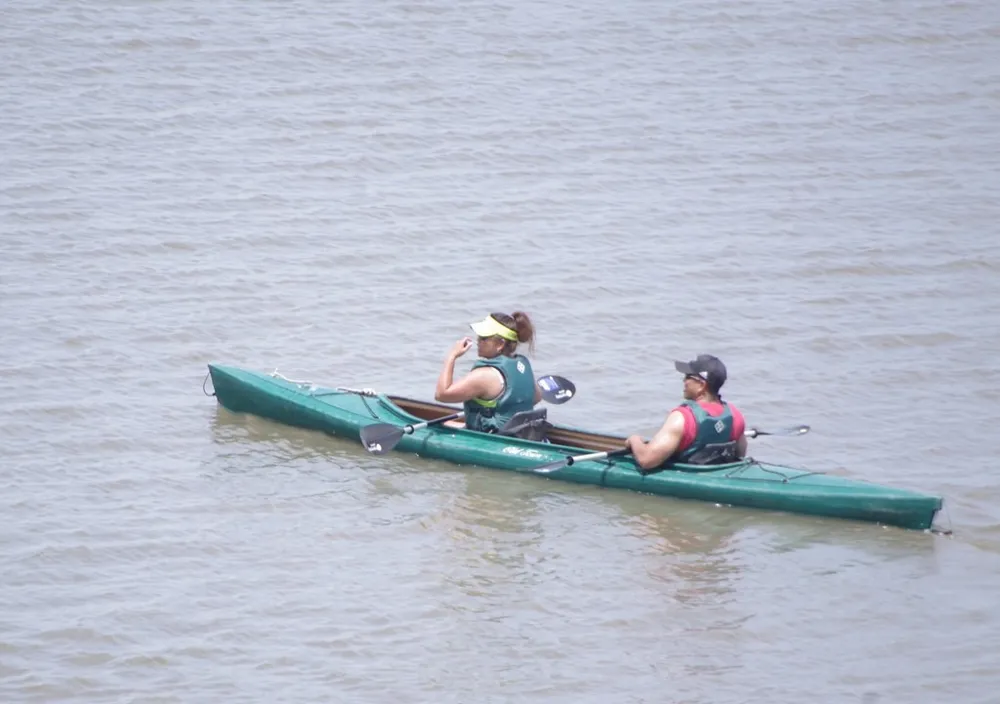
Two paddlers in one boat can be fast and fun, or they can clash paddles all day. A few habits make a big difference.
- Who sits where: the stronger or more experienced paddler usually sits in the back, where they steer and can see the front paddler's stroke. The front paddler sets the pace.
- Match strokes: the rear paddler follows the front paddler's rhythm, so the blades enter the water on the same side at the same time. This avoids clashing and keeps the boat running straight.
- Steer from the back: the rear paddler makes small corrections with sweep strokes or a brief rudder stroke, while the front paddler keeps paddling forward. For a sharp turn, both can sweep on opposite sides.
- Talk: agree on simple calls such as "switch," "stop," "left" and "right," and decide who calls them.
- Trim the boat: move gear so the kayak floats level. A nose-down boat plows, and a tail-heavy boat catches wind.
- Use the right paddle: inflatables are wide, so they often need a longer paddle than a slim hard shell. Our paddle length guide and best kayak paddles can help.
- Plan for wind: inflatables sit high on the water. Paddle into the wind first so the wind helps you home, and stay close to shore on breezy days.
For the basic forward, reverse and sweep strokes, see how to paddle a kayak, and for boarding without tipping, see how to get in and out of a kayak.
Hard-Shell vs Inflatable Tandem Kayaks
Both kinds seat two, but they suit different lives.
| Factor | Inflatable Tandem | Hard-Shell Tandem |
|---|---|---|
| Storage | Rolls into a bag; fits a closet or trunk | Needs a garage, rack or yard space |
| Transport | No roof rack needed | Roof rack, truck bed or trailer |
| Weight to carry | About 28–52 lb for our picks | Often heavier and awkward for one person |
| Setup | Inflate and dry every trip | Ready to launch |
| Speed and tracking | Usually slower; wind affects it more | Usually faster and straighter |
| Durability | Good on quality PVC or fabric; can be punctured | Shrugs off scrapes; can crack if dropped hard |
| Whitewater | Some models rated to Class III–IV | Recreational tandems are for flatwater |
If you have storage space and a way to carry a long boat, a hard shell is simpler to use. See our best tandem kayaks for rigid sit-on-tops, and folding kayaks for another packable option.
Safety and Rules for Inflatable Tandems
Inflatable kayaks count as boats, so the same basic rules apply as for any paddlecraft.
- Life jackets: under U.S. Coast Guard rules, every person on a recreational vessel needs a USCG-approved wearable life jacket of the right size, and it must be readily accessible. Children under 13 must wear one while the boat is underway unless state law sets a different age. Canoes and kayaks don't need a throwable cushion. Wear yours, since it's hard to put one on in the water. See our best kayak PFDs.
- Whistle and light: many states, Florida for example, also require a sound device such as a whistle and a white light (a flashlight or lantern) when paddling between sunset and sunrise.
- Registration: rules for registering non-motorized kayaks vary by state, and adding a trolling motor usually changes them. See our kayak registration laws guide and check with your state boating agency. Rules last checked November 2026; this is not legal advice.
- Wind and offshore breezes: high-floating inflatables can be blown away from shore quickly. Check the forecast, avoid offshore winds and stay near the shore.
- Cold water: the Canadian Safe Boating Council's 1-10-1 rule describes about 1 minute of cold shock, about 10 minutes of useful movement, and up to about 1 hour before hypothermia causes unconsciousness. Dress for the water temperature, not the air. See what to wear kayaking.
- Rivers: only take whitewater-rated boats into rapids, wear helmets, scout unfamiliar water, and paddle with others. Our whitewater kayaks guide covers river gear.
- Capacity and kids: stay under the listed capacity and seat children where an adult can reach them. If a dog is coming, read best kayaks for dogs first.
For a full checklist, including float plans and self-rescue, see our kayak safety guide.
Frequently Asked Questions
Are 2-person inflatable kayaks any good?
Yes, for the right water. Models with drop-stitch floors, multi-layer PVC or fabric covers and a tracking skeg paddle well on lakes and rivers, while basic vinyl tandems are best kept to calm, sheltered water close to shore.
Can one person paddle a 2-person inflatable kayak?
Yes. Many tandems have movable seats, so a solo paddler can sit near the middle for better balance and steering. Some, like the Advanced Elements AdvancedFrame Convertible, are sold specifically as tandem-to-solo boats.
How much weight can a 2-person inflatable kayak hold?
Listed capacities range from about 400 lb on budget vinyl models to 750 lb or more on heavy-duty PVC kayaks such as the Sea Eagle 380x and 420x. Include both paddlers, gear, a cooler and any dog in the total, and stay well under the maximum for good handling.
Where should the heavier person sit in a tandem inflatable kayak?
As a rule of thumb, the stronger or heavier paddler sits in the back, because the rear paddler steers. Then shift gear forward or back until the kayak floats level, since a nose-heavy or tail-heavy boat tracks poorly.
Do inflatable kayaks pop easily?
Quality inflatables are made of thick PVC or coated fabric and have separate air chambers, so one leak won't sink the whole boat. Avoid dragging them over sharp rocks, oyster beds or concrete ramps, and carry the repair kit.
Can a 2-person inflatable kayak handle rapids?
Only models built and rated for it. Sea Eagle lists the 380x and 420x for up to Class IV and the 370 for up to Class III, while basic vinyl tandems are meant for calm water. Rapids also call for a helmet, a whitewater PFD and river skills.
How long does it take to inflate a 2-person kayak?
Often around 5 to 15 minutes with a hand pump, depending on the number of chambers and the pressure. Sea Eagle lists about 8 minutes for the 370; drop-stitch floors take longer by hand, and an electric pump speeds things up.