Parts of a Kayak Explained, From Bow to Stern (2026)
Coaming, bulkhead, skeg, scupper: here's what every part of a kayak is called, what it does, and which parts you'll only find on sit-on-tops, touring boats or inflatables.
Kayak Parts at a Glance
Every kayak shares a few basics: a bow and stern, a hull underneath, a deck on top and somewhere to sit. After that, the parts depend on the kind of kayak. Touring kayaks add bulkheads, hatches and a skeg or rudder; sit-on-tops add scupper holes and molded footwells; inflatables add valves. As REI's kayak anatomy guide points out, not every boat has every part. The diagram shows a sit-inside touring kayak, which carries most of them.
| Part | Where It Is | What It Does |
|---|---|---|
| Bow | Front end | Points where you're going |
| Stern | Back end | Points where you've been; holds the skeg or rudder |
| Hull | Underside | Its shape sets stability, speed and tracking |
| Deck | Topside | Covers your legs and gear; carries lines and hatches |
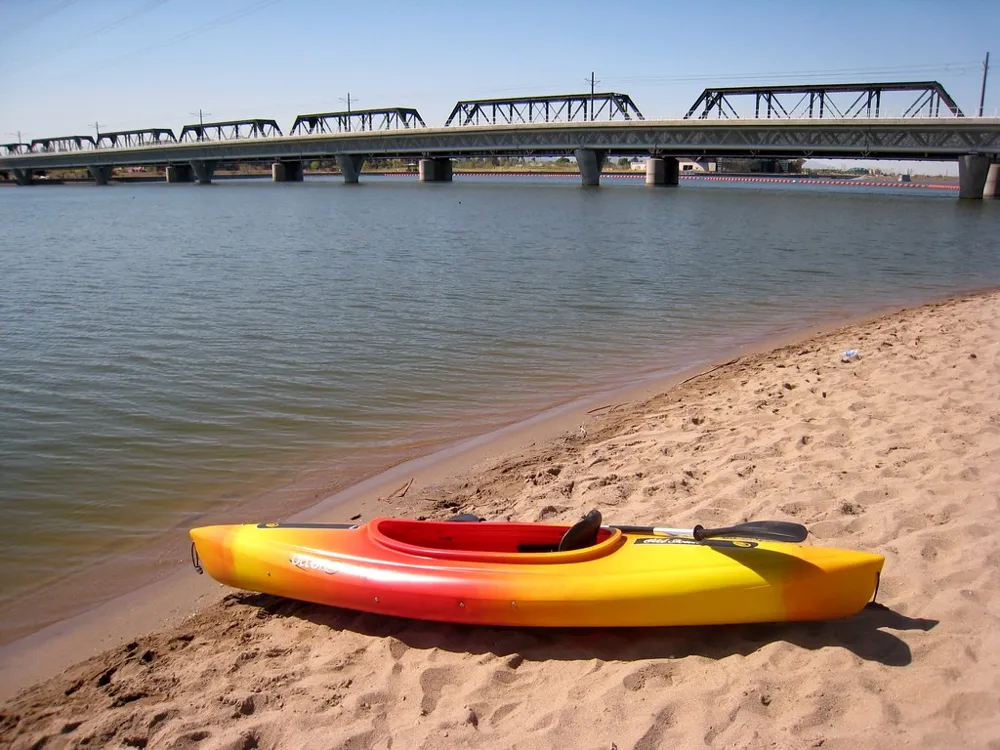
| Cockpit | Opening in the deck | Where you sit and control the boat |
| Coaming | Rim around the cockpit | Anchors the spray skirt |
| Seat and backband | Inside the cockpit | Support and a stable base |
| Footpegs (foot braces) | Inside the footwell | Brace your feet; steer the rudder on ruddered boats |
| Thigh braces | Under the deck at the front of the cockpit | Let your knees and thighs grip the boat for edging and rolling |
| Bulkheads | Sealed walls inside the hull | Dry storage, buoyancy and less water after a capsize |
| Hatches | Openings in the deck | Access to the storage behind the bulkheads |
| Skeg or rudder | Under or behind the stern | Helps the kayak go straight; a rudder also steers |
| Deck lines and bungees | On the deck | Something to grab; hold gear |
| Carry handles and toggles | Bow and stern | Carrying; a secure grip for a swimmer |
| Scupper holes | Through the hull (sit-on-tops) | Drain water off the deck |
Bow, Stern and Sides
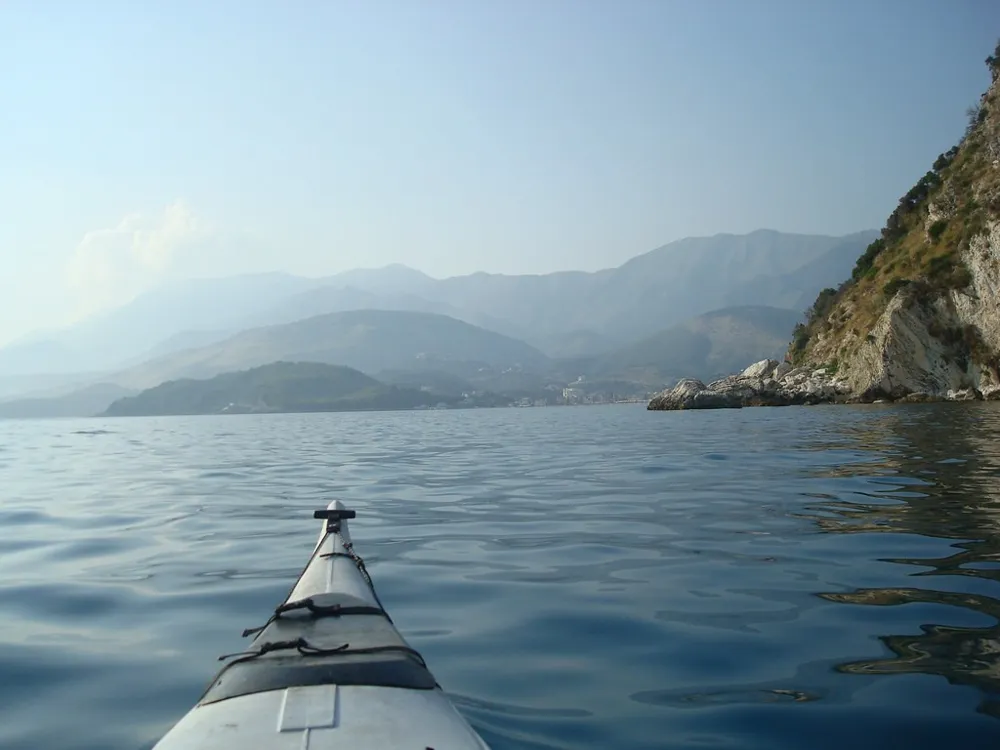
The bow is the front, the end that points where you're headed, and the stern is the back. Bow shape tells you about the boat: whitewater kayaks have short, blunt ends for spinning in current, while touring kayaks have long, fine bows that slice through waves.
Facing the bow, the left side is port and the right side is starboard. "Fore" means toward the bow and "aft" means toward the stern. A kayak's length is measured from the tip of the bow to the tip of the stern, which is the number you'll use with our kayak size chart.
The Hull: Shape, Chine and Rocker
The hull is the bottom of the kayak, the part in the water. Its shape does more than anything else to decide how a kayak feels. Two broad designs show up in most guides:
- Displacement hulls are rounded and long, pushing through the water. They track well and suit touring and recreational boats.
- Planing hulls are flatter with angled sides so they can skim and spin on moving water. They're common on whitewater playboats but don't track as well.
Cross-section shapes include flat (very stable on calm water), rounded (faster, less initially steady), V-shaped (tracks straight and cuts waves) and pontoon or tunnel hulls (very stable, common on fishing kayaks). Our types of kayaks guide compares them, along with primary and secondary stability.
A few more hull terms you'll see on spec sheets:
- Keel line: the centerline running along the bottom of the hull from bow to stern. Some hulls have a molded keel ridge here.
- Chine: where the bottom of the hull meets the sides. A hard chine is a sharp angle; a soft chine is a gradual curve. Some hulls have several chines.
- Rocker: the upward curve of the keel line toward the ends. More rocker makes turning easier; less rocker improves tracking and speed.
- Sheer: the upward sweep of the bow and stern above the waterline.
- Plan view: the kayak's outline seen from above. Some are symmetrical; others are wider toward one end.
Kayaks don't have gunwales like a canoe; the closest equivalent is the edge where deck meets hull. For canoe hull terms like tumblehome and freeboard, see parts of a canoe.
The Deck: Lines, Bungees, Handles and Toggles
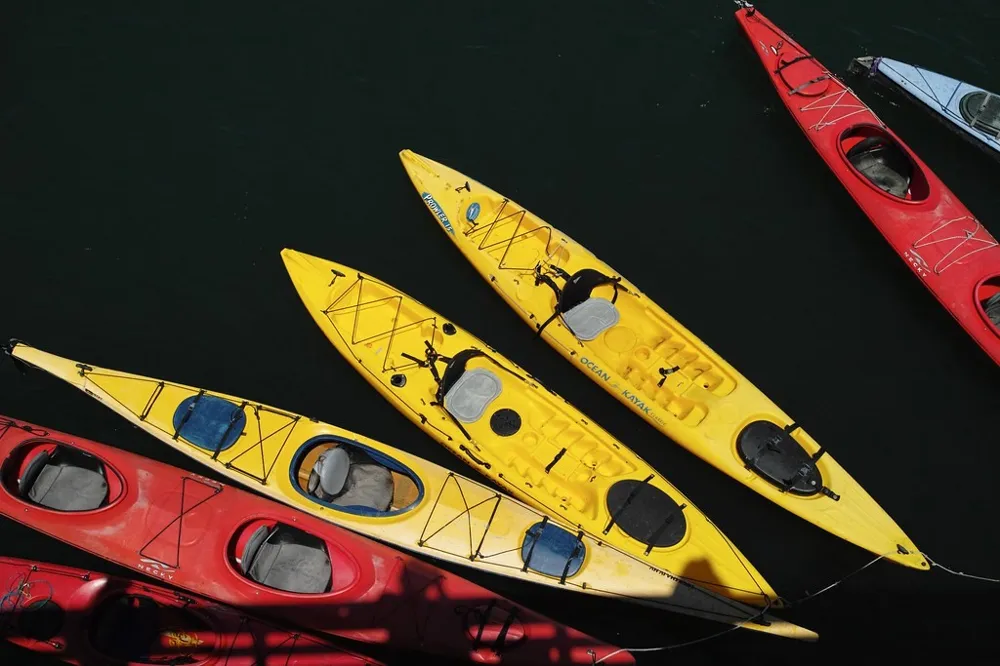
The deck is the topside of the kayak. On a sit-inside, it covers your legs and gear; on a sit-on-top, it's the surface you sit on. Deck hardware includes:
- Perimeter deck lines: static (non-stretch) ropes running around the edges of a sea kayak's deck. You grab them during rescues and when emptying a swamped boat.
- Bungees (deck elastics): stretchy cords in front of or behind the cockpit for a water bottle, map or pump. Replacements should be marine-rated cord.
- Deck fittings: the anchors the lines run through. Sea kayaks often use recessed fittings that sit flush, so they don't knock your hands.
- Carry handles: molded or strap handles at the bow and stern for lifting. Many sit-on-tops have handles in several places.
- Toggles: loops on a short length of cord at the very ends of a sea kayak. Paddling Magazine notes they're separate from carry handles: they give a swimmer something secure to hold during a rescue and can double as carry points.
- Paddle float rigging: lashing behind the cockpit that holds a paddle and paddle float as an outrigger during a self-rescue.
- Security loop and compass recess: a bar or loop for locking the kayak to a rack, and on many sea kayaks a recess in front of the cockpit for a deck compass.
Most add-ons, from deck bags to lights, attach to these lines and fittings; see our kayak accessories checklist.
The Cockpit and Coaming
The cockpit is the opening where you sit. Its size changes how the kayak feels:
| Cockpit Type | Found On | Trade-Off |
|---|---|---|
| Large recreational | Recreational sit-insides | Easiest to get in and out of; harder to seal and brace in |
| Keyhole | Many touring and day-touring kayaks | Long front lets you slide your legs in, with thigh contact once seated |
| Ocean (small, round) | Traditional sea kayaks | Keeps out the most water and gives a snug fit; harder to enter and exit |
The coaming (or cockpit rim) is the raised lip around the opening. A spray skirt hooks under it to seal out waves and rain, so skirts are sized to the coaming, not the kayak. A cockpit cover does the same job when the boat is stored or on the car. For getting in and out cleanly, see how to get in and out of a kayak.
Inside the Cockpit: Seat, Footpegs and Braces
These are your contact points with the boat, and a good fit makes the kayak easier to control:
- Seat: from a simple molded pan to a padded, adjustable frame seat. Touring and whitewater kayaks often use a low backband instead of a tall backrest, which keeps you upright without restricting your rotation. An upgrade is one of the easiest comfort fixes; see the best kayak seats.
- Footpegs (foot braces): adjustable pegs or bars you press your feet against. They help you sit upright and transfer power from the paddle to the boat. On ruddered kayaks, the foot braces also steer the rudder. Whitewater kayaks often use a solid bulkhead foot brace that you can push against anywhere across its width.
- Thigh braces (knee braces): contoured pads under the deck at the front of the cockpit. Pressing your knees up into them lets you edge, brace and roll; see how to roll a kayak.
- Hip pads: removable pads on the sides of the seat that fill the gap so you don't slide around when you lean the boat.
Bulkheads and Hatches
Bulkheads are sealed walls inside the hull, usually one just behind the seat and one in front of your feet. They create watertight compartments for gear and add buoyancy, and if you capsize they limit how much water the boat can take on, which makes rescues far easier. That's why sea kayak guides treat them as a key safety feature. Many recreational kayaks have only a rear bulkhead, and some have none, so check before paddling far from shore.
Hatches are the deck openings that let you reach those compartments. Covers are either hard (screw-on or clip-down) or rubber (stretched over a rim). Some sea kayaks add a small day hatch just behind the cockpit that you can reach while paddling; a third bulkhead keeps it separate from the main stern compartment. Hatches are water-resistant rather than fully waterproof, so pack gear in dry bags inside them. For what to pack in them on overnight trips, see our kayak camping gear list.
Skeg vs Rudder
Both are fins near the stern that help a kayak hold its course, especially in wind, which tends to swing a kayak's bow into the breeze (weathercocking). They work differently:
| Skeg | Rudder | |
|---|---|---|
| What it is | A fin that drops straight down from a slot (the skeg box) in the hull near the stern | A blade hinged off the stern that flips down into the water |
| Does it steer? | No; it only anchors the stern against side forces | Yes; it pivots side to side |
| Control | A slider, or sometimes a rope and cleat, by the cockpit sets how far it drops | Raised and lowered with an uphaul line; steered with the foot pedals |
| Upside | Doesn't affect your foot bracing; partial deployment fine-tunes trim | Direct steering, handy for fishing, photography or long crossings |
| Downside | Sand and gravel can jam it; the skeg box takes up some stern storage | Movable pedals can feel less solid to brace against; more parts to damage and maintain |
Retractable skegs are common on sea kayaks and some recreational and hybrid boats; rudders are common on sea kayaks. Some kayaks have a small fixed skeg molded into the keel, which needs no adjustment. Neither replaces good paddling technique; see how to paddle a kayak for correction strokes. Lift a rudder or skeg before landing or paddling in shallow water.
Sit-On-Top Kayak Parts
A sit-on-top shares the bow, stern, hull and deck, but you sit on a molded seat area instead of inside a cockpit, so it has its own set of parts:
- Scupper holes: sealed tubes that run from the deck through the hull so water that splashes on drains back out. That makes the kayak self-bailing. They can also let water well up from below, which is why some paddlers use scupper plugs on calm, cool days.
- Footwells: a series of molded bumps or steps in the deck. You choose the one that fits your leg length. Some models use adjustable foot braces instead.
- Tankwell: a recessed area behind the seat, usually with bungees. The name comes from fitting a scuba tank; today it more often holds a crate, cooler or dry bag.
- Molded or frame seat: fishing models often have a high-low seat that raises you for visibility or drops you lower for stability in rough water.
- Rod holders and accessory rails: molded holders and mounting tracks for rods, fish finders and cameras on fishing kayaks.
- Pedal drive: on pedal kayaks, a removable propeller or fin drive that slots into a well in the hull.
- Hatches: many sit-on-tops have one or more hatches for storage inside the hull.
For which design suits you, read sit-in vs sit-on-top kayak; for boats, see the best sit-on-top kayaks.
Inflatable Kayak Parts
Inflatables have the same bow, stern and cockpit areas, but their structure comes from air:
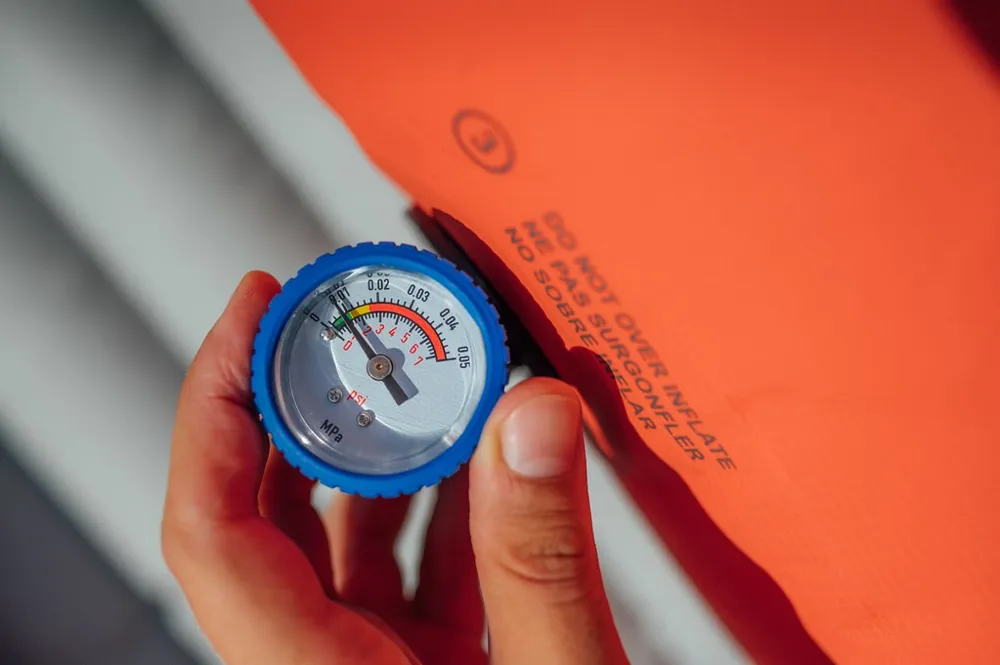
- Air chambers and valves: the side tubes and floor are inflated through valves. Check how many separate chambers a model has, and always inflate to the maker's listed pressure with a gauge.
- Floor: on budget models, an inflatable tube floor; on better models, a drop-stitch floor that inflates to a higher pressure and feels much stiffer. Whitewater inflatables often have self-bailing floors with drain holes.
- Tracking fin: a removable fin or skeg under the stern that helps the kayak go straight on flat water.
- Seats and handles: removable seats, grab handles and attachment points for gear.
Compare models in our best inflatable kayaks guide.
What Kayaks Are Made Of
| Material | Strengths | Trade-Offs |
|---|---|---|
| Rotomolded polyethylene | Tough and abrasion-resistant; the most common material | Usually the heaviest; harder to repair |
| Thermoformed plastic | Lighter and stiffer, with a shiny finish | Less forgiving of hard hits; outer layer can wear |
| Composite (fiberglass, Kevlar, carbon) | Lightest and fastest; mostly touring kayaks | Most expensive to buy and repair; dislikes direct impacts |
| PVC and drop-stitch fabric | Inflatables; pack small | Slower and more affected by wind |
| Frame and skin or folding plastic | Folding kayaks that pack into a bag or box | Assembly time |
Material has a big effect on weight; see how much does a kayak weigh. Plastic kayaks that get beached often benefit from a stick-on keel guard along the bow and keel line.
Parts of a Kayak Paddle
A kayak paddle has a blade at each end, unlike a single-blade canoe paddle:
- Blades: the wide ends that enter the water. The power face is the side that pulls against the water; the back face often has a central ridge, or spine. A dihedral blade has a rib down its center, and an asymmetrical blade is narrower and shorter on one side. Low-angle blades are long and narrow; high-angle blades are shorter and wider.
- Tip: the outer edge of each blade, the part that takes knocks on rocks.
- Throat: where each blade meets the shaft.
- Shaft: the tube you hold. It may be straight or bent (with a kinked section that puts your wrists at a more comfortable angle), and comes in standard or small diameter for smaller hands. Some shafts are oval where your hands go so you can feel the blade angle.
- Ferrule: the joint on two-piece and four-piece paddles. It lets the paddle break down and, on most, sets the feather angle.
- Feather: the angle between the two blades. Feathered blades sit offset so the blade in the air slices through wind; adjustment is often in 15-degree steps, or 0 degrees for matched blades.
- Drip rings: rubber rings near each end of the shaft that stop water running down onto your hands and lap.
Get the length right with the kayak paddle length guide, then compare options in the best kayak paddles.
Related Guides
Ready to buy a boat? Start with kayaks for beginners or step up to a touring kayak with full bulkheads and a skeg or rudder. Before you head out, pick a kayak life jacket, check your kayak's weight limit and read up on kayak transport. Still deciding on a boat type? Compare canoe vs kayak.
Frequently Asked Questions
What are the main parts of a kayak?
The bow (front), stern (back), hull (bottom), deck (top) and cockpit (where you sit). Most sit-inside kayaks add a coaming, seat, foot braces and often bulkheads and hatches, while sit-on-tops add scupper holes and molded footwells.
What is the coaming on a kayak?
The coaming is the raised rim around the cockpit opening. A spray skirt stretches over it to keep water out of the boat.
What is the difference between a skeg and a rudder?
A skeg is a fin that drops straight down near the stern to help the kayak go straight, especially in wind, but it doesn't turn. A rudder pivots side to side, controlled by foot pedals, so it can also steer.
What are scupper holes on a sit-on-top kayak?
Scuppers are sealed holes that run from the deck through the hull so water that splashes onto the deck drains out. They can also let a little water well up from below, which is why some paddlers use scupper plugs.
What is a bulkhead in a kayak?
A bulkhead is a sealed wall inside the hull that separates the cockpit from a storage compartment. It keeps that compartment drier, adds buoyancy and limits how much water the kayak can take on if you capsize.
Are kayak hatches waterproof?
Hatches are designed to keep water out, but most are water-resistant rather than fully waterproof, so pack anything that must stay dry in dry bags inside them.
What are the parts of a kayak paddle?
A kayak paddle has two blades joined by a shaft. Each blade has a power face and a back face, the throat is where blade meets shaft, and many paddles add drip rings and a ferrule joint that lets the paddle break down and set a feather angle.