Mountain Bike Racing: Every Format and How to Enter Your First Race (2026)
Mountain bike racing covers everything from 20-minute short-track sprints to seven-hour marathons and four-minute downhill runs. Here's how each format works, how the World Cup and Olympics fit in, and how to line up at your first local race.
Mountain Bike Racing in a Nutshell
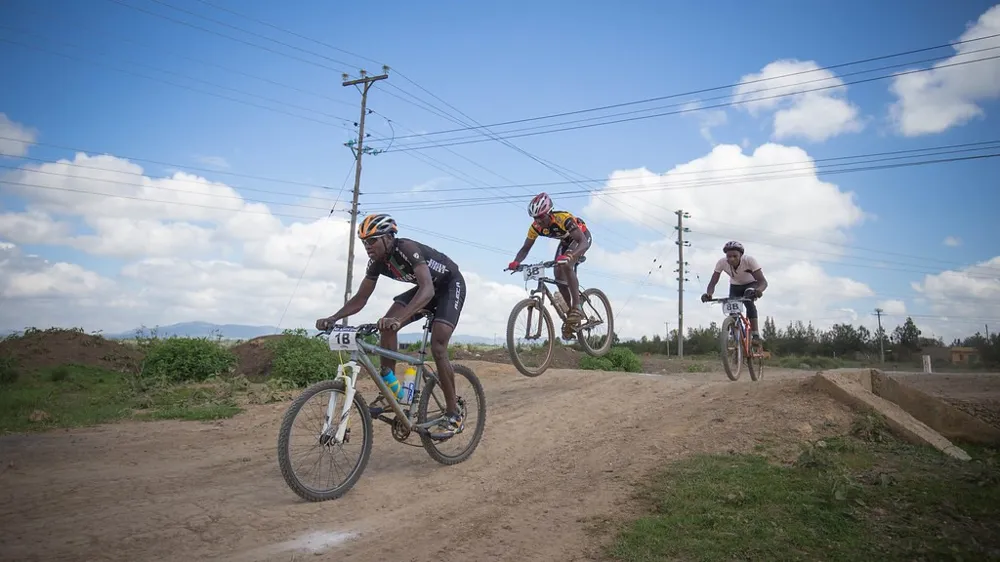
Mountain bike racing is any timed or head-to-head competition on off-road bikes. It splits into two big families. Endurance formats, led by cross-country, reward fitness: riders start together and race laps of a course that climbs as much as it descends. Gravity formats, such as downhill and enduro, reward speed and bike handling on descents: riders usually race the clock one at a time.
The sport's governing body worldwide is the UCI (Union Cycliste Internationale), which runs the World Cup, the World Championships and the Olympic cross-country rules. In the US, USA Cycling sanctions many races, alongside independent regional series and the NICA school leagues. Racing has been part of mountain biking from the start: the Repack downhill races in Marin County began in 1976, and the first UCI world championships were held in Durango, Colorado, in 1990. That story is told in our history of mountain biking.
Mountain Bike Race Formats at a Glance
Typical figures below come from UCI explainers for elite racing. Local races are usually shorter and easier.
| Format | Code | How It Works | Typical Length (Elite) |
|---|---|---|---|
| Cross-country Olympic | XCO | Mass start, several laps of a circuit | About 80–100 minutes; laps about 3.5–4.5 km |
| Cross-country short track | XCC | Mass start on a short, fast circuit | About 20–25 minutes; laps about 1–1.5 km |
| Cross-country eliminator | XCE | Sprint heats of four, top two advance | About 1 minute per heat |
| Cross-country marathon | XCM | Mass start, one long point-to-point or big loop | About 60–160 km; roughly 3–7 hours |
| Team relay | XCR | National teams, one lap per rider | One lap each |
| Downhill | DHI | Individual timed run down a steep course | About 2–5 km; roughly 3–5 minutes |
| Enduro | EDR | Several timed descents linked by untimed climbs | About 5–9 timed stages at World Cup level |
| Four-cross / dual slalom | 4X | Four (or two) riders race side by side | Under a minute per heat |
| E-MTB cross-country / e-enduro | E-XC / E-EDR | XC or enduro on pedal-assist e-bikes | Courses similar to the non-electric versions |
Cross-Country Racing: XCO, XCC, XCE and Relay
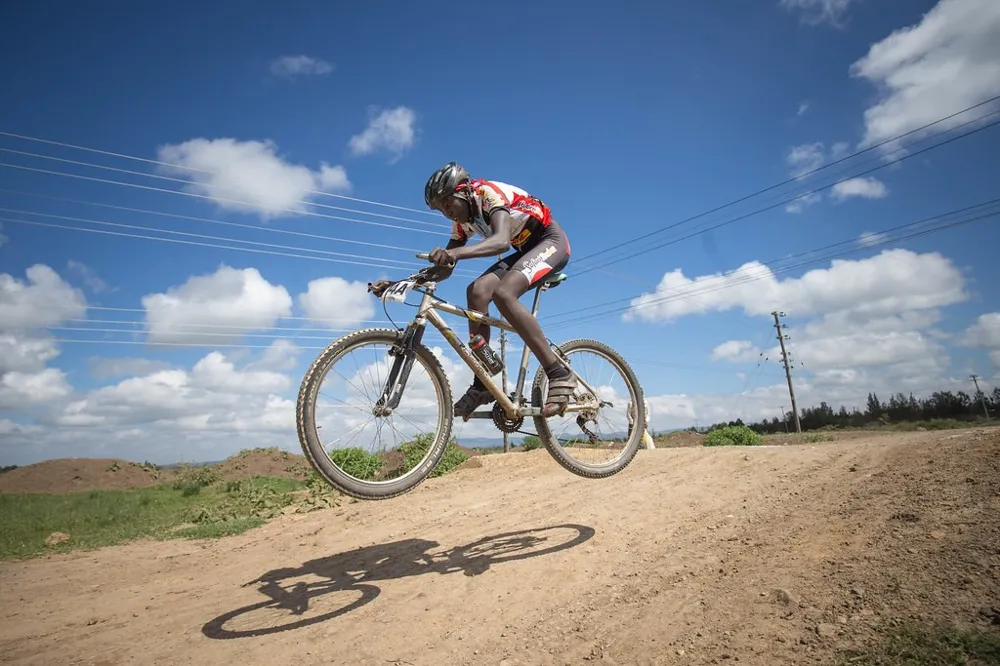
Cross-country (XC) is the most common form of mountain bike racing and the one most local races use. Everyone in a category starts together and the first across the line wins, so fitness, pacing and a good start all matter.
XCO: Olympic Cross-Country
XCO is the flagship format, raced at the Olympics, the World Championships and the World Cup. According to the UCI, World Cup laps are typically about 3.5 to 4.5 km, riders often complete 5 to 9 laps, and elite races last roughly 80 to 100 minutes (Under-23 and junior races are shorter). Courses mix steep climbs, technical descents, rock gardens, drops and singletrack, often with alternate lines that trade speed for safety.
The start is a mass start in rows, so grid position matters: at World Cups, results from the short-track race earlier in the weekend set the front rows of the XCO grid. Along the course, designated feed and technical zones let team helpers hand up bottles and help with repairs under UCI rules.
XCC: Short Track
Short-track cross-country is a fast, mostly flat-out race of about 20 to 25 minutes on a 1 to 1.5 km circuit with fewer technical sections than XCO. The UCI first awarded short-track world titles in 2021, and it's now a full World Cup discipline with its own standings.
XCE: Eliminator
The eliminator is a sprint: riders race short, roughly one-minute laps four at a time, and the top two from each heat move on until a final. It runs as its own small World Cup series (three rounds in 2026) and its own world championship, held in Barcelona in 2026.
XCR: Team Relay
The relay is a national-team event at the World Championships, first raced in 1999. Each team mixes Elite, Under-23 and Junior riders, and each rider completes one lap before tagging the next in an exchange zone.
Marathon, Stage and Endurance Racing
Cross-country marathon (XCM) is the long version of XC. The UCI describes marathon courses as roughly 60 to 160 km with several thousand meters of climbing, mixing forest roads, gravel and singletrack, and elite races take about three to seven hours. Feeding is allowed only in designated zones. The first marathon world titles were awarded in 2003, and the UCI also runs a marathon World Cup (six rounds were listed for 2026). The 2026 Marathon World Championships were held in the Primiero Valley in Trentino, Italy.
Outside the UCI calendar, endurance racing takes several other forms:
- Stage races: multi-day events where times add up across consecutive days.
- Ultra-endurance races: often around 100 miles in a single day.
- 24-hour and 12-hour races: solo riders or teams ride as many laps as possible in the time limit, including at night, so mountain bike lights are part of the kit.
Many US amateur "marathon" and endurance events are run by independent organizers with their own distances, categories and rules, so read the event page before you enter.
Enduro and E-Enduro Racing
Enduro races time only the descents. Riders ride or pedal between timed stages on untimed liaison climbs, and the lowest combined stage time wins. According to the UCI, a World Cup enduro typically has five to nine timed stages, each rider gets a set start time for every stage, and arriving late brings a time penalty. Riders may use only one frame, fork and set of wheels, which officials mark before the start, and they must make their own repairs during liaisons because outside mechanical help is not allowed on course. Local enduros are smaller, often three to five stages in a day.
The format grew quickly after the Enduro World Series began in 2013 and became the UCI Enduro World Cup in 2023. In 2026, the UCI announced that the 2026 Enduro World Cup would be the last held within the UCI Mountain Bike World Series. From 2027, the UCI Enduro and E-Enduro World Championships become enduro's main international event. The 2026 edition was scheduled for 16 to 18 October 2026 in the Finale Outdoor Region of Liguria, Italy. E-enduro runs the same kind of timed-stage format on pedal-assist e-bikes. Enduro bikes are covered in types of mountain bikes.
Downhill Racing
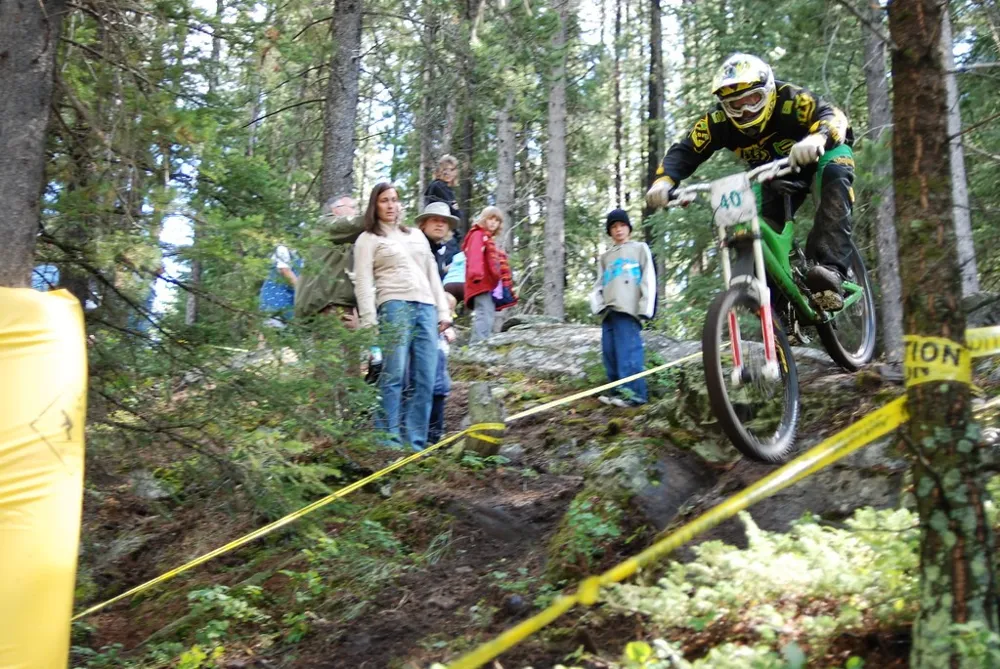
Downhill (DH or DHI) is the purest gravity format: one rider at a time, racing the clock from the top of a steep, purpose-built course to the bottom. The UCI puts elite courses at about 2 to 5 km and race runs at about three to five minutes. Riders use full-suspension downhill bikes with around 200 mm of travel, and a full-face helmet is required. Most courses are reached by ski lift, gondola or shuttle.
A downhill weekend usually includes several practice sessions, then a timed qualifying or seeding run and a final run. The fastest qualifiers start last, so the final minutes of a race are often the most dramatic. Downhill has been on the World Championships program since the first edition in 1990.
Protection matters more here than in any other format. See our guides to full-face mountain bike helmets and knee pads, and practice at lift-served bike parks before you race.
Four-Cross, Dual Slalom and Other Formats
Some formats put riders side by side instead of against the clock:
- Dual slalom: two riders race parallel courses down a short slope with berms and jumps. It was a world championship event from 2000 until four-cross replaced it in 2002.
- Four-cross (4X): four riders start together on a short downhill track with jumps, rollers and berms, a lot like a BMX race on mountain bikes. The top two from each heat advance, and races last under a minute. 4X was dropped from the World Cup after 2011 and from the World Championships after 2021; it continues through the independent 4X Pro Tour, launched in 2012.
- Super D: a long, mostly downhill course raced on a trail bike, with some pedaling. It was a short-lived US format that survives at a few events, such as the Downieville Classic in California.
- Mass-start downhill: events such as the Megavalanche in France send a big field of riders down a long descent together, starting on snow.
- Pump track racing: timed laps on a paved pump track, won by pumping and carrying speed rather than pedaling.
- Judged events: slopestyle and freeride contests, such as Red Bull Rampage and many Crankworx events, are scored by judges, not timed.
Cyclocross, the winter mix of grass, mud and short run-ups on drop-bar bikes, is a separate discipline; see what is cyclocross.
E-Mountain Bike Racing
E-MTB racing uses pedal-assist bikes whose motor help is regulated by the rules. The UCI first awarded E-MTB cross-country (E-XC) world titles at Mont-Sainte-Anne, Canada, in 2019, on courses similar to XCO, and E-XC opened the 2026 World Championships week in Val di Sole on a 2.4 km lap with 120 m of climbing. The UCI did not hold its E-MTB cross-country World Cup in 2026 after a review found the series had not met its growth goals, though E-XC remains on the world championship program. E-enduro world titles are awarded alongside the enduro championships.
At local level, e-bike classes are less common and rules vary, so check whether an event allows e-bikes and which motor class (see e-bike classes). Our electric mountain bike guide covers the bikes themselves.
How the Pro Scene Works: UCI World Cup and World Championships
Elite racing centers on two UCI events. The World Cup is a season-long points series that crowns overall winners in each discipline; since 2023 it has run as the UCI Mountain Bike World Series, promoted with Warner Bros. Discovery. The World Championships are one-off races whose winners wear the rainbow jersey for a year.
The 2026 World Series Calendar
The 2026 series ran over 14 weekends from May to October and opened in South Korea, the first cross-country World Cup rounds held in Asia. Based on the published calendar, there were nine rounds each of XCO, XCC and downhill, and six of enduro:
| Month (2026) | Venue | Disciplines |
|---|---|---|
| May | Mona Yongpyong, South Korea | XCO, XCC, DHI |
| May | Nové Město na Moravě, Czechia | XCO, XCC |
| May | Loudenvielle-Peyragudes, France | DHI, EDR |
| June | Saalfelden Leogang, Austria | XCO, XCC, DHI, EDR |
| June | Lenzerheide, Switzerland | XCO, XCC, DHI |
| June | Val di Fassa, Italy | EDR |
| July | La Thuile, Italy | XCO, XCC, DHI, EDR |
| July | Pal Arinsal, Andorra | XCO, XCC, DHI |
| July | Aletsch Arena, Switzerland | EDR |
| August | Haute-Savoie, France (Les Gets; enduro final at Morillon) | XCO, XCC, DHI; EDR final |
| September | Soldier Hollow, Utah, USA | XCO, XCC |
| September | Whistler, British Columbia, Canada | DHI |
| October | Lake Placid, New York, USA | XCO, XCC, DHI (season finals) |
The 2026 season is over as of November 2026. Final standings and the 2027 calendar are on the UCI and World Series websites.
World Championships
The main 2026 UCI Mountain Bike World Championships were held in Val di Sole, Italy, from 26 to 30 August, with 17 world titles across five formats: XCO, XCC, team relay, E-XC and downhill. Marathon, eliminator and enduro have their own separate championships. In 2027, mountain biking is part of the combined UCI Cycling World Championships in Haute-Savoie, France, with Les Gets and the Grand Massif named as venues.
Mountain Biking at the Olympics
Cross-country (XCO) is the only mountain bike event at the Summer Olympics. It debuted at the 1996 Atlanta Games, with one men's and one women's race. Downhill and enduro have never been Olympic events.
| Games | Mountain Bike Facts |
|---|---|
| Atlanta 1996 | Cross-country makes its Olympic debut |
| Paris 2024 | Raced on Élancourt Hill; Tom Pidcock (Great Britain) wins the men's race over eight laps, retaining his Tokyo 2020 title, and Pauline Ferrand-Prévot wins women's gold for France |
| Los Angeles 2028 | Planned for the Industry Hills MTB course in the City of Industry, Los Angeles County |
For other two-wheel Olympic events, see Olympic BMX, which covers BMX racing and freestyle.
Racing in the US: USA Cycling, NICA and Local Series
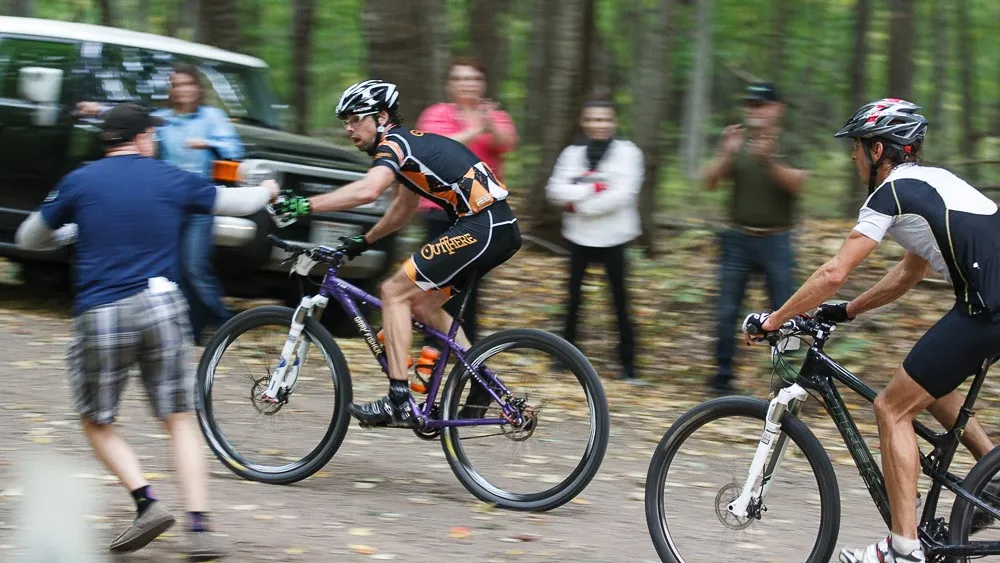
Most US racers never go near a World Cup. They race in state and regional series, many sanctioned by USA Cycling (which absorbed NORBA, the original US mountain bike racing body founded in 1983) and many run independently.
USA Cycling Categories and Licenses
According to USA Cycling, mountain bike racers are grouped by category, age and gender:
| Category | Level |
|---|---|
| Category 3 (Novice) | Beginner; where everyone starts |
| Category 2 | Amateur |
| Category 1 | Elite |
| Pro | Professional |
You move up by earning upgrade points from results, tracked in your USA Cycling account. To race a sanctioned event you need either a one-day license for that race or an annual membership, which includes a racing license for 12 months and lets you earn upgrade points. Junior racers are usually grouped in two-year age bands. Independent series often use their own beginner, sport and expert classes instead. Category rules can change, so check USA Cycling's current upgrade policy (last checked November 2026).
NICA: School Mountain Bike Leagues
The National Interscholastic Cycling Association (NICA), formed in 2009, runs school-based mountain bike leagues for middle and high school students. Its league list shows 33 leagues across about 30 states as of November 2026, starting from the NorCal league founded in 2001. Teams train with licensed coaches, and racing is cross-country, with team scores built from riders' results across a season of races. Fall leagues typically race from August to November, and spring leagues from late January or February to June. Eligible grades and rules vary by league, so contact your state league for details. NICA also runs programs such as GRiT (Girls Riding Together) and Teen Trail Corps.
Race Bikes and Gear by Discipline
"Mountain bikes for racing" means different things in each format:
| Discipline | Typical Bike | Key Gear |
|---|---|---|
| XC, short track, marathon | Light hardtail or short-travel full suspension (about 100–120 mm) | Helmet, clipless shoes, gloves, bottles or hydration pack |
| Enduro | Enduro bike (about 150–180 mm), able to pedal back up | Trail or convertible helmet, knee pads, tools and spares carried on the bike |
| Downhill | Downhill bike (about 180–200 mm or more) | Full-face helmet, goggles, knee and elbow pads, body armor often worn |
| 4X, dual slalom, pump track | Hardtail or short-travel bike, or a dirt jumper | Full-face helmet, gloves, pads |
The travel ranges match our types of mountain bikes guide. To choose a frame style, read hardtail vs full suspension, then best hardtail mountain bikes or best full suspension mountain bikes. For racing contact points, see mountain bike shoes, pedals and tires. Always check each event's rules for required protective gear.
How to Start Mountain Bike Racing
- Pick a format. A local cross-country race is the easiest first step: short beginner laps, a mass start and no lift ticket. If descending is your strength, a local enduro is a friendly second option.
- Find a race. Search BikeReg or your state's race series, look for the USA Cycling logo on sanctioned events, or ask a local shop or club. Teens can look for a NICA league in their state.
- Use the bike you have. Beginner XC classes accept most mountain bikes in good working order. Get it serviced before race day, set your tire pressure and check your brakes.
- Get the right license. Buy a one-day license for a USA Cycling event, or an annual membership if you plan to race often and move up.
- Enter the right class. Start in Category 3 or the beginner class for your age group. Moving up early only means harder racing, not better results.
- Train for the format. For XC, build endurance with regular rides plus some harder interval efforts. For gravity racing, practice bike handling skills and ride similar terrain at well-known trail systems or parks.
- Pre-ride the course. Ride it the day before or during practice, learn the A and B lines and note where to pass.
Race Day Tips
- Arrive early. Check in, collect your number plate, pin or zip-tie it to the handlebar and pre-ride if practice is open.
- Warm up. Ten to fifteen minutes of easy spinning, with a few short harder efforts before an XC start.
- Eat and drink what you know. Don't try new food or drinks on race day; carry enough water for the distance.
- Start steady. Mass starts are fast. Settle into a pace you can hold rather than blowing up on lap one.
- Pass politely. Call your pass ("rider back, on your left"), and let faster riders through when it's safe. In timed formats, a rider who has caught you usually has the right of way.
- Carry basic repairs. A tube or plug kit, a multi-tool and a pump or CO2 can save your race. In enduro you must fix problems yourself.
- Know when to stop. If you crash hard, especially with any head impact, stop and get checked; replace a helmet after a significant crash.
Keep Exploring
Start with our mountain biking guides and the history of mountain biking. For the BMX side of racing, read what is BMX racing, best BMX race bikes and Olympic BMX. For more two-wheel racing, see what is cyclocross.
Frequently Asked Questions
What are the main types of mountain bike racing?
The main types are cross-country (including Olympic XCO, short-track XCC, eliminator XCE and marathon XCM), downhill, enduro and head-to-head formats such as four-cross and dual slalom. E-mountain bike versions of cross-country and enduro are also raced.
Which mountain bike race is in the Olympics?
Only cross-country (XCO). It has been on the Olympic program since the 1996 Atlanta Games. Downhill, enduro and other formats are not Olympic events.
How long is a cross-country mountain bike race?
At World Cup level, an elite XCO race lasts roughly 80 to 100 minutes over several laps of a course of about 3.5 to 4.5 km. Short-track XCC races last about 20 to 25 minutes, and local beginner races are usually much shorter than elite races.
Can I race on a regular mountain bike?
Usually, yes, in a beginner category. Most entry-level cross-country races accept any mountain bike that's in good working order, and many local racers start on the trail bike they already own. Downhill races normally require a full-face helmet and a bike suited to steep, rough terrain, so check the event rules.
Do I need a license to race mountain bikes in the US?
For USA Cycling sanctioned events you need either a one-day license, bought for that race, or an annual membership that includes a racing license. Many independent and regional series run under their own rules, so check the event page.
What category should a beginner race in?
At USA Cycling events, mountain bike racers start in Category 3 (Novice) and move up to Category 2 and Category 1 by earning upgrade points. Local series that aren't sanctioned by USA Cycling often use beginner, sport and expert classes instead.
Is the enduro World Cup ending?
The UCI has announced that the 2026 Enduro World Cup is the last one held as part of the UCI Mountain Bike World Series. From 2027, the UCI Enduro and E-Enduro World Championships become enduro's main international event.
How can kids and teens start mountain bike racing?
In many US states, NICA leagues run school-based mountain bike teams and races for middle and high school students, with coached practices and a fall or spring season. Local race series and USA Cycling events also have junior age-group categories.