Kayak Safety: How to Paddle Smart and Come Home Every Time (2026)
Most paddling deaths are drownings, and most of those victims weren't wearing a life jacket. Here are the habits, skills and rules that keep kayakers safe.
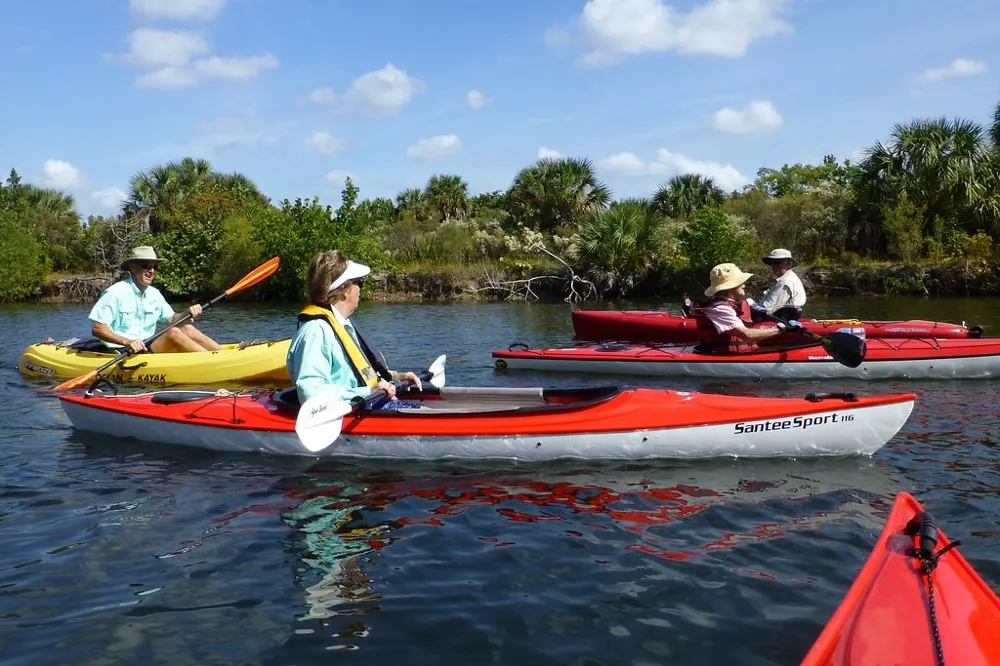
Kayak Safety at a Glance
Kayaking is one of the easiest water sports to start, and that's part of the risk: it's easy to paddle farther, into colder water or rougher conditions than your skills can handle. The good news is that most kayak accidents trace back to a short list of preventable causes. This guide covers the habits that matter most and links to our detailed guides for gear and skills. It is a planning guide, not a substitute for hands-on training with a qualified instructor.
| Safety Habit | Why It Matters | Where to Learn More |
|---|---|---|
| Wear a life jacket, buckled, every trip | Most paddling deaths are drownings | Kayak PFDs |
| Dress for the water temperature | Cold shock can incapacitate you in minutes | What to wear kayaking |
| Check wind, weather and tides | Conditions change faster than a kayak can get to shore | This page |
| Leave a float plan | Someone knows when to call for help | This page |
| Paddle with others | Assisted rescues are faster than self-rescues | This page |
| Practice wet exits and re-entry | A capsize is only dangerous if you can't recover | Getting in and out of a kayak |
| Carry a whistle and a white light | Required by federal rules and helps others find you | Kayak accessories |
| Stay out of boats' way | Kayaks sit low and are hard to see | This page |
| Avoid low-head dams and strainers | Both can trap and drown even strong swimmers | This page |
| Take a course | Rescue skills are best learned in person | This page |
What the Coast Guard Numbers Show
The US Coast Guard's 2024 Recreational Boating Statistics report counted 556 boating deaths across all boat types, which the Coast Guard called the fewest since it began collecting statistics more than 50 years ago. Paddlecraft are a big share of that total:
| Vessel Type (2024) | Total Deaths | Drownings | Share of Deaths From Drowning |
|---|---|---|---|
| Kayak | 89 | 77 | 87% |
| Canoe | 25 | 21 | 84% |
| Stand up paddleboard | 29 | 26 | 90% |
| All paddlecraft | 143 | 124 | About 87% |
Source: USCG 2024 Recreational Boating Statistics (Table 24 and Table 1). Kayaks alone accounted for about 16% of all boating deaths that year, according to the report's summary.
Three other findings from the 2024 report apply directly to paddlers:
- Where life jacket use was known, 87% of drowning victims weren't wearing one.
- Alcohol was the leading known contributing factor in fatal accidents, listed in 20% of deaths.
- Across all boat types, roughly 70% of deaths happened on boats whose operator had not received boating safety instruction.
Put simply: wear the life jacket, stay sober on the water and get some instruction. Those three habits address most of what the numbers show.
Always Wear a Life Jacket
In the US, a kayak is a vessel, so federal Coast Guard rules apply. Each person needs a properly sized, Coast Guard approved wearable life jacket in good condition, and federal rules require children under 13 to wear one while underway unless a state sets its own age. States add their own rules: some require all paddlers to wear life jackets during cold months, and child age limits vary. Our kayak accessories guide has a table of the federal requirements with state examples, and kayak registration laws covers state rules for registration and motors. Check your state boating agency before you go; this is a summary, not legal advice. Last checked November 2026.
The law says carry it. Safety agencies and paddling instructors say wear it, zipped and buckled, every time. A capsize happens in seconds, and in cold water you may not be able to grab, put on and fasten a jacket while gasping. A paddling-specific vest with large armholes and a high-cut back is comfortable enough to forget you're wearing it. For fit checks, Coast Guard labels and the newer performance-level ratings, see our best kayak PFDs guide. Bright colors help boaters and rescuers see you.
Respect Cold Water

Cold water is one of the biggest risks in kayaking because it acts faster than most people expect. Water pulls heat from your body far faster than air (NRS notes it's some 25 times faster), so a warm, sunny day on cold water can still be dangerous if you capsize. The National Weather Service warns that the cold shock response, an involuntary gasp and rapid breathing, can last for the first 2 to 3 minutes or more after you fall in and can be severe in water of 50 to 60°F. A gasp with your head underwater can cause drowning before cold ever affects your muscles.
You may hear the 1-10-1 rule. The Canadian Safe Boating Council teaches it as a memory aid: about 1 minute to get your breathing under control, about 10 minutes of useful movement, and up to about 1 hour before hypothermia makes you unconscious. Treat it as a reminder of how quickly things happen, not a schedule. The National Center for Cold Water Safety warns that the rule understates the danger: breathing can stay out of control for longer than a minute, your ability to swim and grip fades steadily, and people without thermal protection are likely to drown from incapacitation long before they become hypothermic.
What to do about it:
- Dress for the water temperature, not the air. A common guideline paddlers use is that if the air and water temperatures added together are below about 120°F, wear a wetsuit or drysuit. REI, citing the Coast Guard, advises a wetsuit or drysuit when water is below 70°F.
- Check the water temperature before you go, especially in spring, when warm air sits over water still cold from winter.
- Stay close to shore in cold water, so a swim is short.
- If you go in: keep your face out of the water, hold onto your boat and focus on slowing your breathing before you try anything else.
Our guides to what to wear kayaking and wetsuits vs drysuits cover the clothing in detail. A spray skirt keeps water out of a sit-inside cockpit but is not immersion protection.
Check Weather, Wind and Tides
A kayak is slow, so conditions can change faster than you can get back to shore. Before every trip:
- Read the forecast for the time you'll be out, including wind speed and direction. If the forecast is iffy, go another day.
- Plan around the wind. On open water, wind builds waves and can push you away from shore. A common beginner tactic is to paddle into the wind on the way out so it helps you on the way back, rather than fighting it when you're tired.
- Check tides and currents on the coast and in tidal rivers. A tidal current running against you can stall progress, and wind blowing against a current builds steeper, rougher water. Plan crossings and your return around the tide tables.
- Watch the sky while you paddle. Keep an eye on clouds building upwind, and check updates with a phone app or VHF weather channel where you have one.
- Lightning: if thunder or lightning arrives, get off the water right away. A paddler on open water is often the highest point around.
- Ask locally about wind patterns, currents, swells and underwater hazards. Agencies that patrol the water, paddling shops and clubs know the spots that catch visitors out.
Large lakes and the ocean need extra caution. Our ocean kayak and touring kayak guides cover boats built for open water.
Plan Your Route and Leave a Float Plan
Pick a trip within the weakest paddler's ability. Everyone should be able to cover the return distance comfortably, not just the outbound leg. Good first destinations are small, sheltered bodies of water with little powerboat traffic, routes that stay near shore, and places popular with other paddlers.
Then write a float plan and leave it with someone who will notice if you don't come back. It should include:
- Who is going, with phone numbers and a description of each boat (type and color).
- Where you'll launch and take out, and your planned route.
- When you'll launch, when you expect to return, and the time at which they should call for help.
- What they should do if you're overdue, including which agency to call.
Keep a copy in your car and one in your boat. Tell your contact when you're back, so they don't raise an alarm. A kayak GPS or phone app can track your route, but it doesn't replace a plan someone else holds.
Paddle With Others
Paddling alone shrinks your margin for error. A partner can stabilize your boat for re-entry, help you empty it and go for help if you're hurt, and an assisted rescue is usually faster than a self-rescue. As REI puts it, there's no such thing as a self-tow if you're injured.
- Stay together, within earshot or a whistle blast of each other. Spread-out groups lose the benefit of paddling together.
- Agree on signals and a plan before launching: who leads, who sweeps at the back and when to turn around.
- Match the trip to the group. In sit-inside kayaks, everyone should know how to wet exit, and at least one person should know how to perform an assisted rescue.
- Tandems count too. Two people in one tandem kayak share one boat; if it flips, both are in the water.
If you do paddle solo, stay on familiar, sheltered water near shore, leave a detailed float plan and carry a way to call for help, such as a phone in a waterproof case where coverage is reliable, or a VHF radio where it isn't.
What to Do If You Capsize
Every kayaker eventually ends up in the water. A capsize is manageable if you've practiced the recovery in calm, warm water first. The basics:
- Stay calm and control your breathing. Keep your face clear of the water, especially if it's cold.
- Hold onto your kayak and paddle. The boat is a large, visible float and your way home. Stay on the upstream side of the boat in current, so it can't pin you against an obstacle.
- Get out of a sit-inside kayak with a wet exit. Lean forward, pull the spray skirt's grab loop forward and up, and push yourself out. Practice it in shallow water before you need it. See spray skirts for grab-loop safety.
- Get back in. On a sit-on-top, flip the boat, kick and pull yourself across the seat. In a sit-inside, use a paddle float self-rescue or an assisted rescue such as the T-rescue, where a partner lifts and drains your bow and holds your boat while you climb in. Step-by-step methods are in our guide to getting in and out of a kayak.
- Pump out the water with a bilge pump or sponge before paddling on, or the boat will stay unstable.
- If you can't get back in, decide early whether to swim the boat to the nearest shore or signal for help. In cold water, act quickly while your hands still work.
Experienced sea and whitewater paddlers also learn to roll a kayak, which rights the boat without leaving it. A roll is a useful extra skill, but it doesn't replace a life jacket or rescue skills.
Overloading makes a capsize more likely, because a heavy kayak sits low and takes on water easily. Stay well under your boat's limit; see kayak weight limits.
Signals: Whistles, Lights and Distress Signals
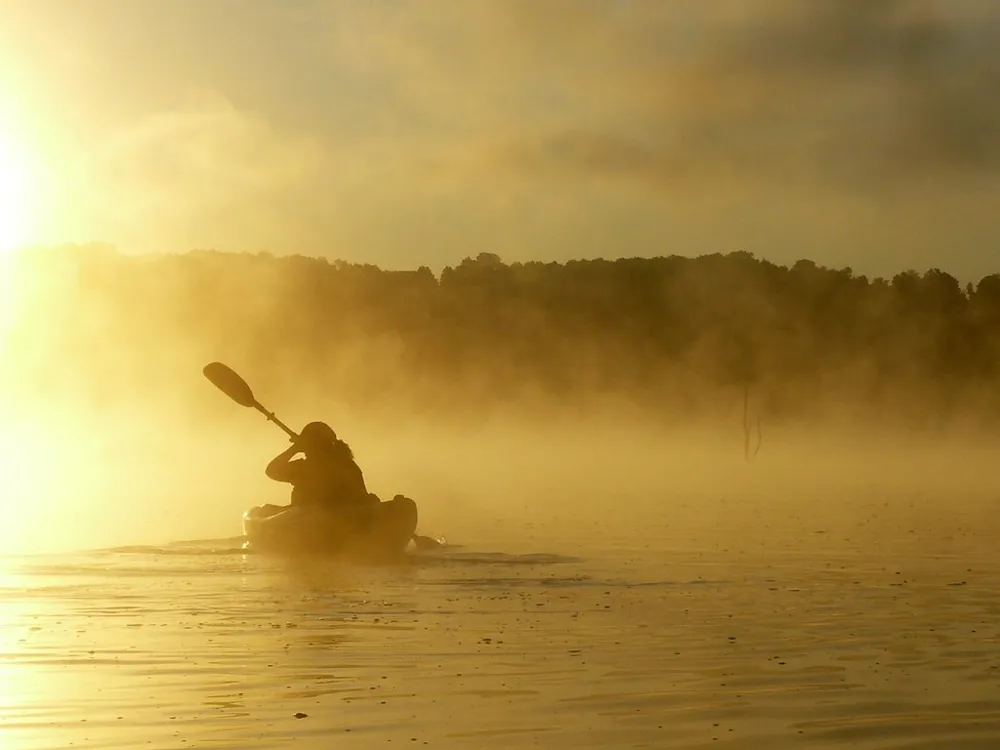
Federal rules require paddlers to carry a sound-producing device, such as a whistle, horn or bell. Attach a whistle to your life jacket so it's always within reach, even in the water. A common paddling convention is one blast to get attention and three blasts to call for help; if you forget the count, keep blowing.
Lights: between sunset and sunrise, and in fog or other restricted visibility, a kayak must have a white light, such as a flashlight or lantern, ready to show in time to prevent a collision. Paddlecraft don't need the red and green sidelights of powerboats. A light on a mast or the back of your hat is easier to see than one on the deck, and reflective tape on paddle blades helps too. Our kayak accessories guide covers light options.
Distress signals: kayaks and canoes don't have to carry daytime visual distress signals, but on coastal waters between sunset and sunrise, approved night signals are required, for example three pyrotechnic night flares or one Coast Guard approved electric distress light. Many coastal paddlers also carry a waterproof VHF radio in a PFD pocket. Rules vary by state and water body, so check yours.
Sharing the Water With Boats
Kayaks sit low and are hard to see from a powerboat's helm, especially in glare, waves or low light. Paddle as if no one can see you and as if you never have the right of way.
- Stay out of channels. Under the federal navigation rules, a vessel less than 20 meters long, which includes every kayak, must not impede a vessel that can safely navigate only within a narrow channel or fairway. Keep to the edge, outside the marked channel where you can.
- Cross channels quickly, at a right angle, as a tight group, and only when the way is clear. The rules also say you must not cross a narrow channel if doing so impedes a vessel that can only navigate within it.
- Use the clock-face check. Note where an approaching boat sits relative to your bow, with your heading at 12 o'clock. If it stays at the same "o'clock" as you keep checking, you're on a collision course. Change direction until its position changes, or stop and let it pass.
- Watch behind you. A boat overtaking you is responsible for avoiding you, but don't count on its skipper seeing you.
- Be visible. Bright boats, bright life jackets, reflective tape and, near dusk, a light. Kayak anglers often add a flag.
River Hazards: Low-Head Dams, Strainers and Rapids
Moving water adds hazards that lake paddlers never meet. Learn the hazards on your stretch of river before you launch, and plan carries (portages) around them.
Low-Head Dams
A low-head dam is a man-made barrier built across a river from bank to bank, with water flowing over its entire crest. Indiana's Department of Natural Resources describes them as typically 1 to about 15 feet tall and "deceivingly dangerous." At higher flows, the water below the dam forms a recirculating current that can push a person underwater and pull them back to the face of the dam over and over. Strong swimmers and rescuers wearing life jackets have drowned at them.
- They're hard to spot. Many aren't marked, and the water above can look calm. Watch downstream for a smooth horizon line where the water seems to end, or concrete or stone walls along the banks.
- Never paddle over one, and stay well away from both the upstream and downstream sides.
- Portage early. Get to shore far enough upstream that the current can't carry you over, and re-launch far enough downstream that the current can't pull you back.
- Be extra careful at high water, when the hydraulic is strongest.
- Don't go in after someone. Indiana DNR says about 25% of low-head dam deaths are people trying to rescue someone else. Get to shore and call for help.
Strainers
A strainer is anything that lets water flow through but not a boat or a body, most often a fallen tree or branches in current. The current can trap a kayak against it and pull a paddler under. Always steer well clear, especially on outside bends where trees fall in. If you're swept into one with no way around, boating safety courses teach trying to pull yourself up and over the top rather than getting pushed under it.
Rapids, Bridges and Other Obstacles
Land well upstream to scout rapids you can't see through, and carry around anything beyond your skill. Take out and portage around waterfalls. Use caution near bridge piers and other man-made structures, and watch for fences and low wires across small creeks. Whitewater paddling needs specific boats, a helmet and training; see whitewater kayaks.
Take a Kayaking Safety Course
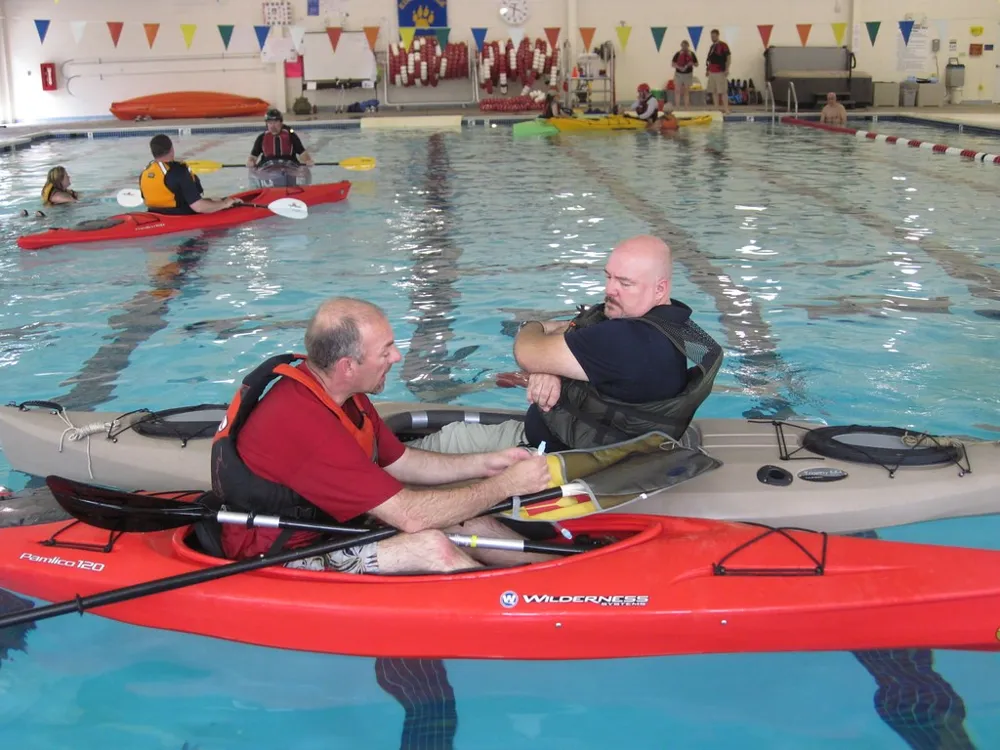
Reading about rescues is not the same as doing them. A short course teaches wet exits, re-entry and assisted rescues in a controlled setting, often a pool or a calm beach, with an instructor watching. The American Canoe Association (ACA) publishes course outlines such as Level 1: Introduction to Kayaking and Level 2: Essentials of Kayak Touring, and lists classes in a course calendar on its website. Paddling clubs, outfitters, parks departments and some colleges run ACA-certified and other classes. Many state boating agencies also offer boating safety education.
A sensible progression is a basic course before your first unguided trips, then a rescue or touring course before open water, cold water or longer trips, and a dedicated whitewater course before running rivers. Pool sessions are also the place to start learning to roll.
Common Kayak Safety Mistakes
- Carrying the life jacket instead of wearing it. Strapped to the deck, it won't help when you're in the water.
- Dressing for the air. Cotton and shorts on a warm spring day over cold water is a classic setup for trouble.
- Drinking alcohol. It slows reactions and worsens balance and cold-water response; it was the leading known factor in 2024 boating deaths.
- Going too far out. Plan for the paddle back, into the wind, when you're tired.
- Never practicing a capsize. The first wet exit shouldn't happen on a cold, windy day.
- Overloading the kayak or putting heavy gear high on the deck.
- Paddling across channels or into boat traffic as if you'll be seen.
- Ignoring river hazards such as low-head dams and strainers.
- Leaving no float plan, so no one knows when to raise the alarm.
New to the sport? Start with how to paddle a kayak and kayaks for beginners, or browse our kayaking hub.
Your Pre-Launch Safety Checklist
| Check | Done? |
|---|---|
| Life jacket on, zipped and buckled, with a whistle attached | ☐ |
| Clothing suits the water temperature (wetsuit or drysuit if cold) | ☐ |
| Forecast, wind and tides checked; turnaround time set | ☐ |
| Float plan left with someone ashore | ☐ |
| Phone in a waterproof case or VHF radio | ☐ |
| White light packed if there's any chance of dusk, dark or fog | ☐ |
| Bilge pump or sponge, paddle float and a spare paddle for longer trips | ☐ |
| Water, snacks, sun protection and essentials in a dry bag | ☐ |
| Route checked for dams, strainers and boat channels | ☐ |
| Kayak loaded below its weight limit | ☐ |
For the full gear list and what to buy first, see our kayak accessories checklist. Heading out overnight? Add the kayak camping gear list.
Frequently Asked Questions
Do you have to wear a life jacket in a kayak?
Federal rules require a properly sized, Coast Guard approved wearable life jacket on board for each person, and children under 13 must wear one while underway unless a state sets its own age. Adults usually aren't required to wear one, but safety agencies and paddling instructors recommend wearing it every time, because there is rarely time to put one on after a capsize.
What is the 1-10-1 rule in kayaking?
It's a cold-water memory aid taught by the Canadian Safe Boating Council: about 1 minute to get your breathing under control, about 10 minutes of useful movement and up to about 1 hour before hypothermia makes you unconscious. The National Center for Cold Water Safety says it understates the danger, because people can lose the ability to swim long before 10 minutes, so dress for immersion instead of counting on the timeline.
Is it safe to kayak alone?
Paddling alone reduces your margin for error, because a partner can rescue you faster than you can rescue yourself and can go for help if you're hurt. If you do paddle solo, stay on familiar, sheltered water close to shore, leave a detailed float plan and carry a way to call for help.
What do I do if my kayak tips over?
Stay calm, hold onto your boat and paddle, and get your breathing under control. In a sit-inside kayak, pull the spray skirt's grab loop and slide out (a wet exit). Then re-enter with a partner's help or a paddle float, or swim the boat to shore if it's close and the water is warm.
What sound signals should a kayaker use?
Carry a whistle on your life jacket. A common paddling convention is one blast to get attention and three blasts to call for help. Federal rules require a sound-producing device such as a whistle, horn or bell.
Do kayaks need lights at night?
Yes. Between sunset and sunrise, and in fog or other restricted visibility, a kayak must have a white light, such as a flashlight or lantern, ready to show in time to prevent a collision. On coastal waters at night, approved night distress signals are also required.
Why are low-head dams so dangerous for kayakers?
Water pouring over a low-head dam forms a recirculating current at its base that can hold a person and pull them back to the dam face repeatedly. They can look calm from upstream, so learn where they are and carry around them well upstream.