Ocean Kayaks That Handle Surf, Swell and Salt Water (2026)
Sit-on-top and sea kayak picks for salt water, with the skills that matter more than the boat: surf launches, tides, wind, rescues and cold water.
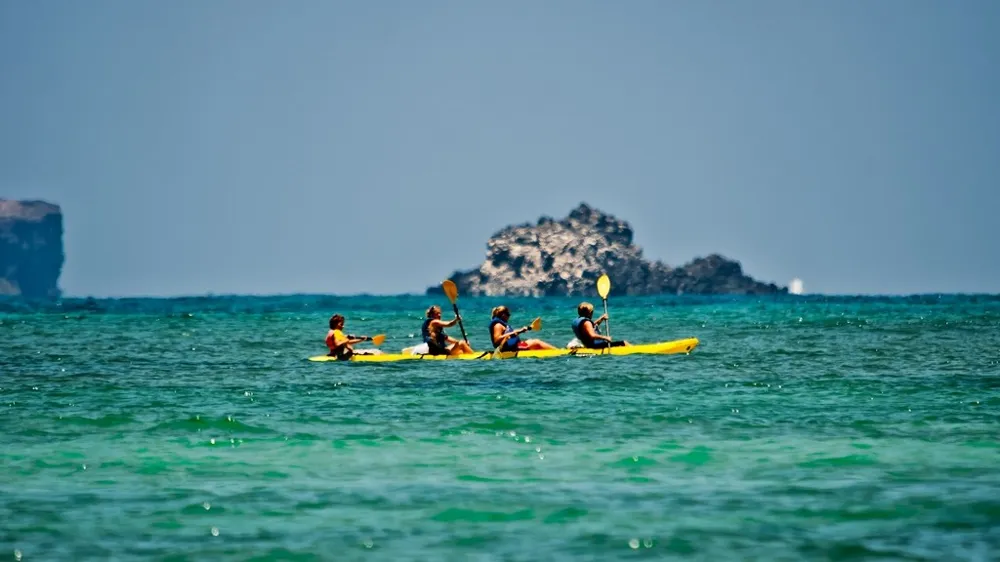
Why Ocean Kayaks Are Different
Salt water asks more of a kayak than a pond does. Waves break on the beach, wind blows harder away from shore, tides move water in and out, and the water is often colder than the air. A good ocean kayak copes with all of that. It launches and lands through small surf, drains or seals out water, tracks straight in a breeze, and can be re-entered from deep water.
Most people searching for an ocean kayak want one of two boats. One is a sit-on-top for beaches, bays, snorkeling and near-shore fishing. The other is a sea kayak, a longer sit-inside with sealed hatches for coastal trips. "Ocean Kayak" is also a brand name, so this guide covers that brand honestly too. Our picks mix Ocean Kayak boats with models from other makers. If you want a long-distance expedition boat, our touring kayak guide covers sit-inside sea kayaks in more depth.
Ocean Kayak Malibu 11.5
Best all-round ocean sit-on-top
- Hull designed for stability in surf
- Between-the-legs QuickStash dry hatch
- 299 lb usable capacity
Wilderness Systems Tarpon 105
Best for coastal day trips and light fishing
- Locking bow hatch and rear tank well
- Phase 3 AirPro seat
- Replaceable skid plate
Perception Carolina 14
Best sit-inside for coastal paddling
- 14 ft V-shape hull with flared bow
- Sealed bow and stern hatches with bulkheads
- Rudder-capable
Best Ocean Kayaks Compared
Specs are maker or retailer-listed figures. "Capacity" is the listed maximum load, and a kayak handles best well below it (see our kayak weight limit guide).
| Kayak | Style | Length | Width | Weight | Capacity | Best For |
|---|---|---|---|---|---|---|
| Ocean Kayak Malibu 11.5 | Sit-on-top | 11 ft 5 in | 31 in | 61 lb | 299 lb usable | Surf, beaches, bays |
| Wilderness Systems Tarpon 105 | Sit-on-top | 10 ft 6 in | 32 in | 57.5 lb | 325 lb | Coastal day trips, light fishing |
| Perception Carolina 14 | Sit-inside day touring | 14 ft | 24.5 in | 57 lb | 300 lb | Coastlines and sheltered bays |
| Ocean Kayak Malibu Two XL | Tandem sit-on-top | 13 ft 4 in | 35 in | 90 lb | 491 lb | Couples and families |
| Ocean Kayak Malibu 9.5 | Sit-on-top | 9 ft 5 in | 33 in | 54 lb | 271 lb | Smaller paddlers, calm beaches |
| Ocean Kayak Malibu Pedal | Pedal sit-on-top | 12 ft | 35 in | 105 lb | 345 lb | Hands-free cruising and fishing |
The Best Ocean Kayaks
1. Ocean Kayak Malibu 11.5
The Malibu 11.5 is the solo all-rounder in the Old Town Ocean Kayak line. Old Town lists it at 11 ft 5 in long, 31 inches wide and 61 lb, with a 299 lb usable capacity (360 lb total including the boat). The maker describes a surf-ready hull designed for stability in surf. Fittings include an adjustable AirComfort backrest, molded foot wells with calf rests, a QuickStash dry hatch between your legs, a bow hatch, a stern tank well with bungees and a YakLock security bar. The hull is single-layer polyethylene and the boat is stackable for storage.
Good to Know
- Hull built with surf stability in mind
- Simple, open deck that is easy to remount
- Molded paddle rest and cup holders
Watch Out For
- No rudder, rod holders or accessory tracks
- Small hatches, so pack light or bring dry bags
2. Wilderness Systems Tarpon 105
The Tarpon 105 is a 10 ft 6 in sit-on-top that Wilderness Systems lists as suited to rivers, lakes or oceans. Specs are 32 inches wide, 57.5 lb and a 325 lb maximum capacity. It has the Phase 3 AirPro seat with three-point adjustment, a locking bow hatch, a removable center dry box, a large rear tank well, configurable deck bungees and a replaceable skid plate, which helps on boats dragged up sand and shingle. The maker describes good initial stability and solid secondary stability with straight tracking.
Good to Know
- Integrated DryTec case and MagnaTec bottle holder
- Flexible mounting options for accessories
- Lifetime limited warranty listed by the maker
Watch Out For
- Some colors are listed as discontinued, so check stock
- Shorter hull is slower than a 12 ft+ boat on long crossings
3. Perception Carolina 14
If you want a sit-inside for the coast without jumping to an expedition boat, the Carolina 14 is a 14 ft day tourer. Perception lists front and rear hatches with sealed covers and bulkheads plus flotation foam, a six-way adjustable seat, adjustable footrests and thigh padding. The boat is rudder-capable with a kit sold separately. REI lists it at 24.5 inches wide, 57 lb and 300 lb capacity, with a V-shape hull, soft chines, an upswept flared bow and reflective perimeter deck lines.
Good to Know
- Sealed compartments keep it afloat if swamped
- Perimeter lines to grab during rescues
- Pairs with a spray skirt for choppy water
Watch Out For
- Needs a wet exit and paddle float rescue skills
- A long sit-inside is harder to handle in breaking surf
4. Ocean Kayak Malibu Two XL
A tandem sit-on-top with two or three seating positions, so two adults can paddle with a child or dog in the middle. REI lists it at 13 ft 4 in, 35 inches wide, 90 lb and 491 lb capacity. It has adjustable AirComfort seats, a QuickStash dry hatch near each seat, redesigned scupper placement for drainage and open bow and stern tank wells. For more two-person options, see our tandem kayak guide.
Good to Know
- Room for two adults plus a small passenger
- Wide, open deck for beach days
Watch Out For
- At 90 lb it is a two-person carry; a kayak cart helps
5. Ocean Kayak Malibu 9.5
The short version of the Malibu, at 9 ft 5 in, 33 inches wide and 54 lb, with a 271 lb capacity (REI). It shares the AirComfort backrest, calf rests, QuickStash dry hatch and YakLock bar of the 11.5. The shorter hull is easier to carry and turn, which suits smaller adults on calm beaches and in bays.
Good to Know
- Easier to lift and store than longer sit-on-tops
- Wide for its length
Watch Out For
- Slower and less straight-tracking than the 11.5 on open water
6. Ocean Kayak Malibu Pedal
A pedal-drive sit-on-top that frees your hands for fishing, photos or a map. REI lists it at 12 ft, 35 inches wide, 105 lb and 345 lb capacity, with a rudder and a mesh suspension seat. A paddle is not included, and you should always carry one in case the drive fouls or fails. Compare more drives in our pedal kayak guide.
Good to Know
- Leg power and a rudder help hold a course in wind
- Wide, stable platform
Watch Out For
- Heavy to launch through surf and drag up a beach
- Carry a paddle as a backup to the drive
Sit-on-Top vs Sea Kayak on Open Water
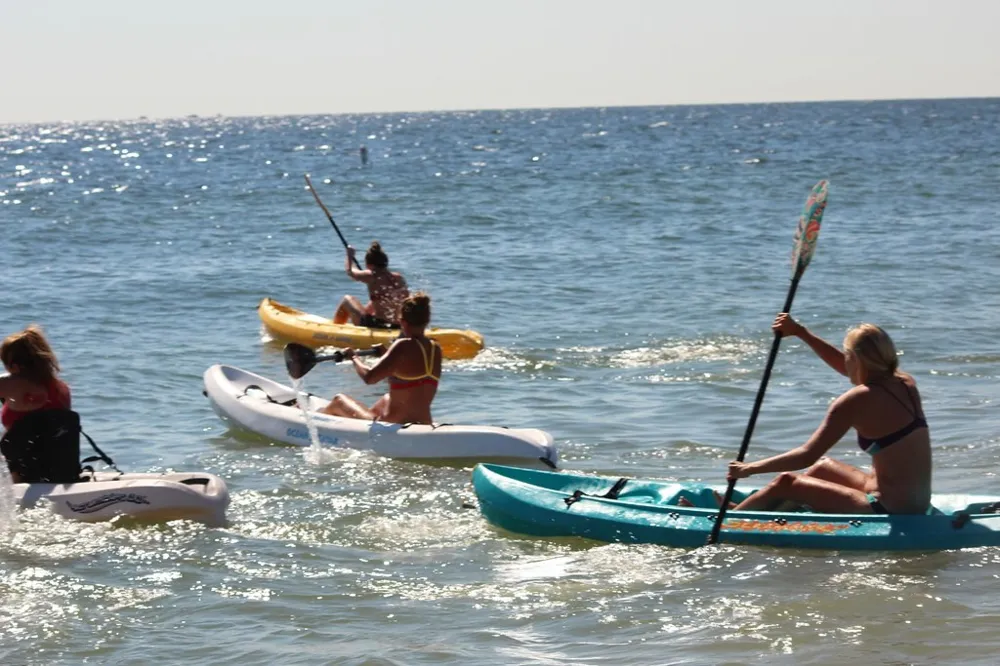
Both boats work on the ocean, but they suit different trips. A sit-on-top is a sealed hull with a molded seat on deck. Water that splashes on drains back out through scupper holes, and if you flip, you roll it back over and climb on. That makes it the default for surf zones, warm water, snorkeling and fishing near shore. The trade-off is exposure: you sit in the spray and wind, which matters in cold water.
A sea kayak is a longer, narrower sit-inside with bulkheads, hatches, deck lines and usually a skeg or rudder. With a spray skirt you stay drier and warmer, and the long hull is faster and holds a line over distance. But after a capsize you need a wet exit and a rescue technique to get back in and pump out.
The boat to avoid on open water is a short recreational sit-inside with a big cockpit and no sealed bulkheads. If it swamps, it can fill with water and be very hard to empty or re-enter. Keep those boats for sheltered lakes and slow rivers.
| Sit-on-Top | Sea Kayak (Sit-Inside) | Recreational Sit-Inside | |
|---|---|---|---|
| Typical length | About 9–13 ft | About 14–18 ft | About 9–12 ft |
| Water on board | Drains through scuppers | Spray skirt keeps it out; pump if swamped | Large cockpit can fill |
| Recovery after a capsize | Flip it back, climb on | Wet exit, paddle float or assisted rescue | Difficult in deep water |
| Speed and tracking | Moderate | Best | Lower |
| Warmth | Exposed to spray | Drier with a skirt | Drier, but swamps easily |
| Best ocean use | Surf zone, bays, fishing, snorkeling | Coastal touring, crossings, camping | Calm, sheltered water only |
For the full comparison away from salt water, read sit-in vs sit-on-top kayaks and our overview of types of kayaks.
Ocean Kayak the Brand vs Ocean Kayaks the Category
"Ocean kayak" describes any kayak meant for salt water, but Ocean Kayak is also a company known for sit-on-tops. Old Town says Ocean Kayak began in 1971, and in 2023 the brand became part of the Old Town lineup. Its boats are now sold as "Old Town Ocean Kayak" models, such as the Malibu 9.5, Malibu 11.5, Malibu Two, Malibu Two XL and Malibu Pedal. Old Town says its kayak hulls are rotomolded in Maine, and REI lists the Malibu models as made in the USA. ThrillAppeal is independent and not affiliated with Old Town or Ocean Kayak.
Older Ocean Kayak names, such as the Caper, Tetra, Trident and Prowler fishing kayaks, often turn up on the used market. When you buy one used, check the hull for deep gouges, cracks around the scuppers and soft spots. Check that the hatches seal, and look for water sloshing inside the hull. For how Ocean Kayak compares with Perception, Wilderness Systems, Pelican and others, see our kayak brands guide.
How to Choose a Kayak for the Ocean
Length and Width
Shorter, wider boats (about 9–12 feet and 30 inches or more) turn quickly and feel steady, which helps in surf and for beginners. Longer, narrower hulls (14 feet and up, around 22–25 inches) glide farther with each stroke and hold a line in wind and swell. Use our kayak size chart to match length, width and volume to your height and weight.
Hull Shape and Rocker
A defined keel line or V-shaped hull tracks straighter. More rocker (an upturned bow and stern) rides over waves and is easier to control on a breaking wave. A raised, flared bow helps the boat punch through small surf instead of burying its nose.
Stability
Primary stability is how steady the boat feels flat on calm water. Secondary stability is how well it resists tipping when leaned or hit by a wave. Ocean paddlers usually want good secondary stability, because swell and chop rock the boat constantly.
Drainage and Flotation
On a sit-on-top, check for enough scupper holes, especially around the seat and foot wells. On a sit-inside, insist on two sealed bulkheads or float bags in both ends, so a swamped boat still floats high enough to empty.
Capacity and Weight
Add your weight, gear, water and any fishing kit, then choose a boat whose listed capacity is comfortably above that total. Remember that you have to carry the boat across the sand too. Our guide to how much a kayak weighs lists typical weights by type.
Steering: Rudder or Skeg
Wind pushes a kayak off course, a problem called weathercocking. A rudder steers with foot pedals. A skeg is a drop-down fin that only helps tracking. Either helps on long open-water legs. Many sit-on-tops have neither, and that is fine for near-shore outings.
Paddle, Pedal or Fishing Setup
For ocean fishing, look for rod holders, gear tracks and a big tank well, and see our fishing kayak picks. Pedal kayaks free your hands but weigh more and need deeper water to launch. Whatever you choose, carry a paddle, sized with our paddle length guide.
Launching and Landing Through Surf
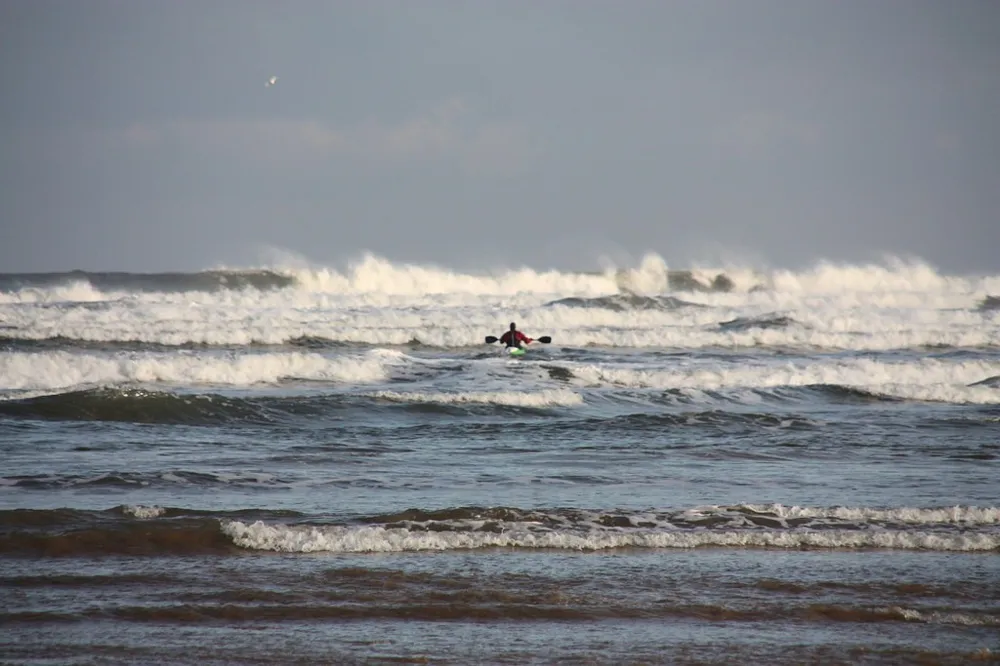
The surf zone is where most ocean kayakers get tossed. Start on days with small, well-spaced waves. Watch the beach for several minutes before you go, and skip it if the waves are dumping hard onto steep sand. Secure everything on deck, and leash or stow your gear so a capsize doesn't scatter it.
Launching
- Scout the beach. Look for a cove or section with smaller or more widely spaced waves.
- Point the bow straight into the waves. Even a small wave that hits the side can spin the kayak parallel to the beach (a broach).
- Float the boat in shallow water. Stand where it floats but you can still touch bottom, and steady it between your legs.
- Wait for a lull. Waves come in sets. When a set passes, sit, swing your feet in and paddle out with short, quick, powerful strokes.
- If you get turned sideways, get off on the seaward side. Never stand between the kayak and the beach, where a wave can drive the boat into you. Reset and try again.
Landing
- Stop outside the break. Watch several sets to time the gaps.
- Follow the back of a wave in. In bigger surf, wait for the last wave of a set to pass, then sprint in behind it.
- Keep the bow pointed at the beach. Use your paddle as a rudder to stay straight if a wave picks you up.
- Get out fast and pull the boat up. Hop out as soon as you touch sand, grab the bow handle and drag it up the beach before the backwash or the next wave arrives.
A tip from Kayak Angler: landing near the end of a falling tide and launching early on a rising tide can help, because the next wave lifts you rather than chasing you. In a group, a confident paddler should land first and signal the others in one at a time. Nobody should try to catch an incoming kayak.
Tides, Currents and Wind
On the coast, the forecast matters more than the boat. Before every trip, check the marine forecast, the tide times and any local current predictions.
- Tides: High and low tide are roughly six hours apart in most places. A falling tide can expose mudflats and sandbars and change your landing beach. Plan routes so the tide helps you home: go out with the current and return when it turns.
- Tidal currents: The strongest flows are where water squeezes through narrow channels, around islands and past headlands. They can produce waves, eddies and whirlpools even on calm days. Slack water, the pause between flood and ebb, is the easiest time to cross.
- Wind against tide: When the wind blows against a tidal stream, waves steepen and break. A pleasant channel can turn rough within minutes when the tide turns.
- Offshore wind: Wind blowing from the land toward the sea is the classic trap. Near the beach the water looks flat, but the wind gets stronger farther out and pushes you away from shore. Paddle into the wind first so it helps you home.
- Wind strength: One sea kayak navigation guide notes that anything above Beaufort force 3 (about 7–10 knots) can feel very challenging to inexperienced paddlers. Gusts are often about a third stronger than the forecast average.
- Rip currents: These are strong flows that pull water away from the beach, and they are common on surf beaches. See our rip current guide for how to spot and escape them.
- Fog and boat traffic: Stay out of shipping channels, carry a compass or GPS, and turn back if visibility drops.
Rescue Skills: Self-Rescue and the Paddle Float
Expect to capsize at some point on the ocean. Learn these skills with an instructor in calm, warm water before you need them.
Sit-on-Top Remount
- Flip the kayak upright if it has turned over, keeping hold of your paddle.
- Move alongside the boat, just in front of the seat, and grip the far edge.
- Let your legs float up behind you, then kick hard and pull to slide your chest onto the deck.
- Stay low, twist around into the seat, then swing your legs back in.
A partner can make this much easier by holding your boat steady from theirs.
Sit-Inside Paddle Float Self-Rescue
- Do a wet exit: release the spray skirt and slide out.
- Hook a leg into the cockpit to keep the boat close, then slide the paddle float onto one paddle blade and inflate it.
- Flip the boat upright, pushing it up hard to limit the water that gets in.
- Lay the paddle across the deck just behind the cockpit, with the float in the water as an outrigger.
- Kick up onto the back deck, hook a leg over the paddle shaft, keep weight on the float side and slide your legs into the cockpit.
- Rotate into the seat, pump out the water, refit the skirt and stow the float.
The faster assisted (T) rescue, where a partner empties your boat over theirs, is another reason not to paddle the ocean alone. Rolling is a further skill for sea kayakers (see how to roll a kayak), but it does not replace a PFD or rescue practice.
Cold Water and What to Wear

The ocean is often far colder than the air, and a capsize puts you straight in. The first danger is cold shock: an involuntary gasp and fast breathing in the first minute, which can make you inhale water. After that, your muscles cool and you gradually lose the strength to swim, hold on or climb back aboard. Washington State Parks warns that even water in the 70s °F can cause cold water shock.
You may hear the "1-10-1" rule (one minute to control breathing, about ten minutes of useful movement, about an hour before hypothermia makes you unconscious). The National Center for Cold Water Safety calls that timeline a myth. Its point is that ability fades progressively, and that people without thermal protection are likely to drown from incapacitation long before they become hypothermic. The safe approach is simple: dress for the water temperature, not the air.
- Life jacket: Always wear it, zipped. It keeps your head up through the gasp. See our kayak PFD picks.
- Wetsuit: Good for cool water and surf zones on sit-on-tops. See our wetsuit guide.
- Drysuit: The best protection in cold water, with layers underneath. See our drysuit guide.
- Avoid cotton: It stays wet and cold. Our what to wear kayaking guide covers layering.
- Sun and heat: On warm days, the reflection off the water is intense. Wear a hat, sunglasses with a strap, a sun shirt and sunscreen, and carry water.
This is general safety information, not medical advice.
USCG Requirements and Ocean Safety Gear
Kayaks are vessels under federal law. On federally regulated waters, the key U.S. Coast Guard rules for a paddled kayak are:
| Requirement | What It Means for a Kayak | Source |
|---|---|---|
| Life jacket | At least one wearable, Coast Guard-approved PFD on board for each person. Throwable devices are not required on kayaks. | 33 CFR 175.15 and 175.17 |
| Visual distress signals | On U.S. coastal waters, manually propelled boats are exempt from day signals but must carry night-use signals between sunset and sunrise. | 33 CFR 175.101–175.115 |
| Light at night | A vessel under oars or paddle may show sailing-vessel lights. If not, it must show an all-round white light or have an electric torch or lantern ready to show in time to prevent a collision. | Navigation Rules, Rule 25(d) |
| Sound signal | Carry a whistle or horn. State rules vary; Florida, for example, requires a bell, horn or whistle that can be heard for half a nautical mile. | Florida FWC (state example) |
States add their own rules. Some require children to wear life jackets (Florida's rule is under 6), some require registration or launch permits, and almost all require registration once a motor is fitted. Check your state boating agency and our kayak registration guide. Rules last checked November 2026. This is not legal advice.
Ocean Kit Checklist
- PFD with a whistle attached
- Paddle float and bilge pump (essential for sit-insides)
- Spare or leashed paddle
- Waterproof light and night distress signals if you could be out after sunset
- Phone in a waterproof case, and a VHF marine radio for more exposed coasts
- Compass or GPS, plus a chart of the area
- Water, snacks and sun protection in a dry bag
- A float plan left with someone ashore: where you're going and when you'll be back
Our kayak accessories checklist and kayak safety tips go into more detail.
Caring for a Kayak After Salt Water
Salt and sand are hard on fittings. After each ocean trip, rinse the hull, deck, hatches, rudder or pedal drive and seat with fresh water. Open the hatches so the inside dries. Store the boat out of direct sun, on its side or hull-up on padded supports, so polyethylene doesn't warp. Check skid plates, scupper edges and bungees regularly, and replace worn deck lines. For transport and storage, see how to transport a kayak and our kayak storage racks.
Where to Start Paddling on the Ocean
Build up in stages. Start in a protected bay, harbor or lagoon on a calm day with an onshore breeze. Next, try small surf on a gently sloping beach. Save headlands, open crossings and longer coastal trips until you can remount, brace and handle wind. Guided tours and ACA-style courses are a fast way to learn local tides and launch spots. Always paddle with a partner. If you are new to kayaking, start with our paddling strokes guide and getting in and out of a kayak.
Frequently Asked Questions
What kind of kayak is best for the ocean?
For beaches, bays and surf, a sit-on-top is the easiest choice because it drains through scupper holes and you can climb back on after a capsize. For longer coastal trips, a sea kayak with bulkheads, deck lines and a spray skirt is faster and more efficient, but it needs rescue skills.
Can you take a recreational kayak in the ocean?
Only in sheltered, calm water close to shore. Most short recreational sit-insides have big cockpits and little or no sealed flotation, so they can swamp in waves and are hard to empty in deep water.
What happened to the Ocean Kayak brand?
Ocean Kayak, which traces its start to 1971, became part of the Old Town lineup in 2023. Its Malibu models are now sold as Old Town Ocean Kayak boats.
Are sit-on-top kayaks safe in the ocean?
They are a good choice for near-shore ocean paddling because they are self-bailing and easy to remount, but they leave you exposed to cold water and wind. Wear a life jacket, dress for the water temperature and stay in conditions you can handle.
How long should an ocean kayak be?
Around 10 to 12 feet works for surf, beaches and short coastal outings. Sea kayaks of about 14 feet or longer track and glide better for distance. See our kayak size chart for fit by height and weight.
What does the Coast Guard require on a kayak?
Under federal rules, every person needs a wearable, Coast Guard-approved life jacket. On coastal waters, manually propelled boats must also carry night visual distress signals between sunset and sunrise, and you need a white light ready at night and a way to make a sound signal. States can add their own rules.