Long-Range E-Bikes: How Far They Really Go (2026)
Big-battery e-bikes from Jasion, Heybike, Lectric, Velotric and more, with plain watt-hour math that shows why listed ranges and real rides rarely match.
How Far Can a Long-Range E-Bike Really Go?
A long-range electric bike is simply one with a lot of stored energy: a battery of roughly 700 watt-hours (Wh) or more, or room for a second battery. That energy lets you commute all week on one charge, ride a full day on rail trails or carry heavy loads without watching the battery gauge.
The catch is the range figure on the box. Makers' "up to 90 miles" numbers are measured under easy conditions, and there is no single required range test for e-bikes in the US, so brands set their own assumptions. In this guide we list makers' ranges as stated, show the battery size behind each one and give you simple watt-hour math to work out what you'll actually get. For volts, amp-hours and battery care, see our e-bike battery guide.
Specs below are as listed by the makers or retailers when we checked (November 2026); check the current listing before buying.
Jasion Kago
Biggest battery for hauling
- Two 52V 20Ah batteries (2,080Wh total)
- 350 lb total payload
- Throttle plus five assist levels
Heybike Ranger 3.0 Pro
Best long-range folding e-bike
- 720Wh removable battery, listed up to 90 miles
- Torque sensor, full suspension
- UL 2849 listed by Heybike
Jasion Thunder
Best full-size long-range fat tire
- 48V 18Ah (864Wh) battery
- Listed up to 80 miles
- 26 x 4-inch tires, 400 lb payload
Long-Range E-Bikes Compared
The last column divides each bike's battery by its listed range. Anything around 8 to 11 Wh per mile means the listed range assumes low assist with plenty of pedaling; mixed real-world riding usually uses about twice that.
| Bike | Battery (Listed) | Listed Range | Motor | Weight | Wh per Listed Mile |
|---|---|---|---|---|---|
| Jasion Kago | 2 x 52V 20Ah (2,080Wh) | Check listing | Hub, 80Nm | About 94 lb | n/a |
| Heybike Ranger 3.0 Pro | 720Wh | Up to 90 mi | 750W hub, 80Nm | 75 lb | About 8 |
| Jasion Thunder | 48V 18Ah (864Wh) | Up to 80 mi | 750W hub, 85Nm | 82 lb | About 11 |
| Lectric XPedition2 Dual | Two 48V packs | Up to 170 mi | 750W hub, 85Nm | 65 lb without batteries | Depends on packs |
| Lectric XP4 750 Long-Range | 840Wh | Up to 85 mi | Hub, 85Nm | 71 lb | About 10 |
| Velotric Discover M | 801.6Wh | Up to 95 mi | Mid-drive, 100Nm | 60 lb | About 8 |
| Aventon Current ADV | 800Wh | Up to 105 mi | Mid-drive | About 56 lb | About 8 |
| Monarc Tracer | 2 x 720Wh (1,440Wh) | Up to 130 mi | 750W hub, 85Nm | 71–73 lb | About 11 |
| Gotrax Mustang | 48V 15Ah (720Wh) | Up to 86 mi | 750W, 90Nm | 76.6 lb | About 8 |
| Segway Xafari | 936Wh | Up to 88 mi | 80Nm | 92.5 lb | About 11 |
Figures for the direct-sale bikes are as reported by the makers and e-bike review sites; models and battery options change often, so confirm them on the maker's page.
The Best Long-Range Electric Bikes on Amazon
1. Jasion Kago
The Kago is a utility e-bike built around two 52V 20Ah batteries. Using the battery guide's formula (volts × amp-hours), that's 1,040Wh per pack and about 2,080Wh in total, the largest capacity on this page. It has an 80Nm hub motor, a twist throttle and five assist levels, 20 x 3-inch tires, a front suspension fork and hydraulic disc brakes, and it lists a 350-pound total payload and a rider height range of about 5'4" to 6'2". At about 94 pounds it's heavy, so it suits riders who start and finish at a garage or ground-floor door. It's also covered in our electric cargo bike guide.
Good to Know
- Two batteries give the most stored energy here
- Built for loads, with lights and turn signals
- Can run on one pack for shorter trips
Watch Out For
- Very heavy to lift or carry upstairs
- Check the listing for UL 2849 certification
2. Heybike Ranger 3.0 Pro
A folding, step-through fat tire e-bike with a removable 720Wh battery that Heybike lists at up to 90 miles. It pairs a 750W rear hub motor with 80Nm of torque and a torque sensor, which adds power in proportion to how hard you pedal and tends to use less energy than an on/off cadence sensor if you pedal steadily. It has full suspension, hydraulic disc brakes, 20 x 4-inch tires, a 440-pound total payload and a 100-pound rear rack. It ships as Class 2 (throttle, 20 mph) and can be set to Class 1 or unlocked to Class 3 (28 mph). Heybike lists UL 2849 certification and a 6–8 hour charge time.
Good to Know
- Torque sensor rewards steady pedaling with more miles
- Folds for an SUV, RV or apartment
- Switchable Class 1, 2 or 3
Watch Out For
- About 75 pounds
- 90 miles assumes the lowest assist; one review site reported about 25 miles in the highest mode
3. Jasion Thunder
A full-size fat tire e-bike with a 48V 18Ah (864Wh) battery, listed at up to 80 miles. It has a 750W motor with 85Nm of torque, 26 x 4-inch puncture-resistant tires, a 400-pound payload and five assist levels. Jasion lists the top assist level at 30+ mph, which is above the 28 mph Class 3 limit, so keep it set to the class allowed where you ride (see e-bike classes). Jasion gives a 7–8 hour charge time on the included 2A charger. We also cover it on our fat tire e-bike guide.
Good to Know
- Big 26-inch wheels for bigger riders
- Larger single battery than many fat tire bikes
- High payload for gear and panniers
Watch Out For
- 82 pounds, and fat tires cost range on pavement
- Top assist exceeds Class 3 speed; UL 2849 not listed on the page we checked
Long-Range E-Bikes Sold Direct and Through Shops
Several of the biggest batteries come from direct-to-consumer brands and dealer bikes. These aren't sold through our Amazon links, but they're worth comparing:
- Lectric XPedition2 Dual Battery: a longtail cargo e-bike with two removable 48V batteries, a 750W (1,310W peak) hub motor with 85Nm and a torque sensor. Lectric lists up to 120 miles on one battery and up to 170 miles with both, a 450-pound payload, Class 1/2/3 settings, UL 2849 for the bike and UL 2271 for the batteries, and 5–7 hours per battery on the standard charger (about 3 hours with its optional fast charger).
- Lectric XP4 750 Long-Range: a folding e-bike reported with an 840Wh battery, a torque sensor and a listed range of up to 85 miles. One review site reported about 25.6 miles on throttle only with a 235-pound rider into wind, a good reminder of how far real range can fall.
- Velotric Discover M: a commuter with a 100Nm mid-drive motor and an 801.6Wh battery, listed at up to 95 miles. A range test reported by Electric Bike Report gave about 32 miles in the hardest mode and about 81 miles riding easy.
- Aventon Current ADV: a mid-drive e-mountain bike with an 800Wh removable battery, reported at up to 105 miles.
- Monarc Tracer: a commuter with two 720Wh packs (1,440Wh) and a listed range of up to 130 miles across both.
- Gotrax Mustang and Segway Xafari: moto-style and comfort cruisers with 720Wh and 936Wh batteries. See our moped-style e-bike guide for that style.
- Specialized Turbo Vado SL and other light dealer bikes: smaller internal batteries with an optional range extender, a different approach that keeps the bike light for daily use and adds energy only for long days.
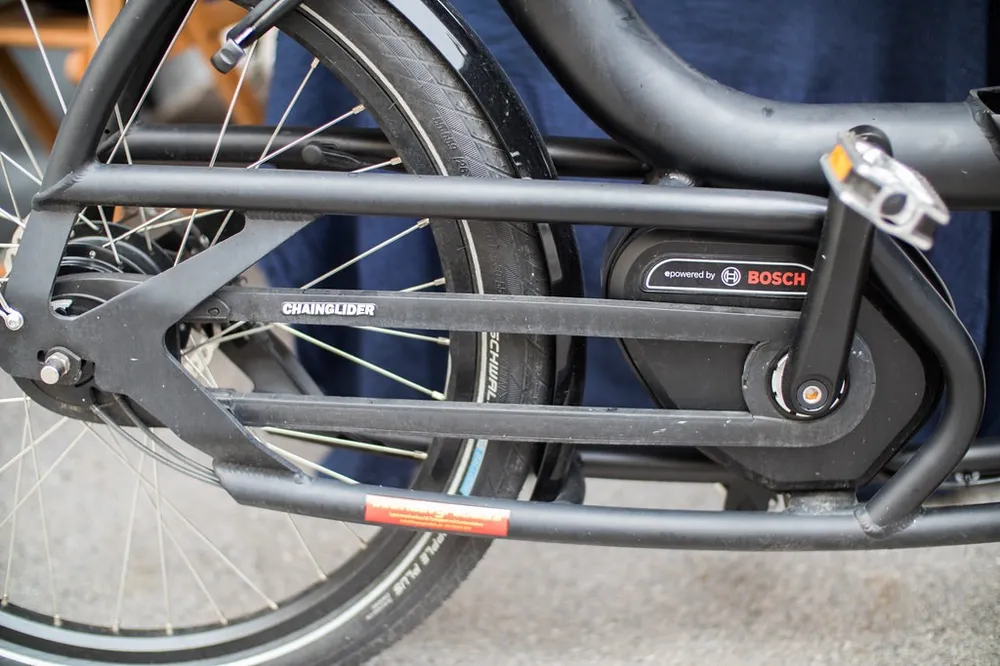
Some dealer brands, such as Tern and Riese & Müller, offer dual-battery options on certain models, often with Bosch mid-drive systems. Test ride at a dealer and ask which batteries and range extenders your exact model accepts.
Listed Range vs Real Range
Listed ranges are best-case numbers. Brands usually measure them in the lowest assist level, with a rider of average weight, on flat ground, in mild weather and with the rider pedaling throughout. Some say so on the page; many, including several listings we checked, give no test conditions at all. One e-bike site estimates that makers assume a rider of roughly 170 to 180 pounds.
Real rides are different. Reported tests on the bikes above show the gap:
| Bike | Battery | Listed Range | Reported Test | Implied Wh per Mile |
|---|---|---|---|---|
| Heybike Ranger 3.0 Pro | 720Wh | Up to 90 mi | About 24.6 mi, highest assist, 195 lb rider | About 29 |
| Lectric XP4 750 Long-Range | 840Wh | Up to 85 mi | About 25.6 mi, throttle only, 235 lb rider, wind and light hills | About 33 |
| Velotric Discover M | 801.6Wh | Up to 95 mi | About 32 mi (hardest mode) to 81 mi (easy riding) | About 25 to 10 |
Tests reported by RiderGuide and Electric Bike Report; their rider weights and routes differ, so use these as examples, not ratings.
The main things that pull real range down are assist level and throttle use, hills, rider and cargo weight, speed and headwinds, cold weather, soft or knobby tires, stop-and-go riding and an aging battery. Our battery guide explains each factor. Speed matters more than most riders expect: air resistance rises sharply as you go faster, so a Class 3 bike cruising at 28 mph uses far more energy per mile than the same bike at 18 mph.
Range Math: Turning Watt-Hours Into Miles
Watt-hours are the best single number for comparing range, because they measure total stored energy. If a listing gives only volts and amp-hours, multiply them: Wh = V × Ah. A 48V 15Ah battery stores 720Wh; a 52V 20Ah battery stores 1,040Wh.
Then divide by how much energy you'll use per mile. One review site uses about 20 Wh per mile for mixed pedal-assist riding and about 30 Wh per mile for throttle-only riding. Gentle, low-assist riding on flat ground with steady pedaling can get close to 10 Wh per mile, which is roughly what most listed ranges assume.
| Battery | Easy Riding (about 10 Wh/mi) | Mixed Assist (about 20 Wh/mi) | Throttle or High Assist (about 30 Wh/mi) |
|---|---|---|---|
| 500Wh | About 50 mi | About 25 mi | About 17 mi |
| 720Wh | About 72 mi | About 36 mi | About 24 mi |
| 864Wh | About 86 mi | About 43 mi | About 29 mi |
| 1,000Wh | About 100 mi | About 50 mi | About 33 mi |
| 1,440Wh | About 144 mi | About 72 mi | About 48 mi |
| 2,080Wh | About 208 mi | About 104 mi | About 69 mi |
These are planning estimates, not tests. Heavier riders, cargo, hills, fat tires and cold weather push you toward the right-hand column.
A Second Method: Runtime × Speed
Electric Bike Report suggests another napkin method: divide watt-hours by the motor's rated (not peak) watts to get hours of full-power runtime, then multiply by your average speed. A 601Wh battery on a 250W motor gives about 2.4 hours; at 19 mph that's about 46 miles. It's a rough floor at full power, and pedaling adds to it.
Plan With a Buffer
Choose a bike whose mixed-assist estimate covers your longest regular ride with 20–30% to spare. That buffer covers headwinds, detours, winter and the slow capacity loss every lithium-ion battery goes through over the years.
How to Choose a Long-Range E-Bike
Battery Capacity in Watt-Hours
Start with watt-hours. For most commuters, 500–700Wh covers a week of short trips; long day rides and heavy riders benefit from 750Wh and up or a second battery. Compare Wh, not listed miles, because brands calculate miles differently.
Voltage
Most e-bikes run 36V or 48V, and some 52V. Voltage alone doesn't set range; a 36V battery with more amp-hours can store more energy than a 48V battery with fewer. Always multiply.
Hub Motor or Mid-Drive
Mid-drive motors drive through the bike's gears, so they can stay in an efficient speed range on climbs, which helps range in hilly areas. Hub motors are simpler and common on value bikes, and work well on flatter routes. See how electric bikes work for the details.
Torque or Cadence Sensor
A torque sensor adds power in proportion to your effort, so steady pedaling at low assist stretches the battery. A cadence sensor adds a set amount of power whenever the pedals turn, which is easy but can use more energy if you ride in a high level.
Tires
Fat 4-inch tires are comfortable on sand and gravel but roll slower on pavement. If most of your miles are on roads or paved trails, narrower hybrid-style tires go further on the same battery. Keep any tire at the right pressure.
Class and Top Speed
Class 3 bikes can assist to 28 mph, but riding there drains the battery much faster. Check which class you're allowed to ride on your routes; many multi-use trails limit Class 3 bikes.
Removable Battery and Charger
A removable battery lets you charge indoors at work or in a hotel room, and makes a spare battery practical. Check the charger's output and whether the maker sells an approved faster charger.
Payload, Fit and Weight
Check the total payload covers you plus bags, and the listed rider height range. Then weigh up the bike's weight, which is the main trade-off of a big battery (below).
Dual Batteries, Spare Packs and Range Extenders
| Option | How It Works | Best For | Trade-Offs |
|---|---|---|---|
| One big battery | A single pack of roughly 700–1,000Wh | Most long-range riders | Heavy pack; whole bike is heavier every ride |
| Dual-battery bike | Two packs mounted on the bike, used one after the other or together | All-day rides, cargo, rural commutes | Most weight and cost; longer to charge both |
| Spare battery | A second maker-approved pack carried in a bag and swapped mid-ride | Occasional long days | You carry several pounds of extra weight; need a padded bag |
| Range extender | A small add-on battery some systems accept, often in a bottle cage | Light bikes that need extra range sometimes | Only for compatible systems; adds less energy than a full pack |
Whichever you choose, use only batteries and chargers approved by your bike's maker. A generic second battery may not match the controller's voltage or connectors, may not be certified and is a fire risk. Lectric lists each XPedition2 battery at about 9 pounds, which gives an idea of what a spare weighs.
Weight: The Cost of a Big Battery
Batteries are the heaviest single part of most e-bikes, so range adds weight. The long-range bikes in our table weigh roughly 56 to 94 pounds, compared with under 40 pounds for many lightweight e-bikes, which often carry around 200 to 375Wh. That weight matters when you lift the bike onto a rack, carry it upstairs or push it with a flat battery.
- Car racks: most long-range e-bikes need a hitch rack rated for heavy e-bikes; remove the battery before loading. See e-bike racks.
- Stairs and storage: a ground-floor garage or bike room is easiest. See how much e-bikes weigh.
- A light bike with an extender can be the better choice if you only need long range a few times a year.
Long-Distance Riding and E-Bike Touring

Long-range e-bikes make multi-day rides, rail-trail trips and bike-and-camp weekends practical for riders who couldn't manage them on a regular bike. In Europe, this kind of bike is usually called a trekking e-bike: a touring hybrid with a rack, fenders, lights and often a mid-drive motor and a large battery. EU rules limit pedelecs to 250W of assistance up to 25 km/h (about 15.5 mph), so trekking e-bikes are tuned for efficiency rather than speed, which is one reason they cover long distances well.
Planning a Long Ride
- Know your Wh per mile. Ride a known loop at your usual assist level and note the battery used, then scale up.
- Plan charging stops at cafés, campgrounds or hotels, and pack your charger. Ask before plugging in.
- Use lower assist early and save higher levels for the last climbs.
- Pack light and low: panniers on a rated rack keep weight low, and every extra pound costs a little range.
- Carry the basics: a pump, a spare tube or plug kit and a lock. A flat on a heavy e-bike is harder to deal with far from home.
- Check trail rules for your bike's class before you go.
Taking an e-bike on a plane is rarely possible, because airlines limit lithium-ion batteries to small capacities and e-bike batteries are far larger. Many riders rent locally or ship the bike through a specialist.
Charging on Long Rides
Bigger batteries take longer to charge on the same charger. Our battery guide gives about 3 to 5 hours for many e-bike batteries; the long-range bikes above list longer times on their standard chargers:
| Bike | Battery | Listed Charge Time |
|---|---|---|
| Heybike Ranger 3.0 Pro | 720Wh | 6–8 hours (2A charger) |
| Jasion Thunder | 864Wh | 7–8 hours (2A charger) |
| Lectric XPedition2 | Per battery | 5–7 hours (2A); about 3 hours (optional 5A charger) |
For multi-day rides, an approved fast charger or a second charger can be worth carrying, so you can top up during a lunch stop. Charge only while you're nearby and awake, on a hard surface away from exits, and never with a charger that isn't approved for your battery.
Battery Safety and UL 2849
Long-range bikes carry a lot of stored energy, so certification matters. Look for UL 2849 certification for the e-bike's whole electrical system, or at least UL 2271 for the battery. Among the bikes above, Heybike lists UL 2849 for the Ranger 3.0 Pro and Lectric lists UL 2849 for the XPedition2 with UL 2271 batteries; check the current listing for any other model. New York City and California require certified e-bikes and batteries, and the CPSC's proposed national rule was not yet final as of November 2026. Our e-bike battery guide explains the standards, charging rules and warning signs, and the CPSC has more safety advice.
How to Get More Miles From Any E-Bike
- Ride in a lower assist level on flats and with a tailwind.
- Pedal steadily rather than relying on the throttle.
- Shift to an easier gear before hills and when starting from a stop, especially on a mid-drive.
- Keep tires at the right pressure; soft tires cost range.
- Slow down a little. Cruising a few mph slower cuts air resistance noticeably.
- Keep the battery warm in winter: store it indoors and fit it just before you ride.
- Carry only what you need and keep the chain clean and lubed.
- Charge to full before a long ride, then go back to partial charges for everyday riding if your maker recommends it.
Related Guides
Compare the best electric bikes overall, cheap e-bikes, folding e-bikes, e-bikes for seniors and the fastest e-bikes. Read about e-bike laws, or see e-bikes vs regular bikes. Riding a scooter instead? See long-range electric scooters.
Frequently Asked Questions
What is considered a long-range electric bike?
There's no official definition. In practice it means an e-bike with a large battery, roughly 700Wh and up, or a dual-battery option, so it can cover long rides or several days of commuting on one charge.
How far can an electric bike go on one charge?
Most e-bikes manage about 20 to 60 miles in real riding, and big-battery or dual-battery models can go further. Divide the battery's watt-hours by roughly 20 Wh per mile for a mixed-assist estimate, or by 30 for heavy throttle use.
Why is my real range lower than the listed range?
Listed ranges usually assume the lowest assist level, a lighter rider, flat ground and mild weather. Throttle use, hills, headwinds, cold, heavy loads and high speeds all cut range, often to less than half the listed figure.
Is a dual battery better than one big battery?
A dual-battery bike gives the most range without stopping, but it adds weight and cost. A spare battery from the bike's maker gives the same total energy and lets you leave it at home on short rides.
Do bigger batteries take longer to charge?
Yes, on the same charger. Many long-range e-bikes take about 5 to 8 hours to charge fully on the included charger, and some makers sell approved faster chargers.
Does a long-range e-bike battery last longer overall?
A bigger battery goes through fewer full charge cycles for the same miles, which can help its lifespan. Charging habits, heat and storage still matter most.
Can I take a long-range e-bike on a plane?
Generally not with the battery. E-bike batteries are far above the small lithium-ion limits airlines allow, so plan to ship the bike through a specialist or rent at your destination.