How Do Electric Bikes Work? A Plain-English Guide (2026)
An e-bike is a bicycle with a motor, battery, sensor and controller working together to add power as you pedal. Here's how each part works.
The Short Answer
An electric bike works like a regular bike with a power boost. A sensor detects that you're pedaling (or a throttle tells it you want power), the controller decides how much power to send, the battery supplies the energy, and the motor adds force to the wheel or cranks. You choose how much help you get with assist levels on the display. The motor stops helping at a set speed.
The Main Parts of an E-Bike
| Part | What It Does |
|---|---|
| Motor | Adds power at the rear wheel, front wheel or cranks |
| Battery | Stores energy, usually lithium-ion, rated in watt-hours |
| Sensor | Measures your pedaling (cadence or torque) to trigger assist |
| Controller | The "brain": takes inputs and meters power from battery to motor |
| Display and buttons | Show speed and battery level; let you choose assist levels |
| Throttle (optional) | A thumb lever or twist grip that adds power without pedaling |
| Brakes, wheels and frame | Built stronger than most regular bikes to handle extra weight and speed |
How Power Flows, Step by Step
- You start pedaling (or press the throttle).
- The sensor detects your pedaling and sends a signal to the controller.
- The controller checks your assist level, speed and sensor data, then draws the right amount of current from the battery.
- The motor turns that electrical energy into extra force at the wheel or cranks.
- At the speed limit for your bike's class, the controller cuts assist. You can keep pedaling faster on your own.
- When you stop pedaling or brake, assist stops. Many e-bikes have brake sensors that cut the motor instantly.
E-Bike Motors: Hub vs Mid-Drive
| Hub Motor | Mid-Drive Motor | |
|---|---|---|
| Location | In the center of the rear (or front) wheel | At the cranks, between the pedals |
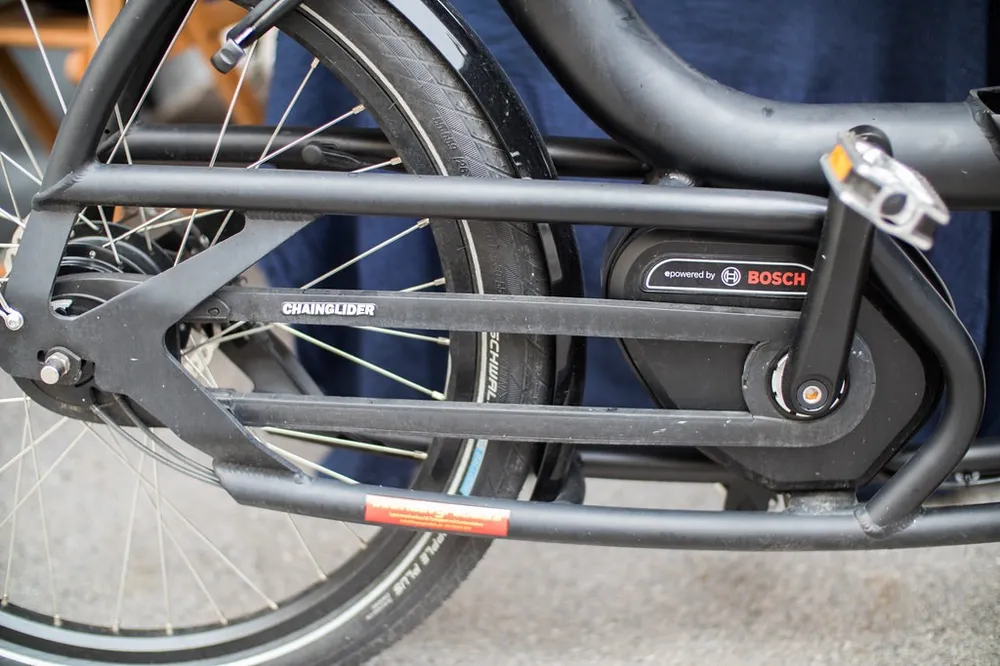
| How it drives | Pushes the wheel directly | Drives the chain, using the bike's gears |
| Feel | A "push" from the wheel | Natural, like stronger legs |
| Hills | Good; can struggle on long, steep climbs | Excellent, because you can shift to easy gears |
| Weight balance | Weight at one wheel | Low and centered |
| Typical sensor | Often cadence | Usually torque |
| Wear | Less strain on the chain | More wear on chain and cassette |
| Common on | Commuters, folding, fat tire and value e-bikes | Mountain, premium commuter and cargo e-bikes |
Geared vs Direct-Drive Hub Motors
- Geared hub motors use small internal gears. They're light and compact and freewheel when you coast, so there's no drag when the motor is off.
- Direct-drive hub motors have no gears. They're very durable and quiet but heavier and create a little drag when unpowered. They're the type that can offer regenerative braking.
Motor Power and Torque
Motor power is listed in watts. "Nominal" or "rated" watts is what the motor can sustain; "peak" watts is a short burst. In the US, e-bikes are limited to 750 W under the three-class system. Torque, measured in newton-meters (N·m), describes pulling power for hills and starts; e-bike motors commonly range from about 40 to 80+ N·m.
Sensors: Cadence vs Torque
- Cadence sensors detect that the cranks are turning and switch on a set amount of power for your assist level. They're simple and affordable, but the power can feel on-off, and you get the same help whether you pedal gently or hard.
- Torque sensors measure how hard you press on the pedals and add power in proportion. The ride feels smoother and more natural, like having stronger legs, and they're usually more efficient with the battery.
Many riders find torque sensors more natural; others like the easy, consistent push of a cadence sensor. Test-ride both if you can.
Pedal-Assist and Throttles
Pedal-assist (also called pedelec) is the most common mode: the motor helps only while you pedal. Most e-bikes have several assist levels; low levels save battery and feel like a gentle tailwind, while high levels flatten hills. A throttle lets you ride without pedaling, which helps when starting from a stop. Throttles are allowed on Class 2 e-bikes and are restricted on some trails and in some countries. See e-bike classes explained.
The Controller and Display
The controller is the computer that links everything together. It reads the sensor, throttle, brake cut-offs and speed sensor; applies your assist level; and limits speed and current. The display (or a phone app on some bikes) shows speed, battery level and assist level, and may show range estimates, trip data or error codes. Class 3 e-bikes must have a speedometer.
The Battery
Nearly all modern e-bikes use lithium-ion batteries, usually 36V or 48V. Capacity is best compared in watt-hours (Wh), calculated as volts × amp-hours: a 36V, 14Ah battery stores 504Wh. More watt-hours generally means more range. Most batteries are removable for charging indoors, and many take a few hours to charge fully. For lifespan, charging and safety, see our e-bike battery guide.
Range: How Far Can You Go?
Range depends on battery size, assist level, terrain, rider and cargo weight, tire type, temperature and wind. Commonly quoted ranges run from about 20 to 60 miles per charge, and some big-battery bikes claim more. Maker range claims are usually based on ideal conditions, so expect less on hilly rides at high assist.
Gears and Drivetrain
Most e-bikes still have gears. On a mid-drive, shifting matters a lot: shifting to an easier gear before a climb saves battery and reduces strain. Some e-bikes use internally geared hubs or continuously variable hubs that can shift while stopped, which is handy in stop-start traffic. Single-speed e-bikes rely on the motor for hills.
Brakes and Regenerative Braking
Because e-bikes are heavier and faster than most regular bikes, most use disc brakes, often hydraulic, which give strong, consistent stopping in wet weather. Many have motor cut-off sensors in the brake levers that stop power the instant you brake.
Regenerative braking, where the motor recharges the battery while slowing, is only possible on bikes with direct-drive hub motors. It adds a small amount of range, more on long descents, and isn't available on most geared hub and mid-drive e-bikes.
How Fast Do E-Bikes Go?
In the US, the motor stops helping at 20 mph on Class 1 and 2 e-bikes and 28 mph on Class 3. In the UK and EU, assist usually stops at 15.5 mph (25 km/h). Bikes that go faster on motor power generally aren't legal e-bikes. See the fastest electric bikes.
Riding an E-Bike for the First Time
- Start in the lowest assist level in a quiet area.
- Expect quicker acceleration than a regular bike, and keep your fingers near the brakes.
- Shift to an easy gear before stopping so it's easier to restart.
- Turn assist off when walking the bike, or use walk-assist mode if it has one.
- Wear a helmet and plan for the extra weight when parking or lifting.
Related Guides
Compare e-bikes and regular bikes, see how much e-bikes weigh, convert your own bike with a conversion kit, or shop the best electric bikes.
Frequently Asked Questions
Do you have to pedal an electric bike?
On pedal-assist e-bikes, yes: the motor helps only while you pedal. Bikes with a throttle (Class 2, and some others) can move without pedaling, up to their speed limit.
Do e-bikes charge while you pedal?
Generally no. Most e-bikes use geared hub or mid-drive motors that freewheel and can't recharge the battery. Some direct-drive hub motors offer regenerative braking, but it adds only a small amount of range.
What happens when an e-bike battery dies?
The motor stops helping and you can pedal it like a regular bike, though it will feel heavier.
Can you ride an electric bike in the rain?
Most e-bikes are built to handle rain and wet roads, but they shouldn't be submerged or pressure-washed. Check your bike's water-resistance guidance.
Which is better, a hub motor or a mid-drive?
Mid-drives usually feel more natural and climb better because they use the bike's gears. Hub motors are simpler, quieter and often more affordable. Both work well for commuting.
How fast do electric bikes go?
In the US, the motor stops helping at 20 mph on Class 1 and Class 2 e-bikes and 28 mph on Class 3. You can pedal faster under your own power.
How long does it take to charge an e-bike?
Many e-bike batteries take roughly 3 to 5 hours to charge fully, depending on capacity and the charger.
Are electric bikes hard to ride?
No. If you can ride a bike, you can ride an e-bike. Start in the lowest assist level and get used to the extra weight and quicker acceleration.