Inline Skating Tricks to Learn First, Style by Style (2026)
Once you can glide, turn and stop on inlines, these are the tricks to learn next, grouped by style: freestyle and slalom, urban, aggressive and park, with steps, common mistakes and the gear that keeps you safe.
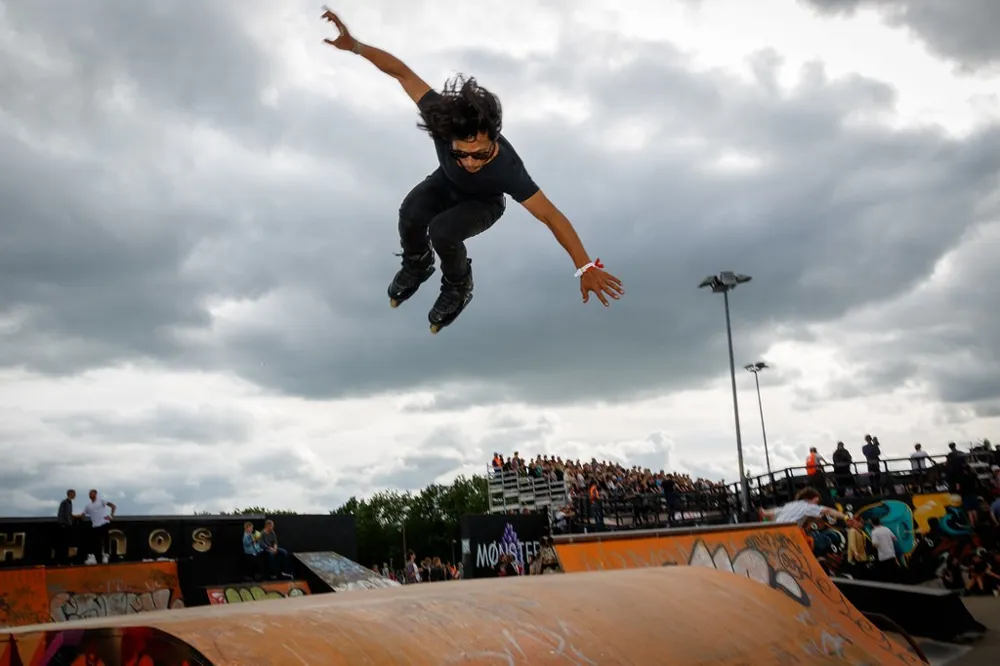
Before You Learn Rollerblading Tricks
Inline tricks fall into a few styles. Freestyle and slalom skating happens on flat ground and around cones. Urban skating uses curbs, steps and the city as a playground. Aggressive skating means grinds and stalls on ledges and rails. Park skating covers ramps, bowls and airs. The basics are the same for all of them, so make sure you can already do these on your skates:
- Hold a ready stance: knees bent, weight over the middle of the frame, hands forward. See how to rollerblade.
- Stop on demand: with the heel brake at first, then a T-stop. See how to stop on rollerblades.
- Turn both ways smoothly, with a scissor stance in tighter turns.
- Fall forward on purpose: get low and land on your knee pads, then wrist guards, instead of sitting back.
Trick attempts mean more falls, even for experienced skaters. Learn each move slowly on smooth, flat ground before you add speed, height or obstacles.
Rollerblading Tricks by Difficulty
The table lists the tricks on this page in a sensible learning order. The levels are a rough guide, since balance, fitness and skate setup all change how hard a trick feels.
| Trick | Style | Level | What It Builds |
|---|---|---|---|
| One-foot glide | Freestyle | Easiest | Single-leg balance |
| Heel-toe roll | Freestyle | Easy | Front and back wheel balance |
| Fishtail | Freestyle | Easy | Edge control on one skate |
| Forward slalom | Slalom | Easy | Quick weight shifts |
| Small jumps | Urban | Easy to medium | Takeoff and landing |
| Forward crossovers | Freestyle | Medium | Speed through turns |
| Fish and snake | Slalom | Medium | Footwork around cones |
| Two-foot spin | Freestyle | Medium | Rotation control |
| Heel-toe spin | Freestyle | Medium | Pivoting on single wheels |
| 180 jump | Urban | Medium | Turning in the air |
| Curb and stair ride | Urban | Medium | Dropping down steps |
| Criss-cross | Slalom | Medium to hard | Crossing legs at speed |
| Frontside and soul grind | Aggressive | Medium to hard | Locking onto ledges |
| Drop-in and ramp 180 | Park | Medium to hard | Riding transitions |
Gear and Safety for Inline Tricks
Wear a helmet, wrist guards, knee pads and elbow pads for every trick session. Skating Magic's beginner guide says that if you only wear two pieces, make them the helmet and wrist guards, because wrist fractures are common in falls. For grinds and park skating, look for a helmet certified to ASTM F1492, the US standard for skateboarding and trick roller skating, and hard-cap pads you can slide out on. Slick Willies also suggests shin pads for aggressive grinds. Our skate helmet and pad set guides go deeper.
Your skates matter too. Each style has its own setup:
| Style | Typical Skate | Why |
|---|---|---|
| Freestyle basics | Recreational or fitness skate | Fine for balance tricks, small jumps and crossovers |
| Slalom and spins | Slalom skate with a short, rockered frame | Fewer wheels on the ground make pivots easier |
| Urban | Urban or freeskate skate with a stiff, high cuff | Support for jumps, stairs and slides |
| Aggressive and park | Aggressive skate with a soul plate and H-block, no brake | Small, hard wheels and grind surfaces |
Wikipedia's freestyle slalom article explains that slalom skates are usually rockered, so only two wheels touch the floor at any point, often with about a 2mm height difference. Aggressive skates have a short frame with a central grinding area (the H-block) and a flat plastic soul plate on the outside of the boot, mounted on a UFS or unibody frame. Our aggressive inline skates guide explains those parts, and rollerblades for men, women and kids covers recreational skates.
187 Killer Pads Six Pack
Knee pads, elbow pads and wrist guards in one bundle, with hard plastic caps for sliding out of falls on ramps. Sizes run from JR to XLT.
Check Price on AmazonTriple Eight Gotham MIPS Helmet
A skate-style helmet with MIPS, designed to reduce rotational forces in angled impacts.
Check Price on AmazonFreestyle Basics: Glide, Heel-Toe, Fishtail and Crossovers
These four tricks need nothing but a smooth, flat surface. They teach the balance and edge control that slalom, spins and urban tricks depend on.
One-Foot Glide
- Build gentle speed with a few strides.
- Bring your skates together, bend your knees and shift your weight fully over one skate.
- Lift the other skate a few inches and hold the glide for a count of three.
- Put the free skate down as soon as you feel unsteady, then switch legs. Build up to several seconds on each side.
Glide on the middle of the wheels. Rolling onto an inside or outside edge turns the glide into a curve.
Heel-Toe Roll
The heel-toe starts from a scissor stance, with one skate rolling half a skate length or so ahead of the other.
- Glide in the scissor stance at a moderate speed.
- Straighten your front leg and lift its toe so only the back wheel stays on the ground.
- Lift your back heel so that skate rolls on its front wheel only.
- Keep your weight centered between your feet, then set the wheels down together.
On recreational skates the heel brake sits on one skate, usually the right. If that skate is in front, the brake can touch the ground when you lift its toe, so lead with the other foot or keep the lift small.
Fishtail
- Build some speed and glide on both skates, one slightly behind the other.
- Put more weight on the toe of the trailing skate.
- Swing the trailing skate's heel in and out in a smooth wiggle, like a fish's tail, while the front skate rolls straight.
Skating Magic notes that more weight over the toe wheel gives a wider arc. Keep the front skate quiet and your shoulders square.
Forward Crossovers
Crossovers keep your speed through a curve, which matters for slalom, urban lines and park skating.
- Practice stepping one skate over the other while standing still, then uncrossing.
- Skate a slow, wide circle, leaning slightly into it and looking where you're going.
- Push with your outside skate, lift it and set it down past the front of your inside skate.
- Push the inside skate out from underneath you, then bring it back beside the other skate.
Skating Magic suggests learning to glide on one skate on its center edge, then on its outside edge, before you add the cross. Practice both directions. Standing too tall is the usual reason crossovers feel shaky.
Slalom Tricks: Forward Slalom, Fish, Snake and Criss-Cross
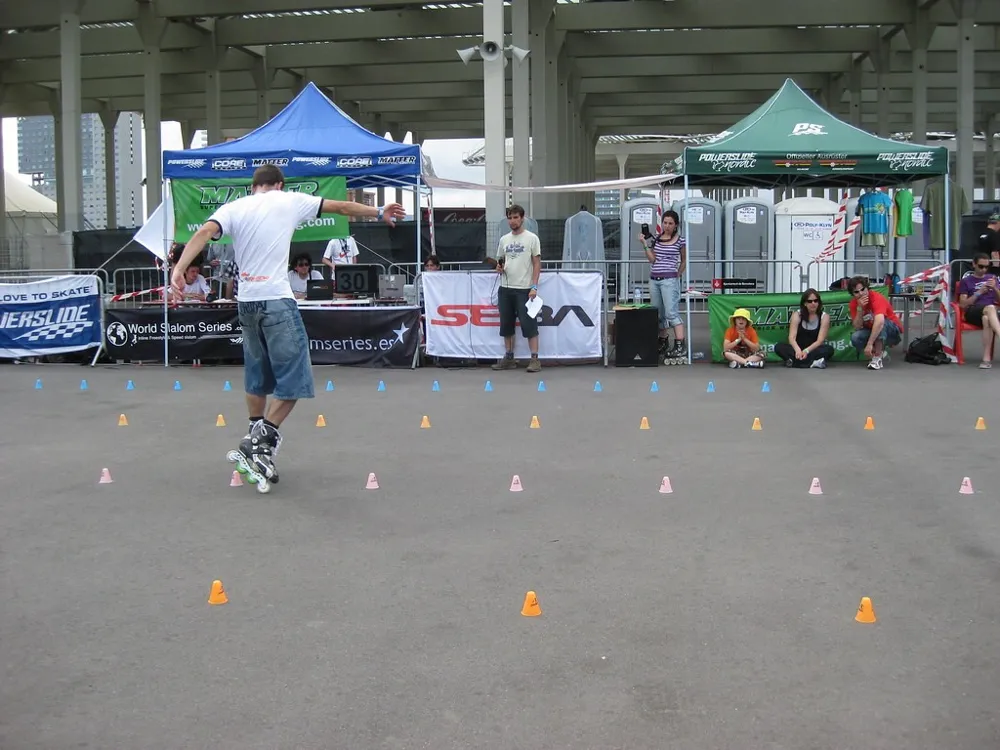
Freestyle slalom is a technical style built around a straight line of equally spaced cones. According to Wikipedia's freestyle slalom article, the three spacings used in competitions are 50cm, 80cm and 120cm, and speed slalom uses a line of twenty cones set 80cm apart. Beginners should start wider. Skating Magic suggests cones about 1 meter apart, moved closer as you improve. Small, flat-topped slalom cones or plastic cups are easy to roll over if you miss.
Forward Slalom
- Roll toward the cone line at a slow, steady speed in a scissor stance.
- Weave around each cone, shifting your weight from edge to edge with your knees bent.
- Swap which foot leads in the scissor stance as you change direction.
- Keep your upper body facing down the line while your legs do the turning.
Fish and Snake
Slalom trick names vary between communities, but Wikipedia lists the forwards parallel (fish) and the forwards monoline (snake) among the basic moves:
- Fish: both skates stay parallel and side by side, weaving around each cone together.
- Snake: the skates follow one line, one behind the other, carving around each cone in a single track.
Criss-Cross
In the criss-cross your legs cross and uncross over each cone. Slick Willies recommends widely spaced cones, a slow speed and keeping your body centered.
- As you reach the first cone, cross one skate in front of the other so the cone passes between them.
- Open your legs back out past the next cone.
- Keep repeating the cross and uncross, using the edges of your wheels to steer.
If your legs catch each other, slow down and widen the cones. Learn the fish and snake first, since the criss-cross combines the edge work of both.
Spins: Two-Foot Spin and Heel-Toe Spin
Spins are easier on smooth floors and on rockered or short-frame skates. A long frame with all four wheels on the ground resists turning.
Two-Foot Spin (Flat Spin)
- Stand still with your feet about shoulder width apart.
- Wind up by twisting your upper body slightly away from the spin.
- Turn your torso toward the spin and let your skates follow, pushing and pulling them in opposite arcs.
- Bring your arms in to keep turning, then open them to slow down.
Skating Magic warns against jerking your upper body suddenly, which can throw off your balance. Spot a fixed point with your eyes and stop after a few rotations until you're used to it.
Heel-Toe Spin
Slick Willies describes the heel-toe spin as a pivot from standing, using your arms and shoulders while rising onto the heel of one skate and the toe of the other. Start with a 180-degree pivot, then build toward a full 360 once the balance feels solid. It combines the heel-toe roll and the two-foot spin, so learn both of those first.
Skating Backwards and Slides
Many tricks land or exit backward, including the 180 jump, the fakie 180 and most slalom variations. Learn backward lemons and C-cuts alongside the tricks above, always checking over your shoulder. Our full how to skate backwards guide covers the stance, backward swizzles, transitions and backward stops on inlines.
Slides are the stopping side of trick skating. After the T-stop, many skaters learn the powerslide, which Slick Willies describes as skating backward and setting your stronger foot at a right angle on its inside edge with your knees bent. Practice it on grass or a gentle slope first. Stopping methods, from the heel brake to hockey stops, are in how to stop on rollerblades.
Urban Tricks: Jumps, the 180 and Stairs
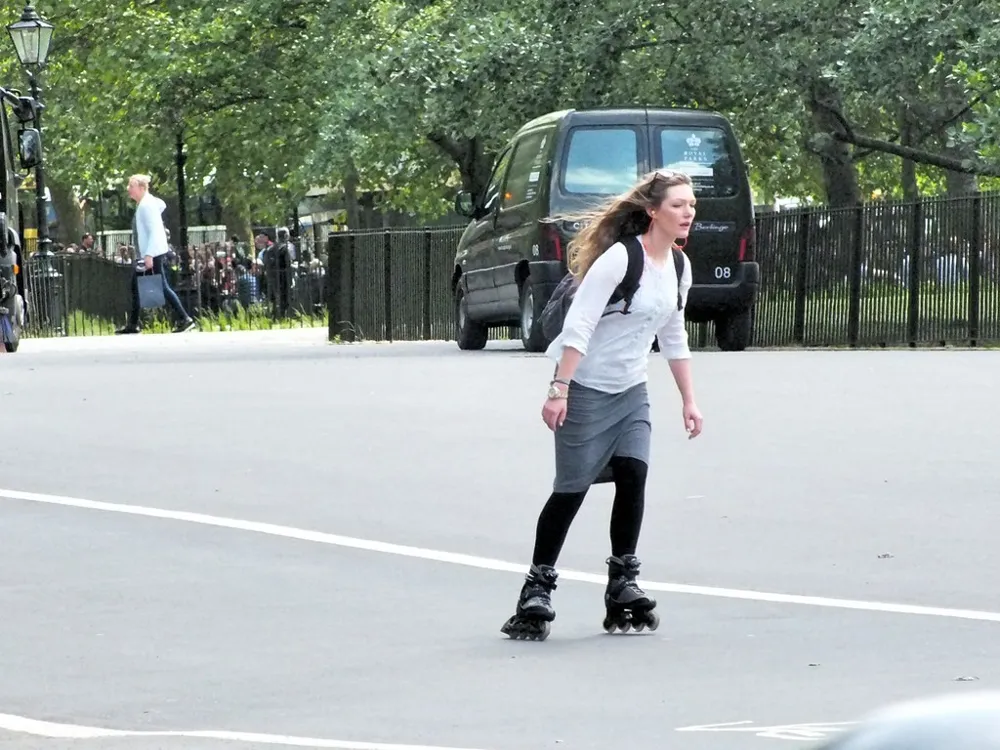
Urban skating turns curbs, steps and gaps into obstacles. Every urban trick starts with a clean jump and a soft landing.
Small Jumps
- Practice small hops in place on grass or carpet so your skates don't roll.
- Move to a slow glide on smooth pavement. Bring your skates together and bend your knees.
- Spring straight up, keeping your arms below chin height.
- Land on both skates together, with your weight slightly forward and your knees bending to absorb the impact.
Skating Magic warns against the "windmill" arm swing, where the arms circle backward during a jump. It shifts your weight back, and landing on your rear wheels can send you onto your back or head. For bigger jumps, add speed and pull your knees up, then land with your knees bent.
The 180 Jump
The 180 turns you from forward to backward in the air. Slick Willies describes it as jumping straight up and twisting your legs so you land backward while your head and upper body keep facing forward.
- Practice the twist with small hops on grass.
- Roll slowly, jump and turn your hips and legs a half turn.
- Land rolling backward with your knees bent, then look over your shoulder.
Once forward-to-backward 180s are steady, try the reverse, a fakie 180 from backward to forward. SkaMiDan's park list includes both the flat 180 and the flat fakie 180 as early tricks. A 360 is a full turn and comes later, once 180s land cleanly in both directions.
Curb and Stair Ride
- Start with a low curb. Roll toward it slowly in a scissor stance.
- Lean your upper body forward slightly and keep some weight toward your heels.
- Roll off the edge, letting the front skate drop, then the back.
- Keep your knees soft so each drop is absorbed.
Slick Willies describes this forward stair ride with a scissor stance, weight on your heels and a forward lean, starting with curbs before small steps. Move to two or three shallow steps only when curb drops feel automatic. Never ride stairs with people on them, and skip wet or worn steps.
Aggressive Tricks: Stalls and First Grinds
Grinds need aggressive skates. Recreational skates have no soul plate or H-block, and their frames and brakes can catch on a ledge. Start on a low, smooth curb or skatepark ledge with a waxed or painted edge.
Stalls First
A stall means locking onto an obstacle in a grind position for a moment, then jumping off. SkaMiDan's park progression puts frontside and backside stalls on curbs and ledges before your first grind. Stand next to the ledge, hop into position, hold it, then hop off. It teaches the landing position without any speed.
Frontside Grind
Toxboe calls the frontside the first and most basic grind to learn, and the Basic Blading Tricks list calls it probably the best beginner trick to start with.
- Approach slowly at a slight angle, with your eyes on the spot where you want to land.
- Jump with both feet, turning 90 degrees so you face the ledge.
- Land with the ledge between the two middle wheels of each skate, in the H-block, with your legs spread apart and your weight balanced over both frames.
- Keep your weight centered over the obstacle, then hop off forward and roll away.
Toxboe notes that landing with your legs apart is easier, and that keeping them together lets your momentum sweep you off.
Soul Grind
In a soul grind, the back skate slides on its soul plate, the flat plate on the outside of the boot, while the front skate sits across the obstacle in its H-block. The Basic Blading Tricks list calls it a classic that is easy to learn but hard to jump onto with both feet at first.
- Practice standing still beside the ledge at 90 degrees. Place the soul plate of your soul skate firmly on the edge.
- Add your other skate in its H-block so you're balanced on both feet.
- Next, roll up slowly and step on with your soul foot first, then bring the back skate on.
- When stepping on feels easy, jump on with both feet at once.
Once you've learned it, the soul grind is one of the easier grinds to balance for longer slides.
Backside Grind
The backside uses the same H-block position as the frontside, but with the ledge behind you. The Basic Blading Tricks list describes it as slightly harder than the frontside and notes that it can feel like you need to turn a little more.
Grind Names Explained
Once the frontside and soul feel solid, most other grinds are variations on them. Names and exact definitions vary between skaters and sources, so treat this table as a starting point and watch tutorials for the details. The levels come from SkaMiDan's aggressive grind list, which uses the level given for curbs, ledges and rails. The same grinds rank higher on copings and pipes.
| Grind | How It Works | SkaMiDan Level (Ledges and Rails) |
|---|---|---|
| Frontside | Both skates across the obstacle in the H-block, facing the ledge | Fundamentals |
| Soul | Back skate on its soul plate, front skate in the H-block | Fundamentals and beginner |
| Backside | Both skates in the H-block with the obstacle behind you | Beginner |
| Makio | A soul grind with the front (non-souling) skate lifted off, often grabbed | Beginner |
| Mizou | Soul skate in front, trailing skate grinding on the inside of the boot, body turned as for a backside | Beginner |
| Acid | A soul grind with the front foot angled open | Beginner |
| Royale | Like a frontside, but with both ankles leaned back | Intermediate |
| Unity | Legs crossed, grinding on the outsides of both boots | Intermediate |
The makio description comes from Toxboe ("just a soul grind, but you lift the non-souling front foot"), as does the mizou's trailing foot on the inside of the boot. The royale and acid descriptions come from the Basic Blading Tricks list, and the unity from Toxboe's skating dictionary. Prefixes such as alley-oop, topside and true describe harder ways of getting onto a grind, and SkaMiDan rates most of those variations as advanced. For the skateboard versions of grind names, see skateboard grind types.
Park Tricks: Ramps, Drop-Ins and Airs
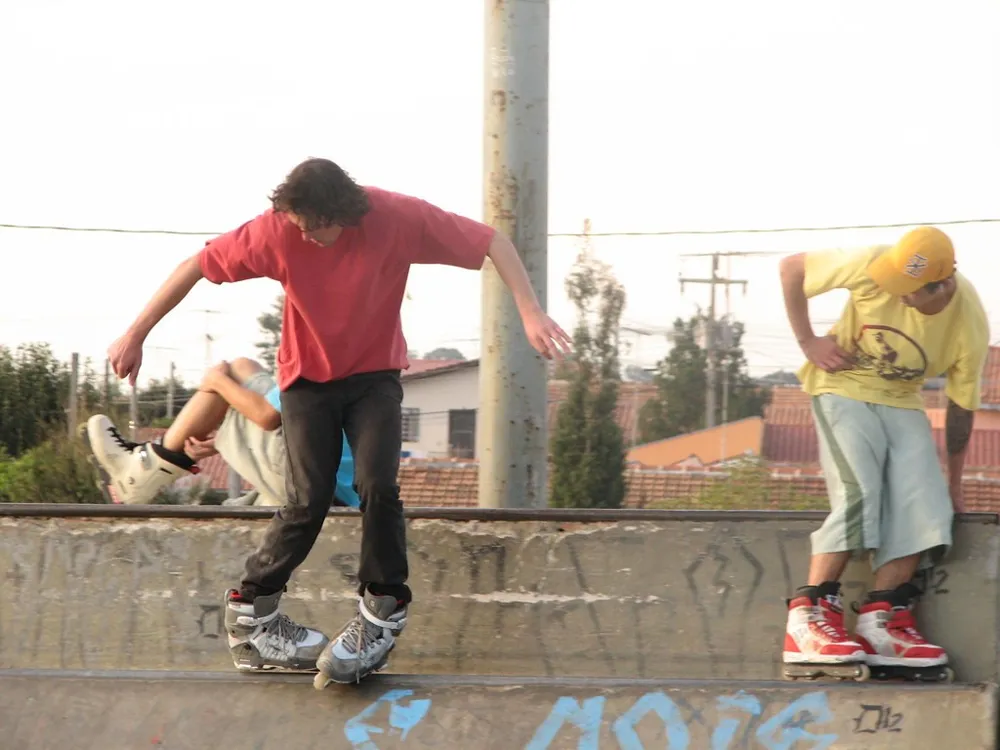
Skateparks add transitions, the curved ramps that send you up and back down. SkaMiDan's skatepark progression is a useful learning order:
- Etiquette and posture: learn the park's rules, wait your turn and keep a low, centered stance.
- Brakeless stops: aggressive skates have no heel brake, so learn a T-stop or drag stop and a back step before you ride ramps.
- Banks and quarter pipes: roll up and back down small ramps, turning around at the top once you're comfortable.
- Drop-ins: start on the deck of a small ramp, lean forward into the ramp and commit your weight over the front of your skates.
- Pumping: on mini ramps, bend and extend your legs through the transitions to gain speed without pushing.
- Stalls and grinds on coping, then gap jumps and spines.
Your first air is a small jump off the top of a quarter pipe or a launch ramp. Bring your knees up, keep your shoulders over your skates and land on the slope rather than the flat. A ramp 180 turns you around in the air so you ride back down facing forward. Learn the flat 180 first, then try it at low height on a quarter pipe. Before you jump on ramps, practice falling: slide down on your knee pads instead of reaching back with your hands.
Most skateparks welcome inline skaters, but some are skateboard-only, so check the posted rules. See where to skate and the best skateparks in the US for spots.
Common Mistakes
- Skipping the basics: if you can't stop on demand, every trick becomes a fall.
- Sitting back: leaning onto your back wheels makes the skates shoot out from under you. Keep your chest over your knees.
- Locked knees: stiff legs can't absorb landings or wobbles.
- Looking down: your weight follows your eyes. Look at the landing spot or the next cone.
- Windmilling arms: backward arm circles in a jump pull your weight back.
- Grinding on the wrong skates: recreational frames and heel brakes catch on ledges.
- One side only: learn spins, crossovers and slalom in both directions.
- Loose gear: pads that slide around won't protect you when you land on them.
A Simple Practice Plan
| Stage | Focus | Tricks |
|---|---|---|
| Stage 1 | Balance | One-foot glide, heel-toe roll, fishtail |
| Stage 2 | Edges and turns | Forward slalom, crossovers, backward lemons |
| Stage 3 | Rotation and air | Two-foot spin, small jumps, 180 jump, T-stop |
| Stage 4 | Pick a style | Fish, snake and criss-cross; curb and stair rides; stalls, frontside and soul grinds; drop-ins |
Move on when a trick works slowly on both sides. Warm up first, try new tricks early in a session while your legs are fresh, and keep sessions short and regular. Filming your attempts often shows posture problems faster than feel alone. The exercises for skating guide has strength and balance work that helps.
Where to Practice
- Tennis or basketball courts: flat and smooth, good for slalom and spins. Check whether skating is allowed.
- Empty parking lots: room for crossovers and jumps, but watch for cracks, gravel and traffic.
- Roller rinks: smooth floors for spins, with lessons at many rinks.
- Low curbs and ledges: for first stalls and grinds, away from pedestrians and where skating is permitted.
- Skateparks: for ramps and coping, during quieter hours while you learn.
Avoid wet or dusty surfaces, since wheels lose grip quickly and slides become unpredictable.
What to Learn Next
- Backward crossovers and backward slalom: start with how to skate backwards.
- Advanced stops: the hockey stop and powerslide in how to stop on rollerblades.
- Quad skate tricks: toe stop spins, shoot the duck and jam moves in roller skating tricks.
- Better wheels: see rollerblade wheels for recreational and urban setups.
- Why skate: fitness and balance benefits in benefits of rollerblading.
For more inline and quad guides, browse the roller skating hub.
Frequently Asked Questions
What is the easiest rollerblading trick for beginners?
Gliding on one foot is usually the easiest start, followed by the heel-toe roll and forward slalom around widely spaced cones. All three build the balance that later tricks need.
Can I do tricks on regular rollerblades?
Yes. Freestyle, slalom, spins, small jumps and stair rides all work on recreational skates, though the heel brake can get in the way of some moves. Grinds need aggressive skates with a soul plate and an H-block, and fitness skates are not built for them.
What is the first grind to learn on inline skates?
Most trick lists start with the frontside grind on a low curb or ledge, then the soul grind. SkaMiDan's aggressive trick list calls these two the fundamental grinds that the others build on.
Do I need to remove my heel brake to do tricks?
Not for balance tricks, slalom or small jumps. Many skaters take it off for spins, backward work or park skating, but only once they can stop reliably with a T-stop or another brakeless stop.
How long does it take to learn rollerblading tricks?
It depends on how often you skate and how solid your basics are. Simple balance tricks can come together in a few sessions, while crossovers, spins and grinds usually take steady practice over weeks or months.
What protective gear do I need for inline tricks?
Wear a certified helmet, wrist guards, knee pads and elbow pads. For grinds and park skating, hard-cap pads you can slide on and optional shin guards add protection.