Mountain Bike Parts Diagram: What Each Part Does (2026)
A part-by-part tour of the modern mountain bike: frame tubes and geometry, fork and shock, cockpit, disc brakes, 1x drivetrains, Boost wheels, tubeless tires and droppers, plus what to check and when.
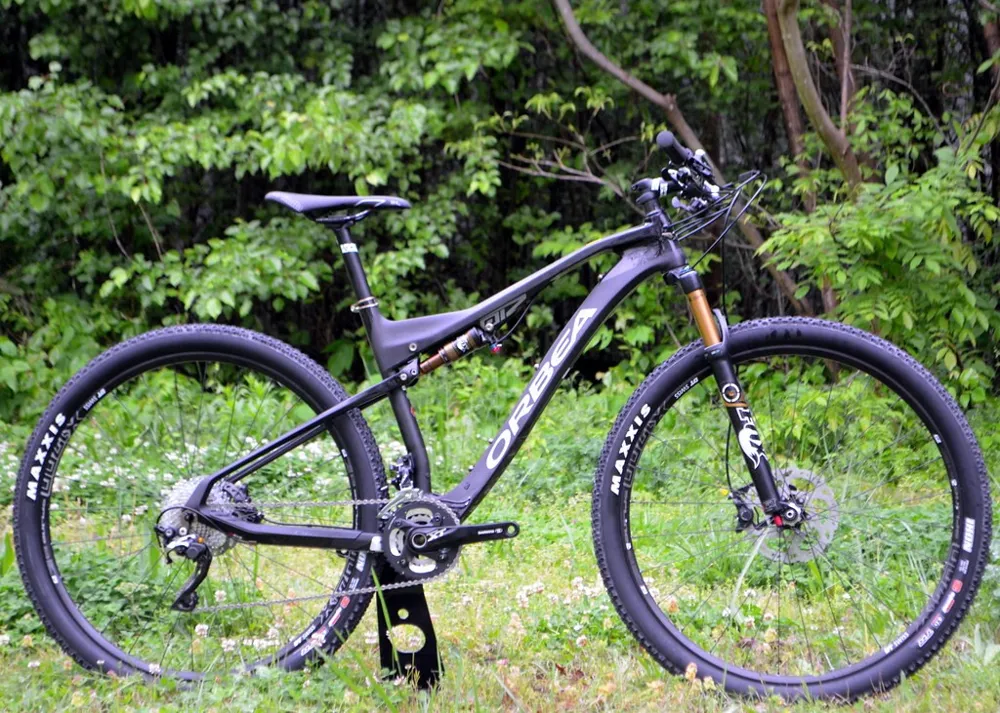
What Are the Parts of a Mountain Bike?
A mountain bike is built from about a dozen systems: the frame, suspension, steering, cockpit, brakes, drivetrain, wheels, tires, seat and pedals. Each one has its own jargon and standards, and knowing them makes it easier to read a spec sheet, talk to a shop, replace worn parts and upgrade in a sensible order. This guide walks through each part, says what it does and links to our deeper guide for the parts that have one.
If you're still choosing a bike, start with types of mountain bikes and hardtail vs full suspension. The mountain biking hub has every other guide.
Mountain Bike Parts Diagram (Labeled Table)
Read this table like a labeled diagram, working from the front of the bike to the back.
| Area | Part | What It Does | Common Types or Standards |
|---|---|---|---|
| Core | Frame | Holds everything; sets fit and handling | Aluminum or carbon; also steel and titanium |
| Front end | Suspension fork | Holds the front wheel, steers and absorbs bumps | Air or coil spring; about 100–200mm travel |
| Front end | Headset | Bearings that let the fork turn | Tapered on most modern bikes |
| Cockpit | Stem and handlebars | Steering and leverage | 31.8mm or 35mm bar clamp |
| Cockpit | Grips, levers and shifter | Hand contact, braking, shifting, dropper control | Lock-on grips; trigger shifters |
| Rear end | Rear shock and linkage | Lets the rear wheel move (full suspension only) | Air or coil; pivots and links |
| Brakes | Levers, calipers, rotors | Slow and stop the bike | Hydraulic or mechanical disc; 2 or 4 pistons |
| Drivetrain | Cranks and chainring | Turn pedaling into drive | 1x most common; 165–175mm arms |
| Drivetrain | Bottom bracket | Bearings the crank spindle turns in | Threaded or press-fit |
| Drivetrain | Chain, cassette, derailleur | Carry drive to the rear wheel and change gears | 11- or 12-speed; clutch derailleur |
| Wheels | Hubs, spokes, rims | Hold the tires and spin on bearings | 29" or 27.5"; Boost 110/148 axles |
| Wheels | Tires | Grip, traction and cushioning | Tubeless or tube; about 2.2–2.6" wide |
| Seat | Saddle and seatpost | Support you while seated; set saddle height | Rigid or dropper post |
| Contact | Pedals | Connect your feet to the cranks | Flat or clipless |
Shimano and SRAM sell many of these parts as a groupset, a matched family of shifter, derailleur, cassette, chain, crankset and brakes. Names like Shimano Deore, SLX and XT or SRAM's Eagle lines refer to these families.
Maxxis Minion DHF
Best for front-tire grip
- Tall, square side knobs
- Many sizes and casings
- Common trail and enduro benchmark
Race Face Chester
Best first flat-pedal upgrade
- Composite body
- Slides off rocks
- Replaces stock plastic pedals
ODI Rogue V2.1
Best cushioned grips
- Lock-on design
- Soft TPE compound
- 33.5mm diameter
Frame: Tubes, Materials and Geometry
The frame is the skeleton of the bike, and its shape and material largely decide how the bike fits and handles. Most mountain bike frames are aluminum or carbon fiber; steel and titanium are also used, mostly on hardtails.
Frame Tubes and Parts
- Top tube: runs from the head tube back to the seat tube. On mountain bikes it slopes down to give you room to move.
- Down tube: runs from the head tube to the bottom bracket. It's the biggest tube and, on e-bikes, often holds the battery.
- Head tube: the short front tube that houses the headset and fork steerer.
- Seat tube: holds the seatpost. Its length and how straight it is decide how long a dropper post you can fit.
- Chainstays and seatstays: the rear triangle that holds the back wheel. On full-suspension bikes these are part of the moving rear end, joined by pivots and links to the shock.
- Bottom bracket shell: where the cranks' bearings sit.
- Dropouts and derailleur hanger: where the rear axle fits. The hanger is a small replaceable piece that holds the derailleur and is designed to bend or break first in a crash, protecting the frame. See derailleur hangers and mounting standards.
Geometry Terms in Brief
A geometry chart lists the angles and lengths of each frame size. You don't need to memorize it, but a few numbers explain most of the difference between bikes.
| Term | What It Measures | What It Changes |
|---|---|---|
| Reach | Horizontal distance from the bottom bracket to the top of the head tube | How long the bike feels when standing; the main sizing number |
| Stack | Vertical distance from the bottom bracket to the top of the head tube | How high the front end sits |
| Head tube angle | Angle of the fork from horizontal | Slacker (lower) is more stable on steep descents; steeper turns quicker |
| Seat tube angle | Angle of the seat tube | Steeper puts you over the pedals for climbing |
| Chainstay length | Bottom bracket to rear axle | Shorter is more playful; longer is more stable and climbs well |
| Wheelbase | Front axle to rear axle | Longer is calmer at speed; shorter is nimbler in tight turns |
| Bottom bracket height or drop | How low the cranks sit | Lower feels planted in corners but risks pedal strikes |
Typical head angles by bike type are in our types of mountain bikes table, and frame sizing by height is in the mountain bike size chart.
Suspension: Fork and Rear Shock
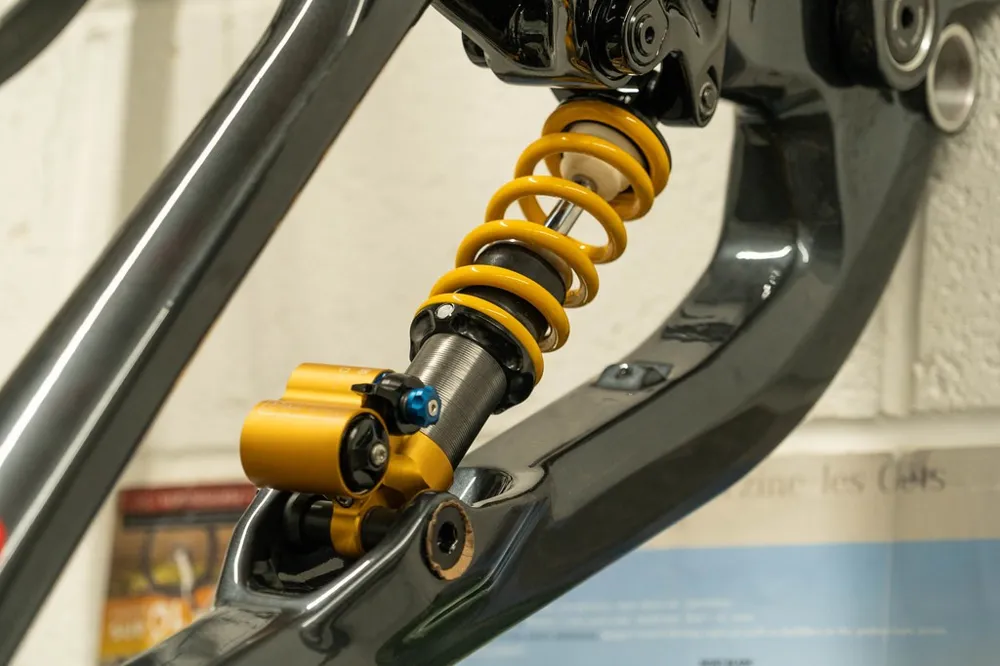
The suspension fork holds the front wheel, lets you steer and absorbs bumps. A hardtail has only a fork and a rigid rear end; a full-suspension bike adds a rear shock and a linkage of pivots that controls how the rear wheel moves. Our hardtail vs full suspension guide covers which suits you.
Fork Parts
- Steerer tube: runs up through the head tube and clamps into the stem.
- Crown: joins the steerer to the stanchions. Downhill forks often use a dual crown that clamps above and below the head tube for extra stiffness.
- Stanchions: the shiny upper tubes. BikeRadar lists roughly 30–32mm on cross-country forks, 34–36mm on trail forks and 36–38mm on enduro forks.
- Lowers and arch: the lower legs that slide over the stanchions and hold the axle.
- Dials: adjusters for rebound, compression and often a lockout.
Travel
Travel is how far the wheel can move. Rough ranges from BikeRadar are about 80–120mm for cross-country (100mm was long the norm, and 120mm is now common on some race bikes), about 120–160mm for trail, about 150–180mm for enduro and about 180–200mm for downhill. Hardtail forks are typically around 100mm for XC and up to about 150mm on aggressive trail hardtails.
Air vs Coil Springs
Most mountain bike forks and shocks use an air spring: you set the stiffness with a shock pump, it's light and it's easy to tune for your weight. A coil spring is a steel (or titanium) spring that is heavier and less adjustable, but some riders prefer its feel on rough descents. To change a coil's stiffness you swap the spring for a different rate.
Sag, Damping and Lockout
- Sag: how far the bike sinks into its travel with you on board. BikeRadar suggests roughly 20–25% at the fork and 25–30% at the shock as a starting point; your fork or shock manual has the maker's figure.
- Rebound damping: controls how fast the suspension extends after a hit. Too fast feels bouncy; too slow packs down over repeated bumps.
- Compression damping: controls how easily it compresses. More compression resists bobbing and diving.
- Lockout or climb switch: a lever that firms the suspension up for smooth climbs and roads. Open it again before descending, and before measuring sag.
Shopping for a fork upgrade? See best mountain bike forks.
Headset and Steering
The headset is the pair of bearings at the top and bottom of the head tube that let the fork turn smoothly without play. Most modern mountain bikes use a tapered steerer and headset, with a bigger lower bearing than upper bearing for stiffness; older bikes often use the same size at both ends.
Headset bearings are set by tightening a top cap before the stem bolts are clamped. Too loose and the front end knocks under braking; too tight and steering feels stiff or notchy. A quick check: hold the front brake, rock the bike back and forth and feel for a clunk at the head tube. A gritty or rough feel when you turn the bars usually means worn bearings.
Cockpit: Stem, Handlebars, Grips and Controls
The cockpit is everything you touch with your hands.
- Stem: clamps the bars to the fork steerer. Mountain bike stems are much shorter than road stems, which gives quicker, more direct steering.
- Handlebars: flat or riser bars, usually with a 31.8mm or 35mm clamp. Most trail riders use bars around 760–800mm wide. Width, rise, sweep and material are covered in best MTB handlebars.
- Grips: lock-on grips clamp to the bar with a small bolt so they don't twist; push-on grips rely on friction. Shapes and diameters vary; see best mountain bike grips.
- Brake levers: one per brake. In the US, the left lever usually works the front brake, but some countries swap it, so check before you ride a new bike.
- Shifter: on 1x bikes there is only a right-hand shifter for the rear derailleur. Trigger, grip-shift and wireless options are compared in best mountain bike shifters.
- Dropper lever: usually under the left grip where a front shifter used to sit.
- Cables and hoses: shifting and droppers usually use a thin cable in housing; hydraulic brakes use a fluid-filled hose. Many frames route them internally.
Brakes: Hydraulic vs Mechanical Disc
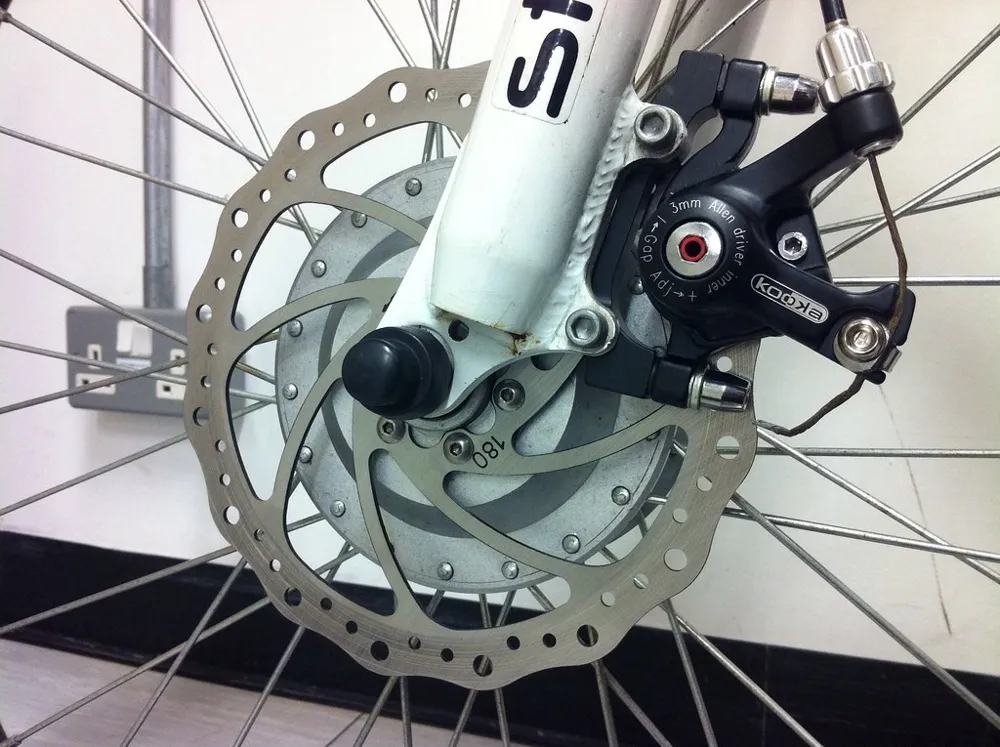
Almost every modern mountain bike uses disc brakes: a caliper on the frame or fork squeezes pads onto a metal rotor bolted to the hub. Older and very cheap bikes may still have rim brakes (V-brakes) that squeeze the wheel rim instead.
| Hydraulic Disc | Mechanical (Cable) Disc | |
|---|---|---|
| How it works | Lever pushes fluid through a sealed hose | Lever pulls a steel cable |
| Feel and power | Generally more power and finer control | Less power; feel depends on cable condition |
| Pad wear | Self-adjusts as pads wear | Needs manual adjustment |
| Maintenance | Occasional bleed to refresh fluid | Cable and housing replacement |
| Where you find it | Most trail bikes | Budget and entry-level bikes |
Calipers, Pads and Rotors
- Calipers: mountain bike calipers have either two or four pistons. Four-piston brakes are favored for steep trails and heavier riders because of their extra power.
- Pads: organic (resin) pads are usually quieter with good bite; metallic (sintered) pads usually last longer and cope better with heat and wet conditions. Keep oil and lube off them; contaminated pads often need replacing.
- Rotors: come in a range of sizes; BikeRadar lists 140mm to 203mm, and gravity bikes often run even bigger ones. Bigger rotors add power and handle heat better. Rotors attach with either six bolts or Shimano's splined Centerlock system, so match the rotor to your hub.
Setup and rub fixes are in how to adjust bike brakes, and upgrade options are in best mountain bike brakes.
Wheels: Rims, Hubs and Axle Standards
Each wheel is a hub at the center, spokes tensioned by small nipples, and a rim that holds the tire. Rims are aluminum or, on pricier wheels, carbon; some tubeless-specific rims are hookless, with no hook on the sidewall to grip the tire bead. Rim internal width matters for tire shape: our mountain bike wheels guide covers widths and upgrade picks.
Wheel Size
Most adult mountain bikes use 29-inch or 27.5-inch wheels, and some mix a 29-inch front with a 27.5-inch rear (a "mullet"). Our mountain bike wheel sizes guide compares them.
Hubs and Freehubs
The rear hub contains the freehub, a ratchet or pawl mechanism that drives the wheel when you pedal and lets it coast when you stop. The cassette slides onto the freehub's driver body, and there are three main types on mountain bikes: Shimano HG, Shimano Micro Spline and SRAM XD. Your cassette must match your driver.
Axle Standards: Quick Release, Thru-Axle and Boost
A quick release is a thin skewer that clamps the wheel into open dropouts. A thru-axle is a thick axle that threads through the fork or frame and hub, which is stiffer and holds the wheel more precisely; almost all modern mountain bikes use thru-axles.
| Standard | Front | Rear | Where You See It |
|---|---|---|---|
| Quick release | 9 x 100mm | 10 x 135mm | Older and budget bikes |
| Non-Boost thru-axle | 15 x 100mm | 12 x 142mm | Mountain bikes from before Boost |
| Boost | 15 x 110mm | 12 x 148mm | Most current XC, trail and enduro bikes |
| Super Boost | — | 12 x 157mm | Some trail and enduro frames |
| Downhill | 20 x 110mm | 157mm (different hub layout from Super Boost) | Downhill and freeride bikes |
Boost widens the hub flanges for stiffer wheels and moves the chainline 3mm outboard, which helps tire clearance. It isn't directly compatible with older spacing, so check both ends before buying wheels or a fork.
Tires and Tubeless Setups
Tires are the only part of the bike touching the ground, so they change grip and comfort more than almost any other part. Trail tires are often about 2.3 to 2.5 inches wide, with narrower, faster-rolling tires on XC bikes. Each tire has a tread pattern (center knobs for drive and braking, side knobs for cornering), a rubber compound (softer grips more but wears faster) and a casing (thicker resists cuts but weighs more). Many riders run a grippier tire up front than at the rear. Tread patterns and pairings are in best mountain bike tires.
Tubeless vs Tubes
Most mountain bike tires and rims are now tubeless-ready. Instead of an inner tube, the tire seals to the rim with rim tape, a tubeless valve and liquid sealant that plugs small punctures. Tubeless setups can lower rolling resistance, improve comfort and reduce flats, and they let you run lower pressures without pinch flats. Tubes are cheaper and simpler but more prone to pinch flats. Some riders also fit tire inserts, foam rings that protect the rim from hard hits.
Pressure matters as much as the tire itself; start with our mountain bike tire pressure chart, and see how to fix a flat bike tire for trail repairs.
Drivetrain: Cranks, Chain, Cassette and Derailleur
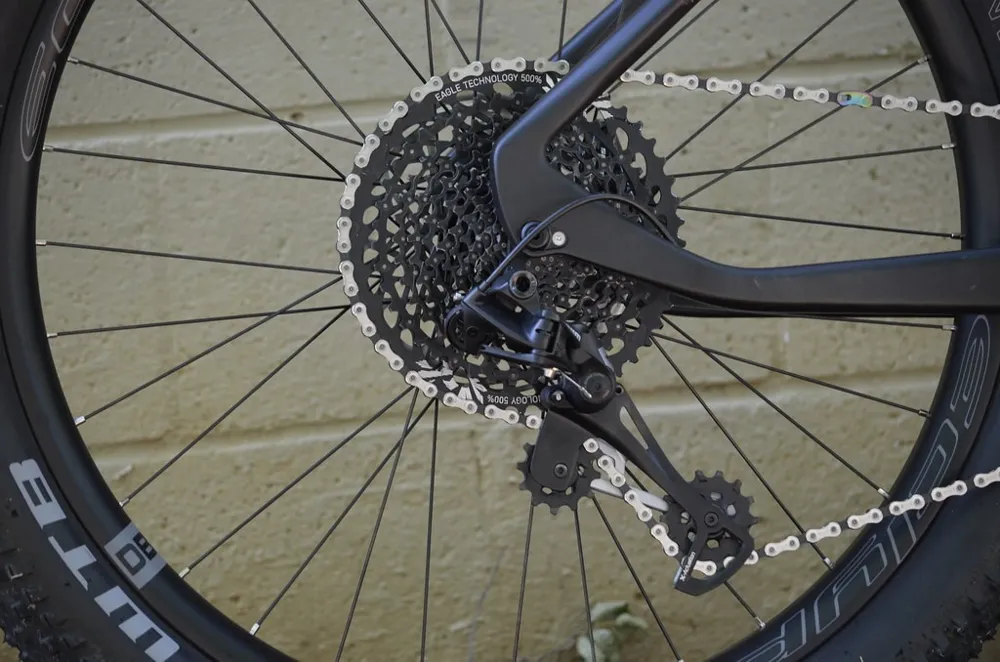
The drivetrain turns pedaling into forward motion and lets you change gears.
1x vs 2x
A 1x ("one-by") drivetrain uses a single chainring up front and a wide-range cassette at the back, with no front derailleur. It's lighter, simpler and holds the chain on better than 2x or 3x setups, which use two or three chainrings and a front derailleur. Most modern mountain bikes are 1x with 12 gears; some budget and older bikes have 11 or fewer, and many entry-level bikes still use 2x or 3x.
Drivetrain Parts
- Crankset: the crank arms and spindle, plus the chainring. Mountain bike arms are commonly 165–175mm long; shorter arms reduce pedal strikes. See best MTB cranksets, and how to remove a bike crank for servicing.
- Chainring: the toothed ring on the crank. On 1x bikes it usually has alternating narrow and wide teeth to hold the chain. Smaller rings make climbing easier; bigger rings give more top speed.
- Bottom bracket: the bearings the crank spindle spins in (more below).
- Chain: must match the number of gears, because chains get narrower as cassettes add cogs. A worn chain wears out the cassette and chainring with it.
- Cassette: the stack of rear cogs on the freehub. Big cogs make climbing easier; small cogs are for speed. SRAM's 12-speed Eagle cassettes come in 10-50 and 10-52 tooth versions, for example.
- Rear derailleur: moves the chain across the cassette. Mountain bike derailleurs have a clutch that keeps the chain tight over bumps to reduce slap and dropped chains. SRAM's newer T-Type Transmission derailleurs bolt directly to frames with a UDH (Universal Derailleur Hanger). See best mountain bike derailleurs.
- Shifter: moves the derailleur by cable or, on electronic systems, wirelessly. Shimano and SRAM shifters and derailleurs generally don't mix.
Bottom Bracket Standards in Brief
There are two broad families. Threaded bottom brackets screw into the frame; the common English/BSA thread is 1.37 inches x 24 threads per inch, according to Park Tool, and T47 is a larger threaded standard. Press-fit bearings push into a smooth shell; Park Tool names them by bore size, such as PF41 (also called BB92), PF42 (BB30) and PF46 (PF30). The crank spindle must also match: 24mm, 28.99mm (SRAM DUB) and 30mm are common diameters. Check the frame maker's spec before ordering a crank or bottom bracket.
Saddle, Seatpost and Dropper Post
The saddle sits on two rails clamped to the seatpost, and a seatpost clamp at the top of the seat tube holds the post at the right height. Saddle shape and padding are covered in best bike saddles.
Most trail bikes now use a dropper post, which lowers the saddle out of the way for descents and raises it again for climbing at the push of a bar lever. BikeRadar notes travel from about 100mm up to around 240mm. Droppers come with internal or external cable routing, and some are wireless. To fit one you need the right diameter (30.9, 31.6 and 34.9mm are common on mountain bikes) and a travel that fits your seat tube and leg length. Our best dropper posts guide explains how to measure.
Pedals
Many mountain bikes ship with basic pedals or none at all. The two main types are:
- Flat pedals: wide platforms with small pins for grip, used with flat-soled shoes. Easy to step off and good for learning skills.
- Clipless pedals: a cleat on the shoe locks into the pedal. Mountain clipless pedals are usually double-sided and use two-bolt cleats, which helps you clip in on rough trails and clears mud.
Mountain bike pedals use a 9/16-inch thread, and the left pedal has a reverse thread, so it loosens clockwise. Compare options in best mountain bike pedals and match shoes with mountain bike shoes.
How Parts Differ by Bike Type
The same parts look different across categories:
| Bike Type | Suspension | Brakes | Tires and Wheels | Other Parts |
|---|---|---|---|---|
| Cross-country | Short travel, light forks; lockouts common | Light two-piston brakes, smaller rotors | Narrower, fast-rolling 29" tires | Sometimes a shorter dropper or rigid post |
| Trail | Mid travel, 34–36mm stanchions | Two- or four-piston, mid-size rotors | 29" or mixed; about 2.3–2.5" tires | Dropper standard on most |
| Enduro | Long travel; coil shocks more common | Four-piston, large rotors | Tough casings, often mixed wheels | Long-travel dropper; chain guide |
| Downhill | Dual-crown fork, longest travel | Four-piston, large rotors | DH casings; 20 x 110mm front axle | Often fewer gears; no dropper needed |
| Budget hardtail | Basic coil fork, may lack lockout | Mechanical or entry hydraulic discs | Quick release or thru-axle | 2x or 3x drivetrain, rigid post |
E-mountain bikes add a motor (usually at the cranks), a battery (often in the down tube) and a display or remote on the bars, and they tend to use stronger brakes, wheels and tires to handle the extra weight. See best electric mountain bikes. Shopping on a tight budget? Are Walmart mountain bikes good explains which parts tend to be cut on cheap bikes.
Common Replacement Parts on Amazon
These wear parts and tools come up on most mountain bikes. Product details come from the makers and listings; always check size, thread and compatibility before ordering.
1. Maxxis Minion DHF
One of the most widely used mountain bike tires and a common benchmark for trail and enduro front tires. Its tall, square-edged side knobs are built for cornering grip, and it comes in many sizes, casings and rubber compounds.
Good to Know
- Works on most terrain
- Huge range of versions
Watch Out For
- Pick the right wheel size, width and casing
2. Race Face Chester
A composite flat pedal that's a popular first upgrade from stock plastic pedals. Composite bodies tend to slide off rocks rather than catch.
Good to Know
- Tough and simple
- Works with any flat shoe
Watch Out For
- Composite wears faster than alloy
3. ODI Rogue V2.1
The classic Rogue large-pad shape in a soft TPE compound, with a lock-on clamp and a large 33.5mm diameter for cushioning.
Good to Know
- Lots of cushioning
- Won't twist on the bar
Watch Out For
- May feel too thick for small hands
4. Lezyne Tubeless Kit
A compact plug kit with a reamer, an insertion tool and five 3.5mm plugs, stored in an aluminum case that doubles as the handle, for punctures that sealant alone won't close.
Good to Know
- Small enough for a pack
Watch Out For
- Only useful with tubeless tires
5. Park Tool Torque Wrench
A ratcheting click-type torque wrench with a 2–14 Nm range for tightening stem, bar, seatpost and brake bolts to the maker's specs.
Good to Know
- Protects carbon parts from over-tightening
Watch Out For
- Not for high-torque bolts like some cranks and cassettes
Maintenance Points by Part
Most mountain bike problems start as small, cheap fixes. This schedule is a common starting point; your bike's manuals and how often and where you ride change the intervals.
| When | What to Check |
|---|---|
| Before every ride | Tire pressure, brakes feel firm, thru-axles and quick releases closed, no headset play |
| After every ride | Wipe down the bike, especially fork stanchions and the chain |
| Weekly or every few rides | Clean and lube the chain; see how to clean a bike chain |
| Monthly | Bolt torques, brake pad thickness, tire wear, chain stretch, suspension sag |
| Every season or year | Suspension service, brake bleed, tubeless sealant top-up, bearing checks (headset, bottom bracket, hubs, pivots) |
Signs a part needs attention: shifting that skips or hesitates (cable, hanger or chain wear), brakes that squeal or feel spongy (contaminated pads or air in the system), a knock from the front end (headset or fork), creaks under pedaling (bottom bracket, pedals or pivots) and tires losing air faster than usual (dried sealant). Suspension service intervals vary by maker, so check your fork and shock manuals. If you're unsure about brakes, suspension or carbon parts, have a bike shop look at them.
Mountain Bike Parts Compatibility Checklist
Before you buy any replacement or upgrade, confirm:
- Wheel size (29", 27.5" or mixed) and tire clearance in your frame and fork.
- Axle standard: Boost or non-Boost, thru-axle or quick release, front and rear.
- Freehub driver: Shimano HG, Micro Spline or SRAM XD to match the cassette.
- Number of gears for chain, cassette, shifter and derailleur, and stay within one brand for shifting parts.
- Derailleur mount: standard hanger or UDH.
- Bottom bracket shell type and crank spindle diameter.
- Steerer: tapered or straight, and steerer length for a new fork.
- Rotor size and mount: six-bolt or Centerlock, and what your fork and frame allow.
- Bar clamp diameter (31.8 or 35mm) to match the stem.
- Seatpost diameter and maximum insertion for droppers.
Tools You Need for Mountain Bike Parts
A basic home kit covers most of the jobs on this page: a set of hex keys (and a T25 Torx for rotor bolts), a torque wrench, a floor pump and shock pump, tire levers, a chain tool and a chain checker. Add a repair stand if you work on the bike often, and carry a multi-tool, pump and plug kit on rides. Cassette, bottom bracket and headset work needs specific tools, so many riders leave those to a shop.
Frequently Asked Questions
What are the main parts of a mountain bike?
The frame, suspension fork (and a rear shock on full-suspension bikes), headset, stem and handlebars with grips and controls, disc brakes, drivetrain (cranks, chainring, chain, cassette, derailleur and shifter), wheels (hubs, spokes, rims), tires, saddle and seatpost or dropper, and pedals.
What is a groupset on a mountain bike?
A groupset is the set of drivetrain and braking parts sold as a family, usually the shifter, derailleur, cassette, chain, crankset and brakes. Shimano Deore, SLX and XT and SRAM's Eagle lines are common examples.
What is the difference between a 1x and 2x drivetrain?
A 1x (one-by) drivetrain has a single chainring and a wide-range cassette, so there is no front derailleur. A 2x has two chainrings and a front derailleur for closer gear steps. Most modern mountain bikes use 1x because it is simpler and holds the chain better.
What is Boost spacing on a mountain bike?
Boost is a hub and axle standard: 15x110mm at the front and 12x148mm at the rear. It spreads the hub flanges for stiffer wheels and moves the chainline outward, and it does not fit older 100mm and 142mm forks and frames without adapting.
Are hydraulic disc brakes better than mechanical?
Hydraulic brakes use fluid in a sealed hose, which generally gives more power and better control and self-adjusts as pads wear. Mechanical (cable) discs are cheaper and simple to fix but need manual adjustment. Most trail bikes come with hydraulic brakes.
Which mountain bike parts wear out fastest?
Tires, brake pads, chains, cassettes and chainrings wear the fastest, followed by grips and pedal pins. Bearings, suspension seals and brake fluid need regular service rather than replacement.
Are mountain bike parts interchangeable?
Many are, but standards vary. Check axle spacing (Boost or non-Boost), wheel size, freehub type (HG, Micro Spline or XD), bottom bracket and spindle size, steerer tube, seatpost diameter and the number of gears before buying any part.