History of Scooters: From Wooden Toys to E-Scooters (2026)
The scooter has been reinvented again and again: as a homemade street toy, a motorized novelty, a folding aluminum craze, a skatepark sport and an app-unlocked rental. Here's who did what, and when.
Scooter History at a Glance
There is no single answer to "who invented the scooter." The word covers three related machines: the kick scooter you push with one foot, the seated motor scooter like the Vespa, and today's electric kick scooter. Each had its own inventors and booms. Here are the key dates, with the shakier claims marked.
| Year | Milestone |
|---|---|
| 1817 | Karl Drais builds his running machine, a two-wheeled ancestor often cited in scooter histories |
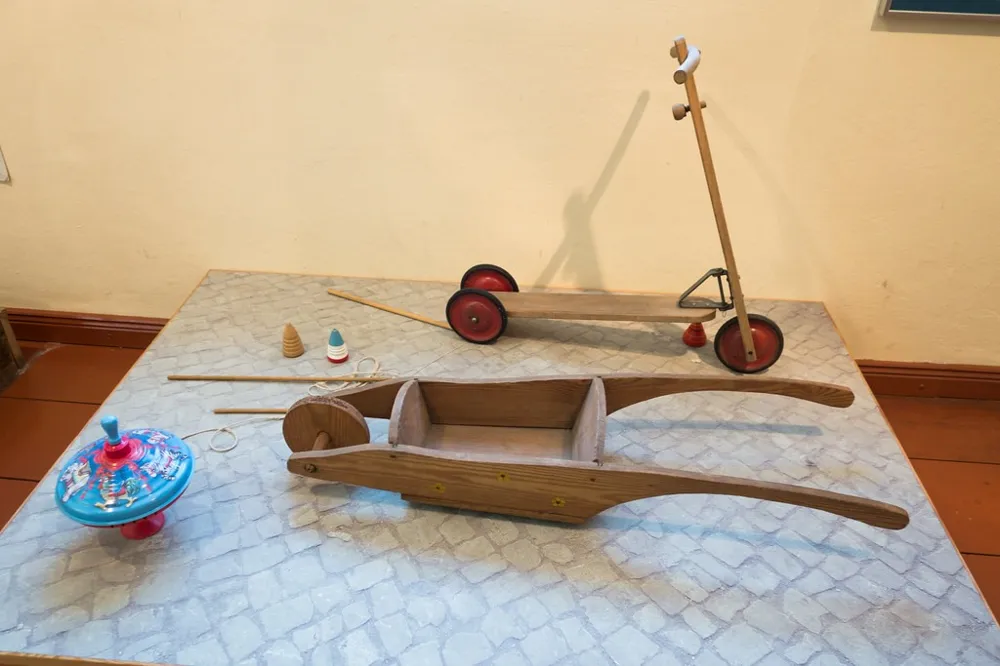
| Late 1800s to early 1900s | Wooden kick scooters appear as children's toys (exact origin undocumented) |
| 1915 | The Motoped and the Autoped, the first motor scooters, reach US streets |
| 1919 | The ABC Skootamota and Reynolds Runabout launch in Britain; Krupp starts building the Autoped in Germany |
| 1936 | The Salsbury Motor Glide and Cushman begin a second wave of US motor scooters |
| 1946–1947 | Vespa (patented April 1946) and Lambretta (on sale December 1947) launch in Italy |
| 1974 | Honda releases the Kick 'n Go, a lever-pedal scooter |
| About 1990 to 1998 | Wim Ouboter develops a folding aluminum scooter in Switzerland (dates vary by source) |
| 1999–2000 | Micro launches; the Razor sweeps Japan and then the US, and Razor USA is founded in June 2000 |
| 2003 | Razor releases its first electric scooter |
| 2005 | First freestyle scooter competition, reportedly in Montreux, Switzerland |
| 2012 | First Freestyle Scooter World Championships |
| 2016 | Xiaomi's M365 launches; docked e-scooter rentals appear in Singapore |
| 2017 | Bird and Lime introduce dockless shared e-scooters in the US |
| 2023 | Paris votes against rental e-scooters; Bird files for Chapter 11 in the US |
Who Invented the Scooter? The Short Answer
Nobody holds a clear claim to the original kick scooter. It seems to have been invented many times over by children and tinkerers, and no patent or named inventor is widely accepted. What can be credited is each major leap:
- Motor scooter: the 1915 Autoped, patented under the name of Arthur Hugo Cecil Gibson and built by the Autoped Company in Long Island City, New York. The Motoped of the same year is often called the first motor scooter.
- Seated motor scooter as we know it: Piaggio's Vespa (1946) set the template for decades.
- Modern folding kick scooter: Swiss inventor Wim Ouboter, founder of Micro Mobility Systems, is generally credited, with Taiwan's JD Corporation turning it into the mass-market Razor.
- Shared electric scooter: Bird, founded in Santa Monica in September 2017, and Lime made dockless rentals a global trend.
Before the Scooter: The 1817 Running Machine
Some scooter histories, including one published by Lyft, begin with German inventor Karl von Drais and his 1817 Laufmaschine, or running machine, also called the Draisine. Riders sat on it and pushed along the ground with their feet. It was expensive and earned the mocking nickname "dandy horse." Strictly speaking it is the ancestor of the bicycle rather than the scooter, but it was one of the first foot-powered two-wheelers, and the same push-and-glide idea runs through every kick scooter since.
Homemade Wooden Kick Scooters (Early 1900s–1950s)
The first kick scooters were simple, and many were homemade. Wikipedia notes that kick scooters were handmade in industrial cities of Europe and the US "since the 1920s or earlier," usually as children's toys. A typical build bolted a roller skate's wheels to a wooden plank, with an upright handle made from an old box or another board. These early scooters were all wood, rolling on small 3 to 4-inch wheels with steel ball bearings.
Factory-made scooters existed too. Lyft's history says Swiss toy maker Wisa Gloria began producing a wooden-wheeled scooter around 1900, which it calls the first recognizable mini-scooter. Scooter maker Unagi dates the wooden kick scooter to the end of the 19th century. Film evidence is firmer: a 1922 short film of Amsterdam streets shows children riding scooters. Because none of these claims names a single inventor, treat any confident "first scooter" date you read online with caution.
The Autoped and the First Motor Scooters (1915–1920s)
The Autoped appeared in 1915 and is the best-documented early motor scooter. Its US patent, filed in July 1913 and granted in July 1916, names Arthur Hugo Cecil Gibson and was assigned to the Auto-Ped Company of America. It was built in Long Island City, New York.
The rider stood on a platform, much like on a modern kick scooter. A 155cc four-stroke engine sat over the front wheel, and Wikipedia lists its top speed at about 20 MPH (some popular histories claim more). Controls were unusual: pushing the steering column forward engaged the clutch, pulling it back released the clutch and applied the brake, and a handlebar lever worked the throttle. The column folded onto the deck for storage.
Autopeds drew famous fans. A 1916 photo shows British suffragette Lady Florence Norman riding a motor scooter, and a 1922 photo shows a traffic officer in Newark, New Jersey, using one. Lyft's history adds that the US Post Office used them. US production ended around 1921, and the German firm Krupp built a licensed version from 1919 to 1922.
Other early motor scooters followed after World War I, including Britain's ABC Skootamota (1919, designed by Granville Bradshaw), the Reynolds Runabout (1919) and the fully enclosed Unibus (1920). Many early machines were unstable or badly built, which hurt the scooter's reputation, and this first generation faded by the mid-1920s.
From Salsbury to Vespa: Seated Motor Scooters (1936–1960s)
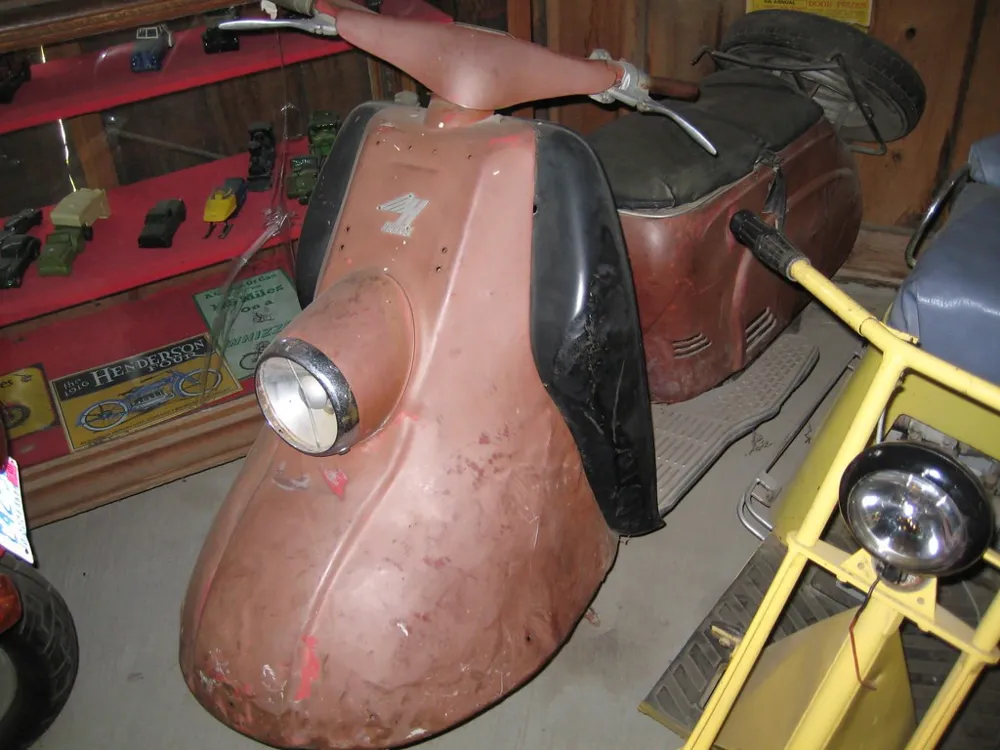
The second wave started in California. The Salsbury Motor Glide arrived in 1936, and in 1938 Salsbury introduced the first continuously variable transmission on a scooter, an idea most later scooters adopted. Cushman built scooters from 1936 to 1965. Unagi's history notes that small motor scooters were used as low-fuel transport during wartime rationing in the 1940s.
After World War II, Italy made the scooter a style icon. Piaggio patented the Vespa in April 1946, with an engine near the rear wheel, a handlebar gearshift and bodywork inspired by aircraft construction. The name comes from the remark "Sembra una vespa" ("It looks like a wasp"). Innocenti's Lambretta debuted in 1947 and went on sale that December. Japan followed with the Fuji Rabbit and Mitsubishi Silver Pigeon in 1946.
These seated scooters are a separate branch from kick scooters. If that's the kind you mean, our guides to 50cc scooter speeds and electric scooters vs mopeds pick up the modern story.
Kick 'n Go, Go-Ped and Kickbikes (1970s–1990s)
Between the Vespa era and the Razor craze, kick scooters kept evolving in smaller steps:
- 1974: Honda released the Kick 'n Go, a scooter driven by stepping on a pedal attached to a lever rather than kicking the ground.
- Early 1980s: Steve Patmont is reported to have patented the Go-Ped, a small stand-up scooter that later came in gas and electric versions.
- About 1987: Many BMX makers sold BMX-style scooters with larger wheels.
- 1994: The Kickbike, a large-wheeled adult kick scooter, was reportedly developed in Finland. Adult "footbike" racing followed, with the Footbike Eurocup starting in 2001.
Wim Ouboter, Micro and the Razor Craze (1990s–2001)
The scooter most people picture today, a folding aluminum frame on small polyurethane wheels, comes from Switzerland. Wim Ouboter, a Swiss banker, wanted a quick way to cover short city trips in Zurich. Lyft retells his story of wanting a sausage from a grill stand about a kilometer from his apartment. Sources disagree on the year: Wikipedia and Unagi say he built his first scooter around 1990, while Lyft places it in the mid-1990s.
His design used inline skate wheels and folded flat. In 1998 he showed the three-wheeled Kickboard, made with K2, at a sports trade fair in Munich, and Micro Mobility Systems launched in 1999. The design was sold under several names, including the Micro Skate Scooter, the JD Bug and the Razor.
The Razor itself came out of Taiwan. Lyft credits Gino Tsai, president of JD Corporation, with developing the Razor after two years of work, and Wikipedia states that the first Razors were made by JD and sold through The Sharper Image. The Razor was introduced in Japan in 1999, where young riders were early adopters, and Razor USA was founded in Cerritos, California, in June 2000 by Carlton Calvin and JD Corporation.
What followed was one of the biggest toy fads of its time. Wikipedia reports that more than 5 million Razors sold in the six months after its 2000 launch, and that the scooter was named Spring/Summer Toy of the Year in 2000. The boom came with injuries: in September 2000, the US Consumer Product Safety Commission reported that emergency room visits linked to lightweight scooters had risen 700 percent since May, with nearly 90 percent of injuries to children under 15. Razor still sells the A-series kick scooters that started it; see how to fold a Razor scooter and our best kids' scooters.
Stunt Scooters and Freestyle Scootering (2000s–Today)

Kids soon took Razors to skateparks, and the folding scooters were not built for it. Riders began reinforcing them, and a new sport, freestyle scootering, grew out of the craze. Razor formed one of the first organized rider teams in the early 2000s and released scooter videos and a video game.
Online communities pushed the gear forward. The Scooter Resource forum launched in 2003, and small brands began making stronger one-piece bars, metal-core wheels and fixed decks. According to Wikipedia, the first scooter competition was held in Montreux, Switzerland, in 2005, and TSI released the first deck with the head tube and neck welded to the deck plate in 2009. The International Scooter Association (now the International Scooter Federation) ran the first World Championships in 2012, won by Dakota Schuetz. The event has run every year since except 2020, with men's park, men's street and women's park titles since 2019.
Today's pro scooters have fixed bars, solid decks and compression systems built for jumps. Compare current models in our best stunt scooters guide, choose parts with pro scooter bars or build a custom stunt scooter, and start with scooter tricks for beginners.
Electric Kick Scooters Grow Up (2000s–2016)
Motorized stand-up scooters never fully disappeared. Wikipedia notes that electric models overtook gas-powered ones in popularity in the early 2000s, and Razor released its first electric scooter in 2003. Unagi's history reports that Go-Ped added an electric stand-up model in 2001, the same year the Segway PT launched (December 2001).
Those early electric scooters were heavy and short-ranged. Lighter lithium-ion batteries, which Unagi's history credits for making modern e-scooters practical, changed that. Self-balancing hoverboards became a craze in 2015 (see how hoverboards work), and in December 2016 Xiaomi launched the M365, a light folding e-scooter that became the basis for the first big rental fleets. The story of the companies behind today's scooters is in our electric scooter brands guide.
Shared E-Scooters: Bird, Lime and the Rental Boom (2017–Today)
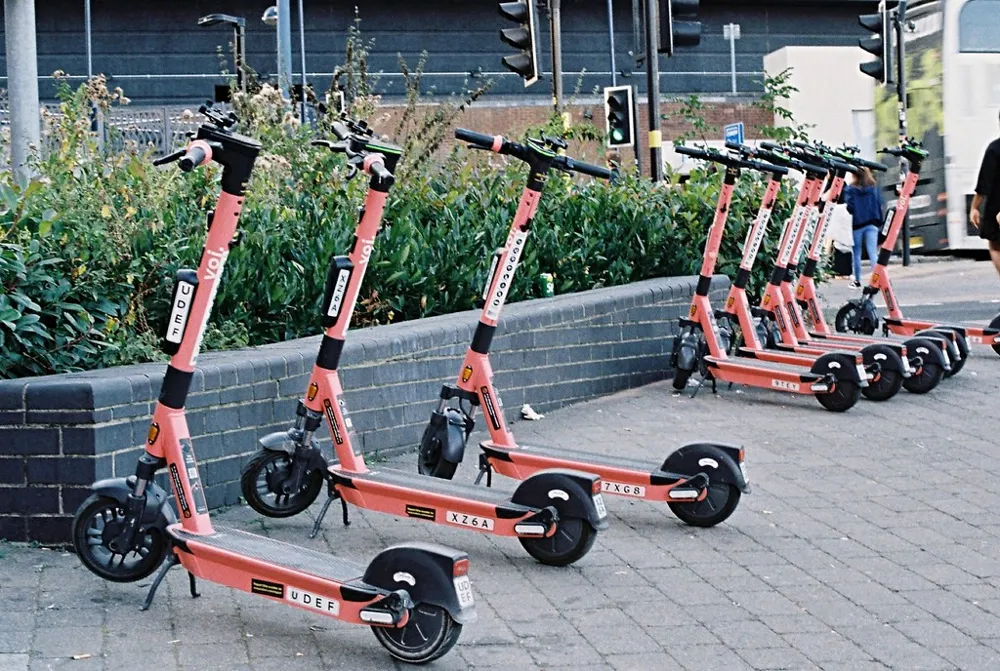
Scooter sharing began with seated vehicles: Scoot Networks rented moped-style scooters from 2012. In 2016, docked e-scooter rentals appeared in Singapore (Wikipedia names Neuron Mobility; Lyft's history names a startup called Telepod).
The real boom began in 2017. Bird was founded in Santa Monica, California, in September 2017 by Travis VanderZanden, a former Lyft and Uber executive, and Bird and Lime both introduced dockless e-scooters that year. Riders unlocked a scooter with a phone app and could leave it at the end of a trip without a dock. Growth in 2018 was fast and messy:
- Bird reportedly expanded to more than 100 cities, and Lime recorded more than 11.5 million rides.
- In May 2018, San Francisco ordered Bird, Spin and Lime to stop after about 1,900 complaints about cluttered sidewalks, then moved to a permit pilot.
- Lyft and Uber launched their own scooter services, and Lime expanded into Paris in June 2018.
Cities then tightened rules. France banned e-scooter riding on sidewalks in September 2019. In a 2023 Paris referendum, about 90 percent of votes cast opposed rental e-scooters, though turnout was under 8 percent. In December 2023 Bird filed for Chapter 11 bankruptcy in the US, and in April 2024 it was acquired by Third Lane Mobility. Rental scooters still run in many cities as of November 2026, but operators and rules change often, so check your city's program.
Scooter Safety and Rules Then and Now
Every scooter boom has brought a safety debate. The CPSC's 2000 warning urged riders to wear a helmet that meets its standard plus knee and elbow pads, to ride on smooth paved surfaces away from traffic, and not to ride at night. That advice still holds for kick scooters.
Electric scooters added traffic law to the picture. Age limits, speed caps, helmet rules and whether you can ride on sidewalks or in bike lanes vary by state and city (last checked November 2026). This is not legal advice; read are electric scooters street legal? and do you need a license for a scooter?, then confirm with your local transportation department. New riders should also read how to ride an electric scooter.
Keep Exploring
Browse every guide in our scooter hub, see how today's fastest models compare in the fastest electric scooters, or read how other wheeled sports grew up in skateboarding history and the history of roller skating.
Frequently Asked Questions
Who invented the scooter?
No single inventor is documented. Children were riding homemade and factory-made wooden kick scooters by the early 1900s, the Autoped motor scooter appeared in 1915, and Swiss inventor Wim Ouboter is credited with the modern folding aluminum kick scooter.
When was the first scooter made?
Nobody knows the exact date. Histories place the first wooden kick scooters around the late 1800s or early 1900s, and Wikipedia notes handmade scooters in European and US cities since the 1920s or earlier.
What was the first motor scooter?
The Motoped and the Autoped both appeared in 1915 in the US, and the Motoped is often described as the first. The Autoped is better known: a stand-up scooter with a small engine over the front wheel, built in Long Island City, New York.
Who invented the Razor scooter?
Accounts differ. The folding design is widely credited to Swiss inventor Wim Ouboter, while Taiwan's JD Corporation, led by Gino Tsai, manufactured and developed the Razor. Razor USA was founded in California in June 2000.
When did electric scooters become popular?
Small electric kick scooters were sold in the early 2000s, and Razor released its first electric model in 2003. They became mainstream after 2017, when Bird and Lime launched dockless rental scooters in US cities.
When did Bird and Lime scooters start?
Bird was founded in Santa Monica, California, in September 2017. Bird and Lime both introduced dockless shared e-scooters in 2017 and spread to dozens of cities in 2018.
When did stunt scootering start?
Freestyle scootering grew out of the Razor craze around 2000. Razor formed an early rider team, the first scooter competition was reportedly held in Switzerland in 2005, and the first World Championships took place in 2012.