Surfboard Roof Racks That Get Your Board There Safely (2026)
Through-door soft racks, crossbar pads, surf carriers, straps and locks, plus the fins-forward debate, how to strap a board down and how to keep your roof scratch-free.

Soft Racks or Crossbars: Which Do You Need?
Most surfboard dings happen on land, and the car roof is a common culprit. There are two basic ways to carry a board up there. Soft racks are padded tubes that sit on a bare roof, with straps that run through the inside of the car. Crossbars with pads use your car's factory or aftermarket roof bars, with foam pads wrapped around them and separate cam straps holding the boards. Surf-specific carriers that clamp to crossbars sit in between.
| Setup | Best For | Lockable? | Trade-Off |
|---|---|---|---|
| Soft racks (through-door straps) | Cars without bars, rentals, short local trips | Usually not | Less stable at speed and in crosswinds |
| Crossbar pads + cam straps | Cars with bars, regular surfers, highway trips | With locking straps | Needs crossbars first |
| Surf carrier on crossbars | Leaving boards on the car, two-board loads | Often built in | Bulkier, check bar and board-width fit |
| Tailgate pad | Pickups | Varies | Long boards hang over the tailgate |
If you already have crossbars, pads and cam straps are the simplest, most secure setup. If you don't, a soft rack gets you to the beach without installing anything. Paddle board owners can follow the same logic in our guide to transporting a paddle board.
FCS D-Ring Double Soft Racks
Best soft rack for cars without bars
- Fits 1 to 6 boards on most cars, per FCS
- 32mm webbing, die-cast metal buckles
- Aero, non-rolling 440mm-wide pads
Dakine Aero Rack Pads 28"
Best pads for aero crossbars
- 28-inch pads, sold as a pair
- 600-denier polyester cover
- Hook-and-loop closures
Thule Board Shuttle
Best lockable carrier
- Carries 2 boards on crossbars
- Lockable, One Key System compatible
- Two 15 ft straps included
Surfboard Car Racks Compared
| Product | Type | Capacity or Size (Maker Listing) | Needs Crossbars? | Locks? |
|---|---|---|---|---|
| FCS D-Ring Double Soft Racks | Soft rack | 1 to 6 boards | No | No |
| Dakine Aero Rack Pads 28" | Crossbar pads | 28 in, pair | Yes | No (add locking straps) |
| Yakima 30" Aero Crossbar Pads | Crossbar pads | 30 in, pair | Yes | No (add locking straps) |
| Thule Board Shuttle | Surf/SUP carrier | 2 boards, 28 to 34 in wide | Yes | Yes |
| NRS 1" HD Tie-Down Straps | Cam straps | 15 ft | Works with pads or carriers | No |
| FCS Kanulock | Locking straps | Steel-cable core | Works with pads or carriers | Yes |
The Best Surfboard Racks, Pads and Straps
1. FCS D-Ring Double Soft Racks
FCS says the D-Ring Double fits 1 to 6 boards on most cars, vans and 4WDs that don't have roof racks. The two pads are aerodynamic, non-rolling and 440mm wide, with a high-density foam shield under a 1000D fabric cover. Each strap is 32mm heavy-duty webbing that closes with a die-cast metal D-ring buckle, and the buckles carry numbered how-to steps. FCS points out that there are no moving parts in the buckle to fail. A storage pouch is included. FCS also sells single and single-wide versions, which suit fewer boards or a narrower roof.
Good to Know
- No crossbars needed
- Up to six boards, per FCS
- Packs into its own pouch
Watch Out For
- Can't be locked
- Less stable than bars at highway speeds
- Straps run through the cabin
2. Dakine Aero Rack Pads 28"
A pair of 28-inch pads that wrap your existing crossbars and close with hook-and-loop strips. The cover is 600-denier polyester, and Dakine backs them with a 2-year limited warranty. They're shaped to sit streamlined on aero (teardrop) bars; Dakine also makes them in 18-inch and 34-inch lengths, and the longer pads give wide longboards and stacked boards more support. Pads protect the board from pressure dents but don't hold anything down, so you still need cam straps.
Good to Know
- Light and quick to fit
- Several lengths
- Stays on the bars between sessions
Watch Out For
- Straps sold separately
- Check the fit on round or square bars
3. Yakima 30" Aero Crossbar Pads
Yakima's 30-inch pads use non-slip foam and sectioned hook-and-loop attachments that work around rack towers and accessories. Yakima lists them for its JetStream bars and for flush and rail bars, and says the length suits most stand-up paddle boards, surfboards and fishing kayaks. They come as a pair, and the extra length over a 28-inch pad leaves room for a wider board or a two-board stack.
Good to Know
- Non-slip foam
- Works around rack accessories
- Doubles for SUPs and kayaks
Watch Out For
- Bars not included
- No straps in the box
Not found on Amazon when we checked (November 2026); check Yakima dealers and REI.
4. Thule Board Shuttle
A two-board carrier that clamps to crossbars. Thule describes a telescoping design that fits board widths from 28 to 34 inches, so measure your boards first; it's aimed at wider boards such as longboards and SUPs. It's lockable and compatible with Thule's One Key System, comes with two 15-foot straps that have wrap-around padding and rubber buckle covers, and lists a 50 kg maximum load and crossbar spacing of about 23 to 36.8 inches. Thule lists compatibility with its WingBar, SquareBar and ProBar families among others; check the fit guide for your bars. The carrier itself weighs 5.8 lb.
Good to Know
- Lockable to the bars
- Straps and padding included
- Carries two boards
Watch Out For
- Check board width against Thule's range
- Needs compatible crossbars
5. NRS 1" HD Tie-Down Straps
Plain cam straps are what most surfers use with crossbar pads. NRS sells these in 15-foot lengths with UV-protected polypropylene webbing that won't stretch when wet, a listed minimum breaking strength of 1,500 lb and cam buckles with dual stainless-steel springs. Fifteen feet is enough to wrap a stack of boards on most cars; shorter straps are tidier for a single shortboard.
Good to Know
- Doesn't stretch when wet
- Hand-tightened cam buckle
- Also used for kayaks and SUPs
Watch Out For
- Not lockable
- Bare metal buckles can scratch; keep them off the board and paint
6. FCS Kanulock Locking Tie Downs
Kanulock straps look like ordinary cam straps but have braided stainless-steel cables running inside the webbing (retailers list two 2.5mm cables) and a lockable buckle. Once they're closed around the boards and crossbars, a thief can't simply cut the webbing. FCS sells them as its locking tie-down option. They're a theft deterrent for a quick stop, not a high-security lock.
Good to Know
- Locks boards to the bars
- Uses like a normal cam strap
Watch Out For
- Need crossbars to lock to
- A determined thief can still cut steel cable
Soft Racks: How They Work
A soft rack is two long foam pads, each with a strap sewn in. You lay the pads across the bare roof, open the doors and run the straps through the car, so they pass over the headliner and the door openings, then close the doors over the webbing. A second set of straps wraps the boards. FCS's D-Ring range, Pro-Lite's single and double soft racks, Creatures of Leisure Wrap Rax, Ocean & Earth's Rap Rax (sold in a version for cars without roof gutters) and Curve's Lockdown all work this way.
- Single vs double: single racks suit one or two boards; doubles carry more. FCS lists its double for 1 to 6 boards, and Cleanline lists the Pro-Lite double for up to 4 longboards or 6 shortboards.
- Width: pick wide versions for wide boards and wide roofs. The pad should sit flat, not drape down the sides.
- Roof shape: soft racks need a reasonably flat roof and door openings to route the straps through. On a strongly curved roof or an unusual door layout, check the maker's fit notes first.
- Doors, not windows: run straps through the door openings with the doors closed. Routing straps through open windows lets rain and dust in.
Soft racks are cheap, store in a bag and fit rentals, which makes them a favorite for surf trips. The trade-off is hold: review guides such as The Inertia and Cleanline describe them as less secure than crossbars, better for local runs than long highway drives. A few things make them more stable:
- Space the pads as far apart as the board allows, roughly under the widest points of the board, so it can't seesaw.
- Put the longest, heaviest board on the bottom and the shortest on top.
- Pull the roof straps snug but don't crush the roof or the door seals.
- Check the maker's instructions for any speed or load limit and stay under it.
Crossbars With Pads: The Secure Setup
If your car has factory roof rails, you can add crossbars from Thule, Yakima or other rack makers using a fit kit for your model; our roof bike rack guide explains rails, feet and fit guides in more detail. Once bars are on, pads and straps make a surf rack in a couple of minutes, and the bars also take bike, ski and kayak carriers. That versatility is why most review guides call crossbars the better long-term option for regular surfers.
Aero vs Round and Square Bars
Aero (teardrop) bars are generally quieter than round or square bars, but some pads are shaped for one bar profile. Dakine's Aero pads target aero bars; Yakima lists its 30-inch pads for JetStream, flush and rail bars. Check the pad's listed fit before you buy.
Flush vs Overhang Bars
Flush bars end at the rack feet; overhanging bars stick out past them. Overhang gives you more width for two boards side by side, while flush bars look cleaner and are quieter. For a single stack of boards, either works.
Pad Length
Surf pads are commonly sold in about 18-, 28- and 34-inch lengths. Shorter pads are compact and suit narrow loads; 28- to 34-inch pads give more support for longboards, wide boards and stacks. Longer pads also cover more of the bar, so a strap buckle is less likely to touch bare metal.
Surf-Specific Carriers
Carriers like the Thule Board Shuttle clamp to crossbars and add padded cradles, built-in straps and a lock. They're worth it if you leave boards on the car during the day or carry two wide boards regularly. Thule also sells plain Surf Pads, and its SUP Taxi XT and Yakima's SUPDawg are lockable carriers built mainly for paddle boards. For one or two shortboards, pads and cam straps do the same job with less bulk.
Check three things before buying a carrier: that it lists your crossbar model, that your board width falls inside its range, and that your crossbar spread matches its listed spacing.
Which Way Should the Fins Face?
Deck down, fins up is the standard advice: the board's rounded bottom faces the sky, and the fins stay clear of the pads and the roof. Which end points forward is where advice splits:
| Source | Advice | Reasoning Given |
|---|---|---|
| The Inertia gear guide | Fins up and fins forward (tail toward the windshield) | Presented as standard surf practice; also says to keep as little board as possible over the front of the car |
| Caltech aeronautics professor, quoted by The Inertia (2017) | Nose first, with the tip angled slightly down | In a side wind, a tail-first board adds more drag because airflow separates at the fin |
| Paddle board makers (see our SUP transport guide) | Mostly fin toward the front | Varies by maker |
Fins-forward is the common habit at surf breaks; the aerodynamic argument favors nose-forward. In practice, a properly strapped board stays put either way. What matters more: center the board so little hangs over the windshield, keep the nose from pointing upward into the wind, and follow your rack or carrier maker if it specifies a direction. Our surfboard bag guide notes the nose-forward option as well.
How to Strap a Surfboard to a Roof Rack
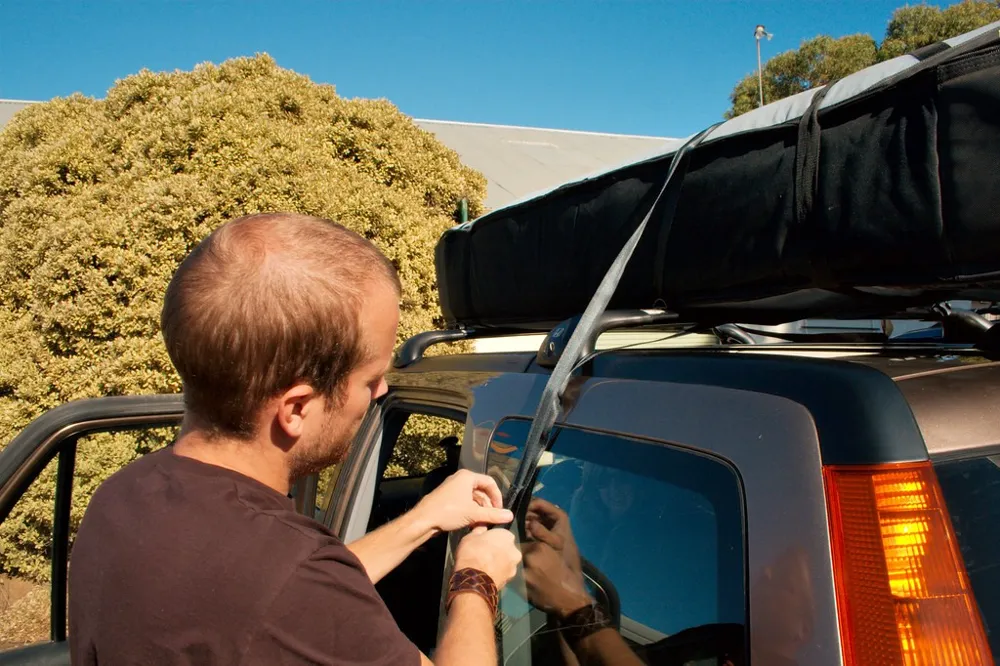
- Clean the roof and pads. Wipe off sand and grit so nothing is trapped under the pads.
- Position the pads or soft racks. Space them to support the board near its widest points.
- Load the boards deck down, fins up. Longest board on the bottom, shortest on top, centered between the bars.
- Run one strap at each bar. Pass the strap over the boards and around the bar inside the rack feet (or around the soft rack pad), so the board sits between the strap and the pad.
- Keep the buckle off the board. Set the cam buckle beside the boards against the pad, not on the deck or rail, where it can press a ding.
- Twist the straps. A couple of twists where the strap crosses the board reduces humming and vibration at speed.
- Tighten by hand. Snug, so the boards don't move when you push them, but not so tight you dent the rails.
- Tie off the tails. Loop or tuck loose ends so they can't flap against the paint or work the buckle loose.
- Check after a few miles. Straps settle; recheck before you hit the highway and at stops.
Cam Straps vs Ratchet Straps
Use cam straps. Ratchet straps make it easy to over-tighten and crack a rail or ding the deck. Avoid bungee cords too: they stretch, and boards can lift in wind. Soft-top boards are especially easy to dent, so a board sock or day bag between the strap and the board helps. See our soft-top surfboard guide for more on foam boards.
Strap Length
Cleanline lists Pro-Lite straps at 10 feet for one or two shortboards and 15 feet for wider longboards, and Dakine's Baja straps come in 12- and 20-foot lengths. Stacks of three or more boards, thick board bags and tall vehicles need the longer sizes.
Locking Straps and Theft Prevention
A board on the roof is an easy target. Your options, from least to most secure:
- Soft racks: usually can't be locked. Don't leave boards on them unattended.
- Locking tie-downs: straps with a steel cable inside, such as FCS Kanulock, lock boards to crossbars so the webbing can't simply be cut.
- Lockable carriers: the Thule Board Shuttle locks to the bars and is One Key System compatible, so one key can match other Thule locks.
- Lockable rack feet: make sure the crossbars themselves are locked to the car, or a thief can take the whole rack.
Locks buy time, not immunity. For longer stops, take boards inside or keep them in view, and hide the key somewhere that isn't the board bag.
Board Bags, Tailgate Pads and Other Options
Board bags on the roof: a day bag protects the board from strap pressure, grit and sun, and keeps wax off your roof. Bags make the stack thicker, so you may need longer straps, and The Inertia notes that bagged boards are a tight fit on soft racks. Our surfboard bag guide covers socks, day bags and padding.
Pickups: a tailgate pad lets you lay boards over the tailgate with the tails in the bed, and some surf-specific pads add built-in straps. Our truck bed rack and tailgate pad guide covers the options.
Inside the car: many shortboards fit inside a hatchback or wagon with the seats folded. Put the board in a sock or bag, keep the fins away from the windows, and don't let it rest against hot glass in the sun.
Removable fins: taking fins out before a long drive can reduce the risk of snapping a fin box. See surfboard fins for how fin systems work.
Bike-Mounted Surf Racks
If you live close to the beach, a side-mounted bike rack carries a board upright beside the rear wheel so you can ride with both hands on the bars. Moved By Bikes, Carver, Cor and Ho Stevie! all make them. There are three common styles:
- Seatpost-mount racks: clamp to the seatpost and usually suit shortboards and mid-lengths.
- Frame or rear-rack mounts: attach at two points, which The Inertia notes is steadier on bumpy roads; longboard versions use wider-set arms.
- Trailers: tow a longboard or SUP behind the bike on a small axle.
Measure your bike and board before buying, and check the rack's listed board size and weight limit. A board on one side pulls the bike off balance, especially in a crosswind, so ride slower until you're used to it. Pad the arms or use a board bag to prevent rubbing. If you ride an e-bike or cargo bike, look for racks made for those frames; our car bike rack guide covers getting the bike itself to the beach.
Protecting Your Car's Roof
- Clean before you load. Sand trapped under a soft rack pad acts like sandpaper on clear coat.
- Take soft racks off between trips. Cleanline recommends removing them after each use and storing them somewhere cool and dry, which also stops them rubbing the paint in wind.
- Watch the buckles. Metal cam buckles chip paint and glass. Rest them on the pad, tie off loose tails and use buckle covers where you can.
- Mind the door seals. Through-door straps press on the rubber seals; pull them snug, not crushing, and check seals for wear.
- Respect roof load limits. Your owner's manual lists a maximum roof load, and racks and carriers have their own (Thule lists 50 kg for the Board Shuttle). Stay under the lowest of them.
- Keep wax off the roof. Wax softens in heat. Board bags or socks keep it off your paint; our surf wax guide covers temperature ratings.
- Rinse after the beach. Salt and sand on straps and buckles wear the webbing and the paint they touch. Rinse them with fresh water and let them dry before storing.
Driving With Boards on the Roof
A few habits prevent most roof-rack mishaps:
- Push on the boards before every drive; nothing should shift.
- Recheck straps after the first few miles and at every stop.
- Slow down in strong crosswinds, especially on soft racks.
- Remember your extra height in garages, car washes and drive-throughs.
- Expect some wind noise; twisted straps and a nose-down board help.
Most surfboards don't hang far past the car, but long boards on short cars or in truck beds can. Many US states require a red or orange flag, and a light at night, when a load extends more than a few feet past the rear of the vehicle. Limits vary by state (last checked November 2026), so check your state's vehicle code; our kayak transport guide covers overhang in more detail. This isn't legal advice.
Once you're at the beach, our surfboard size chart and leash guide cover the rest of your setup, and the surfing hub has everything else.
Frequently Asked Questions
Should surfboard fins face forward or backward on a roof rack?
Advice is split. The Inertia's gear guide says fins up and fins forward, while a Caltech aeronautics professor quoted by The Inertia preferred nose first with the tip angled down for less drag in a crosswind. Either works if the board is strapped tight; follow your rack maker's instructions if it gives a direction.
Should a surfboard go deck up or deck down on the roof?
Deck down, fins up. The rounded bottom faces the sky and the fins stay clear of the roof and the rack pads.
Are soft racks safe on the highway?
They hold less firmly than crossbars. Retailer and review guides generally recommend them for short, local trips and suggest crossbars with pads for long highway drives. Check the maker's instructions for any speed limit.
Can I use ratchet straps on a surfboard?
It's best not to. Ratchet straps can be cranked tight enough to ding or crack a board, so use cam straps pulled snug by hand.
How do I stop straps humming on the highway?
Put a couple of twists in each strap where it crosses the board before you tighten it. The twists break up the airflow that makes flat webbing vibrate.
How do I lock a surfboard to my car?
Use locking tie-downs with a steel cable inside the webbing, such as FCS Kanulock straps, or a lockable carrier like the Thule Board Shuttle. They deter quick theft but aren't a substitute for keeping boards in sight on longer stops.
Do soft racks damage car paint?
They can scuff it if grit gets trapped under the pads. Wipe the roof and the pad bases clean before fitting them, and take the racks off when you're not using them.