Best Bike Racks for Cars and How to Pick the Right Type (2026)
Six racks across hitch, trunk, roof and spare-tire mounts, plus how to match a rack to your car, your hitch and your bikes.
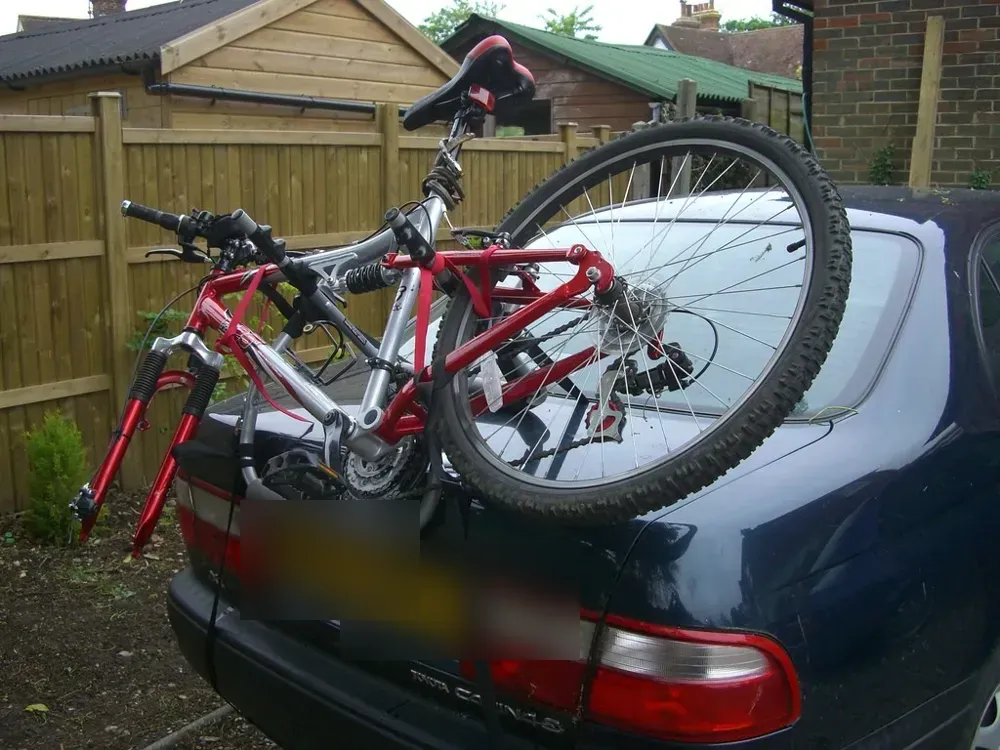
How to Choose a Bike Rack for Your Car
The best bike rack for a car is the one that fits your vehicle, your bikes and how often you ride. There are four main ways to carry bikes on a car: a hitch rack in a receiver behind the bumper, a trunk rack strapped to the trunk or hatch, a roof rack on crossbars, and a spare-tire rack on vehicles with an outside spare. Pickups, RVs and SUVs have their own options too.
Start with three questions. Does your car have a receiver hitch, or roof crossbars? What do your bikes weigh, and do any have carbon frames, fat tires or a motor? How many bikes do you carry, and how often? The answers narrow the field quickly. This guide gives one strong option for each mount type, then explains hitch classes, tongue weight, e-bike and fat-tire fit, plate and light visibility, security and how to use each maker's vehicle fit guide. For deeper roundups of each type, see our guides to hitch bike racks, trunk bike racks and roof bike racks.
Yakima StageTwo
Best hitch rack for most riders
- Yakima lists 70 lb per bike on the 2" version
- 16" to 32" wheels, tires up to 5"
- Tilts with bikes loaded
Saris Bones EX 2-Bike
Best rack for cars without a hitch
- About 11 lb, straps onto the trunk
- Anti-sway straps
- Saris fit check for your vehicle
Thule UpRide
Best roof rack
- No frame contact
- 20" to 29" wheels, tires up to 3"
- Fat-bike adapter sold separately
Car Bike Racks Compared
Specs below come from the makers' product pages as of November 2026 where we could confirm them; figures change between model years, so check the current listing before you buy.
| Rack | Mount | Bikes | Listed Per-Bike Limit | Needs |
|---|---|---|---|---|
| Yakima StageTwo | Hitch, platform | 2 (4 with add-on, 2" only) | 70 lb on 2" hitch | 1.25" or 2" receiver |
| Saris Bones EX 2-Bike | Trunk, hanging | 2 | Check listing | Compatible trunk or hatch |
| Thule UpRide | Roof, upright | 1 | 44 lb (20 kg) | Crossbars |
| Thule EasyFold XT 2 | Hitch, folding platform | 2 | About 65 lb | Receiver hitch |
| Yakima RidgeBack | Hitch, hanging | 2, 4 or 5 versions | About 40 lb | Receiver hitch |
| Allen Sports Deluxe Spare Tire | Spare tire | 2 | Check listing | Outside-mounted spare |
The Best Bike Racks for Cars
We kept this list short on purpose: one strong rack for each way of mounting, plus a folding hitch option for heavier bikes, a hanging rack for carrying more bikes and a spare-tire rack. Each of our type guides compares more models.
1. Yakima StageTwo
The StageTwo is a two-bike platform hitch rack sold in 1.25-inch and 2-inch versions. Yakima lists a 70 lb per-bike road rating on the 2-inch version (42 lb when used off-road), and a StageTwo +2 add-on takes the 2-inch rack to four bikes. Yakima's specs cover wheels from 16 to 32 inches, tires up to 5 inches wide and wheelbases from 30 to 52 inches, which takes in most road, mountain, fat-tire and many e-bikes. A remote three-position tilt lowers the rack for trunk access with bikes loaded, and it folds flat when empty. Integrated SKS locks secure the bikes and the rack, and Yakima lists optional RampUp ramps and SafetyMate lighting as compatible accessories. The trade-off is weight: Yakima lists the rack at 63 lb.
Good to Know
- Wide wheel, tire and wheelbase range
- Tilts with bikes on
- Locks for bikes and rack included
- Listed as e-bike rated up to 70 lb (2")
Watch Out For
- Heavy to lift on and off
- Needs a receiver hitch
- Lower off-road rating
2. Saris Bones EX 2-Bike
The Bones EX is the updated version of Saris's long-running arched trunk rack. It weighs about 11 lb, carries two bikes by the top tube and uses anti-sway straps to keep them from swinging. Its arched legs help it clear many spoilers, and Saris provides a vehicle fit check so you can confirm it suits your car before buying. Like all trunk racks, it rests on the car's body, so it isn't meant for heavy bikes, and step-through or full-suspension frames may need a top-tube adapter.
Good to Know
- No hitch or crossbars needed
- Light and easy to store
- Vehicle fit check from Saris
Watch Out For
- Two bikes only
- Not for e-bikes or heavy bikes
- Can block the plate and lights
3. Thule UpRide
The UpRide is an upright roof rack for one bike that holds the front wheel with a hook, so nothing touches the frame. Thule lists it as carbon-frame compatible and suitable for rear suspension, bottle cages and non-traditional frame shapes. It fits wheels from 20 to 29 inches and tires up to 3 inches wide, or up to 5 inches with the separately sold Fatbike Adapter, with a maximum bike weight of 44 lb (20 kg). You don't need to remove the front wheel, and it is listed as thru-axle compatible. Thule lists the rack at 7.7 kg (about 17 lb) and compatible with a range of its own crossbars; lock cylinders may be sold separately, so check what's in the box.
Good to Know
- No frame contact
- Keeps the rear of the car clear
- Fat-bike adapter available
Watch Out For
- Needs crossbars
- Lifting overhead on tall vehicles
- 44 lb limit rules out most e-bikes
4. Thule EasyFold XT 2
The EasyFold XT 2 is a folding platform hitch rack that packs down with a carry handle, so it's easier to remove and store than most platform racks. It includes loading ramps and lists a per-bike limit around 65 lb, which suits many e-bikes. It's a good fit if you take the rack off between trips and have limited storage space. See our e-bike rack guide for heavier-duty options.
Good to Know
- Folds for storage
- Ramps included
Watch Out For
- Two bikes maximum
- Premium pricing
5. Yakima RidgeBack
The RidgeBack is a hanging hitch rack: bikes hang by the top tube on padded arms. It comes in two-, four- and five-bike versions, the arms tilt away for rear access, and it's lighter than a platform rack. Expect a per-bike limit around 40 lb, so it suits conventional bikes rather than e-bikes, and step-through, kids' and many full-suspension frames need a top-tube adapter bar.
Good to Know
- Carries up to five bikes
- Lighter than platform racks
Watch Out For
- Bikes can sway and touch
- Adapter needed for some frames
6. Allen Sports Deluxe 2-Bike Spare Tire Rack
For vehicles with a spare tire mounted on the rear door, this Allen rack attaches to the spare and holds two bikes on individual tie-down cradles, away from the road and exhaust. It needs no hitch or crossbars. Check that it suits your spare's size and that the rear door can carry the extra load, and expect a lower capacity than a platform hitch rack.
Good to Know
- No hitch needed
- Bikes ride high, clear of the road
Watch Out For
- Only for outside-mounted spares
- Not for heavy bikes
Types of Car Bike Racks
Each mount type trades cost, convenience and capacity differently. Here is how they compare at a glance.
| Type | How It Mounts | Best For | Main Drawbacks |
|---|---|---|---|
| Hitch platform | Receiver hitch; bikes stand on wheel trays | Frequent use, carbon frames, e-bikes, easy loading | Heavy, costly, adds length, needs a hitch |
| Hitch hanging | Receiver hitch; bikes hang by the top tube | Carrying three to five conventional bikes | Sway and bike-to-bike contact; adapters for some frames |
| Trunk (strap-on) | Straps and hooks on the trunk or hatch | Occasional use, cars without a hitch | Low weight limits, paint contact, fit varies by car, weak security |
| Roof | Crossbars; wheel, frame or fork mount | Keeping the rear clear, mixing with other roof gear | Lifting overhead, drag and noise, height clearance |
| Spare tire | Bolts or straps to an outside spare | Jeep-style SUVs without a hitch | Only for outside spares, limited capacity |
Hitch Racks: Platform vs Hanging
Platform (tray) racks hold bikes upright by the wheels, usually with an arm on the front wheel and a strap on the rear. Because they don't need to touch the frame, they fit carbon, full-suspension, step-through and kids' bikes, and loading is a low lift onto a tray. They are the heaviest and most expensive style, often 35 to 65 lb or more for the rack alone. Hanging racks hold bikes by the top tube on two arms. They're lighter and cheaper and can carry more bikes, but bikes can swing into each other, and frames without a level top tube need an adapter bar. A third style, the vertical rack that hangs bikes by the front wheel, carries many mountain bikes at once and suits pickups and vans. The hitch rack guide covers more models in each style.
Trunk Racks
Trunk racks rest on padded feet against the trunk or hatch and hold on with hooks and straps. They are the cheapest and lightest way to carry bikes and need nothing installed on the car, which makes them practical for renters and occasional riders. The trade-offs are lower weight limits, possible paint contact, rear-window and spoiler conflicts and limited security. See trunk bike racks for fitting steps and more picks.
Roof Racks
Roof racks need crossbars and come in three styles: wheel-mount racks that grab the wheel and don't touch the frame, frame-mount racks that clamp the down tube, and fork-mount racks that hold the fork after you remove the front wheel. They leave the trunk free and let you carry other gear on the back, but you lift bikes overhead and must remember the extra height. See roof bike racks for the styles in detail.
Spare-Tire Racks
Spare-tire racks fit vehicles with a full-size spare on the rear door. They are simple and need no hitch, but capacity is limited, they add load to the door hinges and they can block a camera mounted in the spare's center. For SUVs in general, our SUV bike rack guide compares all four options.
Other Vehicles
Pickup owners can skip a car rack entirely and use a tailgate pad or a bed-mounted rack; see truck bed bike racks. Motorhomes and travel trailers need racks the maker approves for RV use, covered in RV bike racks.
Hitch Class, Receiver Size and Tongue Weight
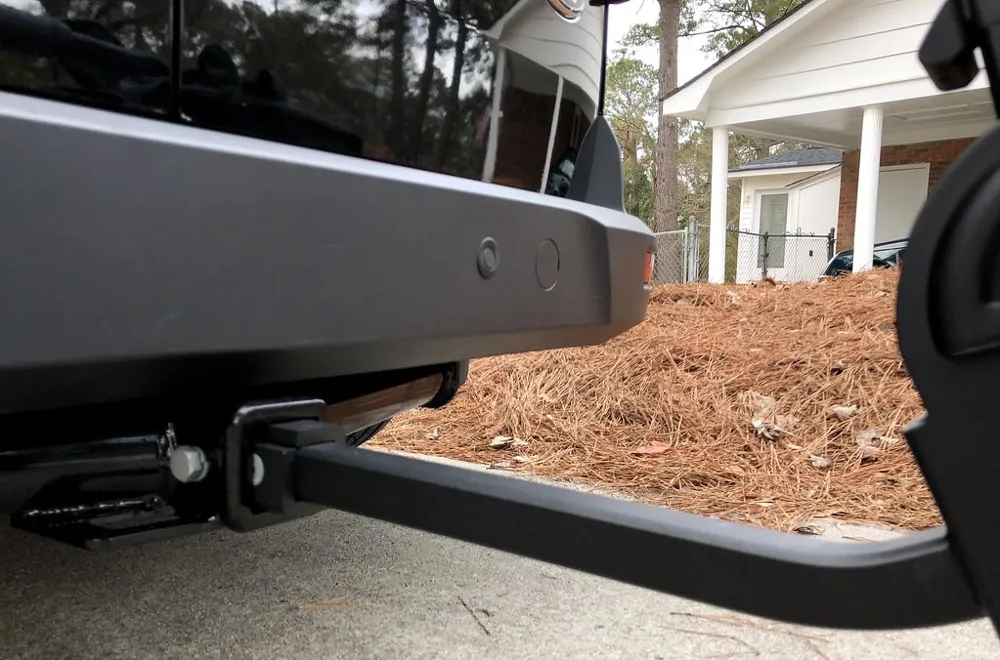
A hitch rack is only as good as the hitch it slides into. Before buying, find three things on your hitch label or in your owner's manual: the receiver opening size, the hitch class and the tongue weight rating.
Receiver Size and Hitch Class
Receiver hitches are grouped into classes by how much they can carry. In general, Class I and Class II hitches use a 1.25-inch receiver and are common on smaller cars, while Class III and Class IV hitches use a 2-inch receiver and are common on SUVs, trucks and many crossovers. Larger receivers are used on heavy-duty trucks. Many bike racks are sold in separate 1.25-inch and 2-inch versions, and the 2-inch version often carries more bikes or more weight per bike; Yakima, for example, sells the StageTwo +2 add-on for the 2-inch version only. Buy the version that matches your receiver. Adapters exist, but many racks list lower ratings or don't allow them, so check the rack's manual.
Tongue Weight
Tongue weight is the downward load the hitch can carry at the receiver. For a bike rack, add the weight of the rack to the weight of every bike you'll carry. That total must stay under the lowest of three numbers: the hitch's tongue weight rating, the vehicle's rating in the owner's manual and the rack's own capacity. A heavy platform rack can use up a lot of a small hitch's capacity before you load a single bike. As an example, a 63 lb rack carrying two 60 lb e-bikes puts about 183 lb on the hitch. Hitch extenders also move the load further from the receiver, which effectively reduces what the hitch can carry, so avoid them unless the rack and hitch makers allow it.
On-Road vs Off-Road Ratings
Some makers publish a lower rating for rough roads. Yakima, for example, lists the StageTwo at 70 lb per bike on the road but 42 lb per bike off-road. If you drive forest roads or washboard gravel to trailheads, plan around the lower figure.
E-Bikes and Fat-Tire Bikes
E-bikes are much heavier than regular bikes, and fat-tire bikes have tires too wide for many trays, so both need a closer look. Our e-bike racks page covers heavy-duty models, and how much an e-bike weighs lists typical weights by type.
What an E-Bike Rack Needs
- A per-bike limit above your bike's weight. Weigh the bike as you'll carry it. Many makers advise removing the battery for transport, which also lightens the load.
- A platform hitch rack, usually on a 2-inch receiver. Trunk racks and most roof racks have limits far below a typical e-bike, and lifting a heavy bike overhead is risky. Thule's UpRide, for example, is listed at 44 lb.
- A loading ramp. The EasyFold XT 2 includes ramps, and Yakima offers RampUp ramps for the StageTwo.
- Enough tongue weight for the rack plus two heavy bikes (see above).
Fat Tires, Long Wheelbases and Fenders
Check three specs against your bike: maximum tire width, maximum wheelbase and wheel size range. Fat-bike tires are much wider than standard mountain bike tires, so look for a listed tire limit that covers yours. The StageTwo lists tires up to 5 inches, and the UpRide goes from 3 to 5 inches with its fatbike adapter. Long-travel mountain bikes, cargo-style e-bikes and some step-through e-bikes have long wheelbases that overhang short trays. Fenders can also stop wheel arms from seating properly, so check how the rack holds the wheel. For bikes themselves, see fat bikes and fat tire electric bikes.
Check Your Car's Fit Before You Buy
A rack that suits one car may not suit another of the same size. Every major maker publishes a vehicle fit tool, and it's the single most important check, especially for trunk and roof racks.
Use the Maker's Fit Guide
| Maker | Where to Check Fit | What It Tells You |
|---|---|---|
| Thule | Vehicle selection on product pages and Thule's fit guide | Whether a rack, crossbars and fit kit suit your make, model and year |
| Yakima | Yakima's Technical Fit Lookup | Compatible racks, towers and clips for your vehicle |
| Saris | Saris's vehicle fit check (linked from trunk rack pages and packaging) | Whether a trunk rack fits your car and any limits |
| Kuat | Product pages and hitch specs | Receiver sizes and bike fit for each hitch rack |
| Allen Sports | Product listing and manual | Vehicle types the rack is designed for |
Enter your exact model year and body style. A hatchback and a sedan of the same model often get different answers, and a facelift year can change the result.
Things Fit Guides Flag
- Spoilers and glass hatches: many trunk racks can't rest on a rear spoiler or a frameless glass hatch.
- Plastic bumpers and trunk edges: hooks need a solid metal edge to grip.
- Roof type: naked roofs, raised rails, flush rails and fixed points each need a different crossbar fit kit.
- Roof load limit: the vehicle's roof limit must cover the crossbars, the rack and the bikes; it's listed in the owner's manual.
- Ground clearance: low cars with long hitch racks can scrape on steep driveways; some racks offer a rise or angled shank.
- Rear access: check whether your hatch or trunk can open with the rack tilted down and bikes loaded.
License Plate, Lights and Rear Visibility
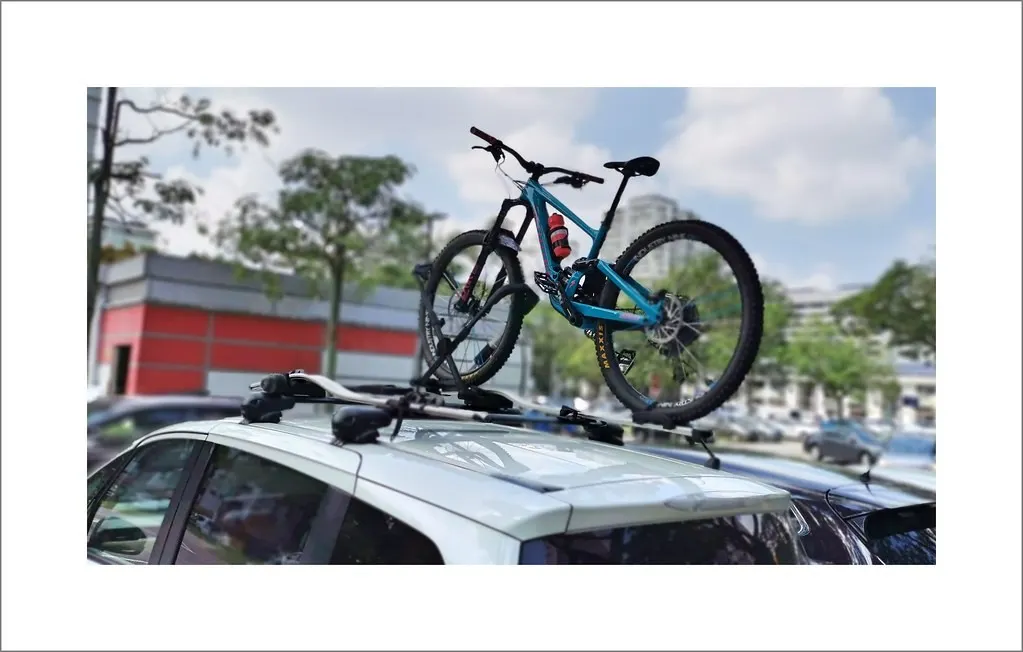
Rear-mounted racks and bikes can hide your license plate, brake lights and turn signals. Many states require the rear plate to be clearly visible and readable and require working tail and brake lights, so a blocked plate can lead to a ticket. Rules and enforcement vary by state (last checked November 2026), so check your state's vehicle code or DMV guidance; this isn't legal advice.
- Light boards: some makers offer an auxiliary light bar that plugs into your trailer wiring. Yakima lists its SafetyMate lighting as compatible with the StageTwo.
- Plate holders: some platform racks include or accept a plate bracket.
- Load order: putting a smaller bike on the outside position can uncover more of the plate.
- Roof racks avoid the problem entirely, which is one reason some drivers choose them.
Cameras and Parking Sensors
Hitch racks can block the rear camera and set off parking sensors. Some vehicles have a trailer or hitch mode that adjusts the sensors; check your owner's manual. Remember the extra length when reversing and parking, and remember the extra height before driving into a garage, carport or drive-through with bikes on the roof.
Security and Theft Prevention
A bike rack has two things to protect: the rack itself and the bikes on it.
- Locking hitch pin: stops a hitch rack from being pulled out of the receiver. Some racks include one; others sell it separately.
- Integrated cable locks: many hitch and roof racks include short cable locks, often keyed alike (Yakima's SKS and Thule's One-Key System). They deter quick grabs but aren't a substitute for a strong lock on longer stops.
- Trunk racks: most don't lock to the car, so the whole rack and bikes can be lifted off. Don't leave bikes unattended for long.
- Roof racks: look for a lockable wheel or frame clamp and lockable rack mounts.
- Add your own lock: for restaurant or overnight stops, run a heavy cable or chain through the frames and a fixed point. Our bike lock guide covers sturdier options.
Bike Compatibility
Your bikes matter as much as your car. Match the rack to the bikes you own, not just the one you ride most.
| If You Have | Look For |
|---|---|
| Carbon frames | Wheel-only contact: platform hitch or wheel-mount roof rack; avoid frame clamps unless the maker approves them for carbon |
| Full-suspension or step-through frames | Platform hitch or wheel-mount roof rack; hanging racks need a top-tube adapter |
| Kids' bikes | Racks that list small wheel sizes, or a hanging rack with an adapter bar |
| Thru-axle forks | Fork-mount roof racks may need a thru-axle adapter |
| E-bikes | Platform hitch rack with a high per-bike limit and a ramp |
| Fat or plus tires | A listed tire width that covers yours, or a fat-tire kit |
| Four or more bikes | Hanging or vertical rack on a 2-inch hitch, or a platform rack with an add-on |
Which Rack for Which Car?
| Your Situation | Consider |
|---|---|
| Sedan or hatchback with no hitch, occasional rides | Trunk rack, after checking fit |
| Small car with a 1.25-inch hitch | Two-bike platform or hanging rack in the 1.25-inch version |
| SUV, truck or crossover with a 2-inch hitch | Platform hitch rack; add-on for more bikes |
| Vehicle with crossbars, want the hatch free | Roof rack |
| Jeep-style SUV with an outside spare | Spare-tire rack or a hitch rack with swing-away |
| Heavy e-bikes | Platform hitch rack on a 2-inch receiver with ramps |
| Pickup truck | Tailgate pad or truck bed rack |
If none of those fit, a hitch installer can often add a receiver to cars that don't have one.
Installing, Loading and Driving With Bikes
- Read the manual first. Torque values, strap order and load order differ between racks.
- Tighten the hitch connection. Use the rack's anti-wobble bolt or knob so the rack doesn't rattle in the receiver.
- Load the heaviest bike closest to the car on hitch and trunk racks.
- Remove loose items such as bottles, pumps, lights and, where the maker recommends it, e-bike batteries.
- Check clearance between bikes, and between bikes and the car, before you drive.
- Recheck after the first few miles and at each stop; straps can stretch and clamps can settle.
- Drive with the load in mind. Roof racks add wind noise and drag at highway speed, and rear racks add length.
Rack Care and Storage
Rinse road salt, sand and grime off the rack after winter and beach trips, and lubricate hitch pins and pivots now and then. Clean the pads on trunk racks and the car's paint where they touch, since trapped grit is what scratches paint. Remove the rack when you won't use it for a while to cut theft risk, wear and fuel use; folding hitch racks and light trunk racks are the easiest to store. For home bike storage, see garage bike racks, and for more cycling guides, visit our biking hub.
Frequently Asked Questions
What is the best type of bike rack for a car?
For most riders a platform hitch rack is the easiest to load and fits the widest range of bikes, but it needs a receiver hitch. Without a hitch, a trunk rack is the simplest option and a roof rack keeps the rear of the car clear if you have crossbars.
Can I put a bike rack on a car without a hitch?
Yes. Trunk racks strap onto the trunk or hatch, roof racks mount to crossbars, and spare-tire racks bolt to an outside-mounted spare. You can also have a receiver hitch installed on many cars.
Will a bike rack fit any car?
No single rack fits every car. Spoilers, glass hatches, plastic bumpers and roof shapes can rule some racks out, so check the maker's vehicle fit tool for your exact make, model and year before you buy.
Is it illegal for a bike rack to cover the license plate?
Many states require the rear plate to be visible and readable, and blocked lights can also earn a ticket. Rules vary by state, so check your state's vehicle code; a light board or plate relocation kit can help.
What size hitch do I need for a bike rack?
Bike racks come in 1.25-inch and 2-inch receiver versions. Buy the version that matches your receiver; 2-inch racks often carry more bikes and higher weights. Check your hitch's tongue weight rating too.
Can a car bike rack carry an e-bike?
Usually only a platform hitch rack rated for the bike's weight. Most trunk and roof racks have per-bike limits well below a typical e-bike, and lifting a heavy e-bike onto a roof is hard and risky.
Do bike racks damage cars?
Trunk racks can scuff paint where the pads and hooks touch if grit gets trapped, and roof-mounted bikes can hit garage doors. Clean contact points, follow the fitting instructions and check straps regularly.