How to Carry, Rack and Strap a Paddle Board (2026)
Most paddle board damage happens on land, not on the water. Here's how to carry a SUP, load it on a roof or truck, strap it down properly and keep it out of the heat.
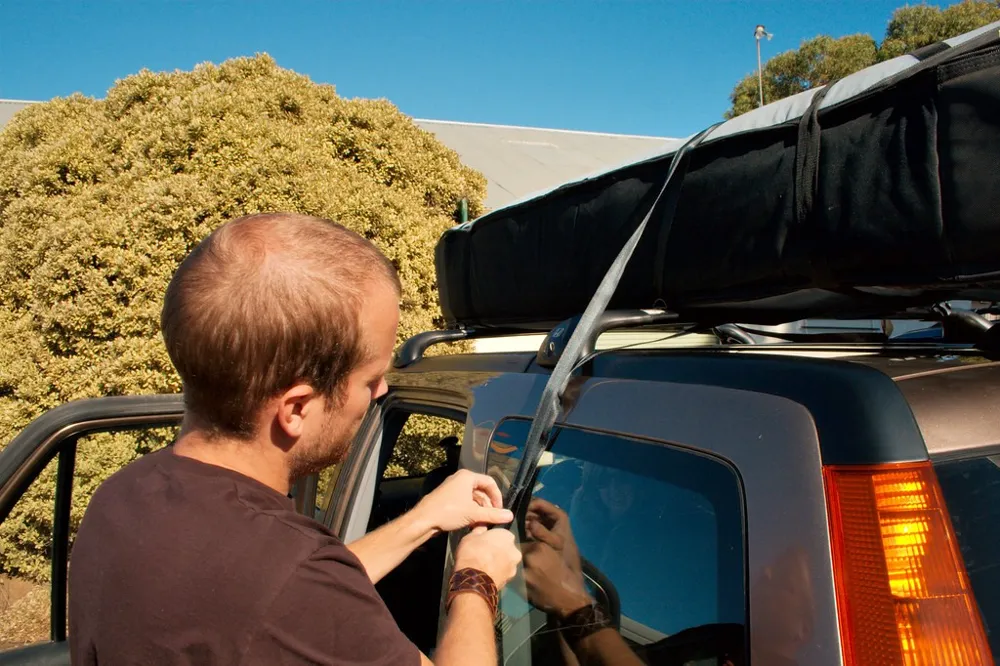
Paddle Board Transport Options at a Glance
How you move a stand up paddle board depends on whether it's a hard board or an inflatable, what you drive and how far you're going. Hard boards need a rack, pads or a truck bed; inflatables roll up and ride in the trunk. If you haven't bought a board yet, our inflatable vs hard paddle board comparison covers how transport and storage differ.
| Method | Best For | You Need | Watch Out For |
|---|---|---|---|
| Roof rack with pads or a SUP carrier | Regular trips, highway drives | Crossbars, rack pads or a SUP mount, two cam straps | Overtightening, added vehicle height |
| Soft racks or foam pads | Short, local trips without crossbars | Soft rack set, straps through the cabin | Not for long, fast drives |
| Truck bed | Pickup owners | Tailgate pad, straps, a flag for overhang | Board hanging too far out |
| Trunk or back seat | Inflatable boards | The board's bag | Heat if left in the car |
| Carry strap, cart or backpack | Parking lot to the water | Shoulder strap, SUP cart or the inflatable's pack | Wind catching the board |
For kayaks, see how to transport a kayak and our kayak roof racks guide.
How to Carry a Paddle Board to the Water
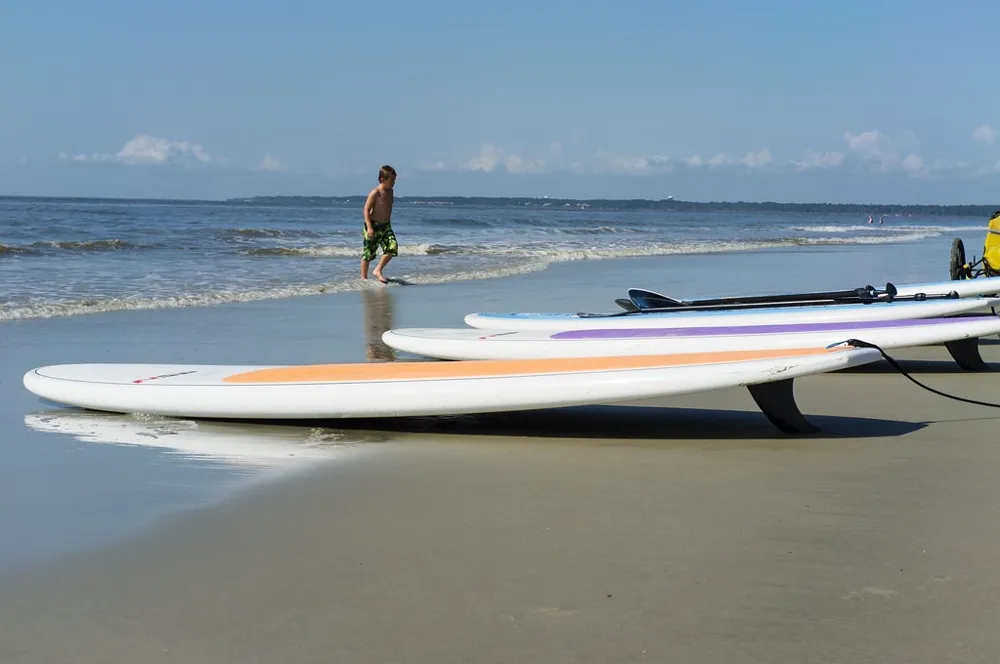
A 10- to 11-foot board is more awkward than heavy, and wind makes it harder. Pick a carry by distance, board weight and wind, and keep the board close to your body.
Under the Arm
The quickest method for short walks. REI notes that nearly all SUPs have a carry handle at the center of the board. Stand the board on its rail beside you with the nose pointing forward, reach over and grab the handle, and tuck it under your arm. Paddling Magazine describes holding it with the deck pad facing away from you. In a breeze, carry on the downwind side and steady the nose with your free hand, because a strong crosswind can flip the board as you lift it.
On Your Head
Useful for medium distances and for smaller paddlers carrying a heavier board. Squat at the tail, walk your hands up the rails to tip the board upright, then step under its middle, center it on your head and stand.
Two-Person Carry
One person takes the nose and one the tail. Paddling Magazine calls this a balanced, low-effort way to cover long stretches of beach, and it's the easiest way to lift a board onto a high roof.
Carry Straps, Carts and Backpacks
- Shoulder strap or sling. Clips to the board's center D-rings or loops at the nose and tail so the board hangs from one shoulder. Your hands are free for the paddle, which saves a second trip from the car. Check that a strap fits your board's width and D-ring layout before buying.
- Cart. For long walks, a cart takes the weight while you steer with one hand. Some hold the board on its rail, others flat. On sand, look for wide balloon-style wheels; our kayak cart guide explains wheel types, and several brands sell SUP-specific carts.
- Inflatable's backpack. Many inflatables come with a bag you can sling, roll or wear. For long hikes to a remote lake, a snug pack with a hip belt carries better than a roomy bag that flops around.
For carry straps and other add-ons, see our paddle board accessories checklist.
Roof Racks vs Soft Racks vs Foam Pads
The safest everyday setup for a hard board is a hard roof rack: factory or aftermarket crossbars with padding on them. Rack pads, which wrap around each bar, are the simplest option. Dedicated SUP mounts such as the Thule SUP Taxi XT and Yakima SUPDawg clamp to crossbars and hold the board with their own straps; follow the rack maker's fit guide and weight limits for your bars.
Thule SUP Taxi XT on Amazon Yakima SUPDawg on AmazonWith no crossbars, soft racks are the usual answer. These are padded foam tubes that sit on the bare roof, with straps that pass through the inside of the car and buckle closed. Paddling Magazine calls them relatively inexpensive, but they hold less firmly than bars:
- BOTE says soft racks are meant for shorter trips and are not recommended above 55 MPH.
- Isle suggests them for local trips, says a few minutes of highway driving is fine, recommends hard racks for long drives and notes that soft racks don't work well on 2-door cars or minivans.
- Space the two pads to suit the board. Isle warns that pads set too far apart let the board slip, and pads set too close make it unstable.
Foam blocks work the same way as soft racks; our kayak transport guide walks through the foam block steps. Whichever you use, REI warns never to attach tie-down straps to plastic parts of your car. For a side-by-side look at pads and racks built for boards, see surfboard car racks.
Which Way Up? Deck Down and Fin Direction
Deck down, fin up. Makers agree here. REI, Isle and Paddling Magazine all have you set a hard board with the standing deck face-down on the pads, so the fin points at the sky instead of into your roof. On a soft-top board, Isle notes that straps can leave dents in the rails, so put a board bag, sock, or a strip of cardboard or EVA foam between the straps and the board.
Fin direction is where advice differs. REI, Isle and BOTE all point the fin toward the front of the car, while Paddling Magazine's two-board method loads the bottom board with its fin typically at the back. Fin-forward is the more common advice, but if your board or rack maker specifies a direction, follow theirs. Either way, center the board so similar lengths hang off each end.
| Source | Deck | Fin |
|---|---|---|
| REI | Down | Toward the front of the car |
| Isle | Down (fins up) | Toward the windshield |
| BOTE | Fin facing up | Toward the front of the car |
| Paddling Magazine | Down | Bottom board's fin typically at the back (two-board setup) |
How to Load and Strap a Paddle Board to Your Car
- Get two straps ready. REI recommends two cam straps about 12 feet long or longer for one board.
- Lift the board on. With two people it's simple. Solo, Paddling Magazine says most boards can be loaded by one person: on a sedan, lift it from the side; on a tall vehicle, REI suggests resting the board deck-down near the back of the vehicle, then sliding it forward onto the rack.
- Position it. Deck down, fin up, centered between the bars.
- Throw the first strap. Keep the buckle on your side, toss the free end over the board near one crossbar, and loop it around the crossbar on each side. With soft racks, the straps run through the cabin instead: open the doors, pass the strap through, and close the doors on it, not the windows.
- Cinch it. Pull the strap snug by hand, then repeat at the other bar.
- Tidy the tails. Tie off or tuck the loose ends so they can't flap against the paint or come undone.
- Wiggle-test. Push the board side to side. Paddling Magazine's rule: if it shifts easily, cinch down some more.
NRS 1" HD Tie-Down Straps
Cam straps sold in 15-foot lengths, which covers REI's 12-foot minimum for a single board. NRS lists UV-protected polypropylene webbing that won't stretch when wet, a minimum breaking strength of 1,500 lb and cam buckles with dual stainless-steel springs.
Good to Know
- Long enough for one board on most cars
- Non-stretch webbing
- Also fits kayaks and truck beds
Watch Out For
- Stacking two boards may need longer straps
- Pull snug by hand; don't overtighten
Strap Technique: Cam Straps, Not Ratchet Straps
- Use cam straps, never ratchet straps. BOTE says never to use ratchet straps because they can cinch down too tightly and damage your board. REI adds that too much tension can deform a SUP. Snug is the goal.
- Skip bungee cords, which stretch and let the board lift at speed.
- Twist the strap. REI, Isle and BOTE all suggest a twist or two in the strap across the board to stop the loud humming and vibration at speed.
- Mind the buckle. REI positions the buckle on top of the board near the edge; Isle tucks it between the board and the roof. Either way, keep the metal buckle off the paint and handle it carefully, since Isle notes a buckle can damage the board.
- Add bow and stern lines when needed. REI recommends them for a very long SUP or windy driving, on top of the two cam straps.
- Lock it if you'll leave it. Paddling Magazine recommends locking straps, for boards left on the car while you're away.
Carrying Two Boards on One Roof
Two boards can ride stacked on one set of bars, or side by side if your bars are wide enough. Paddling Magazine's method for stacking:
- Load the first board deck down.
- Lay padding on top of it so the boards don't touch.
- Set the second board deck down, offset so it sits just in front of the bottom board's fin.
- Strap both boards together with longer straps.
Paddling Magazine reminds owners of tall vehicles to watch height restrictions, so check garages and drive-throughs before you pull in. SUP carriers list a maximum number of boards; check the rack maker's limit.
Truck Beds and Tailgate Pads
A pickup is the easiest way to move a hard board without lifting it overhead. REI's method is to lay a pad on the tailgate, then set the board deck-side down in the bed with the nose supported on the tailgate. BOTE adds two rules: load the fin end first so the nose doesn't get damaged, and keep at least half the board inside the bed. Paddling Magazine suggests closing the tailgate and sliding the board as far into the bed as it will go.
Strap the board to the bed's tie-down points so it can't slide or bounce, and avoid ratchet straps here too. For longer boards, REI suggests red flagging on the nose. Many US states require a flag (and a light at night) when a load extends more than a few feet past the rear of the vehicle, but the limits vary by state. Check your state's vehicle code before driving; this is not legal advice. Rules last checked November 2026. A tailgate pad sold for bikes, covered in our truck bed bike racks guide, can double as a cushion for a board.
Inflatable Paddle Boards: Trunk, Seat or Roof

This is where inflatables win. BOTE notes they can be deflated, packed into a bag and put in a trunk of any size. Before packing:
- Rinse the board and let it dry before rolling it for storage, which helps prevent mildew.
- Follow your board's manual for deflating, removing the fin and rolling it.
- Pack the pump, paddle and leash in the same bag so nothing gets left at the launch.
Isle says an inflated board can also go on a roof rack using the same steps as a hard board, which saves pumping it up twice when you're driving between nearby spots. Paddling Magazine notes that good inflatables are surprisingly rigid, but a puncture is still possible if something strikes the board, so pad it like a hard board. Our paddle board pumps guide covers 12V pumps that run from the car.
Highway Checks Before and During the Drive
- Before you leave: tug each strap, wiggle the board and check that no loose ends can flap.
- After about 15 minutes: REI suggests pulling over and giving the board a tug, because straps can loosen while driving.
- At every stop: check again, especially after rough roads, wind or rain.
- In wind: slow down. A board on the roof catches crosswinds and gusts from passing trucks.
- Soft racks and overhang: keep soft-rack trips short and under BOTE's 55 MPH ceiling, and flag any overhang as your state requires.
Heat, Sun and Leaving a Board in the Car
Inflatables: iRocker says an inflatable board must not be left in direct sunlight when it's out of the water, warns that heat from hot surfaces can raise the board's internal pressure even in shade, and suggests limiting time on heat-retaining surfaces to 15 minutes at a time. It also says heat damage from improper storage is not covered by its warranty. A closed car in summer is one of those hot spaces, so drive with the board deflated in its bag where possible, don't leave an inflated board on a hot roof or in a hot cabin for long, and check your own board's manual.
Hard boards: BOTE notes that even an epoxy seal can't protect a board from endless sun exposure, and Paddling Magazine warns that hot sun can damage a board left on a car. Park in the shade, don't leave a board racked for days, and consider a reflective or thermal board bag; our surfboard bags guide explains bag types.
At home: store any board out of direct sun and away from heat sources such as a hot attic or a car parked in the sun. Hard boards rest on padded wall arms or slings; see storage racks for wall and freestanding options.
Common Paddle Board Transport Mistakes
- Ratchet straps, bungees or overtightened cams that dent the board or let it lift.
- Fin down on the roof, pressing the fin into the car.
- Straps through open windows instead of closed doors on soft racks, or tied to plastic trim.
- Soft racks on long, fast highway drives.
- Forgetting the added height at the garage or drive-through.
- Leaving a board baking on the roof or in a hot car.
Once the board is at the water, our beginner's guide to paddle boarding covers getting on and paddling, and the paddle boarding hub links every SUP guide.
Frequently Asked Questions
Should a paddle board go deck up or deck down on a roof rack?
Deck down, with the fin facing up. REI, Isle and Paddling Magazine all describe loading a hard board with the standing deck face-down on the rack pads, which keeps the fin clear of the roof and the rounded bottom facing the sky.
Which way should the fin face on a car roof?
Most board makers, including REI, Isle and BOTE, say to point the fin toward the front of the car. Some guides load it at the back instead, so if your board or rack maker gives a direction, follow theirs.
Can I use ratchet straps on a paddle board?
No. BOTE says never to use ratchet straps because they can cinch down too tightly and damage the board, and REI warns that too much tension can deform a SUP. Use cam straps pulled snug by hand.
Can you put a paddle board on a car without a roof rack?
Yes, with soft racks or foam pads and straps that run through the inside of the car. BOTE says soft racks are meant for shorter trips and not for speeds over 55 MPH, and Isle suggests them for local drives.
Can I leave an inflatable paddle board in a hot car?
It's best not to. iRocker says inflatables should not sit in direct sun out of the water, warns that hot surfaces raise internal pressure and excludes heat damage from its warranty. Carry it deflated in its bag and store it somewhere cool and shaded.
How long should paddle board straps be?
REI recommends two straps about 12 feet long or longer for a single board. Stacking two boards or using a tall vehicle can call for longer straps.
Can a paddle board stick out of a truck bed?
Yes, within limits. BOTE says at least half the board should be inside the bed, and REI suggests padding the tailgate and flagging the nose of longer boards. Overhang rules vary by state, so check yours.