Reef-Safe Sunscreens for Snorkelers and Beach Days (2026)
Mineral sunscreens with zinc oxide or titanium dioxide, what the Hawaii and Virgin Islands rules require, and how to read SPF and water-resistance labels before you get in the water.
What "Reef Safe" Really Means
Search any beach shop and you'll find bottles labeled "reef safe," "reef friendly" or "ocean safe." None of those phrases is a legal or FDA-defined standard. A brand can print them on almost any formula, so the label that matters is the Drug Facts box on the back, where the active ingredients are listed.
What snorkelers and divers usually mean by reef-safe sunscreen is a mineral sunscreen whose only active ingredients are zinc oxide and/or titanium dioxide, ideally in non-nano particle sizes, with no oxybenzone or octinoxate. That's also what keeps you legal in places like Hawaii and the U.S. Virgin Islands. NOAA's National Ocean Service calls mineral sunscreen a better option for aquatic life than formulas with the chemical filters it lists, and it suggests UPF clothing and shade to cut how much sunscreen you need in the first place.
Every product below is a mineral sunscreen. We chose them for clear active ingredients, broad-spectrum protection and a stated water-resistance time, and we describe them only from the makers' listings.
Thinksport Mineral Sunscreen SPF 50+
Best for most snorkelers
- Zinc oxide, broad spectrum
- 80-minute water resistance
- Also in kids and spray versions
Blue Lizard Sensitive Mineral SPF 50
Best for sensitive skin
- Zinc oxide and titanium dioxide
- Fragrance-free and paraben-free
- Listed as hypoallergenic
Badger Mineral Sunscreen Cream SPF 30
Best short ingredient list
- Five listed ingredients
- Zinc oxide, unscented
- 40-minute water resistance
Reef-Safe Sunscreens Compared
| Sunscreen | SPF | Mineral Filter (as Listed) | Water Resistance (as Listed) | Format | Best For |
|---|---|---|---|---|---|
| Thinksport SPF 50+ | 50+ | Zinc oxide | 80 minutes | Lotion | All-round snorkeling |
| Blue Lizard Sensitive | 50 | Zinc oxide and titanium dioxide | Water resistant (check label for minutes) | Lotion | Sensitive skin |
| Badger Mineral Cream | 30 | Zinc oxide | 40 minutes | Cream | Short ingredient list |
| Raw Elements Face and Body | 30 | Zinc oxide | 80 minutes | Lotion in a metal tin | Cutting plastic |
| Stream2Sea SPF 30 | 30 | Mineral (check label) | 80 minutes | Lotion | Face and body |
| Sun Bum Mineral SPF 50 | 50 | Zinc oxide | 80 minutes | Lotion | Matte finish |
| All Good Sport Butter Stick | 50 | Zinc oxide | Water resistant (check label for minutes) | Stick | Face, nose and ears |
| Thinksport Spray | 50+ | Non-nano zinc oxide and titanium dioxide | Listed as highest water resistance | Non-aerosol spray | Quick top-ups on land |
| Thinkkids SPF 50+ | 50+ | Mineral | Listed as highest FDA water resistance | Lotion | Kids |
Details come from each Amazon listing as of November 2026. Formulas change, so check the Drug Facts panel on the product you buy.
The Best Reef-Safe Sunscreens
1. Thinksport Mineral Sunscreen SPF 50+
Thinksport's sport lotion is a zinc oxide sunscreen with broad-spectrum SPF 50+. The listing says it offers the highest water resistance the FDA allows, 80 minutes of swimming or sweating, and that it's vegan and Leaping Bunny certified, with no PABA or parabens. The same family includes a kids' lotion and a spray (below), which makes it easy to keep the whole group on one brand.
Good to Know
- SPF 50+ with zinc oxide
- 80-minute water resistance
- Lotion, spray and kids' versions
Watch Out For
- Mineral lotions can leave a white tint until rubbed in
2. Blue Lizard Sensitive Mineral Sunscreen SPF 50
Blue Lizard's Sensitive formula uses zinc oxide and titanium dioxide for broad-spectrum SPF 50 protection. The listing describes it as water resistant, hypoallergenic, fragrance-free and paraben-free, with organic aloe vera. A good fit for anyone whose skin reacts to scented or chemical-filter sunscreens.
Good to Know
- Two mineral filters
- Fragrance-free
- Several sizes, including travel tubes
Watch Out For
- Check the label for the 40- or 80-minute water-resistance time
3. Badger Mineral Sunscreen Cream SPF 30
Badger keeps it simple: the listing names just five ingredients, zinc oxide, sunflower oil, beeswax, vitamin E and seabuckthorn, and says the cream is 98% organic and unscented. It's broad-spectrum SPF 30 and water resistant for 40 minutes, so plan to reapply more often on long snorkel sessions. The 2.9 fl oz tube is TSA carry-on sized.
Good to Know
- Very short ingredient list
- Unscented
- Carry-on size
Watch Out For
- 40-minute water resistance, not 80
- Contains beeswax, so it isn't vegan
4. Raw Elements Face and Body SPF 30 Tin
Raw Elements packs a zinc oxide, broad-spectrum SPF 30 lotion in a recyclable aluminum tin instead of a plastic tube. The listing claims water resistance beyond 80 minutes (80 minutes is the longest time the FDA lets a label state) and says it's suitable for adults and kids.
Good to Know
- Plastic-free tin
- Face and body use
Watch Out For
- Tin is less handy than a squeeze tube with sandy hands
5. Stream2Sea SPF 30 Mineral Sunscreen
This broad-spectrum SPF 30 mineral sunscreen is listed as water resistant for 80 minutes, biodegradable and for face and body. The listing's own tip is useful for any mineral sunscreen: start with a small amount, hydrate skin first and rub in section by section to reduce white cast.
Good to Know
- 80-minute water resistance
- Made in the USA
Watch Out For
- Goes on white at first
- Check the Drug Facts box for the specific mineral filter
6. Sun Bum Mineral SPF 50 Sunscreen Lotion
Sun Bum's mineral line is zinc-based with broad-spectrum SPF 50 and a matte finish. Its directions say to reapply after 80 minutes of swimming or sweating and at least every two hours. Check that the bottle says Mineral, since brands often sell several formulas under the same name.
Good to Know
- SPF 50 zinc formula
- Travel-size tube
Watch Out For
- A white tint is normal, per the maker
- Check you have the Mineral version
7. All Good Sport Sunscreen Butter Stick SPF 50
A zinc oxide stick with broad-spectrum SPF 50 in a coconut oil and beeswax base, listed as water resistant. A stick is the easiest way to cover the nose, cheekbones, ears and the skin around your mask strap without getting lotion in your eyes or on the mask lens. The maker notes the coconut oil base hardens in the cold; warm it on your hand first.
Good to Know
- No-mess face application
- SPF 50
Watch Out For
- Listed as a 3-pack
- Slow for covering your whole body
8. Thinksport Mineral Sunscreen Spray SPF 50+
This non-aerosol, air-powered spray uses non-nano zinc oxide and titanium dioxide for broad-spectrum SPF 50+, and Thinksport lists its highest water and sweat resistance; check the label for the minutes. Sprays are quick for reapplying on the boat, but it's easy to miss spots; spray into your hands for the face, rub it in and spray away from the water and other people.
Good to Know
- Non-nano mineral filters
- Non-aerosol pump
Watch Out For
- Easy to under-apply; rub it in
9. Thinkkids Mineral Sunscreen SPF 50+
The kids' version of Thinksport's lotion: mineral, broad-spectrum SPF 50+ and listed with the highest FDA water resistance, with no PABA, parabens or phthalates per the listing. Pair it with a rash guard for young snorkelers, who often spend long stretches face-down in the water. See our kids' snorkel set guide for the rest of their kit.
Good to Know
- Same water resistance as the adult lotion
- Mineral formula
Watch Out For
- Not for babies under six months (see below)
Mineral vs Chemical Sunscreen
Sunscreen active ingredients fall into two groups. Mineral (sometimes called physical) sunscreens use zinc oxide or titanium dioxide, which sit on the skin. Chemical (organic) sunscreens use filters such as oxybenzone, octinoxate, avobenzone, homosalate, octisalate and octocrylene, which absorb into the top layer of skin.
| Mineral Sunscreen | Chemical Sunscreen | |
|---|---|---|
| Active ingredients | Zinc oxide, titanium dioxide | Oxybenzone, octinoxate, avobenzone, homosalate, octisalate, octocrylene and others |
| Hawaii statewide law | Allowed | Oxybenzone and octinoxate banned from sale |
| Maui and Big Island rules | Allowed | Non-mineral sunscreens restricted |
| On the skin | Thicker; can leave a white tint | Usually rubs in clear |
| Reef concern | NOAA calls mineral the better option, but lists nano-sized particles as a concern | Several filters on NOAA's list of chemicals harmful to marine life |
The trade-off is texture. Mineral sunscreens are thicker and can look chalky until they're worked in. Tinted formulas, applying in small sections and putting moisturizer on first all help. If you only use a mineral sunscreen at the beach, you can still use whatever you like for everyday wear; the ingredient laws cover where you swim and buy.
Nano vs Non-Nano Zinc Oxide
"Nano" means the mineral particles are ground small enough to rub in clear. NOAA includes nano-zinc oxide and nano-titanium dioxide in its list of sunscreen chemicals that can harm marine life, and the National Park Service's Pu'uhonua o Honaunau page suggests avoiding nanoparticles. That's why many reef-focused brands advertise non-nano zinc. Not every listing says which particle size it uses, so if this matters to you, look for "non-nano" on the label or the maker's site.
Sunscreen Ingredients to Avoid for Coral Reefs
NOAA's National Ocean Service lists these sunscreen chemicals as harmful to marine life:
| Ingredient | Notes |
|---|---|
| Oxybenzone (benzophenone-3) | Restricted in Hawaii, the USVI and Palau |
| Octinoxate (octyl methoxycinnamate) | Restricted in Hawaii, the USVI and Palau |
| Octocrylene | Banned in the USVI; NPS Hawaii also suggests avoiding it |
| Benzophenone-1 and benzophenone-8 | Related to oxybenzone |
| OD-PABA | A PABA derivative |
| 4-methylbenzylidene camphor and 3-benzylidene camphor | Camphor-based UV filters |
| Nano-zinc oxide and nano-titanium dioxide | Nano-sized mineral particles |
According to NOAA, these chemicals can wash off when we swim or shower, build up in coral tissue and can induce bleaching, damage DNA, deform young corals and even kill them. NOAA also lists effects on green algae, mussels, sea urchins, fish and dolphins.
The NPS also suggests avoiding avobenzone, homosalate and octisalate. Some brands market a sunscreen as reef safe simply because it drops oxybenzone and octinoxate while keeping other chemical filters, which is another reason to read the active ingredients yourself.
Reef-Safe Sunscreen Laws by Destination
Hawaii restricts sunscreen ingredients at both the state and county level to protect its reefs. Here's how the rules stack up, last checked November 2026:
| Law | Where | What It Does |
|---|---|---|
| Act 104 (2018), now HRS 342D-21 | Statewide | Since January 1, 2021, bans selling, offering for sale or distributing sunscreen that contains oxybenzone or octinoxate, unless prescribed by a licensed healthcare provider |
| Maui County Bill 135 | Maui, Moloka'i, Lana'i | Bans the sale, distribution and use of non-mineral sunscreens; took effect October 1, 2022 |
| Hawaii County law | Big Island | Bans the sale and distribution of non-mineral sunscreens |
On Maui, using a non-mineral sunscreen is itself against county law, so a mineral-only sunscreen is the simple choice for any Hawaii trip. Our Hawaii snorkeling guide covers the islands' reef rules in more detail.
Other Places With Sunscreen Rules
- U.S. Virgin Islands: the territory's ban on sunscreens containing oxybenzone, octinoxate and octocrylene took effect on March 30, 2020, after stores were told to stop ordering new stock in 2019. See our Caribbean snorkeling guide for Trunk Bay and Buck Island.
- Palau: the Western Pacific nation passed a law in 2018, taking effect in 2020, that bans "reef-toxic" sunscreens containing any of 10 listed chemicals, including oxybenzone and octinoxate. Retailers who break it face fines.
- Key West and the rest of Florida: Key West passed an ordinance against sunscreens containing oxybenzone and octinoxate, but Florida's SB 172, signed in 2020, bars Key West and other Florida cities from banning sunscreens. So there's no local sunscreen ban to follow in the Keys. NOAA still recommends cutting chemical sunscreen use on the reef; see our Florida Keys snorkeling guide.
Other Caribbean islands, marine parks and tour operators may set their own rules, and some ask snorkelers to use mineral sunscreen only. Laws change; this is general information, not legal advice. Check the official tourism or government site for your destination before you travel.
How to Read a Sunscreen Label: SPF, Broad Spectrum and Water Resistance
The FDA regulates sunscreen as an over-the-counter drug in the US, and the label tells you most of what you need:
- Broad spectrum: protects against both UVA and UVB radiation. Not every sunscreen is broad spectrum, so check.
- SPF: mainly a measure of protection against sunburn (UVB). The FDA advises choosing a broad-spectrum sunscreen with SPF 15 or higher. Products that aren't broad spectrum, or that are below SPF 15, must warn that they have only been shown to help prevent sunburn, not skin cancer or early skin aging.
- Water resistant (40 minutes) or (80 minutes): a water-resistance claim must be backed by FDA-required testing, and the label must say whether protection lasts 40 or 80 minutes while swimming or sweating. For snorkeling, 80 minutes is the better pick.
- No "waterproof": the FDA says there's no such thing as waterproof sunscreen. All sunscreens eventually wash off.
- Active ingredients: listed first in the Drug Facts box. For a mineral-only sunscreen, you should see only zinc oxide and/or titanium dioxide here.
The FDA's list of allowed active ingredients is also changing. As of November 2026, the agency's sunscreen page says it added a new filter, bemotrizinol, in June 2026 and issued a final order removing PABA and trolamine salicylate in September 2026. Zinc oxide and titanium dioxide remain among the most commonly used active ingredients.
How Much Sunscreen to Apply and When to Reapply
Most people don't use enough. The FDA says an average-sized adult or child needs at least one ounce of sunscreen, about enough to fill a shot glass, to cover the body. Then:
- Apply on dry skin before you go out, following the timing on the label. Some brands say protection starts right away; others say to apply 15 minutes before sun exposure.
- Don't forget the snorkeler's spots: the back of the neck, the backs of the knees and thighs, the tops of the ears and the strip of back above your swimsuit. When you float face-down, your back and legs take the most sun.
- Keep it off the inside of your mask. Put on sunscreen well before you gear up, wipe your hands and keep lotion away from your forehead line and the mask skirt so it doesn't run into your eyes or fog the lens. A stick works well around the face.
- Reapply at least every two hours, and sooner after the 40 or 80 minutes on the label, after toweling off and whenever you've been sweating.
- Use other protection too. The FDA and NOAA both suggest limiting sun between 10 a.m. and 2 p.m. and wearing protective clothing, hats and sunglasses.
For more on staying safe in the water, including heat, cold and fatigue, see our snorkeling safety tips.
Lotion, Stick or Spray?
| Format | Pros | Cons | Best Use |
|---|---|---|---|
| Lotion or cream | Easiest to apply evenly and in the right amount | Slower; mineral lotions can look white | Full-body coverage before you get in |
| Stick | No mess, easy to control around eyes and mask | Slow for large areas | Face, nose, ears, hands |
| Spray | Quick to reapply on the boat or beach | Easy to miss spots and use too little; drifts in wind | Top-ups on land, rubbed in |
Many snorkelers carry two: a lotion for the morning application and a stick for the face and quick top-ups. Whatever format you use, apply it on land, not while standing in the water.
Rash Guards and UPF Clothing: Less Sunscreen in the Water
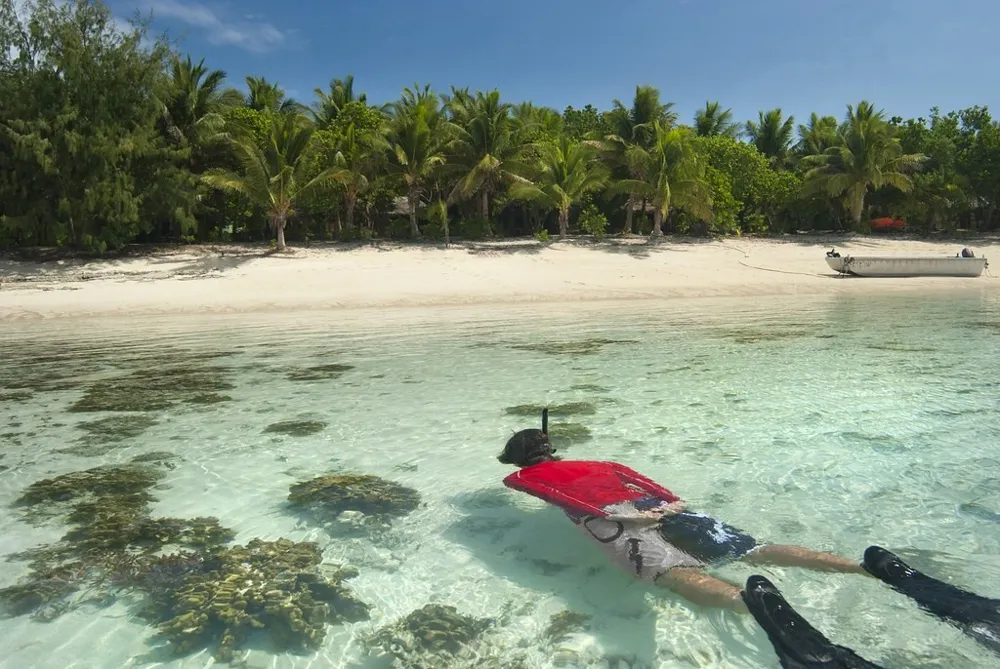
The most reef-friendly sunscreen is the one you don't need. A long-sleeve rash guard, swim leggings and a sun hat between swims cover most of what's exposed while you snorkel, so you only need sunscreen on your face, neck, hands and feet. NOAA recommends UPF sunwear for exactly this reason.
A fabric's UPF (Ultraviolet Protection Factor) shows how much UV gets through. A UPF 50 fabric blocks about 98% of UV radiation, and the Skin Cancer Foundation rates UPF 30 to 49 as very good protection and UPF 50+ as excellent. Rash guards also help with scrapes and stings, and bright colors make you easier for boats to see. In cooler water, a thin wetsuit does the same job with added warmth.
| Area | Rash Guard Setup | Sunscreen Needed |
|---|---|---|
| Back and shoulders | Covered by long-sleeve top | None under the shirt |
| Arms | Covered by long sleeves | Backs of hands |
| Legs | Covered by swim leggings | Ankles and tops of feet if no fins or socks |
| Face, ears, neck | Not covered | Yes, a stick works well |
Reef-Safe Sunscreen for Kids and Babies
Kids can lose track of time face-down in the water, so plan their sun protection before they get in. Mineral sunscreens such as the Thinkkids lotion and a long-sleeve rash guard make a good pair, and a stick is handy for faces that won't stay still. Reapply on the same schedule as adults.
For babies, the FDA says sunscreen is not recommended for infants under six months. Keep them out of the sun entirely, and ask a doctor before using sunscreen on a baby that young. See our kids' snorkel gear guide for when children are ready for the water.
How to Choose a Reef-Safe Sunscreen
- Check the Drug Facts box: only zinc oxide and/or titanium dioxide as active ingredients.
- Look for "non-nano" if you want to follow NOAA's and the NPS's guidance on particle size.
- Broad spectrum, SPF 30 or higher for long days in the water. SPF 15 is the FDA minimum for a broad-spectrum skin cancer claim; higher SPF gives more sunburn protection.
- Water resistant (80 minutes) is the better choice for snorkeling and diving.
- Check inactive ingredients if you have sensitive skin; fragrance-free formulas such as Blue Lizard Sensitive or unscented Badger are simpler.
- Pick a format: lotion for the body, stick for the face, spray only for top-ups.
- Pack it before you fly. Carry-on liquid limits apply, and in Hawaii you won't find oxybenzone or octinoxate sunscreens on store shelves. Bring mineral sunscreen or buy it locally.
- Ignore vague claims like "reef safe," "reef friendly," "ocean safe" or "biodegradable" on their own; they're not a substitute for reading the active ingredients.
More Snorkeling Gear and Trip Guides
Finish your reef kit with our guides to snorkel sets, snorkel masks, snorkel fins, snorkel vests and rash guards. New to it? Start with how to snorkel, then plan a trip with the best places to snorkel in the world, Hawaii, the Caribbean and the Florida Keys. For more beach-day sun protection, see our beach umbrella and beach tent guides.
Frequently Asked Questions
Is reef-safe sunscreen a regulated term?
No. "Reef safe" and "reef friendly" are marketing phrases, not legal or FDA-defined standards. Laws such as Hawaii's name specific ingredients, so read the active ingredients list rather than the front of the bottle.
What sunscreen ingredients are banned in Hawaii?
Hawaii bans the sale and distribution of sunscreens containing oxybenzone or octinoxate unless prescribed by a licensed healthcare provider. Maui County and Hawaii County go further and restrict non-mineral sunscreens.
Is zinc oxide sunscreen reef safe?
Mineral sunscreens with zinc oxide or titanium dioxide are the usual choice where chemical filters are restricted, and NOAA calls mineral sunscreen a better option for aquatic life. NOAA also lists nano-sized zinc oxide and titanium dioxide among chemicals of concern, so many brands specify non-nano particles.
How long does water-resistant sunscreen last in the water?
FDA rules let a label claim water resistance for either 40 or 80 minutes of swimming or sweating, based on testing. After that time, or after towel drying, reapply. No sunscreen is waterproof.
How much sunscreen should I use for snorkeling?
The FDA says an average adult or child needs at least one ounce, about a shot glass full, to cover the body. Reapply at least every two hours and more often when swimming or sweating, following the label.
Is a rash guard better than sunscreen for snorkeling?
A long-sleeve rash guard covers your back, the area most exposed while you float face-down, and means less sunscreen washes into the water. You still need sunscreen on uncovered skin such as the face, neck, hands and backs of the legs.
Can I use reef-safe sunscreen on a baby?
The FDA says sunscreen is not recommended for infants under six months old and the best protection is keeping them out of the sun. Ask a doctor before using sunscreen on a baby that young.