Downhill, Super-G, Giant Slalom and Slalom Explained (2026)
How each alpine racing event works, from the 160 km/h downhill to the tight gates of slalom, with the FIS rules on courses, skis, suits and scoring.
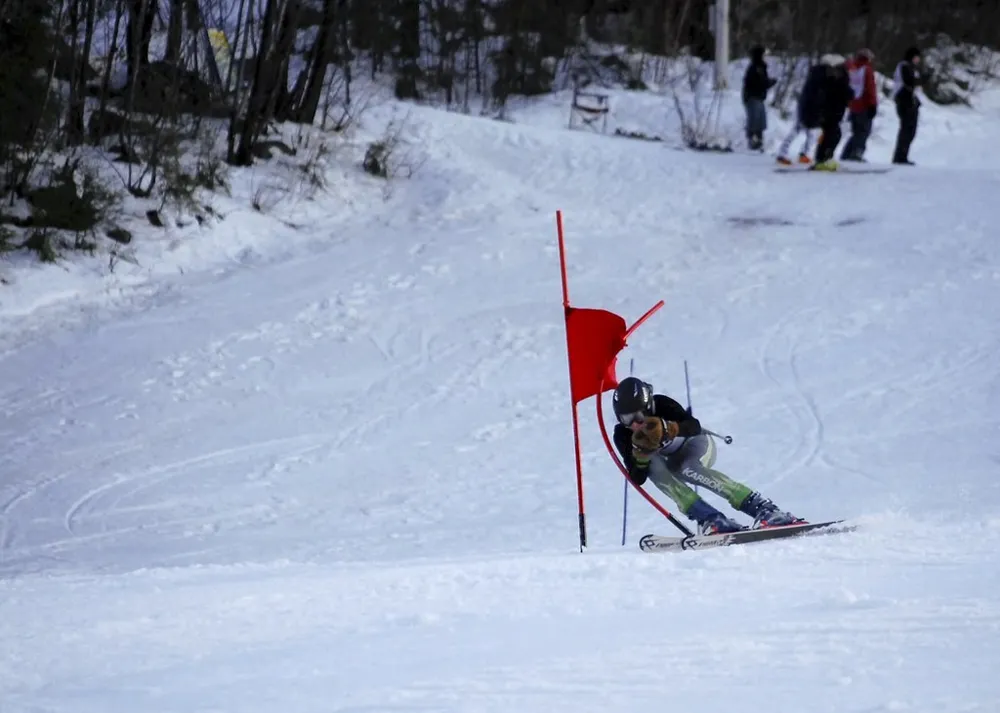
The Alpine Ski Racing Disciplines at a Glance
Alpine ski racing is timed racing down a course marked by gates, and the International Ski and Snowboard Federation (FIS) recognizes several events, or disciplines. Two are speed events: downhill and super-G. Two are technical events: giant slalom and slalom. Combined events add a speed run to a slalom run, and parallel events put two racers side by side. This guide explains how each one works, using the current FIS International Competition Rules (ICR) and the FIS equipment specifications for the 2026/27 season.
| Discipline | Type | Runs | Vertical Drop (World Cup level) | How Gates Are Set |
|---|---|---|---|---|
| Downhill | Speed | 1 (after official training) | Men 800–1,100 m; women 450–800 m | Few gates, at least 8 m wide, mostly to control the line |
| Super-G | Speed | 1 (no training runs) | Men 400–650 m; women 400–600 m | Direction changes of at least 6% of the vertical drop; turning poles at least 25 m apart |
| Giant slalom | Technical | 2, times added | Men 300–450 m; women 300–400 m | Direction changes of 11–15% of the vertical drop; turning poles at least 10 m apart |
| Slalom | Technical | 2, times added | Men 180–220 m; women 140–220 m | Direction changes of 30–35% of the vertical drop (±3); turning poles 6–13 m apart |
| Alpine combined | Both | 2 (speed run + slalom run) | As for each event | A downhill or super-G course, then a slalom course |
| Parallel | Technical | Head-to-head heats | At least 50 m | Two matching courses side by side, at least 15 direction changes |
Figures are from the current FIS International Competition Rules (ICR) for Olympic, World Championship and World Cup races; lower-level FIS races allow somewhat shorter courses. For how these events fit into the Winter Games and who won them in 2026, see our guide to Olympic skiing.
Speed Events vs Technical Events
The split between speed and technical events shapes almost everything about a race: the course, the skis, the suit and even the type of athlete. Speed events (downhill and super-G) are long, fast and decided in a single run. Gates are far apart, turns are wide, and racers spend much of the run in a tuck. Technical events (giant slalom and slalom) are shorter, with many more gates, and the winner is the racer with the lowest combined time over two runs.
Speed skiers use much longer skis with very straight sidecuts, while slalom skis are short and turn quickly. Many World Cup racers specialize in one group; a few, often called all-rounders, score points in both. Olympics.com gives typical speeds of about 130 km/h in downhill, about 80 km/h in giant slalom and about 60–70 km/h in slalom.
Downhill
Downhill is the longest, fastest event and the one with the biggest jumps. The course follows the natural terrain, and gates are used mainly to set the line and stop racers from cutting corners. Under the ICR, men's downhills at the Olympics, World Championships and World Cup must have a vertical drop of 800 to 1,100 meters (750 m in exceptional cases), and women's downhills 450 to 800 meters. Each gate has four poles and two panels and must be at least 8 meters wide.
Downhill is the only discipline with compulsory official training. FIS rules say three days should be scheduled for inspection and training, competitors must take part, and each racer must complete at least one timed training run before the race. The race itself is normally a single run. If snow or weather threatens the full course, the jury can run a shorter downhill in two runs, with the times added.
The classic courses are famous in their own right. Wengen's Lauberhorn in Switzerland is the longest downhill on the World Cup, at about 4.2 km and around two and a half minutes, and Kitzbühel's Streif in Austria starts with a gradient of about 51%, according to Head. Guinness World Records lists the fastest World Cup downhill speed as 161.9 km/h (100.6 MPH), set by France's Johan Clarey on the Lauberhorn on January 19, 2013.
Super-G
Super-G, short for super giant slalom, blends downhill speed with giant slalom turning. It has less vertical drop than a downhill and more turns, and it is decided in one run. There are no training runs: racers inspect the course on race morning and then race it blind at full speed, which makes reading terrain a key skill.
At World Cup level, men's courses drop 400 to 650 meters and women's 400 to 600 meters. The ICR sets the minimum number of direction changes at 6% of the vertical drop for the Olympics, World Championships and Continental Cups, and 7% for other FIS races. So a 600 m course at the top level needs at least 36 direction changes. Turning poles of successive gates must be at least 25 meters apart, open gates are 6 to 8 meters wide and vertical gates 8 to 12 meters wide. Jumps may be set where the terrain allows.
Super-G is the youngest of the four main events. The first official World Cup super-G was held at Val d'Isère, France, in December 1982, and the event joined the World Championships in 1987 and the Olympics at Calgary in 1988.
Giant Slalom
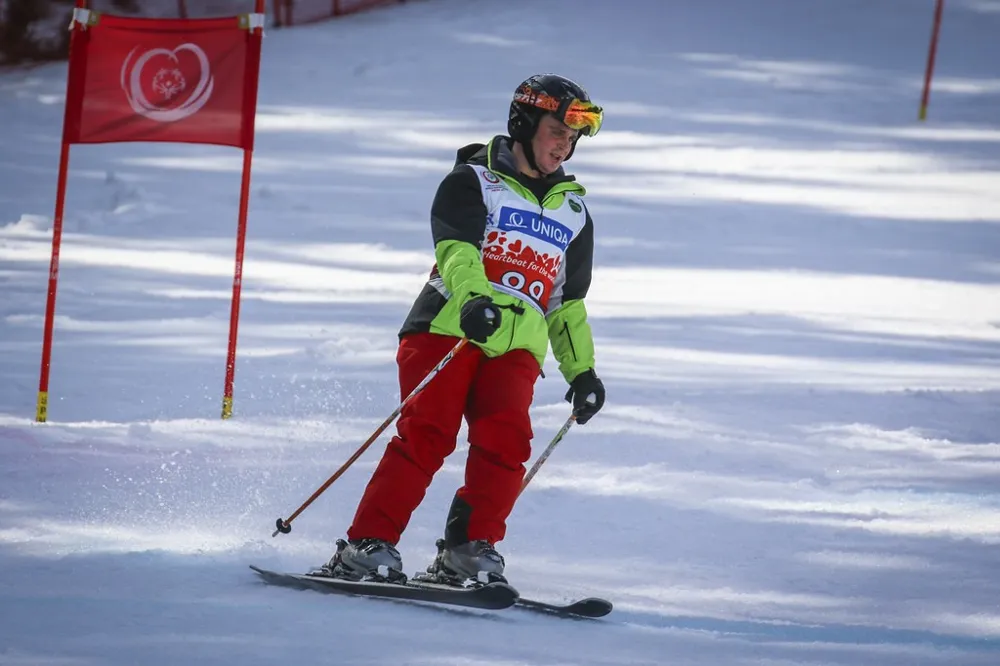
Giant slalom (GS) is the fastest technical event and a test of carving long, clean turns. Each GS gate has four poles and two panels, alternating red and blue, with the bottom of the panel about 1 meter above the snow. Gates must be 4 to 8 meters wide, and the turning poles of two gates must be at least 10 meters apart.
The ICR requires 11% to 15% of the vertical drop in direction changes, so a 400 m course has about 44 to 60 turns. At the Olympics, World Championships and World Cup, the vertical drop must be at least 300 meters, with a maximum of 450 m for men and 400 m for women. Course setters are told to use the terrain and mix long, medium and short turns rather than relying on gate combinations.
A giant slalom is always decided by two runs. Both can use the same slope, but the gates must be reset for the second run, and both runs are held on the same day whenever possible. The jury can cut the second run to half the first-run start list.
Slalom
Slalom is the most technical discipline, with the shortest course and the quickest turns. At the Olympics, World Championships and World Cup, men's courses drop 180 to 220 meters and women's 140 to 220 meters. Gates are two single poles, alternating blue and red, 4 to 6 meters wide, and the distance from turning pole to turning pole must be between 6 and 13 meters.
The number of direction changes must be 30% to 35% of the vertical drop, plus or minus three, so a 200 m slalom has roughly 57 to 73 turns. Every World Cup-level slalom must also include set combinations:
- Hairpins: at least three pairs of closed gates set straight down the hill.
- Vertical combinations: one to three runs of three or four closed gates in a line.
- Delayed gates: one to three longer gaps, 13 to 18 meters between turning poles, that change the rhythm.
Slalom poles are hinged flex poles, so racers ski the tightest line and clear the pole with their shins, hands or guards. Like GS, slalom is run twice on the same day, but on two different courses, with the times added. FIS also allows a single-pole slalom with no outside poles, where both feet and ski tips must pass the turning pole on the correct side.
Alpine Combined and Team Combined
The alpine combined joins one speed run (downhill or super-G) with one slalom run, held on the same day where possible, and the times are added. It rewards versatility, which is why it has become rarer as racers specialize. The ICR also recognizes a classical combined, built from a full downhill and a full slalom, and special triple or quadruple combinations.
The team combined is the newer format. Each team has two racers of the same gender: one starts the speed run and the other the slalom run, and each can start only one run, for one team. The second run starts in the first-run order except that the top 30 go in reverse, the two run times are added, and any points or prize money are split half and half. The team combined replaced the individual combined at the Milano Cortina 2026 Olympics.
Parallel and Team Events
In a parallel race, two racers go head to head on two matching courses side by side, and the faster one moves on in a knockout bracket. The ICR asks for a vertical drop of at least 50 meters, at least 15 direction changes and a course at least 160 meters long, with corresponding gates at least 8 meters apart. The course on the skier's left is red and the course on the skier's right is blue. Parallel can be run with slalom gates (PSL) or giant slalom gates (PGS), and the World Cup can award a parallel trophy when at least two are held in a season.
The mixed team parallel is a nations event run on giant slalom gates. A team has up to six racers with at least two of each gender. In each heat, two women and two men race their opposite numbers, each leg win scores one point, and a 2–2 tie goes to the nation with the lowest combined time of its best woman and best man. The event made its Olympic debut at PyeongChang 2018 and was dropped from the 2026 program.
Race Skis: Length and Radius Rules
FIS controls race skis closely to manage speed and injury risk. The two key numbers are the ski's length and its sidecut radius: the longer the radius, the straighter the ski and the longer the turn it wants to make. These are the 2026/27 rules for Olympic, World Championship, World Cup, World Junior and Continental Cup races:
| Event | Women's Ski Length | Men's Ski Length | Minimum Radius (W / M) | Waist Width |
|---|---|---|---|---|
| Downhill | 210–218 cm | 218–223 cm | 50 m / 50 m | 65 mm max |
| Super-G | 205–215 cm | 210–218 cm | 40 m / 45 m | 65 mm max |
| Giant slalom | 188–192 cm | 193–200 cm | 30 m / 30 m | 65 mm max |
| Slalom | 155 cm min | 165 cm min | No rule | 63 mm min |
Source: FIS Specifications for Alpine Competition Equipment 2026/27. Other limits apply to the whole system: the height from the ski base to the boot's bearing surface is capped at 50 mm, boot soles at 43 mm, and each event has a maximum weight for the ski, plate and binding together. Youth (U14 and U16) racers use shorter, tighter-radius skis, and Masters rules are mostly recommendations. A recreational ski is nothing like these; to size one for the resort, use our ski size chart or browse the best skis and ski brands, many of which build race skis for the World Cup.
Suits, Helmets and Protection
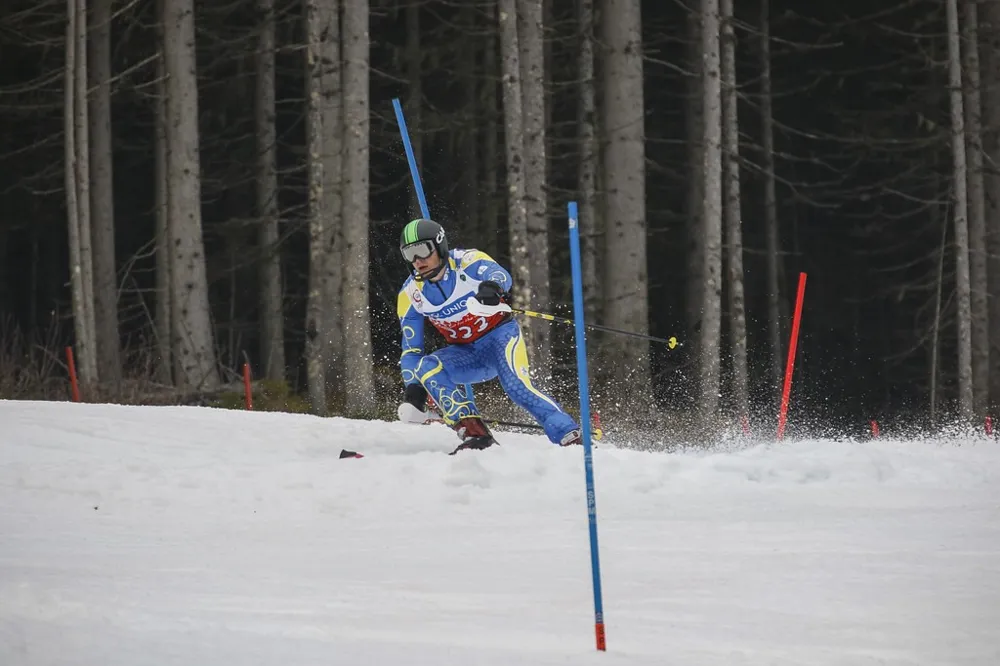
Racing suits are skin-tight for aerodynamics, but FIS limits how slippery they can be. Suits for downhill, super-G and giant slalom must let at least 30 liters of air per square meter per second pass through them and carry a non-removable "CS 2015" conformity label; at the top levels, a racer without a labeled suit is not allowed to start. Under the 2026/27 rules:
- Helmets are compulsory at every FIS alpine event, in training and racing. Speed, GS and parallel helmets must meet ASTM F2040 and EN 1077 class A standards and carry the FIS "RH 2013" label. Slalom helmets have a lower minimum standard, and only slalom helmets may have soft ear protection.
- Cut-resistant underwear pants are mandatory at all FIS alpine events, covering the legs from the hips to the top of the boot to protect against ski-edge cuts.
- Airbag protectors, which inflate when a crash is detected, are mandatory in speed events at the top two race levels.
- Back protectors are allowed under the suit, up to 45 mm thick, and FIS recommends them for young racers.
Slalom racers also wear shin guards, pole guards on their hands and often a chin guard to clear the gates. For your own lid, see our guide to ski and snowboard helmets.
How Races Are Run: Inspection, Start Order and Scoring
Before every race, racers inspect the course by sliding slowly beside the gates and memorizing the line. Results are timed to the hundredth of a second, and missing a gate, or "straddling" a pole by putting one ski on each side, means disqualification unless the racer climbs back up to pass it correctly.
In two-run races, the second run reverses the top 30: the 30th-fastest racer from run one starts first and the leader starts 30th, with everyone from 31st down following in result order. This keeps the leaders on similar snow and builds suspense to the end. On the World Cup, the top 30 finishers in each race score points, from 100 for a win and 80 for second down to 1 point for 30th. The racer with the most points across all events wins the overall title and a large trophy, the famous crystal globe, and the leader in each discipline wins a smaller globe.
Where to Watch: World Cup, Worlds and Olympics
- FIS World Cup: the season-long tour. It traditionally opens in October on the Rettenbach glacier above Sölden, Austria, and runs through March, with classic stops such as Wengen and Kitzbühel.
- FIS Alpine World Ski Championships: held every two years, with medals in each discipline plus team events.
- Winter Olympics: every four years. Milano Cortina 2026 had downhill, super-G, giant slalom, slalom and team combined for men and women. The next Games are in the French Alps in 2030; see Olympic skiing for results and the schedule.
Below the World Cup sit the Continental Cups (such as the European Cup and Nor-Am Cup), FIS races, junior and youth races, and Masters racing for older athletes.
A Short History of Alpine Racing
| Year | Milestone |
|---|---|
| 1921 | Arnold Lunn organizes the British Ski Championships at Wengen, including a downhill race |
| 1922 | The first slalom race is held in Mürren, Switzerland, organized by Lunn |
| 1924 | Lunn founds the Kandahar Ski Club |
| 1928–1930 | FIS trials downhill and slalom, then accepts alpine racing at its 1930 congress |
| 1931 | The first alpine World Championships are held in Mürren |
| 1936 | Alpine skiing joins the Olympics at Garmisch-Partenkirchen with a combined event |
| 1948 | Downhill and slalom are added to the Olympics |
| 1952 | Giant slalom joins the Olympics in Oslo |
| 1982 | The first official World Cup super-G is held at Val d'Isère |
| 1988 | Super-G joins the Olympics at Calgary, and the combined returns |
| 2013 | Johan Clarey reaches 161.9 km/h at Wengen, the fastest World Cup downhill speed |
| 2018 | The mixed team event debuts at the PyeongChang Olympics |
| 2026 | The team combined replaces the individual combined at Milano Cortina |
For the bigger story of skiing, from ancient skis to shaped skis, read our history of skiing and our list of skiing facts and records.
How to Get Into Ski Racing
Most racers start in a club or resort race program, usually in slalom and giant slalom, before moving up to speed events. Many resorts also run recreational timed courses, such as NASTAR in the US, where you can try a GS course and compare your time with others. Before you start, you should be able to link carved turns at speed; our guides to turning and stopping on skis and the ski workout help with the basics.
Race gear isn't needed for a first try: a well-tuned ski with sharp edges matters more (see how to wax and tune skis), along with a properly fitted helmet and stiff, snug ski boots. To compare racing with other ways to ski, see types of skiing, freestyle skiing and ski mountaineering, or browse all our skiing guides.
Frequently Asked Questions
What is super-G skiing?
Super-G, short for super giant slalom, is a speed event that sits between downhill and giant slalom. Racers make one run on a course with more turns than a downhill, and there are no training runs, only a course inspection.
What is the difference between slalom and giant slalom?
Slalom has the tightest gates, 6 to 13 meters apart between turning poles under FIS rules, and the shortest course. Giant slalom gates are at least 10 meters apart, so turns are longer and faster. Both are decided by two runs with the times added together.
How fast do downhill skiers go?
Speeds of around 130 km/h are common in World Cup downhills. Guinness World Records lists Johan Clarey's 161.9 km/h (100.6 MPH) at Wengen in January 2013 as the fastest World Cup downhill speed.
How long are downhill skis?
Under FIS rules for the World Cup, Olympics and World Championships, men's downhill skis must be 218 to 223 cm long and women's 210 to 218 cm, with a sidecut radius of at least 50 meters.
How many runs are in a giant slalom?
Two. FIS rules say a giant slalom must always be decided by two runs, and the second run must be reset even if it uses the same slope. The 30 fastest racers from run one start run two in reverse order.
Why do slalom skiers hit the gates?
Slalom poles are hinged flex poles, so racers take the tightest line and knock the pole out of the way with their shins, hands or guards. A racer is disqualified only for missing a gate, not for hitting one.
What is the team combined in skiing?
A two-person event where one skier races a downhill or super-G run and a teammate of the same gender races a slalom run. Their times are added, and it replaced the individual combined at the 2026 Olympics.