Old-School BMX Bikes: The Classics, How to Date Them and Where Reissues Fit (2026)
From the first purpose-built race frames to the chrome freestylers of the mid-1980s: the bikes collectors look for, how to identify and date one, and what to know before you restore it.
What Makes a BMX Bike Vintage?
Vintage BMX usually means a bike from the sport's first two decades: the 1970s race bikes that grew out of kids copying motocross, and the 1980s race and freestyle bikes that many riders still call the golden era. Collectors sort them into rough eras:
- Old school: 1970s and 1980s bikes, the core of the vintage scene.
- Mid school: roughly the 1990s.
- New school: the 2000s onward.
The labels are loose, and collector guides often split serial-number systems along the same lines. If you're new to the sport's origins, start with what BMX stands for; this page is about the bikes themselves.
Vintage BMX Timeline
Dates below match our BMX brands guide and the sources listed in each section.
| Year | Milestone |
|---|---|
| Early 1970s | Kids in Southern California race Schwinn Sting-Rays and similar bikes on dirt tracks |
| 1972 | GT is founded by Gary Turner and Richard Long in Santa Ana, California |
| 1974 | Skip Hess starts BMX Products, Inc. (Mongoose); its first product is the Motomag wheel |
| 1976 | Torker, a Fullerton, California frame maker, enters BMX |
| 1977 | Scot Breithaupt founds SE (Scot Enterprises) in Long Beach, California |
| 1978 | Bob Haro founds Haro; the UK's JAG Cafe Racer dates from the same year |
| 1979 | SE PK Ripper and Mongoose Supergoose are introduced |
| 1980 | Redline's tubular chromoly Flight cranks enter production |
| 1982 | The Haro Freestyler, built by Torker, appears as an early dedicated freestyle frame |
| 1984 | GT Pro Performer, Haro Sport and Mongoose's loop-tail Supergoose frame; Torker shuts down at the end of the year |
| 1985 | Mongoose FS-1, the brand's first freestyle model |
| 1987 | S&M Bikes is founded |
| Mid-1990s | Heavy-duty street and dirt frames such as the Standard STA and S&M Dirt Bike define the mid-school era |
The 1970s: From Sting-Rays to Purpose-Built Race Bikes
The first BMX racers rode what they had, mostly Schwinn Sting-Rays and other small-wheeled kids' bikes with high-rise bars. As racing caught on, small Southern California companies started building parts and frames made to survive jumps and berms.
Wheels came first for Mongoose: Skip Hess started BMX Products, Inc. in Simi Valley in September 1974, and its first product was the Motomag wheel, which became one of the most recognizable parts of the era. GT began in 1972, Redline dates to the early 1970s and SE followed in 1977. SE's PK Ripper arrived in 1979 and is often described as the longest-running production BMX bike.
Torker, in Fullerton, California, was another key maker. Its own serial guide covers frames from about 1977 to 1984 and lists models such as the 280, the L.P., the Pro XL, mini frames and cruisers. Outside the US, the JAG Cafe Racer of 1978 is a classic British track bike built by Glynn Hicks.
The 1980s: The Golden Era of Race and Freestyle
By the early 1980s BMX racing had national sanctioning bodies, and 24-inch cruisers were part of American racing too. Bikes such as the 1981 Diamond Back Silver Streak, the 1982 Diamond Back Harry Leary Turbo and the 1984 Hutch Pro Star are names that still come up whenever riders list their favorite race bikes of the decade.
Freestyle split off as its own scene in the same years. The Haro Freestyler of 1982, built by Torker, is described as the first dedicated freestyle BMX frame. It was followed by the Haro Master, with Torker-style twin top tubes, which stayed a flatland favorite for years, and in 1984 by the Haro Sport, which had a single top tube, a longer wheelbase and a slacker head angle for ramp riding. The originals were welded by Torker in Fullerton and chrome-plated by Bush Plating in Garden Grove; after Torker shut down at the end of 1984, Haro moved production to the Anlen factory in Taichung, Taiwan. That year Haro also began offering complete bikes for the first time.
Other brands answered quickly. GT's Pro Performer, introduced in 1984, was GT's first freestyle bike and made its bent down tube a trademark. Mongoose's FS-1 arrived in 1985 as its first freestyle model, while its Supergoose race bike, launched in 1979, got its loop-tail frame in 1984.
Classic Models Collectors Look For
This list sticks to models with documented dates. It isn't a ranking, and it doesn't cover what any bike is worth.
| Model | Year | Type | Known For |
|---|---|---|---|
| JAG Cafe Racer | 1978 | Race | Classic British track bike |
| SE PK Ripper | 1979 | Race | Often called the longest-running production BMX |
| Mongoose Supergoose | 1979 (loop-tail 1984) | Race | Mongoose's signature race bike, reissued several times |
| Diamond Back Silver Streak | 1981 | Race | A well-known early-1980s race bike |
| Diamond Back Harry Leary Turbo | 1982 | Race | Often praised for its stance and look |
| Haro Freestyler | 1982 | Freestyle | Described as the first dedicated freestyle frame |
| Haro Master | By 1984 | Freestyle (flatland) | Twin top tubes; long-running flatland frame |
| Haro Sport | 1984 | Freestyle (ramp) | Single top tube, longer and slacker than the Master |
| GT Pro Performer | 1984 | Freestyle | GT's first freestyle bike; bent down tube |
| Hutch Pro Star | 1984 | Race | A high-end, polished race frame of its day |
| Mongoose FS-1 | 1985 | Freestyle | Mongoose's first freestyle model |
| Standard STA 500 | 1995 | Street/park | Heavy, strong mid-school frame |
| S&M Dirt Bike | 1995 | Dirt jumping | Clean, lighter mid-school dirt frame |
Redline is collected as much for parts as for frames: its Flight cranks, a tubular chromoly three-piece design, went into production in 1980. Motomag wheels, pads, number plates and seats from the right year matter to collectors as much as the frame itself.
How to Identify a Vintage BMX Frame
Many old frames have lost their decals, so identification often starts with the metal. Work through these clues:
- Serial number: usually stamped under the bottom bracket shell, sometimes on a rear dropout. See the next section for dating.
- Frame shape: twin top tubes, loop-tail rear ends, bent down tubes and gusset shapes are often brand- and year-specific.
- Dropouts and braze-ons: the shape of the dropouts, brake mounts, cable guides and peg mounts changed between model years.
- Finish: chrome, paint color and decal style help, but they're the easiest things to change, so treat them as supporting evidence.
- Fork and parts: a matching original fork, cranks, wheels and bars make identification far easier than a bare frame.
- Catalogs and ads: period catalogs and magazine ads show what each model looked like when new. Collector registries and brand-specific catalog archives are the usual references.
If a part's name is unfamiliar, our guide to BMX parts explains each component.
How to Date a BMX by Serial Number
There was no industry-wide serial system, so each brand, and often each factory, used its own code. Collector guides decode many of them, but they are reconstructed from surviving frames and catalogs, and their authors often say they aren't definitive. A few documented examples:
| Brand and Era | How the Code Works (per collector guides) |
|---|---|
| Torker, about 1978 to 1984 | A two-letter date code (later three letters from September 1982), a production number and sometimes a model letter. Torker's own guide covers Fullerton-built frames only. |
| Mongoose, mid-school (1990s) | Serials start with four letters; the third letter gives the year (A for 1991 through I for 1999) and the fourth gives the month (A for January through L for December). |
| Mongoose, new school (2000s) | Serials start with five letters; the fourth continues the year sequence (J for 2000 onward), with the same A to L month letters. |
| Haro | Frames are reported to be built the year before the model year they were sold as, so the build date and model year can differ. |
For other brands, look for a serial guide specific to that maker, and confirm the result against the frame details above. A serial alone rarely proves a model: brands reused codes, and some guides contain small inconsistencies. Registries such as Bike Index can help with model lookups, but coverage of vintage BMX frames is patchy.
Original, Replica or Reissue?
Three kinds of "old-school" bike turn up for sale, and it pays to know which one you're looking at:
- Original: made in the period, with its own serial number and wear consistent with its age.
- Replica: a newly made copy of an old frame, sometimes produced in small, numbered runs. Haro's 2020 replicas of the 1984 Master and Sport, for example, were a limited run of 300 framesets welded in Santa Ana, California, and chromed by Bush Plating, the same plater as the originals.
- Reissue: a production bike that borrows a classic name and look, usually with modern parts.
Clues that a "vintage" bike is newer than claimed include a serial format that doesn't match the brand's period code, modern parts such as sealed-bearing hubs on a bike sold as all-original, and decals that look too fresh for the wear on the frame. Ask the seller for clear photos of the serial number, dropouts and welds before you commit.
Collecting Vintage BMX Bikes
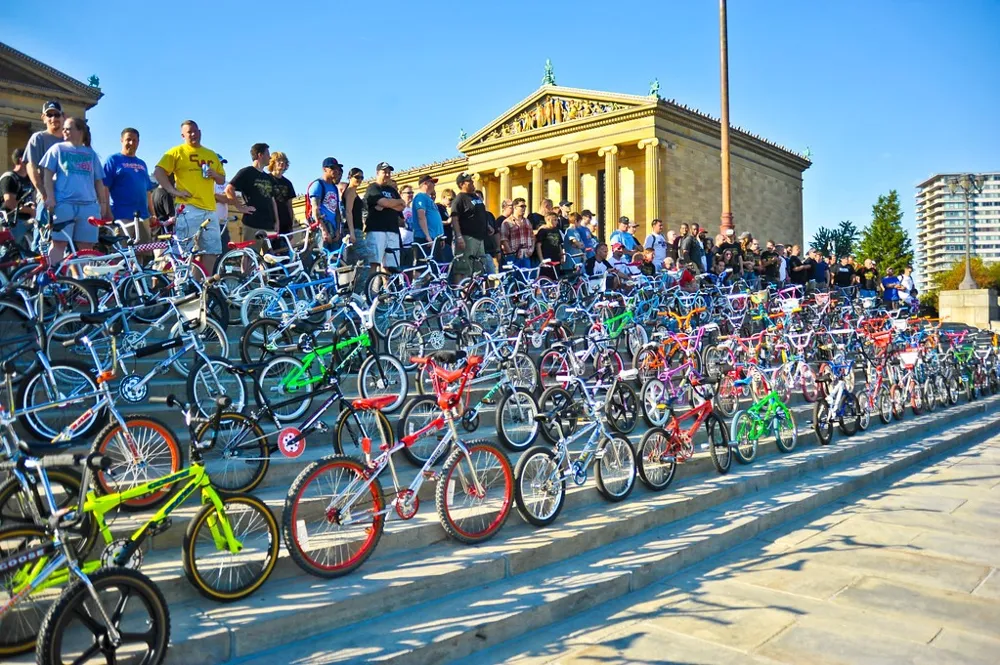
Collectors tend to fall into a few camps: riders rebuilding the bike they had (or wanted) as a kid, period-correct restorers chasing every original part, and riders who want old-school looks on a bike they can use. Decide which one you are before buying, because it changes what a "good" find looks like.
- Condition terms: "survivor" usually means an unrestored bike with its original finish; "NOS" (new old stock) means a part that was made in the period but never used.
- Completeness: an original frame and fork together are the foundation; matching period parts add to the story.
- Documentation: original receipts, catalogs, race plates and photos help confirm a bike's history.
- Where to look: collector forums and registries, online marketplaces, swap meets and old-school BMX meetups and races, where riders bring restored bikes.
We don't list prices or values: they vary widely by model, condition and originality, and change quickly. Check recent completed sales before you buy or sell.
Restoring an Old-School BMX
A good restoration starts with a plan. These steps apply to most vintage frames:
- Document first. Photograph the bike from every side, plus the serial number, decals and each part, before taking anything off.
- Decide on the goal. A period-correct show bike, a clean survivor or a rider will each lead to different choices on paint, chrome and parts.
- Clean gently. Use mild cleaners and soft brushes; harsh abrasives can strip original chrome, paint and decals.
- Check the frame. Look for cracks near the head tube, bottom bracket and dropouts, and for dents or bends. A cracked or bent frame should be repaired by a qualified frame builder or retired from riding.
- Service the moving parts. Old bearings, cables, tires and brake pads usually need replacing; grease and rubber age even when a bike sat unused.
- Source parts carefully. Period parts come from collectors and NOS sellers; reproduction decals and some reissued parts exist for popular models.
- Keep the originals. Bag and label anything you remove, especially if you refinish the frame.
Refinishing is the big decision. Collectors often favor an original finish, even worn, over a fresh repaint or rechrome, so think hard before stripping a rare frame. A common frame you plan to ride is a different story.
Retro BMX Reissues You Can Still Buy
Several heritage brands make bikes and parts that copy their classics. Availability changes often, so check each brand's site for current models (as of November 2026):
- Mongoose: for its 50th anniversary, Mongoose announced in September 2024 a Supergoose based on the 1984 loop-tail frame (4130 chromoly, alloy rims, Dia-Compe brakes), an FS-1 reissue with five-spoke nylon mag wheels and white gumwall tires, and Motomag III wheelsets with sealed-bearing hubs.
- Haro: besides the 2020 Master and Sport replicas, Haro has sold retro models under its Lineage name, including Freestyler and Team Master versions.
- Torker: the revived brand lists retro items such as an Old Skool 50th-anniversary limited edition made with Vans.
- SE Bikes: the PK Ripper name has stayed in the lineup in various forms.
Reissues are newly made, so they aren't vintage in the collector sense, but they are a practical way to ride the look without risking a rare original. For modern bikes, see our BMX race bikes and BMX cruisers guides.
Riding a Vintage BMX Safely
Old bikes can be ridden, but parts age. Replace dried-out tires, perished grips and old brake pads, and check that cranks, stem and bars are tight before every ride. Older frames and mild-steel parts weren't built to modern standards, so avoid big jumps on a rare or untested frame. Always wear a certified helmet; see our helmet guide. Getting back into riding? Our BMX size chart helps if you're choosing between a 20-inch bike and a cruiser.
Keep Exploring
Read what BMX stands for for the sport's origins, what BMX racing is for how races work, our BMX brands guide for where today's companies came from, and our BMX hub for every BMX guide. Interested in other retro gear? See vintage skateboards and the history of mountain biking.
Frequently Asked Questions
What counts as a vintage BMX bike?
Most collectors use 'old school' for BMX bikes from the 1970s and 1980s, 'mid school' for the 1990s and 'new school' for the 2000s onward. The lines are loose, and each brand's own history matters more than an exact cutoff year.
Where is the serial number on an old BMX bike?
It is usually stamped under the bottom bracket shell. Some brands stamped it on a rear dropout instead, so check both, and clean off grime gently before reading it.
How do I find out what year my BMX bike is?
Read the serial number and compare it with a collector guide for that brand, since each maker used its own date codes. Then cross-check the frame shape, dropouts, decals and original parts against period catalogs.
Can I look up a BMX bike by serial number?
There is no single official database for vintage BMX frames. Brand-specific serial guides written by collectors, period catalogs and registries such as Bike Index are the usual starting points, and none is complete.
Should I repaint or rechrome a vintage BMX?
Collectors often prefer a bike with its original finish, even if worn, so think twice before stripping a rare frame. A refinish can suit a common frame you plan to ride; keep any original parts you remove.
Are retro BMX reissues the same as the originals?
No. Reissues copy the look of classic models, but they are newly made and often use updated parts such as sealed-bearing hubs. They suit riding and nostalgia; originals are what collectors mean by vintage.