Vintage Skateboards: A Collector's Guide From the '60s to the '90s (2026)
Clay-wheel surf boards, 70s fiberglass, 80s pro models and 90s popsicles. Here's how to date an old skateboard, spot a reissue and keep a collection in good shape.
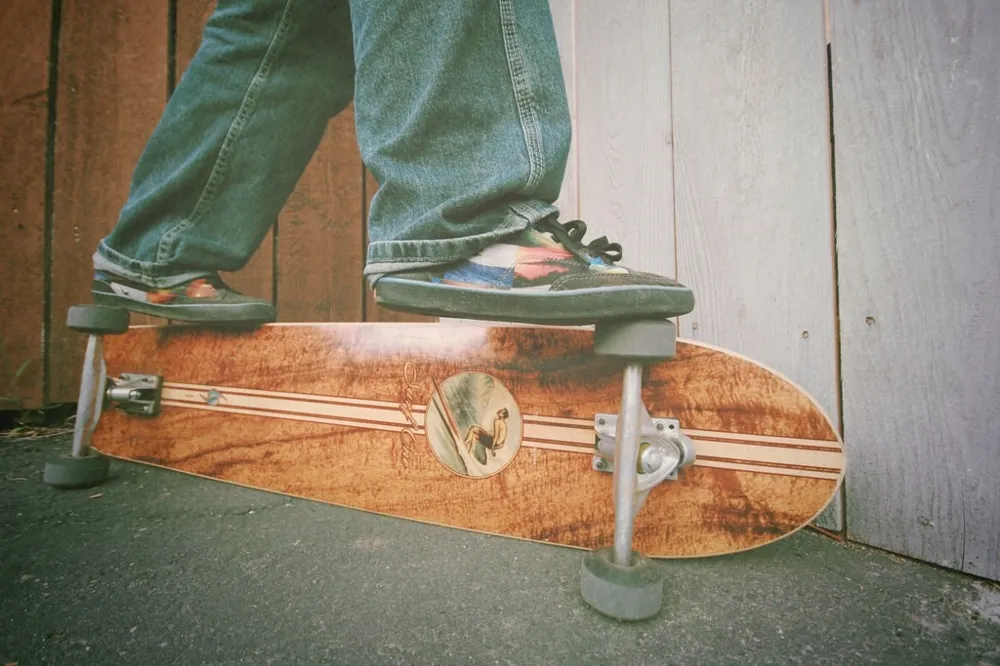
Vintage Skateboards at a Glance
A vintage skateboard is any original board from skateboarding's earlier eras, usually the 1960s through the 1980s, with 1990s street decks now joining the list. Collectors also call them "old school" boards. Each era has its own look, and those differences in shape, wheels, materials and printing are what let you date a board and tell an original from a later copy.
| Era | Typical Board | Wheels | Makers Collectors Look For |
|---|---|---|---|
| 1960s | Narrow, surfboard-shaped deck of solid wood, plastic or occasionally metal, about 6–7" wide | Clay or steel roller-skate wheels | Roller Derby, Makaha, Hobie, Gordon & Smith |
| 1970s | Fiberglass, polypropylene, solid and laminated wood; kicktails and wider pool shapes by the late decade | Early urethane, later with precision bearings | Bahne, G&S, Logan Earth Ski, Z-Flex, Sims |
| 1980s | Wide maple vert decks, pro models and bold screen-printed graphics | Wide, hard urethane | Powell Peralta, Santa Cruz, Vision, Alva, Sims |
| 1990s | Narrow, near-symmetrical double-kick "popsicle" street decks | Small, hard street wheels | Early-90s street brands such as Real, Plan B, Girl and Chocolate |
This guide focuses on collecting. For the full story of how the sport developed, see our skateboarding history timeline and who invented the skateboard.
What Counts as Vintage? Key Terms
There is no official age cutoff, so the words collectors use matter more than the label "vintage." These are the terms you'll see in listings and collector groups:
- OG (original): a board made during the model's first production run.
- Reissue: a model the brand made again later, identically or almost identically. Quality varies by maker; some copy the original shape and printing, others use modern shapes and printing.
- Reproduction or repro: usually an unofficial copy. A repro or a reissue sold as an original is the main risk for new collectors.
- SP and HT: screen print and heat transfer, two ways a graphic is applied (more below).
- Old school: a loose term for 1970s and 1980s shapes, including new boards built in that style. See the old-school section of our types of skateboards guide.
1960s Boards: Clay Wheels and Sidewalk Surfing
The first commercial skateboards were made for surfers who wanted to ride when the waves were flat. The Roller Derby board of 1959 is widely called the first mass-produced skateboard. Larry Stevenson's Makaha began production in Santa Monica in 1963, sponsored one of the first contests that year and was the first company to sponsor a skate team. Surfboard shaper Hobie Alter partnered with the Vita-Pakt juice company in 1964 to create Hobie Skateboards, and Gordon & Smith introduced its Fibreflex board in the mid-1960s, a laminate of fiberglass-reinforced epoxy and maple that Concrete Wave calls the first laminated skateboard.
Boards from this era are easy to spot once you know the signs:
- Shape: narrow, surfboard-like outlines, usually about 6 to 7 inches wide, with flat decks and no kicktail.
- Material: solid wood or plastic, with a few metal decks.
- Wheels: clay or steel wheels borrowed from roller skates. Clay wheels gripped poorly and wore out fast.
- Trucks: simple roller-skate-style trucks, often stamped with the skate maker's name.
The first boom faded in the mid-1960s, so fewer boards were made and fewer survived in good shape. Larry Stevenson's kicktail, patented in 1969, marks the change toward the next generation of boards.
1970s Boards: Urethane, Fiberglass and the Second Boom
Frank Nasworthy's Cadillac urethane wheels changed everything in the early 1970s. They gave a smoother, faster and more controllable ride than steel or clay. Nasworthy licensed the wheels to Bahne and Co. of Encinitas, California, and Bahne boards were sold with Cadillac wheels; Bahne reported selling 10,000 to 20,000 boards a month in 1975. Precision-bearing wheels such as Road Rider followed and soon overtook the first urethane wheels.
The second boom brought a wave of brands and experiments that collectors now chase:
- New deck materials: polypropylene, fiberglass and other modern materials appeared alongside solid and laminated wood, giving flexible decks a following.
- Logan Earth Ski: founded by the Logan family in 1975 and closed in 1980, with handmade solid-wood boards and later laminated and exotic-wood lines. The Smithsonian's National Museum of American History holds a Bruce Logan model deck.
- Z-Flex: a 1970s brand whose Jay Adams model boards are also held by the Smithsonian's National Museum of American History.
- Purpose-built trucks: Tracker trucks grew out of Larry Balma's work from 1973, the Bennett Hijacker arrived in 1975, and Gullwing introduced a split-axle design.
- Wider pool boards: by the late 1970s, kicktails and wider decks for pools and early skateparks were common, and maple plywood became the most popular deck material.
Powell's Quicksilver ProSlalom deck was first sold in 1976 through Sims, two years before George Powell and Stacy Peralta formed Powell Peralta. Slalom, freestyle and downhill boards from this decade have their own collector followings.
1980s Boards: Pro Models and Big Graphics
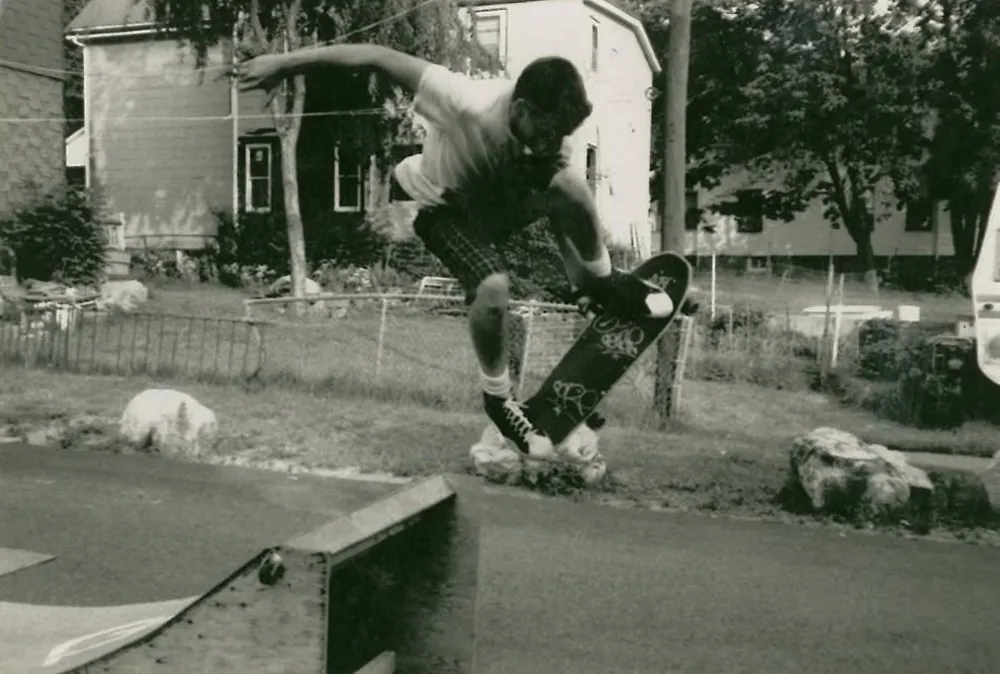
The 1980s are the decade most collectors think of first. Decks grew wide for vert ramps and pools, and skaters' signature pro models made graphics a selling point. Many top skaters owned companies or helped design their boards, and some models were made in limited runs.
- Powell Peralta: founded in 1978, it formed the Bones Brigade team in 1979 and sold pro models for riders such as Tony Hawk, Steve Caballero and Lance Mountain. Artist Vernon Courtlandt Johnson (VCJ) is closely tied to the brand's graphics.
- Santa Cruz: part of NHS, founded in 1973. Its Screaming Hand, drawn by Jim Phillips in 1985, is one of skateboarding's most recognized images.
- Vision, Alva and Sims: other popular brands of the era whose pro models are widely collected.
Late in the decade, street skating pushed shapes narrower. For the artists and imagery behind these decks, see skateboard art history.
1990s Boards: The Street Popsicle Era
Street skating took over in the late 1980s and the 1990s, and boards changed fast. Decks became narrow and nearly symmetrical, with a kicktail at each end, and wheels shrank. This is the shape of today's standard skateboard, so a 1990s deck can look modern at first glance.
Many brands that still exist started then, including Real (1990), Plan B (1991), Element and Birdhouse (1992), Girl and Toy Machine (1993), and Chocolate and Creature (1994). See our skateboard brands guide for the full list. Because most 90s street decks were ridden hard and broken, an unridden early-90s deck can be harder to find than its production numbers suggest.
How to Identify a Vintage Skateboard
Start with the board as a whole, then work through the details. No single clue proves age; you're looking for several that agree.
| Clue | What to Check |
|---|---|
| Shape and width | Narrow surf outlines suggest the 1960s; kicktails and wider pool shapes suggest the late 1970s; very wide decks suggest 1980s vert; narrow double kicks suggest the 1990s or later |
| Material | Solid wood, plastic, fiberglass and metal point to the 1960s and 1970s; laminated maple became standard later |
| Graphic printing | Screen printing was used throughout the original eras; heat-transfer graphics became common in the 2000s as a cheaper method |
| Concave and kicks | Older decks are often flatter, with a single kicktail or none; deep concave and steep double kicks are newer features |
| Wheels and trucks | Clay or steel wheels mean the 1960s; urethane with loose or early bearings means the 1970s; check truck stampings and baseplate shapes against period catalogs |
| Markings | Brand stamps, model names, pro names and any printed dates or series marks on the top, bottom or edges |
| Wear | Wear should match age and use; heavy wear on the bottom with a crisp, bright top deserves a closer look |
Once you have a likely brand and model, compare it with photos of known originals. Old magazine ads, brand catalogs, museum collections and collector groups are the best references. Our skateboard anatomy guide explains the parts if any terms are unfamiliar.
Originals vs Reissues: How to Tell
Brands have reissued classic decks for more than 20 years. Powell Peralta has reissued pro decks for riders including Steve Caballero, Ray "Bones" Rodriguez and Mike McGill, and Santa Cruz releases reissues on a rolling schedule. Not every model or colorway gets reissued, which is one reason some originals stay scarce.
A reissue can look a lot like an original, especially one that has been stored in a garage for years. Check these points:
- Printing method: some reissues copy the original screen printing, while others use heat transfers, which look smoother and more photographic.
- Shape and concave: reissues may use a modern press with more concave or slightly different dimensions than the original.
- Wood and finish: compare the ply colors, edges and finish with documented originals.
- Markings: look for reissue, series or later copyright information, and compare logo placement with the original.
- Packaging: modern shrink wrap or labels on a supposedly decades-old deck is a warning sign.
Reissues aren't lesser boards; they're a way to own or ride a classic shape without risking an original. The key is that they're described honestly. Collectors generally say first editions carry the most collector interest.
Condition Grading Terms
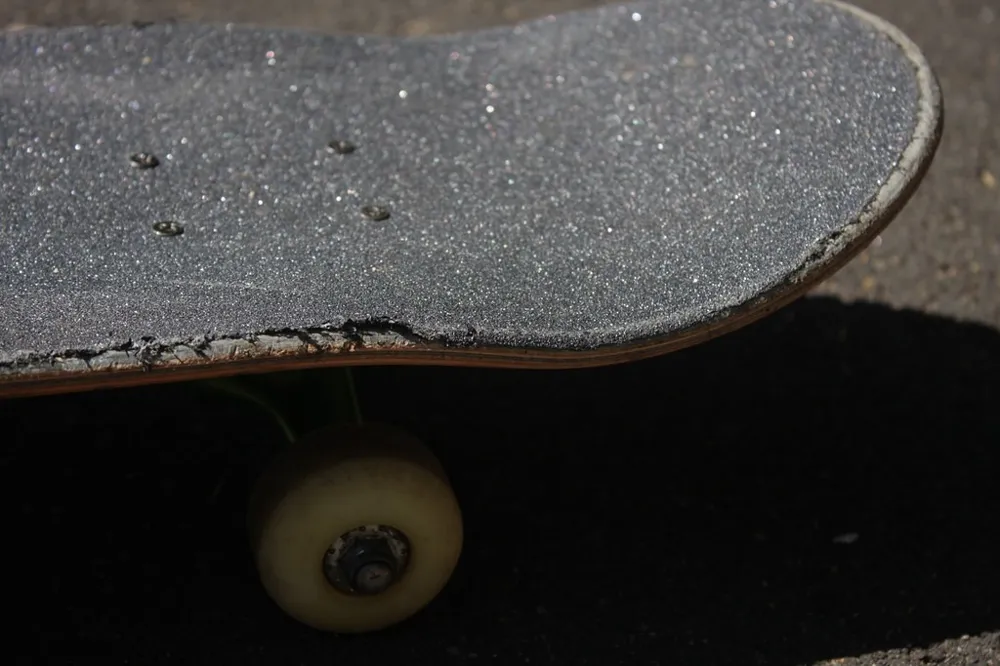
Condition is one of the biggest factors in how collectors see a board. There's no universal grading standard, so read every listing's description and photos rather than relying on a single word.
| Term | What It Usually Means |
|---|---|
| NOS or dead stock | New old stock: never sold or ridden, often kept in a shop or distributor's stock for years |
| Mint | Perfect, like-new condition |
| In shrink | Still in its original shrink wrap |
| Unridden or no grip | Never set up or skated; may have shelf wear |
| Gripped or mounted | Grip tape applied or trucks mounted, even if barely ridden |
| Used or ridden | Skated, with wear to the graphic, tail, nose or edges |
| Complete or original setup | Sold with trucks and wheels; period-correct original parts are a plus |
Grip tape is the big dividing line for decks. One long-time collector told Jenkem that gripping a collectible deck is like putting "a sticker on a Ferrari." Chips, delamination, pressure cracks, warping and sun fading all lower condition.
What Affects a Vintage Skateboard's Value
We don't list prices, because they change constantly and depend on the exact board. These are the factors collectors weigh:
- Original or reissue: first-run originals generally draw the most interest.
- Condition: unridden and NOS boards sit at the top; heavy wear, grip and damage pull interest down.
- Rarity: short production runs, limited editions, colorways that were never reissued and boards from small or short-lived companies.
- Demand: iconic pro models, famous graphics and brands with large followings.
- Completeness: period-correct original trucks and wheels, packaging, ads or paperwork.
- Provenance: a documented history, such as a board from an original team rider, company staff member or shop.
To estimate value, identify the board exactly, grade it honestly and compare completed sales of the same model and condition. Asking prices on listings often don't reflect what boards actually sell for. For a formal opinion, ask an experienced collector group or an appraiser. Not every old skateboard is valuable, and many boards matter more for their story than their market.
Where to Buy and Sell Vintage Skateboards
- Online auctions and marketplaces: the widest selection of originals and reissues. Check completed listings for real selling prices, and read seller feedback.
- Collector groups: Facebook and Instagram communities, often organized by brand, region or era, plus dedicated collector forums. Each group has its own rules, so read them before posting.
- Skate shops and reissue specialists: the easiest source for official reissues, and some shops still have old stock.
- Swap meets, collector shows and estate sales: a chance to inspect boards in person.
- Industry people: former shop owners, ex-pros, company staff and artists sometimes sell boards with a clear history.
If you're selling, photograph the top, bottom, nose, tail, edges and any markings in good light, describe condition plainly, and say clearly whether it's an original or a reissue. For shipping, see how to wrap a skateboard.
Spotting Fakes and Misdescribed Boards
Outright counterfeits are less common than honest-looking reissues sold as originals, but both happen. Before you commit to a high-interest board:
- Ask for clear photos of the top, bottom, edges and any stamps or markings.
- Compare the graphic, colors, logo placement and shape with verified originals.
- Check the printing method and whether the wear looks natural for the board's claimed age.
- Ask the seller where the board came from and how long they've had it.
- Post photos in a collector group and ask for opinions before buying.
- Use payment methods with buyer protection, and be cautious with sellers who won't answer questions.
Preserving and Displaying a Collection
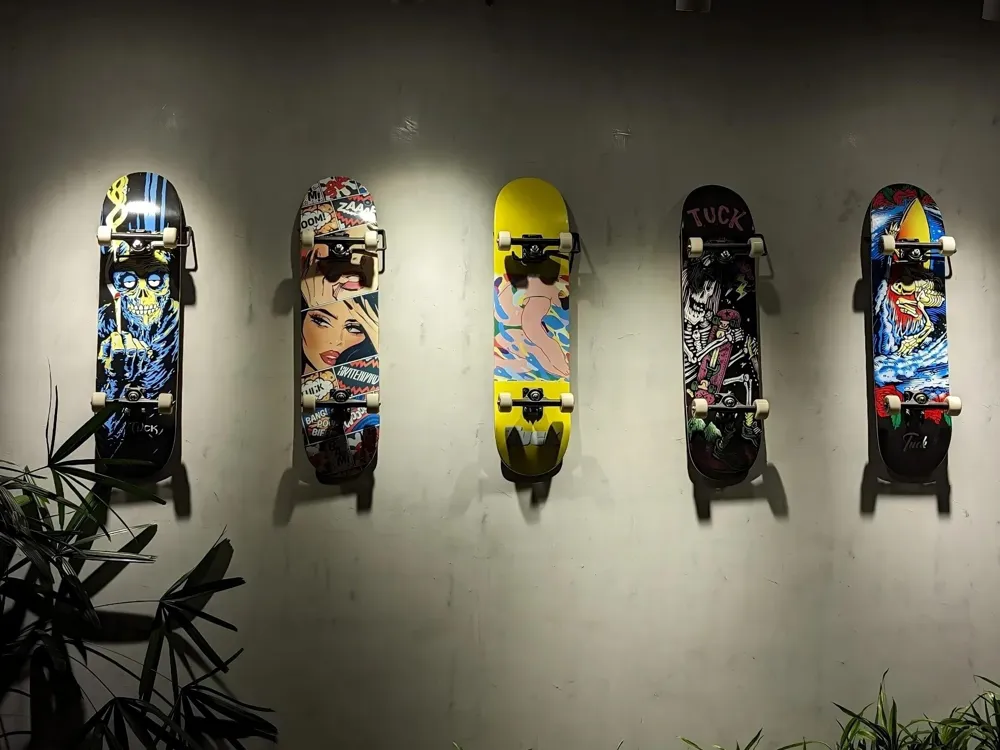
Wood, paint and urethane all age, so storage matters as much as buying well.
- Keep out of sunlight. UV light fades graphics. Avoid windows and direct sun on display walls.
- Control humidity and temperature. Damp air and big temperature swings can warp and delaminate decks. A stable indoor room is better than a garage, attic or basement, and collectors advise against hanging decks on exterior walls.
- Prevent wood-to-wood contact. Decks stacked against each other scuff; store them in plastic sleeves or bags, or separate them.
- Think about shrink wrap. Some collectors remove cheap shrink wrap from decks they're keeping, because the plastic can damage paint and graphics over time.
- Don't grip collectible decks, and dust them gently with a dry, soft cloth instead of cleaners.
- Display with care. Use mounts that hold the deck without screws through it, on a flat interior wall. See how to hang a skateboard on a wall, the best skateboard racks and how to store a skateboard.
Should You Ride a Vintage Skateboard?
You can, but think twice with originals. Clay, steel and early urethane wheels are much harder to control than modern wheels, old hardware may be fatigued, and every session lowers a board's condition. Most collectors display originals and skate reissues or modern old-school shapes instead. If you do ride an old setup, check trucks, hardware and wheels first, wear a helmet, and read our skateboard maintenance guide. If you're returning to skating after years away, see getting back into skateboarding.
Keep Exploring
Read about skateboard art, the best skateboarders of all time, skateboarding magazines and skateboarding documentaries.
Frequently Asked Questions
What is considered a vintage skateboard?
There is no official cutoff. Collectors usually mean boards made from the 1960s through the 1980s, and more and more people now include 1990s decks too. Original boards from those years are often called "OG" to separate them from later reissues.
How can I tell if my skateboard is an original or a reissue?
Check how the graphic was printed, the shape and concave, the wood or material, and any dates or reissue markings, then compare it with documented originals in collector groups. Screen printing was the standard in the original eras, while many later reissues use heat transfers and modern shapes.
What does NOS mean for skateboards?
NOS stands for new old stock: a vintage board that was never sold or ridden, often one that sat in a shop or distributor's stock for years. Collectors also call it dead stock.
Should I remove the shrink wrap from a vintage deck?
Some long-time collectors advise taking cheap shrink wrap off decks you plan to keep, because the plastic can damage paint and graphic transfers over time. Removing it can affect how a deck is described for sale, so decide based on whether you are keeping or selling it.
How do I find out what my old skateboard is worth?
Identify the exact brand, model, year and whether it is an original or a reissue, then grade its condition honestly. Compare completed sales of the same board rather than asking prices, or ask an established collector community or appraiser.
Can you ride a vintage skateboard?
You can, but old clay, steel or early urethane wheels are much harder to control than modern ones, and riding an original lowers its collector condition. Most collectors display originals and ride a reissue of the same model instead.
What skateboards were popular in the 80s?
The 1980s were the era of wide vert decks and pro models from brands such as Powell Peralta, Santa Cruz, Vision, Alva and Sims, many with bold screen-printed graphics. Late in the decade, narrower street shapes began to take over.