How to Fix a Surfboard Ding, From Quick Patch to Full Repair (2026)
Most dings are an afternoon job if you match the resin to your board. Here's how to assess the damage, seal it fast and make a lasting repair.
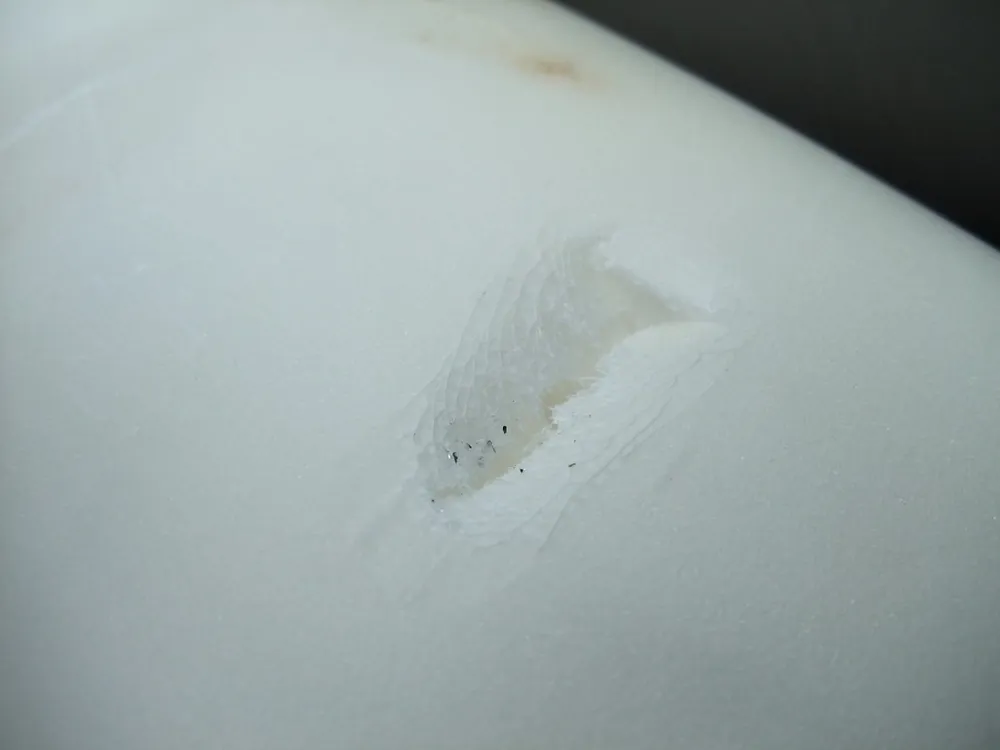
What a Ding Is and Why to Fix It Fast
A ding is any damage to a surfboard's shell: a dent, a crack, a chipped rail or a hole through the fiberglass. Most hard boards are a foam core wrapped in fiberglass and resin, and that shell is what keeps water out. Once it's broken, the foam can soak up water, get heavier and start to separate from the glass (delamination). A small, fresh ding is easy to fix. A ding that has been surfed for weeks often isn't.
This guide walks through the whole process: deciding what kind of damage you have, drying the board, finishing a session with a temporary seal, then making a proper repair on a PU (polyester) or EPS (epoxy) board. It also covers soft tops, safety and when a shop is the better call.
How to Assess the Damage
Look at the board in good light, run your fingers over the area and check the rails, nose and tail, where most dings happen. A quick test from Clean Line Surf: run a fingernail across a crack. If it catches on an edge, the glass is open and the ding needs fixing soon. NSP adds another check: if you can feel air passing through the ding, the outer layers are punctured.
| Damage | What It Looks Like | Water Getting In? | Usual Fix |
|---|---|---|---|
| Pressure ding | Shallow dent in the deck from heels, knees or a knock; glass not cracked | No | Usually leave it; wax hides heel dents |
| Hairline or spider crack | Fine cracks in the shell, often around a dent | Possibly | UV-cure resin or a small resin fill |
| Open ding | Broken glass with foam showing, often on a rail, nose or tail | Yes | Dry, fill, glass and sand |
| Delamination | Bubble, soft patch or bowl where the glass has lifted off the foam | Often | Inject or cut out and re-glass; often a shop job |
| Fin box or fin damage | Loose, cracked or pulled-out fin box; cracked glass around fins | Yes | Shop job for most people |
| Snapped or creased board | Crease across the deck or a full break, often through the stringer | Yes | Shop repair, or replace the board |
Pressure dings are the most common problem on PU boards, because PU foam has poor compression strength. Clean Line Surf calls pressure dents that haven't cracked the glass "often minor." Watch them for cracks, but they don't need resin.
First Steps: Get Out of the Water and Dry the Board
If you find an open ding mid-session, paddle in. Surfing on it pumps water into the foam. Water behaves differently in each core, as our epoxy vs PU surfboards guide explains: PU soaks it up slowly and can yellow and turn brittle, while in EPS the water can travel between the fused beads and spread deep into the blank. With EPS, don't keep surfing on an open ding.
- Rinse and wipe the area with fresh water to remove salt and sand, then pat it dry.
- Drain it. Ombe suggests turning the board so the ding faces down, letting gravity pull water out of the foam.
- Dry it fully. A hairdryer on low speeds things up. If water got into the foam, Clean Line Surf allows 1–2 days of drying before repairing. Resin won't bond properly to wet foam, and sealing water in leads to delamination.
- Check again. Don't start until there are no damp patches or discolored, wet-looking foam around the ding.
Know Your Board: PU or EPS Before You Buy Resin
This is the one rule you can't skip. Polyester resin contains styrene, which dissolves EPS foam. Put polyester on an epoxy board and it will eat into the core. SurferToday puts it bluntly: polyester can react with polystyrene foam and "literally melt it."
| Board Construction | Polyester Resin | Epoxy Resin |
|---|---|---|
| PU foam + polyester (traditional) | Yes | Yes |
| EPS foam + epoxy | No | Yes (only option) |
| XPS foam + epoxy | No | Yes (only option) |
| Not sure | No | Yes (safe choice) |
Check the label on the stringer or deck, or the maker's spec page, because the same model can come in PU and epoxy. Many molded epoxy boards, from labels such as NSP, Surftech and Torq, have EPS cores, though some of those brands also sell PU models. If you still can't tell, use epoxy: it bonds to both. Clean Line Surf notes that epoxy is fine on a PU board in a pinch, though purists later redo those repairs in polyester to match. Our surfboard types guide shows the common constructions.
Temporary Fixes to Finish a Session
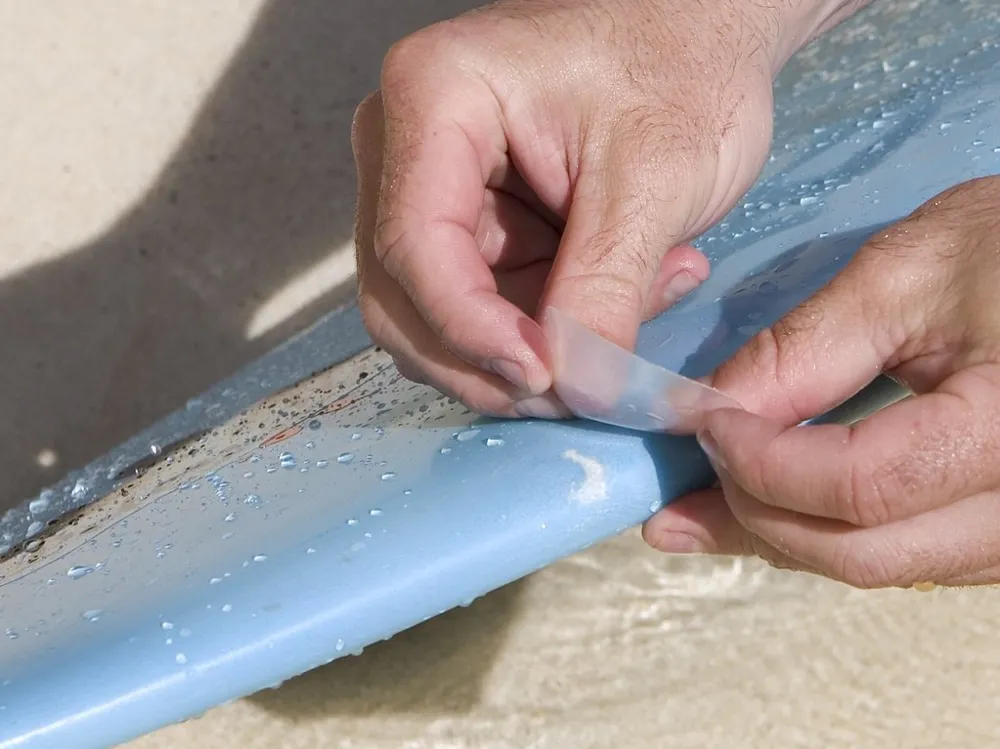
A temporary seal keeps water out until you can do a real repair. Every option below is a stopgap. SurferToday warns that tape, stickers and wax won't protect the board long term, and water in the foam can weaken it until it breaks.
- Ding tape or clear repair stickers: clear vinyl patches made for boards. Dry the area, press the patch on firmly and smooth out the edges.
- Duct tape or Gorilla tape: the classic beach fix. Ombe calls it a temporary seal that should be followed by a proper repair.
- Repair putty stick: a fiberglass-reinforced putty you knead and press into the ding. Some cure in or out of the water.
- UV-cure (solar) resin: a ready-to-use resin that hardens in sunlight in minutes. It can be a permanent fix for small dings and cracks if the area is dry and prepped; SwimOutlet's guide notes quick fills may need redoing later.
Never use wax as a ding filler, and peel tape off soon after the session so the area can dry out.
Ding Repair Kits and Supplies
Pick a kit by the size of the damage and, above all, by your board's construction. Product details below are as listed by the makers and retailers; check the label for the resin type before you buy.
1. Phix Doctor Ding Tape
Clear vinyl repair stickers for sealing small dings and cracks so you can keep surfing. Quick and cheap to carry in a wetsuit bag or car.
Good to Know
- No mixing or curing
- Works on any construction as a short-term seal
Watch Out For
- Temporary only; doesn't restore strength
2. Solarez Epoxy UV Cure Ding Repair
A UV-curing epoxy resin that needs no mixing; the listing includes a dual 60/240-grit sanding pad. Squeeze it in, cover with clear plastic, smooth, and cure in direct sun in a few minutes. Because it's epoxy, it's suited to EPS boards as well as PU.
Good to Know
- No hardener to measure
- Safe resin type for epoxy boards
Watch Out For
- Starts curing in sunlight, so work in the shade
- Best for small to medium dings
3. Ding All Sun Cure Polyester Repair Kit
A ready-to-use, UV-curing polyester resin in a tube, reported to harden in about 5 minutes in sunlight. Good for small cracks and dings on traditional PU boards.
Good to Know
- Fast cure, no catalyst to mix
- Matches the resin used on PU boards
Watch Out For
- PU boards only; never use on EPS or XPS
4. Ding All Epoxy Repair Kit
A two-part epoxy kit for larger dings, listed for both epoxy and polyester boards. SurferToday lists it with resin and hardener, fiberglass patch, sanding pads, mixing cups and sticks, cover sheets and Q-Cell filler.
Good to Know
- Everything for a fill-and-glass repair
- Works on PU and EPS
Watch Out For
- Slower cure than UV resin
- Measure resin and hardener carefully
5. Phix Doctor Rapid Repair Putty Stick
A fiberglass-reinforced putty for epoxy and polyester boards. Knead it, press it into the ding and smooth it with your fingers; SurferToday reports a cure of about 20 minutes, in or out of the water.
Good to Know
- Handy for travel and cloudy days
- No sun needed to cure
Watch Out For
- Harder to sand to a smooth finish than resin
Tools and Materials for a Full Repair
| Item | What It's For |
|---|---|
| Resin matched to your board (polyester or epoxy) | Filling, laminating and hot coating |
| Hardener or catalyst (MEKP for polyester) | Starts the cure on two-part resins |
| 4 oz fiberglass cloth | Patches that rebuild the shell's strength |
| Q-Cell filler | Thickens resin to fill deep holes in the foam |
| Sandpaper: 60, 120, 220, 320, 400 grit | Shaping, feathering and finishing |
| Razor knife or utility knife | Cutting away broken glass and wet foam |
| Acetone and rags | Cleaning the area before resin goes on |
| Masking tape | Protecting the board and building dams on rails |
| Mixing cups, sticks and a squeegee | Mixing and spreading resin |
| Nitrile gloves, respirator, safety glasses | Protection from resin, fumes and dust |
Two resin terms come up constantly. Laminating resin stays slightly tacky after it cures so the next layer bonds to it; it's what you use to wet out cloth. Sanding resin (hot coat resin) has a wax additive, called surfacing agent, that rises to the surface so it cures hard and tack-free for sanding, according to One Revolver Surfboards. Epoxy kits use one matched resin and hardener with no separate hot coat product.
How to Repair a Ding on a PU Surfboard
These steps follow the fill, glass and hot coat method from Clean Line Surf's repair guide. Prepare everything before you mix resin, because the clock starts as soon as you do.
- Remove wax from a few inches around the ding and make sure the board is completely dry.
- Cut away damage. Use a razor knife to remove cracked or loose fiberglass, including any glass still stuck to the foam, plus any crushed or discolored foam.
- Shape the area. Sand a shallow bowl with 60 grit, extending 1–2 inches beyond the cut glass. The taper gives the patch more surface to grip.
- Clean. Put acetone on a rag (don't pour it onto the board), wipe the area, then mask around it with tape. On a rail, build a tape dam to hold the resin.
- Fill deep dings. If foam is missing, mix resin, catalyst and Q-Cell to about mayonnaise consistency (thicker for big holes), work it into every gap with a stick and leave it slightly proud. Let it cure.
- Sand the fill flush with 120 grit and clean with acetone.
- Glass it. Cut two pieces of 4 oz cloth, one the size of the sanded area and one slightly larger. Brush on a thin layer of laminating resin, lay the smaller patch, saturate it, then lay and saturate the larger patch. Squeegee off excess resin; too much makes the repair heavy and weak.
- Let it cure, trim loose cloth and feather the edges into the board with 120 grit, taking care not to sand into the surrounding glass.
Then hot coat and finish sand (below). Clean Line Surf allows about 24 hours of cure time for each stage. Polyester needs MEKP catalyst, and the amount matters: too little leaves it soft, too much can make it gel in the cup. Follow the ratio on your resin's label for the temperature you're working in.
How to Repair an EPS/Epoxy Surfboard
The steps are the same as for PU, with a few differences:
- Epoxy only, for the fill, the laminate and the hot coat. No polyester resin, no polyester filler and no polyester-based solar resin.
- Measure carefully. Epoxy uses a fixed resin-to-hardener ratio from the kit, not catalyst drops. MEKP isn't used with epoxy.
- Allow more time. Epoxy generally cures more slowly than polyester, and temperature and humidity have a big effect. Check that your workspace is within the range on the label.
- Dry thoroughly. Because water spreads between EPS beads, a wet EPS board may need longer to dry than the ding size suggests.
- Don't overheat it. Heat and sun can trigger delamination on epoxy boards, so avoid leaving the board baking on a hot day once the repair is done.
UV-cure epoxies such as Solarez Epoxy make small EPS repairs much quicker: sand, fill, cover with plastic, cure in the sun, then sand smooth.
Hot Coat and Finish Sanding
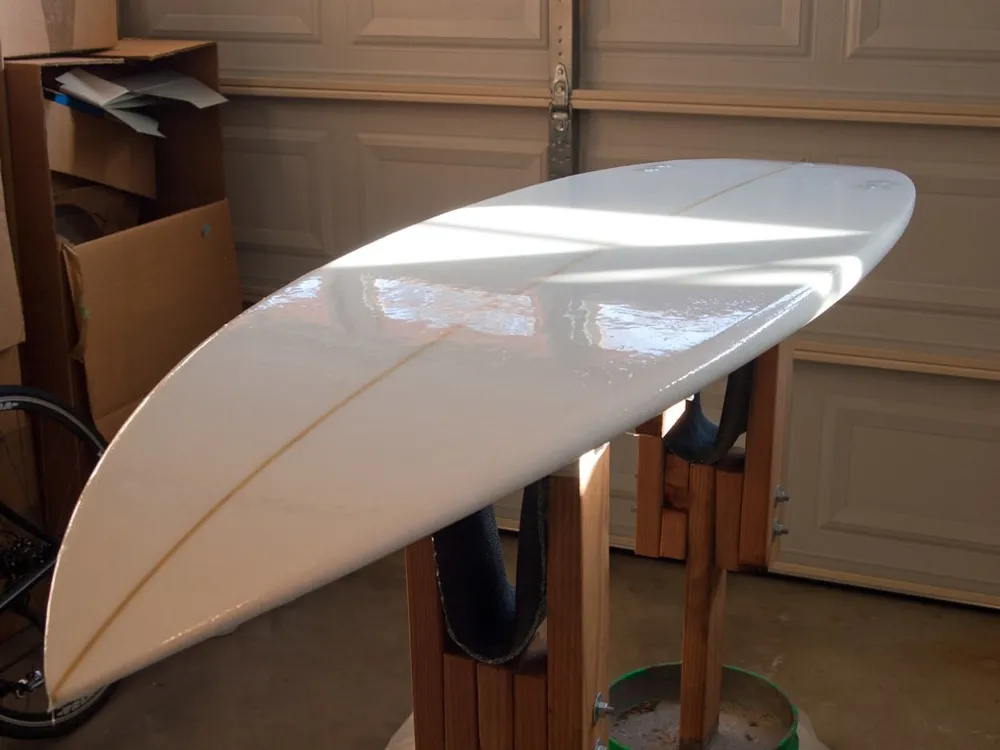
The hot coat fills the weave of the cloth so you can sand the repair smooth without cutting into the fibers.
- Mask just outside the patch.
- Brush on a thin coat of sanding resin (or your epoxy) over the glass. Pull the tape before it fully hardens and let it cure, about 24 hours for two-part resin per Clean Line Surf.
- Finish sand through 120, 220, 320 and 400 grit, keeping the repair level with the board. Stop if you start to see cloth texture: you've sanded through the hot coat and need another thin coat.
- Optional: wet-sand finer for a gloss board. NSP's epoxy repair guide uses 60, 250, 400 and 600 grit with water, and notes glossy boards need more fine wet sanding than matte ones.
Color matching and pinlines are optional and cosmetic. A poor repair can usually be sanded back and redone.
Quick Repairs with UV-Cure (Solar) Resin
For small dings and cracks, UV-cure resin skips the catalyst and the long wait. One Revolver Surfboards describes it as staying liquid in the shade and curing in a couple of minutes in sunlight.
- Work in the shade. Ombe and NSP both warn that sunlight starts the cure before you're done.
- Dry, scuff and clean the ding. Sand around it so the resin has something to grip, and wipe larger dings with acetone.
- Fill generously, then press a clear, non-stretch plastic sheet over the top and smooth the resin under it.
- Move the board into direct sun (or under a UV lamp) with the sheet still on until it hardens.
- Peel the sheet and sand the repair flush, coarse to fine.
Choose solar epoxy for EPS boards. Solar polyester is for PU boards only. Some resins won't cure well in cold conditions, so check the temperature range on the tube.
Pressure Dings, Cracks and Delamination
Pressure dings that haven't cracked the glass don't need fixing. Keep an eye on them; if a crack appears around the dent, seal it before water gets in.
Hairline cracks can be opened slightly with sandpaper and sealed with UV-cure resin. Cracks that run across the board, or a crease you can see when you sight down the deck, can mean the stringer or core is damaged, which is a shop job.
Delamination is the glass separating from the foam, most common on PU boards and often started by water in a crack or by heat. It shows up as bubbles, bowls or soft spots, and it spreads if left alone. SurferToday describes two fixes: injecting a resin mix through a small hole with a large syringe and pressing the glass back down, which it calls a basic method, or cutting out the delaminated glass, drying the foam, filling and re-glassing, which it says leaves the board lighter and stronger. Large delamination is a good reason to see a pro.
Soft-Top Surfboard Repairs
Soft tops shrug off bumps, and Decathlon notes that dents in the foam are mostly cosmetic. Their main problems are tears in the foam skin, nicks from other boards' fins, and heat damage that blisters the deck or peels it away from the core.
- Follow the brand's instructions first. Many hard-board ding resins and solar resins are rigid and can damage soft foam.
- Small tears and cuts: dry the board fully, then seal them with a flexible, foam-safe adhesive or silicone sealant. Masking tape around the area helps give a neater finish.
- Emergency seal: strong adhesive tape keeps water out until you can repair it properly.
- Hard bottoms: a soft top with a hard epoxy bottom, or a soft-top epoxy board, is repaired on the hard skin like any epoxy board.
- Prevention: heat is the main enemy. Keep the board out of hot cars and direct sun, and don't store it standing on its tail for long periods; see our best soft top surfboards guide for care tips.
When to Take It to a Pro
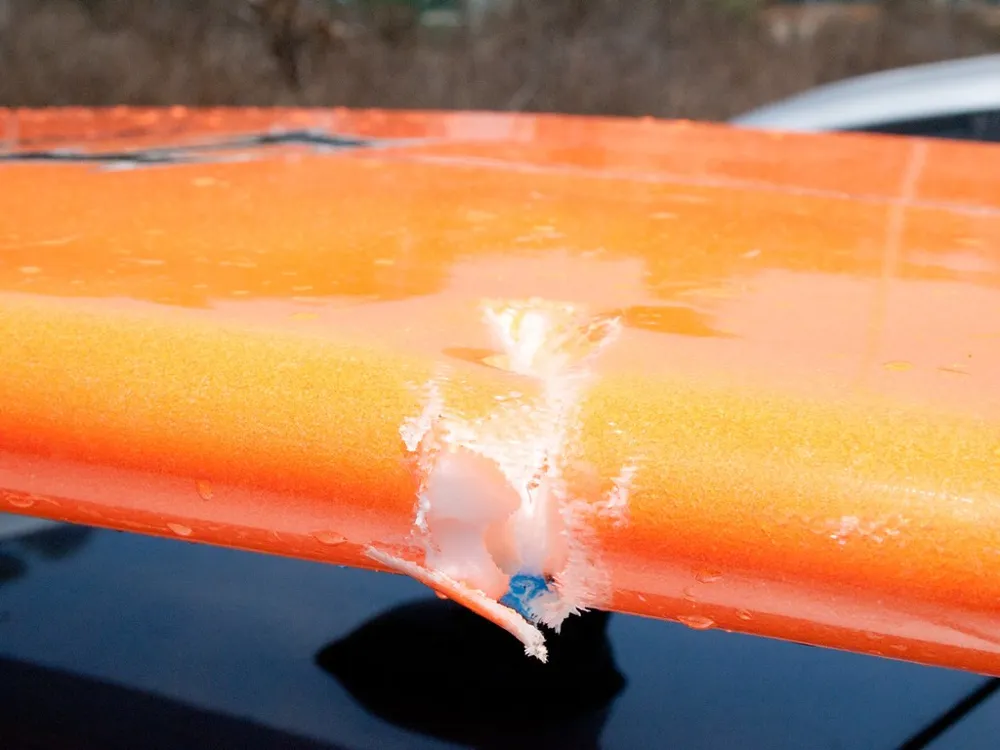
DIY suits most small dings, cracks and rail chips. Clean Line Surf recommends a professional for these jobs:
- Fin box replacement or a fin box that's pulled loose, and broken fin glass
- Delamination, especially large areas
- Partial or full breaks and broken stringers
- Color, pinline and gloss work you want to match the original
It may make more sense to replace the board after a full snap, widespread waterlogged delamination, or on an old PU board whose glass has gone brittle. If you're unsure, a ding shop can assess it; turnaround varies, and one retailer's guide puts it at about two weeks, so plan around your next trip. Before you drop off an EPS board, confirm the shop works with epoxy.
Safety: Gloves, Ventilation and a Respirator
- Wear nitrile gloves. Uncured epoxy can cause skin sensitization with repeated contact, and resin is hard to get off skin.
- Ventilate. Polyester resin gives off a strong styrene smell. Work outdoors or in a well-ventilated space.
- Use a respirator and safety glasses when sanding. Fiberglass and resin dust irritate lungs, eyes and skin. Clean Line Surf lists a respirator, gloves and goggles for every repair.
- Handle acetone carefully. Apply it to a rag rather than pouring, keep it away from flames, and use cups that resin and solvent won't melt.
- Read the label and safety data sheet for your specific resin, catalyst and solvent, and keep them away from children and pets.
- Wear old clothes. Resin and fiberglass dust don't wash out.
How to Prevent Dings
- Carry and store the board in a padded surfboard bag; most dings happen out of the water, in cars, doorways and parking lots.
- Use padded surfboard car racks and don't over-tighten straps, which can crack or dent the rails.
- Keep boards out of hot cars and direct sun to reduce delamination.
- Use a leash that suits your board, and a traction pad to spread heel pressure on the tail.
- Rinse with fresh water after surfing and check the rails, nose, tail and fin boxes regularly so you catch cracks early.
Fixing other gear? See how to fix a broken skateboard, or head back to the surfing hub.
Frequently Asked Questions
Can I surf with a ding?
Not with an open ding. If the shell is cracked or broken, water gets into the foam, adds weight and can lead to delamination. Get out, dry the board and seal it first; a closed pressure dent is usually fine to surf.
Can I use polyester resin on an epoxy surfboard?
No. Polyester resin contains styrene, which attacks EPS and XPS foam and can eat a hole in the core. Use epoxy resin on epoxy boards. Epoxy also works on PU boards, so it's the safe choice if you don't know the construction.
How long does a surfboard ding repair take to cure?
UV-cure (solar) resins harden in a few minutes in direct sun. Two-part resins take much longer; one detailed guide allows about 24 hours per stage (fill, glass, hot coat), and temperature and humidity change that. Follow your resin's label.
Is ding tape a permanent fix?
No. Ding tape and clear repair stickers keep water out so you can finish a session or a trip, but they don't restore strength. Remove the tape, dry the board and make a proper resin repair as soon as you can.
How do I fix a soft top surfboard?
Follow the maker's instructions first. Many hard-board ding resins can damage soft foam, so small tears are usually sealed with a flexible, foam-safe adhesive or sealant. Hard-bottom soft tops are repaired like an epoxy board on the bottom.
Should I repair a ding myself or take it to a shop?
Small dings, cracks and rail chips are good DIY jobs. Take fin box replacements, broken stringers, snapped boards, large delamination and color or gloss work to a ding repair shop.
What sandpaper grit do I need for surfboard repair?
A typical set runs from about 60 grit for shaping the repair area, through 120 for fill and glass, to 220, 320 and 400 for the finish. Some guides wet-sand up to 600 for a glossy board.