The Story of Skateboard Art, From Plain Planks to Museum Walls (2026)
Deck graphics started as an afterthought and became one of skateboarding's loudest voices. Here are the eras, artists and images that shaped them.
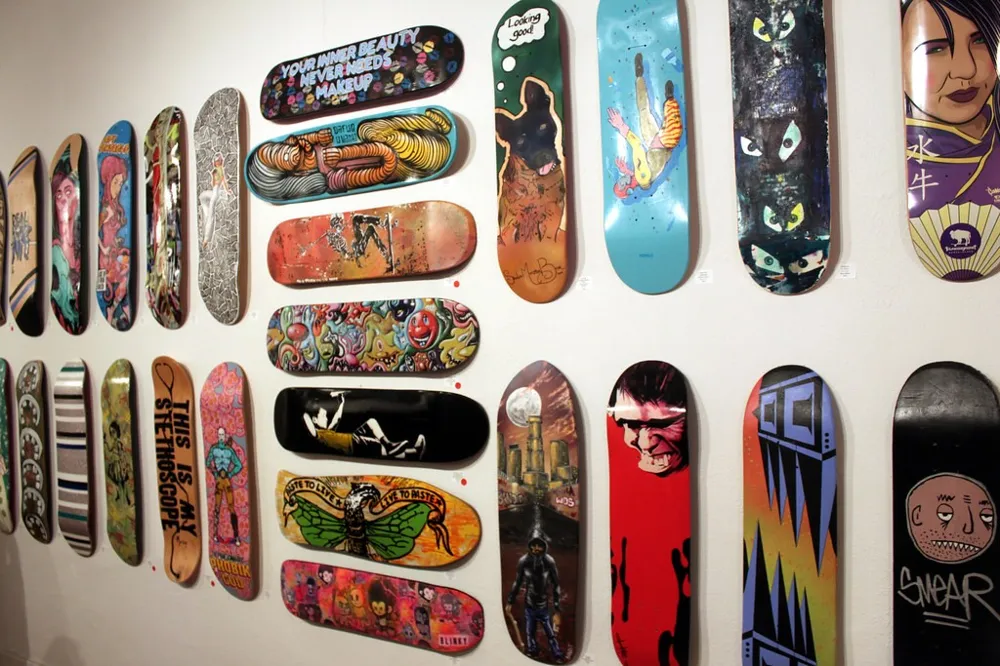
What Skateboard Art Is and Why It Matters
Skateboard art usually means the graphic on the bottom of a deck, but it also covers logos, top-sheet designs, ads, stickers and the artists who made them. For most of skateboarding's history, that art was made to be destroyed: the first boardslide scrapes it, and a few months of skating can wipe it away. That throwaway quality is part of why the art was free to be loud, strange and personal, and why surviving originals are now collected and shown in galleries.
This guide follows the art from plain early boards through the 1970s, the Powell-Peralta and Santa Cruz golden age of the 1980s, 1990s street graphics and slick bottoms, and on to artist collaborations, exhibitions and collecting. For the sport's wider story, see our skateboarding history timeline.
Skateboard Art Timeline at a Glance
| Year or Era | Milestone in Deck Art |
|---|---|
| 1959 | Roller Derby sells one of the first mass-produced skateboards; early boards are sold on shape and wheels, not art |
| 1962 | Jim Phillips's first published illustration appears in the spring issue of Surfer Quarterly |
| 1963 | Makaha, one of the first skateboard companies, begins production |
| 1970s | Wes Humpston's work on the original Dogtown boards; skaters paint and customize their own decks |
| 1973 | NHS, the company behind Santa Cruz, is founded; Phillips later serves as its art director |
| 1978–1979 | Powell Peralta is founded, then forms the Bones Brigade; VCJ creates the Skull and Sword and other early graphics |
| 1980s | Wide vert decks with bold screen-printed pro-model graphics |
| 1985 | Jim Phillips designs the Screaming Hand for Santa Cruz |
| 1989 | Steve Rocco founds World Industries; Marc McKee and Sean Cliver bring humor and pop-culture parody |
| Early 1990s | 101 and other street brands push edgy graphics; slick bottoms appear on street decks |
| 1990–1994 | Real, Plan B, Girl, Toy Machine, Chocolate and Creature launch, each with its own art direction |
| 2000s | Heat-transfer printing becomes common as a cheaper way to apply graphics |
| 2009 | An art show built around Powell-Peralta's Ripper is reported |
| 2011 | VCJ's return to Powell-Peralta is announced |
| 2016 | The Screaming Hand 30th anniversary show tours more than 25 art venues |
Early Decks: Plain Boards and Surf Roots (1950s–1960s)
The first boards were built by surfers who wanted something to ride when the waves were flat. Commercial boards followed, including the Roller Derby board of 1959 and Makaha's boards from 1963. These were narrow, surfboard-shaped decks of solid wood, plastic or occasionally metal, with clay or steel wheels. What set them apart was the shape, the material and the wheels, not artwork.
The surf connection still mattered for the art that came later. Jim Phillips, who would draw some of skateboarding's best-known images, had his first illustration published in Surfer Quarterly in 1962. For the boards themselves, see our vintage skateboards collector's guide and who invented the skateboard.
The 1970s: Dogtown, Pool Boards and the First Deck Art
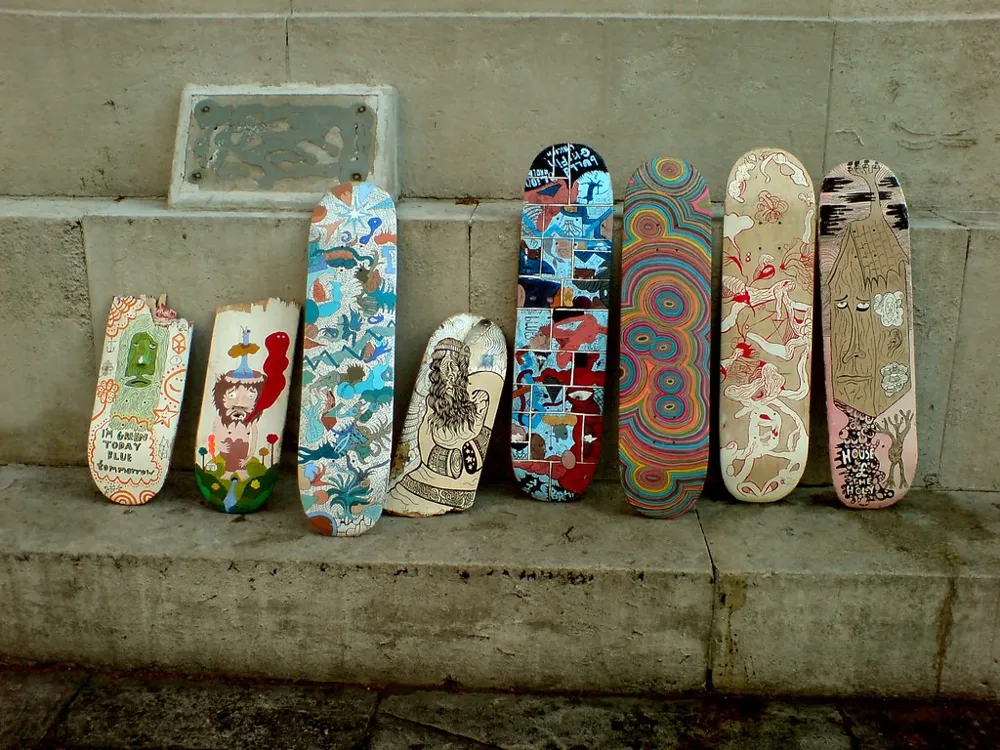
Frank Nasworthy's urethane wheels revived skateboarding in the early 1970s, and by the end of the decade boards were wider, with kicktails for pools and early skateparks. Skate art's roots are usually traced to this period and the early 1980s, when skaters painted their own graphics and customized their boards.
Wes Humpston is the name most tied to this period. He has been involved in skateboard graphics since the 1970s and is best known for his work on the original Dogtown boards. The Dogtown cross is still counted among skateboarding's best-known logos. This hand-drawn, homemade spirit set the tone for everything that followed: the art came from skaters, not from an outside design agency.
Santa Cruz's parent company, NHS, was founded in 1973, and Jim Phillips served as its art director in the 1970s and 1980s, creating graphics, T-shirt designs and logos for the company's brands. Want to try the do-it-yourself approach? See how to paint a skateboard.
The 1980s: Powell-Peralta, VCJ and the Bones Brigade Look
The 1980s are the decade most people picture when they think of skateboard art. Decks were wide for vert ramps and pools, pro models sold on a rider's name, and the graphic became the main selling point. Most were screen printed, a method that rewards bold, clean lines.
George Powell and Stacy Peralta founded Powell Peralta in 1978 and formed the Bones Brigade team in 1979. Two people shaped the brand's look:
- Vernon Courtlandt Johnson (VCJ). Known as "Court," he was raised in Santa Barbara and largely self-taught, citing influences such as heavy metal, M.C. Escher, Fritz Eichenberg and Robert Crumb. George Powell, his brother-in-law, asked him to help build the new business, and he soon produced the Skull and Sword, drawn for Ray "Bones" Rodriguez using a full-size skeleton as a model. He also drew Mike McGill's Skull and Snake, the brand's dragon and Lance Mountain's Future Primitive graphic, which he has said was inspired by the rock art of the Tassili n'Ajjer caves in North Africa.
- Craig Stecyk. The artist and photojournalist was brought in to build what has been called Powell-Peralta's "anti-brand": ads and imagery that felt irreverent rather than corporate.
VCJ's best-known creation may be the Ripper, a character he has said was fashioned after the MGM lion. It still appears on Powell-Peralta decks, stickers and apparel. VCJ has also said that the respect for a line depended on whether it could be silkscreened, which helps explain the crisp, high-contrast style of the era. He later spent about 20 years away from the company making posters, and his return to Powell-Peralta was announced in March 2011.
The decade's look was heavily shaped by punk, metal and horror imagery, and skulls, skeletons and monsters spread across many brands. For the riders behind these pro models, see the best skateboarders of all time.
Jim Phillips, Santa Cruz and the Screaming Hand
If VCJ defined Powell-Peralta, Jim Phillips (born 1944) did the same for Santa Cruz. As NHS art director he produced a long run of deck graphics, shirts and logos, and in 1985 he designed the Screaming Hand for Santa Cruz Skateboards. It is widely described as a defining image of skateboard design.
Phillips's work is collected in several books, including Surf, Skate & Rock Art of Jim Phillips (2003), Rock Posters of Jim Phillips (2006) and The Skateboard Art of Jim Phillips (2007). In 2016 the Screaming Hand 30th anniversary show toured more than 25 art venues worldwide, including the Santa Cruz Museum of Art and History.
Skater-Artists and the Shift to Personal Art
Not all 1980s art came from staff illustrators. Pro skaters such as Mark Gonzales and Neil Blender drew their own graphics, which made board art feel even more personal. Ed Templeton, who founded Toy Machine in 1993, became another skater whose own art defined a brand. This skater-as-artist tradition carried straight into the 1990s and into today's gallery shows.
The 1990s: Street Graphics, World Industries and Slick Bottoms
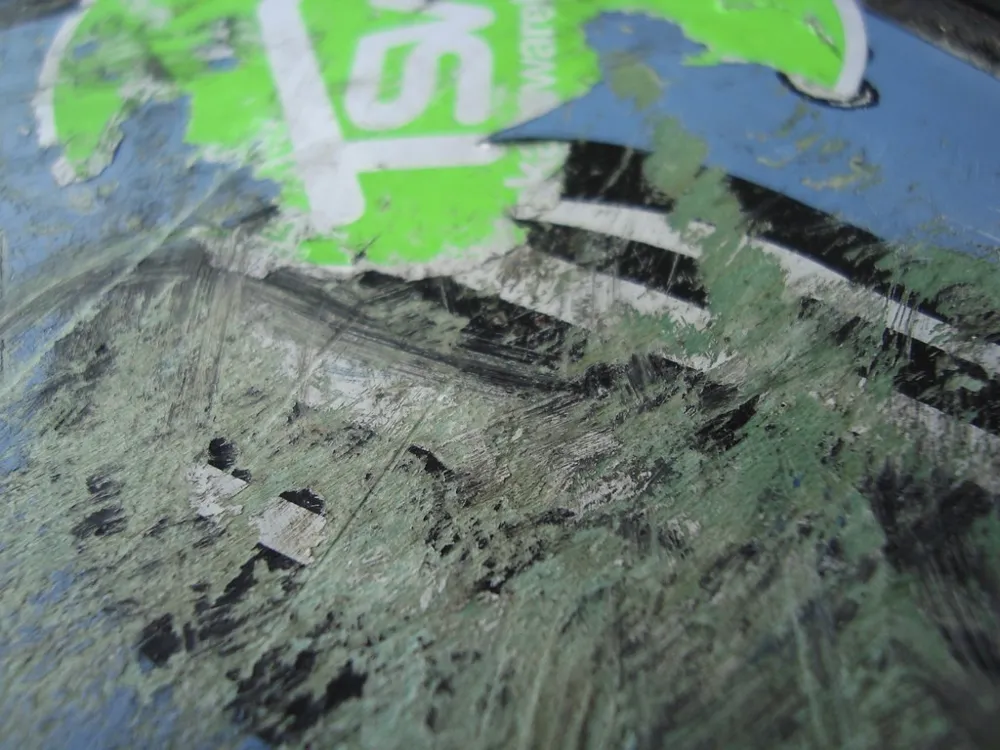
As street skating took over in the late 1980s, decks became narrow double-kick "popsicle" shapes, and the art changed just as fast. Most street decks were ridden hard and broken, and the new brands used their graphics to stand out from the established 1980s companies.
- World Industries. Steve Rocco founded the company in 1989. Marc McKee and Sean Cliver brought wit and pop-culture commentary to its graphics, and McKee's cartoon characters Devil Man, Flame Boy and Wet Willy became its mascots. Its designs were described as offensive or close to copyright infringement, and the company received cease-and-desist letters, including one from Disney, which it reportedly ignored. By the end of 1998, World Industries and its sister brand Blind were reported as the number one and number two brands. World Industries also led to Big Brother magazine, which in turn led to Jackass (more in our skateboarding magazines guide).
- Blind. Gonzales and Rocco named it Blind as a jab at Vision, Gonzales's former sponsor.
- 101. In the early 1990s it had a reputation for cutting-edge and sometimes offensive graphics.
- Chocolate. A company that broke away from World Industries, it leaned toward fine-art influences; artist Evan Hecox is known for taking mundane objects like guitars and soda bottles and turning them into deck art.
Slick Bottoms
A slick deck has a smooth, slippery laminate layer on the bottom instead of a painted or printed wood surface, so it slides more easily on ledges and rails. Santa Cruz is credited with popularizing the concept, and early-1990s street brands such as Blind and 101 used it. On one 101 Natas Kaupas model, a graffiti piece was photographed and sublimated into the slick laminate, an early example of photographic art on a deck. Slick constructions are still made today; see skateboard deck construction for how they compare with standard decks.
How Deck Graphics Are Printed
Through the original eras, deck art was screen printed: each color is pushed through its own screen, which favors bold lines and a limited palette. Heat transfer became common in the 2000s as a cheaper method. The design is printed onto a film and bonded to the sealed deck with heated rollers, which allows full-color, photographic images. These methods also help collectors date a board and spot reissues. The full process is in our deck construction guide, and making your own design is covered in custom skateboard decks.
Famous Skateboard Logos and the Stories Behind Them
Many of the most searched skateboard logos began as deck graphics and outlived the riders and models they were drawn for:
| Logo or Character | Brand | Artist and Origin |
|---|---|---|
| Screaming Hand | Santa Cruz | Jim Phillips, 1985 |
| Ripper | Powell-Peralta | VCJ; fashioned after the MGM lion, by his account |
| Skull and Sword | Powell-Peralta | VCJ, for Ray "Bones" Rodriguez |
| Dragon | Powell-Peralta | VCJ; a recurring brand design |
| Dogtown cross | Dogtown | Tied to Wes Humpston's 1970s Dogtown boards |
| Devil Man and Flame Boy | World Industries | Marc McKee's 1990s cartoon characters |
| Panda | enjoi | The brand's humorous mascot since its 2000 launch |
Brand histories and founding years are in our skateboard brands guide.
Artist Collaborations and Art-World Crossovers
In the 1990s and 2000s, skateboarding and the wider art world moved closer together. Brands such as Supreme, Girl and Alien Workshop invited artists to design decks, and artists such as Mark Gonzales, Shepard Fairey and KAWS became part of that crossover. Art-edition companies now release decks featuring the work of artists including Andy Warhol, Jean-Michel Basquiat, Louise Bourgeois and Yoshitomo Nara, mostly meant for walls rather than for skating.
Brands also revisit their own past. Powell-Peralta reissues classic pro models from riders such as Steve Caballero, Ray "Bones" Rodriguez, Mike McGill, Steve Steadham and Mike Vallely, and Santa Cruz runs regular reissues of its classic graphics. Reissues let new buyers own a famous image, though collectors treat them differently from originals.
Skateboard Art in Museums and Exhibitions
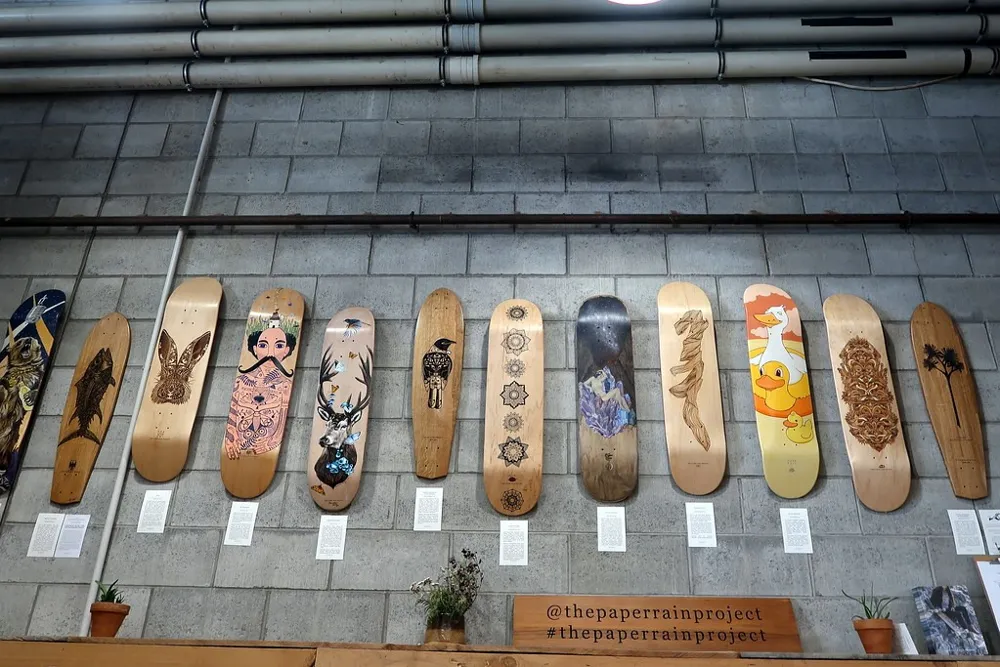
Deck art now appears in galleries, auctions and museum collections. A few verified examples:
- Smithsonian. The National Museum of American History holds skateboards including a Bruce Logan model Logan Earth Ski deck and Jay Adams model Z-Flex boards.
- Santa Cruz Museum of Art and History. It was among the venues for the Screaming Hand 30th anniversary show, which toured more than 25 venues in 2016.
- Ripper art show. An art show built around Powell-Peralta's Ripper was reported in early 2009, and the brand sells a Rip the Ripper book.
- Auctions and galleries. Art-deck sellers report decks being displayed in galleries, auctioned at Christie's and held in museum collections.
Local skate shops, cafes and galleries also run group shows where artists paint blank decks, a good way to see new skateboard art up close. Check museum and gallery sites for current exhibitions, as shows change often.
Collecting and Displaying Skateboard Art
Collectors usually focus on original decks from the 1970s through the 1990s, especially pro models with famous graphics, limited runs and unridden "new old stock." Value depends on originality, condition and demand rather than age alone. A few basics:
- Original or reissue: check the printing method, shape, concave and any reissue markings, then compare with documented originals. Our vintage skateboards guide covers this in detail.
- Condition: sun fades graphics, and cheap shrink wrap can damage paint over time. Keep display decks out of direct sunlight.
- Display: wall mounts, floating racks and frames keep decks safe and visible. See skateboard wall art ideas, how to hang a skateboard on the wall and the best skateboard racks.
- Reading: artist books, such as Phillips's The Skateboard Art of Jim Phillips and the survey Disposable: A History of Skateboard Art, are useful references for identifying graphics.
If you would rather ride than hang a graphic, current decks from many of these brands are in our best skateboard decks guide.
Keep Exploring
Go deeper with skateboarding history, vintage skateboards, skateboard brands, custom skateboard decks, how to paint a skateboard and skateboarding documentaries.
Frequently Asked Questions
Who is the most famous skateboard artist?
Two names come up most often for the 1980s: Vernon Courtlandt Johnson (VCJ), who drew many Powell-Peralta graphics, and Jim Phillips, who designed Santa Cruz's Screaming Hand in 1985. Marc McKee and Sean Cliver are the names most tied to the 1990s World Industries era.
What is the Powell-Peralta Ripper?
The Ripper is one of Powell-Peralta's best-known characters, drawn by VCJ. He has said it was fashioned after the MGM lion, and the brand still uses it on decks, stickers and apparel.
When was the Santa Cruz Screaming Hand created?
Jim Phillips designed the Screaming Hand for Santa Cruz Skateboards in 1985. Its 30th anniversary show in 2016 toured more than 25 art venues, including the Santa Cruz Museum of Art and History.
Why were 1990s skateboard graphics so controversial?
Street brands such as World Industries and 101 used humor, pop-culture parody and shock value. World Industries' designs were described as offensive or close to copyright infringement, and the company drew cease-and-desist letters, including one from Disney.
What is a slick bottom skateboard?
A slick has a smooth laminate layer on the bottom, sometimes with the graphic printed into it, so the deck slides more easily on ledges. Santa Cruz is credited with popularizing the idea, and several early-1990s street brands used it.
Are old skateboard decks worth collecting?
Original decks with famous graphics, pro models and limited runs are the most sought after, but value depends on originality, condition and demand. Check reissue markings and compare with documented originals before buying.