Skateboard Deck Technology: From Maple Plies to Carbon (2026)
A deck looks like a simple plank, but its pop, strength and lifespan come from how the wood is chosen, glued, pressed and finished. Here is how decks are built, what reinforced constructions change and how to spot a well-made board.
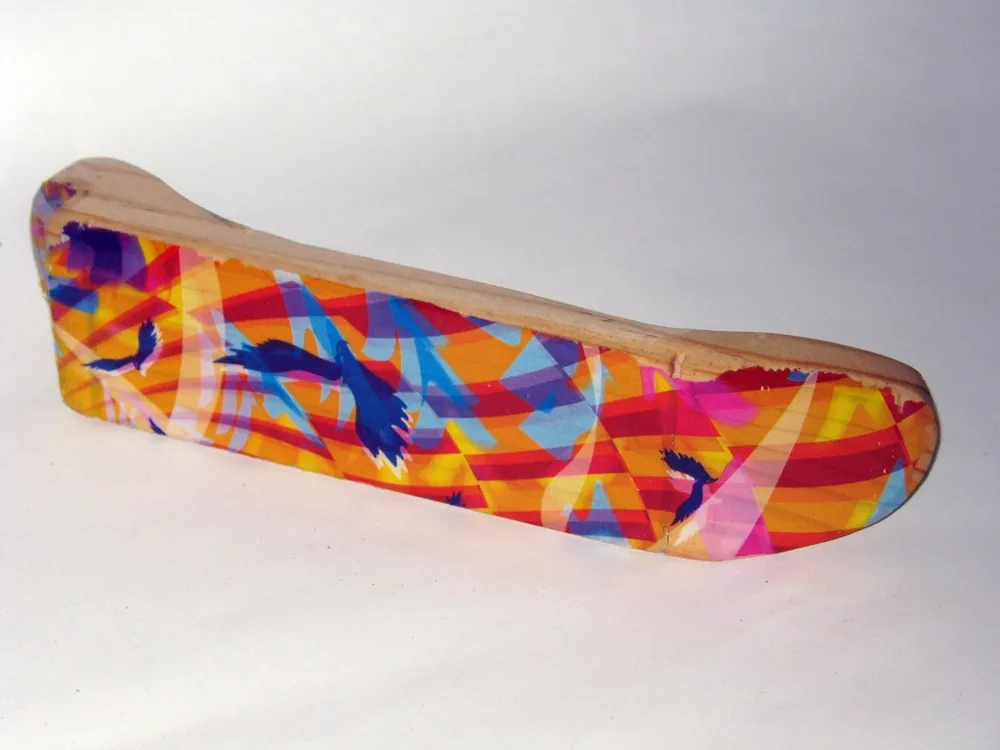
How a Skateboard Deck Is Built
A modern street or park deck is plywood made for one job: taking hard landings while still snapping back for the next ollie. Most decks follow the same basic process, whether they come from a large woodshop or a small maker:
| Stage | What Happens | Why It Matters |
|---|---|---|
| 1. Select wood | Thin hard maple veneers are sorted and stacked | Dense, even wood gives pop and strength |
| 2. Glue and lay up | Seven plies are glued, with some grain running crosswise | Cross-grain layers stop the deck from splitting along its length |
| 3. Press | The stack is pressed in a shaped mold | Sets the concave, nose and tail |
| 4. Cure | Pressed blanks rest while the glue fully sets | Helps the deck hold its shape |
| 5. Cut and drill | The outline is cut and truck holes are drilled | Shape, symmetry and straight holes |
| 6. Sand and seal | Edges are rounded, faces sanded and lacquered | Smooth rails and protection from moisture |
| 7. Graphic | Art is applied by heat transfer or screen print | Looks; also adds a slide layer on the bottom |
The sections below walk through each stage, then cover reinforced constructions and how they change strength and weight. For the names of each part of the finished board, see our skateboard anatomy guide.
Hard Rock Maple and Other Woods

Maple is the standard wood for trick decks. Brands commonly describe their wood as Canadian or North American hard rock maple: Powell Peralta lists "US hard rock maple" for its 7-ply decks, and one European skate shop says its maple comes from Canada or the northwestern United States, where short summers and long, cold winters produce slow-growing, dense, hard wood. That density is what gives a fresh deck its crisp pop.
It was not always this way. Early boards were homemade from whatever lumber was around, 1960s commercial boards used local woods, and the 1970s brought fiberglass and aluminum decks before laminated maple took over. You can read more about that era in our skateboarding history and vintage skateboards guides.
Other materials still appear today:
- Bamboo: flexible and light, more common in longboards and cruisers than in trick decks, sometimes combined with maple.
- Birch and mixed woods: found in some lower-cost and toy-store boards; they are often reported to have less pop than maple. See are Walmart skateboards good for what that means in practice.
- Composites: fiberglass, carbon fiber, aramid and resin layers combined with maple, covered in detail below.
Veneers and Cross-Grain Lamination
A deck is not cut from a solid board. Maple logs are peeled or sliced into thin sheets called veneers, and seven of them are glued into a single panel. Plywood is far stronger and more stable than a solid plank of the same thickness because the layers support each other.
The key is grain direction. In one widely described layup, the stack runs top face, core, cross ply, core, cross ply, core, bottom face. The face and core plies run lengthwise, nose to tail, which gives the deck its stiffness and spring. The cross plies run side to side, which stops the deck from splitting along the grain when it lands hard or flexes across its width.
Glue goes on both sides of the inner plies and on the inside face of the outer plies, so every layer is bonded to its neighbours. Powell Peralta, for example, says it uses a water-resistant, high-strength glue in its maple decks. Reinforced decks often use epoxy instead, which is covered below.
Pressing: How Concave and Kicks Are Made
The glued stack goes into a press between two shaped mold plates. The mold is what creates the deck's concave (the side-to-side curve), the kicks of the nose and tail, and any extra features such as a steeper nose or a flatter center. Change the mold and you change how the board feels under your feet, which is why the same brand can sell several shapes with different concaves. Our skateboard size chart explains how concave and shape affect fit.
Commercial shops typically use hydraulic presses with metal molds. One deck-making guide reports pressing times of roughly one to four hours depending on the adhesive, presses that hold anywhere from one to seven decks at once, and a curing period of about a week or more before the blanks are shaped further. It also notes that pressing a single deck at a time tends to give the truest copy of the mold shape. Powell Peralta describes its own presses as AirLam presses. Hobby builders use homemade versions: concrete molds weighed down, foam molds inside a vacuum bag, or wooden molds with clamps.
Pressing quality has a direct effect on the finished board. Uneven pressure can leave one side of the concave steeper than the other, or leave weak, under-glued spots that later separate.
Cutting, Drilling, Sanding and Sealing
Once cured, the pressed blank is a curved rectangle. Large shops cut the outline with CNC routers, using one bit to remove excess wood and a round-over bit to soften the edge. Small makers use a jigsaw or band saw followed by a router or sander.
Truck holes are drilled next. One deck-making guide gives hole diameters of 3/16 inch or 13/64 inch and stresses that the holes must be straight, not angled. Drilling after the outline is cut helps center the trucks on the finished shape. Crooked or off-center holes are one of the clearest signs of a poorly made deck, because they can make the board turn unevenly.
The edges are rounded on a drum sander and the faces are sanded smooth before finishing. A sprayed lacquer or sealer then protects the wood from moisture swings that can cause warping or splitting. Powell Peralta, for example, says it seals its 7-ply decks with a semi-gloss lacquer and puts a wood sealer plus two ink layers on the bottom.
How Graphics Get on a Deck
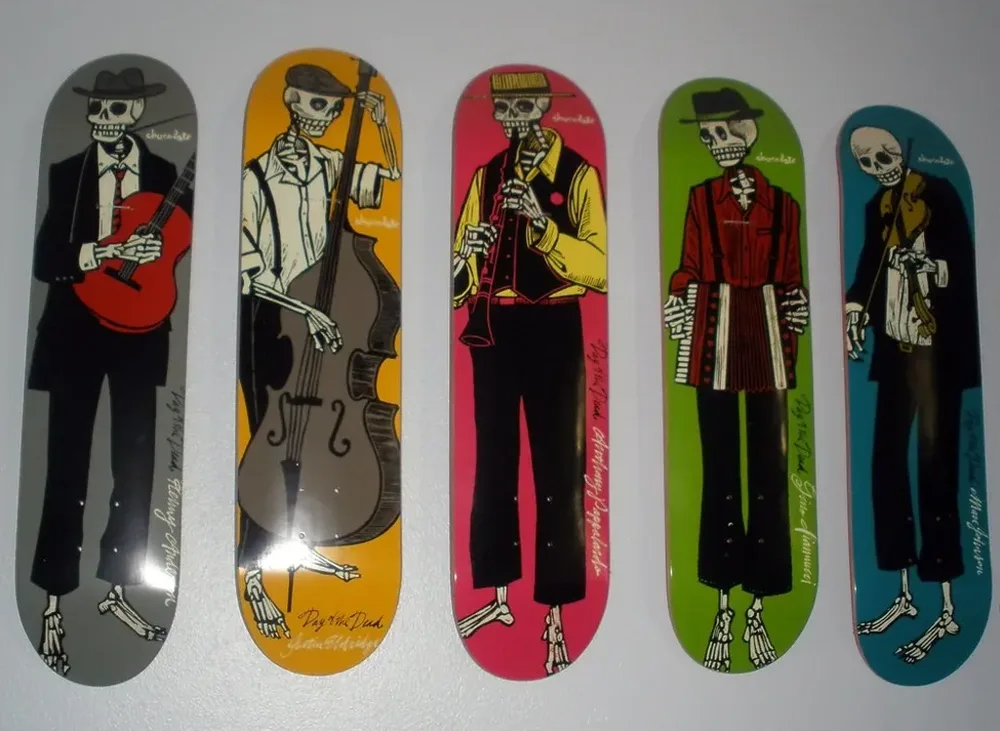
Most mass-produced decks get their bottom graphic by heat transfer. The artwork is printed onto a transfer film, laid on the deck, and run through a press with heated silicone rollers that bond the ink to the sealed wood. Screen printing is the other main method. The design is applied one color at a time through stencils with a squeegee, which suits smaller brands and short runs. Hand painting is used for one-off and display decks but is impractical for mass production.
The graphic layer does more than look good. The ink and lacquer on the bottom help a deck slide on ledges and rails until they wear through. If you want to put your own art on a deck, see custom skateboard decks for printing services and file specs, or how to paint a skateboard for the DIY route.
Reinforced Decks and Deck Technology
"Technology decks" keep the basic maple-and-mold process but add, replace or reinforce layers to make the board stronger, lighter or longer-lasting. The details below come from brand and retailer descriptions; layups change over time, so check the current listing for any model you are considering.
Fiberglass and Carbon Fiber
Fiberglass and carbon fiber are woven fiber fabrics set in resin. Added to a deck, they stiffen it and resist the fatigue that makes plain maple feel soft over time. Some constructions add a full fiber layer; others add patches only where stress is highest, such as around the truck mounts. Because fiber layers are strong for their weight, some brands use them to remove a maple ply and make a thinner, lighter deck.
Almost Impact Family
Almost's Impact decks are reinforced maple decks. Retailer descriptions explain several versions: Impact Support places carbon fiber discs where the trucks attach, bonded with epoxy, to spread landing forces through the board; Double Impact adds a full carbon top sheet, which allows one wood ply to be removed; and Über Light uses a carbon fiber foam core that runs through the deck like a spine. Almost also sells lighter Impact versions such as Impact Light, and the exact layup varies by model.
Powell Peralta Flight
Powell Peralta describes Flight decks as an "epoxy infused, fiber reinforced structure" in which strength comes from the reinforcing plies, while the maple bottom ply is there for grinding. The brand says Flight decks are thinner than a 7-ply and more than twice as strong in its own tail-break tests, and that team testing suggests they last several times as long. It adds that Flight decks usually wear out from edge impacts and razor tail rather than snapping. These are the maker's claims, not independent results.
Santa Cruz VX
According to a retailer breakdown, Santa Cruz VX decks use five maple plies plus two "Quad X" layers that combine fiberglass and carbon fiber fabric laid crosswise to each other. One Quad X layer sits at the top and the other second from the bottom. Santa Cruz positions VX as thinner, stronger and longer-lasting in pop than a standard deck.
Flip P2
Flip's P2 construction inlays an oval panel of aramid fiber, a fiber CCS notes is used in aerospace and military applications, flush into the deck with a maple frame around it, so the edges remain 7-ply maple. CCS describes the inlay as patented and says the oval shape is meant to spread stress across the whole deck. P2 decks are described as thinner and lighter than a traditional 7-ply.
Creature Slick
Retailers describe Creature's Slick decks as having a special bottom layer that reduces friction, so boardslides and lipslides travel further. The slick layer is reported to add some weight compared with other technology decks, and it eventually scratches through like any graphic.
Deck Constructions Compared
| Construction | How It's Built | Main Goal | Trade-Off |
|---|---|---|---|
| Standard 7-ply maple | Seven maple veneers, cross-grain layup, wood glue | Classic pop and feel | Pop fades and wood chips with heavy use |
| Spot reinforcement (e.g. Impact Support) | Maple with carbon fiber at the truck mounts | Resist cracks and pressure at the bolts | Rest of the deck wears like maple |
| Fiber layers (e.g. VX, Double Impact) | Fewer maple plies plus carbon and/or fiberglass layers | Thinner, lighter, longer-lasting pop | Feel differs; costs more |
| Epoxy composite (e.g. Flight) | Epoxy-infused fiber-reinforced plies with a maple bottom | Very high resistance to snapping | Thin, distinct feel; premium cost |
| Inlay (e.g. P2) | Aramid panel inlaid into maple | Spread stress, lighter and thinner | Edges are still regular maple |
| Slick bottom | Maple deck with a low-friction bottom layer | Longer, faster slides | Reported extra weight |
| Bamboo or bamboo hybrid | Bamboo layers, often with maple | Flex and light weight | Mostly cruisers and longboards; different feel |
Construction affects weight as well as strength. For how much decks weigh and whether lighter is better, see skateboard deck weight.
Why Decks Lose Pop and Break
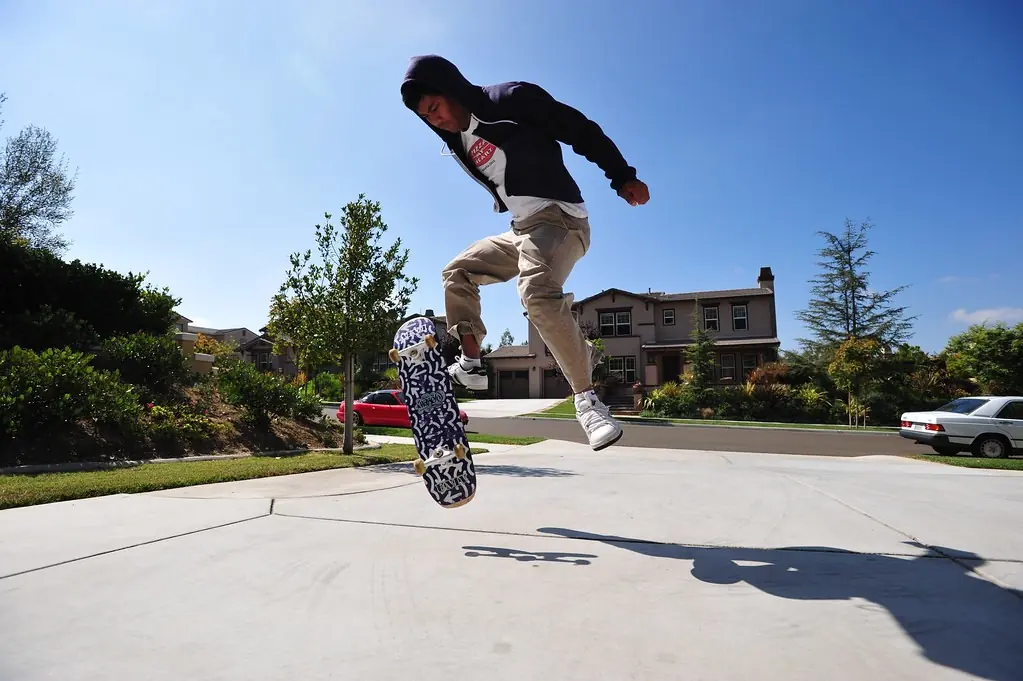
Every deck wears out eventually. Knowing how the construction fails helps explain both the damage and the fixes:
- Fiber fatigue: each landing causes tiny amounts of damage inside the wood. Over time the deck feels soft or "soggy" and loses pop, even if it never cracks.
- Snaps: big drops, stair sets and landings with the feet over the bolts or primo concentrate force on a small area. Narrower and thinner boards are generally more prone to snapping.
- Pressure cracks: hairline cracks often start near the truck holes, where the trucks push landing forces into the wood. Spot reinforcements at the mounts are designed to address this.
- Razor tail and chips: popping and dragging the tail grinds the plies down to a sharp edge, and hitting ledges and stairs chips the nose and tail. Retailer testing suggests fewer or thinner plies can speed up razor tail.
- Delamination: plies separating, usually at the tips, from weak glue bonds, impacts or moisture.
- Water and heat: moisture damages the wood and can soften the glue, and extreme heat or cold shortens deck life. A warped or waterlogged deck rarely gets its pop back. See can you skateboard in the rain and how to store a skateboard.
For typical lifespans by skating style, read how long a skateboard lasts. If your deck is already damaged, how to fix a broken skateboard covers which repairs are worth trying.
How to Judge Deck Quality
You can't see the glue inside a deck, but several checks point to good or poor construction:
- Wood: look for maple listed in the specs. Unnamed "hardwood" or mixed wood on a skate-style deck is usually a sign of a budget board.
- Ply lines: on the edge, the layers should be tight and even, with no gaps, voids or lifting at the nose and tail.
- Symmetry: sight down the deck from the nose. The concave should be the same on both sides and the kicks should match the listed shape.
- Flatness: set the deck on a flat floor. It should not rock or twist from corner to corner, which would point to warping.
- Holes: truck holes should be straight, cleanly drilled and centered.
- Finish: smooth, sealed edges and an even graphic suggest careful sanding and sealing.
- Source: established skate brands and woodshops tend to be more consistent. Our skateboard brands guide lists well-known deck makers, and many brands state which woodshop or country makes their decks.
Warranties are another clue. Some brands cover manufacturing defects such as delamination, but snapping a deck while skating is normally treated as wear, so read the brand's current policy.
Reinforced Decks to Compare
If you go through standard decks quickly, these reinforced constructions are widely sold and documented. A plain maple deck is still the usual starting point for most skaters; see our best skateboard decks for traditional options and sizing.
1. Powell Peralta Flight Deck
An epoxy-infused, fiber-reinforced deck with a maple bottom ply for grinding. Powell Peralta says it is thinner and stronger than a 7-ply in its own testing.
Good to Know
- Designed to resist snapping and keep its pop
- Thin profile
- Maker publishes construction details
Watch Out For
- Feel differs from regular maple
- Premium cost
- Still wears at the edges and tail
2. Santa Cruz VX Deck
Five maple plies plus two crossed fiberglass and carbon fiber "Quad X" layers, positioned as thinner and longer-lasting than a standard deck.
Good to Know
- Fiber layers aim to keep pop longer
- Feels close to maple underfoot
- Many widths and graphics
Watch Out For
- Costs more than a regular deck
- Tail can still razor with heavy use
3. Almost Impact Light Deck
Part of Almost's Impact range of reinforced maple decks. The Light version is aimed at keeping weight down; check the listing for its exact layup.
Good to Know
- Reinforced maple construction
- Lighter version of the Impact range
Watch Out For
- Layup details vary by Impact version
- Feel may differ from plain 7-ply
Keep Exploring
Put a new deck together with how to build a skateboard, grip it with how to apply grip tape, and keep it in shape with our skateboard maintenance routine.
Frequently Asked Questions
What are skateboard decks made of?
Most are seven thin layers of hard maple glued and pressed together. Reinforced decks add or swap in layers of fiberglass, carbon fiber or other fibers, and some boards, mostly longboards and cruisers, use bamboo.
Why are skateboard decks 7 ply?
Seven maple plies is the long-standing industry standard, giving a balance of strength, flex, weight and thickness for trick skating. Some layers are laid with the grain across the deck so the board resists splitting along its length.
What is the strongest skateboard deck construction?
Fiber-reinforced and epoxy-based constructions such as Powell Peralta Flight, Santa Cruz VX and Almost's Impact range are designed to outlast a standard 7-ply. Their strength figures come from the brands, so treat them as claims rather than independent test results.
Are carbon fiber skateboard decks worth it?
They can be for skaters who break or wear out decks quickly, because reinforcement is designed to keep pop longer. A standard maple deck still suits most skaters, especially beginners still finding their size and shape.
Why do skateboard decks snap?
Most snaps come from hard impacts such as landing primo, slipping off a big drop or landing with feet over the bolts. Water damage, heat and worn, tired wood make a deck more likely to crack.
Where are skateboard decks made?
Large deck woodshops are reported to be mainly in the United States, Canada and Mexico, with some production in Asia. Many brands use outside woodshops, so the brand on the graphic is not always the maker of the wood.