Electric Bike Laws: License, Age, Helmets and Where to Ride (2026)
In most US states, a Class 1, 2 or 3 e-bike needs no license, registration or insurance. The exceptions, age limits and helmet rules are where riders get caught out.
The Short Answer
In most US states, you don't need a driver's license, registration or insurance to ride an e-bike that fits the standard Class 1, 2 or 3 rules. Those bikes are generally treated like bicycles, not motor vehicles. But "most states" isn't "all states", and the details that do apply (minimum ages, helmets, where Class 3 can go) vary from one state and city to the next.
- Usually no license, plate or insurance for a classed e-bike.
- Exceptions exist. New Jersey, for example, now requires a license and registration for every e-bike.
- Class 3 carries the most rules: often a minimum age of 16, a helmet, and limits on paths.
- Bikes outside the classes (over 750 watts, or faster on motor power) can be mopeds or motorcycles that need a license, registration and insurance.
Laws vary and change often. Everything here was last checked in November 2026. It's general information, not legal advice; confirm with your state DMV, state statutes or a lawyer before you rely on it.
Federal Law: What Counts as an E-Bike
Federal law defines a "low-speed electric bicycle" in 15 U.S.C. 2085: a two- or three-wheeled vehicle with fully operable pedals, an electric motor of less than 750 watts (1 horsepower), and a top speed of less than 20 mph on motor power alone with a 170-pound rider. Bikes that meet it are regulated as consumer products by the Consumer Product Safety Commission, under the same safety standard as regular bicycles (16 C.F.R. part 1512), rather than as motor vehicles.
That federal definition covers how e-bikes are built and sold. It doesn't decide who may ride, where, or whether you need a license. Those are state and local questions, which is why the answer to "do I need a license?" depends on where you live.
The Three Classes in Brief
Most states sort e-bikes into three classes based on a model law promoted by PeopleForBikes. In short: Class 1 is pedal-assist to 20 mph, Class 2 adds a throttle to 20 mph, and Class 3 is pedal-assist to 28 mph with a speedometer, all capped at 750 watts. The class label on the frame shows which one you have. For the full breakdown, including throttles on Class 3 and "Class 4" myths, see electric bike classes explained. For speed questions, see the fastest electric bikes.
The class matters for the law because states hang their rules on it. A Class 1 bike is usually treated almost exactly like a regular bike; a Class 3 bike often carries age, helmet and path restrictions.
License, Registration and Insurance
For a bike that fits the three classes, the usual pattern is:
| Requirement | Typical Rule for Class 1–3 | Notable Exceptions (as of November 2026) |
|---|---|---|
| Driver's license | Not required | New Jersey requires one for all e-bikes |
| Registration or plate | Not required | New Jersey requires registration for all e-bikes |
| Insurance | Not required | New Jersey requires it for Class 2 and 3 |
| Title | Not required | Out-of-class bikes treated as mopeds or motorcycles |
Florida's statute is a clear example of the typical rule: it says an electric bicycle and its operator are not subject to laws on driver's licenses, vehicle registration, title certificates or financial responsibility (Fla. Stat. 316.20655).
New Jersey is the big exception. According to PeopleForBikes, a law signed on January 19, 2026 keeps the "low-speed electric bicycle" label for Class 1 only, treats Class 2 and 3 e-bikes as motorized bicycles, requires registration and a driver's license for all e-bikes, and requires an insurance policy for Class 2 and 3. PeopleForBikes also reported that the law had no clear implementation plan when it was signed, so check the NJ Motor Vehicle Commission for current steps and deadlines.
Should You Insure an E-Bike Anyway?
Even where insurance isn't required, it's worth asking two questions. Does your homeowner's or renter's policy cover theft of or damage to an e-bike? Some policies treat motorized bikes differently from regular bikes. And would you be covered for liability if you hit someone? Your insurer can answer both; specialty bicycle and e-bike policies also exist.
Age and Helmet Rules by Class
Age and helmet rules are where states differ most. The typical pattern under the three-class model:
| Rule | Class 1 | Class 2 | Class 3 |
|---|---|---|---|
| Minimum age | Usually none | Usually none | Often 16 |
| Helmet | Follows the state's bicycle helmet law (often under-18s) | Follows the state's bicycle helmet law | Often required for all riders |
| Passengers | Generally only on a seat the bike is designed and equipped for; check your state's bicycle passenger rules | ||
Examples from official sources:
- California: the Attorney General's April 2026 consumer alert says Class 3 e-bikes may only be ridden by people 16 or older who are wearing helmets, and that riders under 16 may ride Class 1 and 2. California's bicycle helmet law for riders under 18 applies on e-bikes too.
- New York: state law says no one under 16 may operate a bicycle with electric assist, of any class. There's no statewide e-bike helmet rule in that section, but cities, towns and villages can require helmets by local law.
- Florida: state law lets local governments set minimum ages for e-bike riders and require a photo ID, so the rule can differ from one city or county to the next.
Whatever the law says, a helmet is cheap protection at e-bike speeds. See our guides to bike helmets and mountain bike helmets, and our pages on e-bikes for seniors and teaching kids to ride for younger and older riders.
Where Each Class Can Ride
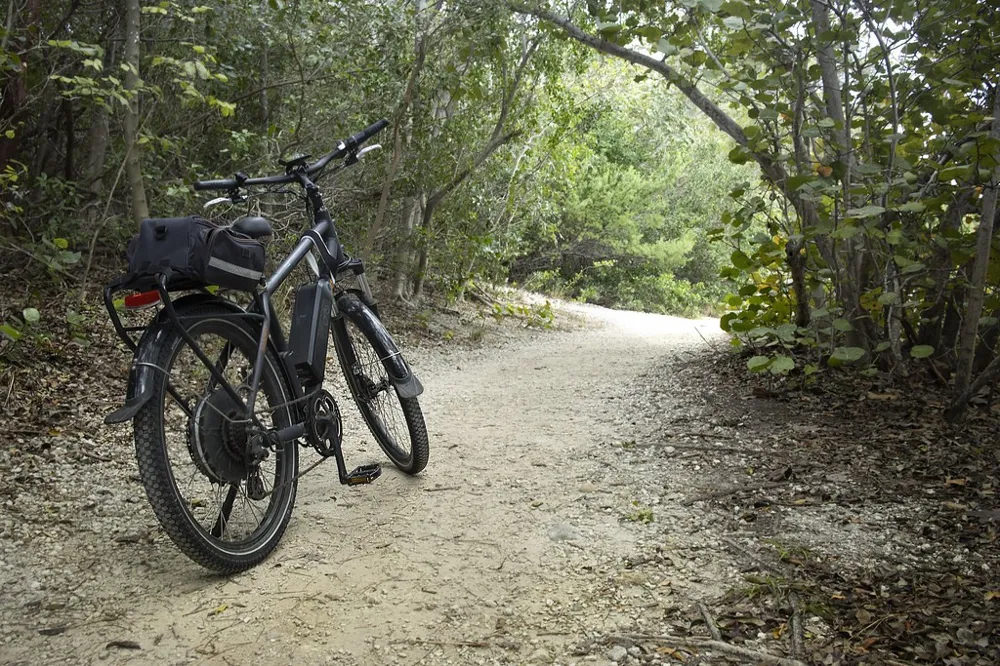
Access is the rule most riders bump into. The short version:
- Roads and bike lanes: all three classes, in most states. New York, for instance, limits e-bikes to roads with a posted speed limit of 30 mph or less unless local rules say otherwise.
- Paved multi-use paths: Class 1 and 2 are usually allowed; Class 3 is often restricted. Local governments can ban any class from a path.
- Dirt trails: decided by the land manager. Class 1 gets the most access; throttles are less welcome.
- Sidewalks: often banned, as for regular bikes. New York bans e-bikes on sidewalks unless local law allows them.
National Parks, BLM and National Forests
On federal land the manager decides. National parks generally allow e-bikes where regular bikes can go, with each park setting details, and never in designated wilderness. Bureau of Land Management areas follow a 2019 Interior order to treat e-bikes more like bikes, subject to local decisions. National forests generally treat e-bikes as motor vehicles. Our classes guide covers these rules and a class-by-class access table in more depth; always check the trailhead sign or the park or forest website before you ride.
E-Bike Rules in Large States
A few large states, checked against official sources in November 2026. This is a snapshot, not a complete list: rules change, and cities and counties add their own.
| State | License / Registration / Insurance | Age and Helmet | Notes |
|---|---|---|---|
| California | Not required for Class 1–3. Out-of-class vehicles may need an M1 or M2 license, DMV registration and insurance | Class 3: 16+ and helmet; under-18 helmet rule applies to all bikes | Bikes sold must carry a class label; local governments and schools can add rules (CA Attorney General, April 2026) |
| Florida | Not required (Fla. Stat. 316.20655) | No statewide minimum in the e-bike statute; local governments may set ages and require ID | May ride where bicycles are allowed; local governments can restrict paths, trails, beaches and dunes |
| New York | E-bikes don't qualify for registration as a motorcycle, moped or ATV (NY DMV) | 16+ for any class; helmets set locally | Class 3 allowed only in cities of 1 million or more, with assist to 25 mph; roads posted 30 mph or less |
| New Jersey | License and registration for all e-bikes; insurance for Class 2 and 3 (law signed January 2026) | Check NJ MVC | Class 2 and 3 treated as motorized bicycles; check NJ MVC for timing |
New York's rules come from Vehicle and Traffic Law section 1242 and the NY DMV; Florida's from its statute; California's from the Attorney General; New Jersey's from PeopleForBikes' summary of the new law. For any other state, start with your state DMV or legislature website, or the state-by-state summaries PeopleForBikes publishes.
When an E-Bike Becomes a Moped or Motorcycle
The "no license needed" answer only holds if the bike really is a Class 1, 2 or 3 e-bike. California's Attorney General lists the traits of a two-wheeled electric vehicle that is not an e-bike:
- Pedal assist beyond 28 mph
- Throttle assist beyond 20 mph
- A motor of more than 750 watts
- Pedals that don't work
In California, such a vehicle may need DMV registration, an M1 or M2 license and insurance, and the alert warns that modifying an e-bike past the limits can turn it into a moped or motorcycle. Many states take a similar approach, treating over-class bikes as mopeds, motor-driven cycles or off-highway vehicles.
This catches a lot of buyers of moped-style e-bikes with "unlocked" or "off-road" modes and electric motorbikes sold online. Fully electric off-road bikes are covered in electric dirt bikes; New Jersey's 2026 law also banned online advertising and sale of pedal-equipped e-motos over 750 watts that can exceed 28 mph, according to PeopleForBikes.
Other Rules Riders Overlook
- Class labels. Many states require a permanent label showing class, top assisted speed and motor wattage. New York requires one on bikes sold or leased from June 1, 2022 and can fine riders without one on public streets.
- Tampering. Florida bars changing a bike's motor-powered speed unless the label is replaced to match; other states have similar rules.
- Brake cut-off. Florida and New York require the motor to stop when you stop pedaling or apply the brakes (or, in New York, when a throttle switch is released).
- Traffic laws still apply. E-bike riders generally have the same duties as cyclists: obey signals, ride with traffic, use lights at night and yield to pedestrians. In some states, impaired-riding laws can apply to bicycles and e-bikes too.
- Battery and certification rules. Some states and cities now regulate e-bike batteries; see our battery guide.
- Traveling. Visitors are generally held to the rules of the state they ride in, so check before taking an e-bike on a trip.
How to Check Your Local Rules
- Read your bike's class label and make sure the bike is set up to match it.
- Check your state DMV or legislature website for the e-bike definition, age and helmet rules.
- Check your city or county for path, sidewalk and park rules.
- Check the land manager (park, forest or trail system) before riding off-road.
- Ask your insurer about theft and liability cover.
Thinking about buying? Compare options in the best electric bikes, or weigh e-scooters against e-bikes; e-scooter rules are different and covered in are electric scooters street legal.
Related Guides
Learn how electric bikes work, compare e-bikes and regular bikes, browse electric mountain bikes and budget e-bikes, or read whether you need a license for a scooter.
Frequently Asked Questions
Do you need a driver's license to ride an e-bike?
In most US states, no, as long as the bike fits Class 1, 2 or 3. New Jersey is a major exception: a law signed in January 2026 requires a driver's license and registration for all e-bikes. Bikes outside the classes can need a moped or motorcycle license.
Do e-bikes need to be registered or insured?
Usually not when they fit the three classes. Florida law, for example, exempts e-bikes from licensing, registration and financial responsibility rules. New Jersey now requires registration for all e-bikes and insurance for Class 2 and 3. Your homeowner's or renter's policy may or may not cover an e-bike, so ask your insurer.
How old do you have to be to ride an e-bike?
It depends on the state and class. California sets 16 as the minimum age for Class 3, and New York sets 16 for any bicycle with electric assist. Many states set no minimum for Class 1 and 2. Cities can add their own limits.
Do you need a helmet on an electric bike?
Many states require helmets for Class 3 riders and for younger riders on any class. California requires a helmet for Class 3 riders and for riders under 18. Wearing one on every ride is wise wherever you live.
Can a 14-year-old ride an e-bike?
In many states a 14-year-old can ride a Class 1 or Class 2 e-bike, but Class 3 often has a minimum age of 16. Some states, such as New York, set 16 as the minimum for any e-bike. Check your state and city rules.
Is a 1,000W e-bike legal?
Usually not as an e-bike. A motor rated above 750 watts falls outside the federal definition and the three-class model, so many states treat the bike as a moped or motorcycle. California's Attorney General lists a motor over 750 watts as one trait of a vehicle that isn't an e-bike.
Are e-bike laws the same in every state?
No. Most states use the three-class model, but ages, helmets, path access and Class 3 rules differ, and some states, like New Jersey and New York, depart from it. Cities and land managers add their own rules on top.