Cable Wakeboarding: How the Park Works and How to Ride It (2026)
No boat needed: how an overhead cable tows you, which system to learn on, how to get up off the dock, survive the corners and fit in at your first park.
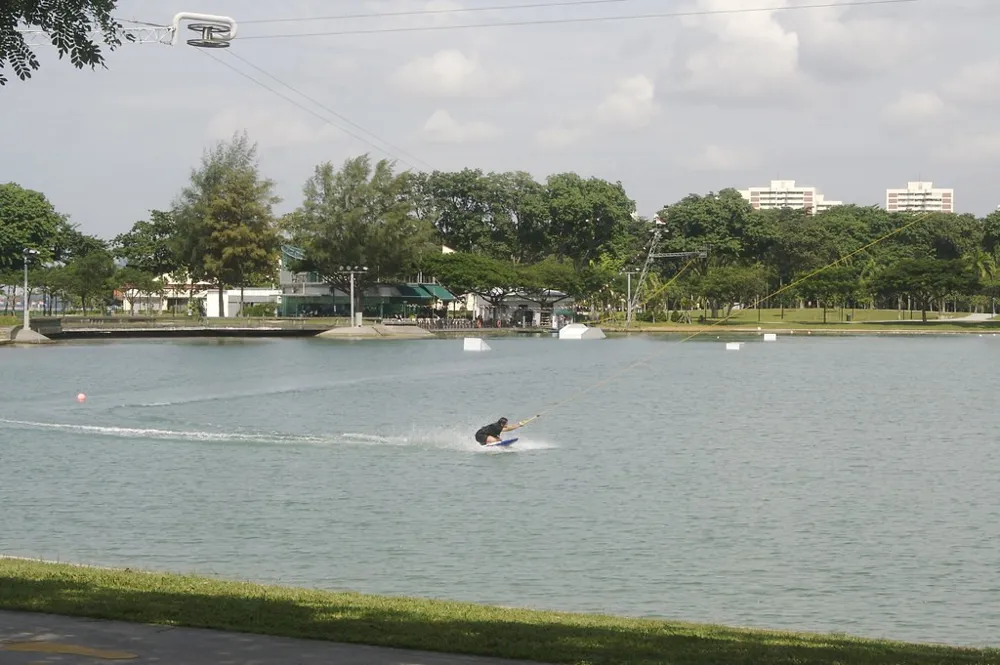
What Is Cable Park Wakeboarding?
Cable park wakeboarding means riding a wakeboard while an overhead cable, not a boat, pulls you across a lake or pond. An electric motor drives the cable, and your rope and handle clip onto it. There's no boat wake to jump, so parks add features instead: kickers (ramps), boxes and rails sit in the water for riders to jump and slide.
For many people the cable is the easiest way into wakeboarding. You don't need a boat, a driver or a spotter, you pay for a session or a pass, and parks usually rent the gear. The trade-offs are a different start (most riders launch from a dock) and corners that take some learning. This guide covers how cables work, the two main systems, your first ride, park features, the boards built for cable and the unwritten rules. For general riding basics, start with how to wakeboard.
How a Wakeboard Cable Works
Modern cable skiing is usually credited to German engineer Bruno Rixen, who sold the first commercial cable system in 1966, according to Wikipedia's cable skiing entry; it also notes a 1950s cable in Helsinki that was claimed to be the first. The basic idea hasn't changed:
- Towers and the main cable: a cable loop is strung high above the water between towers set around the lake. Wikipedia describes the cable as hanging about 26–30 ft (7.9–9.1 m) above the water.
- Carriers: metal carriers are spaced along the cable. Riders' tow ropes hook onto them, and ropes can be clipped on and released without stopping the system, so several riders share one cable.
- Speed: the operator sets it, not the rider. Wikipedia gives about 19 mph (31 km/h) as the most common setting for wakeboarders; the system can run faster for water skiers and slower for beginner sessions.
- Corners: on a full-size cable you ride a lap around the lake, turning at each tower. Some cables run clockwise and some counterclockwise, so depending on your stance you'll ride parts of the lap toeside or heelside.
- A higher pull: because the cable is overhead, the rope pulls you up and forward rather than just forward. That higher angle is part of why cable riders can get big air off kickers and by loading the line (edging against the rope tension and using it like a spring).
The pull is steady because there's no boat speeding up, slowing down or turning, but your speed through the water changes with your edge: riding out from under the cable line makes you go faster, and riding back under it slows you down.
Full-Size Cable vs 2-Tower (System 2.0)
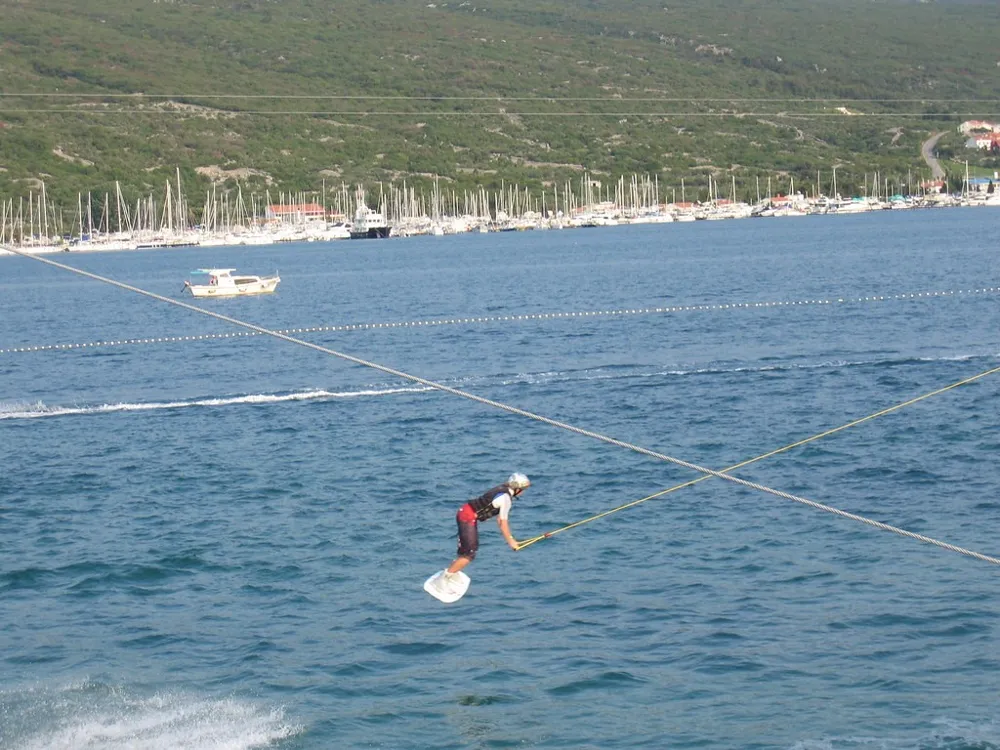
Most parks run one or both of two kinds of system. British Water Ski and Wakeboard (BWSW), the UK governing body, describes them as straight line (2-tower) and full cable (4–6 corner) systems. In the US you'll also hear 2-tower setups called "2.0" cables, after one well-known make of straight-line system.
| 2-Tower (Straight Line) | Full-Size Cable | |
|---|---|---|
| Layout | One cable between two towers; you ride out and back | A loop around several towers (BWSW lists 4–6 corners) |
| Riders at once | Usually one rider at a time | Several riders spaced along the cable |
| Control | Operator controls the pull for each rider | Operator sets one speed for everyone; can slow it for beginner sessions |
| Starts | Dock or water start; operator can ease you up | Usually a dock start |
| Corners | None; you turn around at each end | A turn at every tower |
| Typical use | Lessons, first rides, practicing features with one rider on the water | Lap riding, park features, open sessions |
BWSW calls the 2-tower system a common entry point for beginners because the rider is under constant operator control. If your park has both, learning to get up and turn on the 2-tower first, then moving to the full cable, is a common route. If it only has a full-size cable, look for slower beginner sessions or lessons.
Cable Park vs Boat Wakeboarding
| Cable Park | Behind a Boat | |
|---|---|---|
| What you need | A session pass; gear often rentable | A boat, driver and observer (where required) |
| Speed | Set by the operator, steady | Set by the driver; can be fine-tuned per rider |
| Pull angle | From above | From behind |
| Starts | Mostly dock starts (water starts on many 2-tower systems) | Mostly deep-water starts |
| What you jump | Kickers, boxes, rails and other features | The boat's wake |
| Falls | Swim or walk back and wait your turn | The boat circles back |
Cable riders often size their boards a few centimeters longer because the pull is slower than a boat; see the wakeboard size chart. If you're weighing wake sports more broadly, see wakeboarding vs wakesurfing.
What to Bring and What Parks Provide
- Life jacket or vest: required at many parks, and rules differ on which type. Waco Surf in Texas, for example, says life jackets are required for all cable park riders and that staff check that a rider's own jacket is US Coast Guard approved (as of November 2026). Other parks may let experienced riders use an impact vest. Our wakeboard life vests guide explains the difference.
- Helmet: many parks require or recommend one, and BWSW's cable guidance says to always wear a suitable, correctly sized helmet. See wakeboard helmets.
- Board and bindings: most parks rent them. If you own a boat board, ask whether you can ride it and whether you need to remove the fins.
- Clothing: board shorts or a swimsuit with a rash guard, or a wetsuit in cool water. BWSW recommends neoprene shorts if you're not wearing a suitable wetsuit.
- Leave jewelry at home: rings and other jewelry can catch on ropes and handles.
- Waiver and booking: many parks ask you to sign a waiver and book a session in advance; check the park's site.
Safety rules here are general information, not legal advice. Each park sets its own rules, and state boating laws differ; check with the park and your state's boating agency (last checked November 2026).
Your First Ride: Step by Step
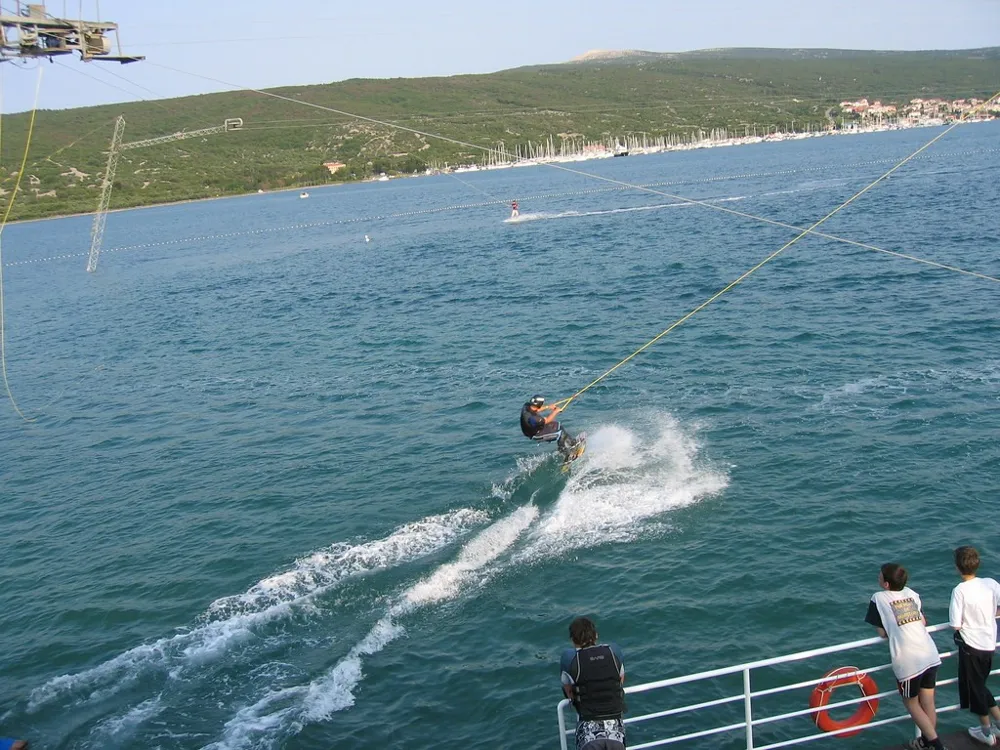
Expect a short briefing first. BWSW recommends getting instruction on leaving the dock before you try a dock start, and on the turns and corners. These are the three starts you're likely to meet.
Water Start (Common on 2-Tower Systems)
- Float on your back with the board on, knees pulled to your chest and the tip out of the water, as in a deep-water start behind a boat.
- Hold the handle with straight arms. BWSW says the board's edge should be out of the water and the rope taut before you give the agreed signal.
- Let the pull lift you. On straight-line systems the operator can drag you gently before full power, which makes the start more forgiving.
- Stay low as you rise, let the board turn sideways, and stand up slowly.
Seated Dock Start
- Sit on the edge of the dock with your board on and your knees bent, with the board positioned the way staff show you for that dock.
- Make sure the board's edge is clear of the dock, as BWSW advises, then signal the operator.
- Hold the handle close with both hands and keep your body compact. When the carrier takes up the slack, let the rope pull you off the dock.
- Keep your knees bent and weight slightly back as you leave the dock, then settle into your riding stance.
Standing Dock Start
Riders who can already ride often start standing at the edge of the dock and hop off as the rope comes tight; BWSW notes you should signal the operator and jump when the rope is taut. Wakeboarding Magazine's LearnWake tip on this start flags the classic mistake: catching an edge as the handle snaps out of your hands. Get coached through it, because the right approach depends on which foot you put forward and which way the cable spins.
Once You're Up
- Keep the handle low near your front hip and your knees bent.
- Stand tall through your chest and look ahead, not at the board.
- Ride under or slightly outside the cable line for a steady pull. Edging out from under the line speeds you up.
- Expect to fall a lot on the first session. That's normal.
Riding the Corners
Corners are where most beginners drop off a full-size cable, because the pull changes direction as the carrier swings around the tower and the rope can go slack. Common advice from cable coaching guides:
- Carry speed in. Approach the corner with enough speed so the rope stays tight as it turns.
- Stay centered. Don't lean too far forward or back; keep your weight over the board.
- Edge into the turn. Lean slightly into the corner and use your heels or toes to hold an edge.
- Look at the exit. Turn your head and shoulders toward where you want to go.
- Keep moving after the turn. Hold your speed coming out so the rope stays tight and doesn't jerk you.
Because the cable may spin clockwise or counterclockwise, some corners will be heelside for you and some toeside. If one direction feels much harder, ask the operator for tips specific to your stance. On a 2-tower system there are no corners; you turn around at each end under the operator's control.
Falling, Letting Go and Getting Back
BWSW's first rule for falls is simple: always let go of the handle when you fall. Then:
- Get your board back quickly and look up the line for riders coming toward you.
- Watch for loose handles. A dropped handle keeps traveling with the cable. Move out of its path, or duck under if you can't, and never try to catch one.
- Don't try to come in fast at the dock or shore. BWSW advises sitting down if you're heading in too fast.
- Follow the park's route back. Parks differ on where you exit the water and how you return to the dock, so ask during your briefing.
On a 2-tower system the operator can stop the pull and you can usually restart from the water or swim to the dock. On a full-size cable, you'll typically get out and rejoin the line for your next lap.
Park Features and Obstacles
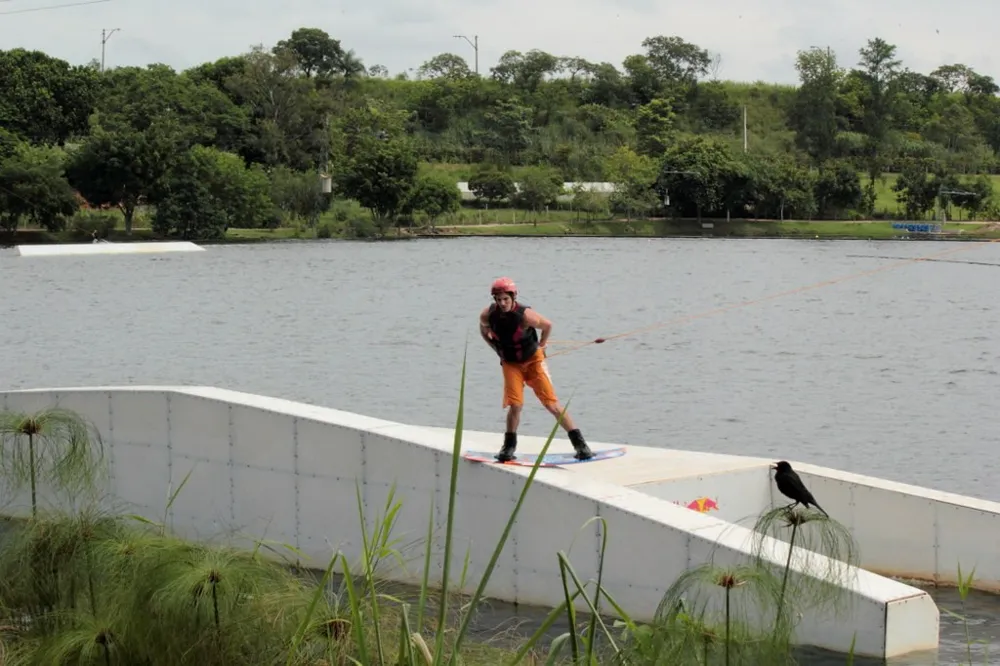
Features turn a cable lake into a terrain park on water. Layouts vary from park to park, but most features fall into these groups:
| Feature | What It Is | Typical Use |
|---|---|---|
| Kicker | A ramp that launches you into the air | Straight airs, grabs and spins |
| Box | A wide, flat-topped feature you slide across | First slides; easier than rails |
| Rail | A narrow bar or tube to slide | Board slides, presses and spins on and off |
| Combination features | Ramps, flat sections and slide surfaces built together; designs vary by park | Linking jumps and slides once the basics are solid |
BWSW's guidance is not to try a feature until a cable operator or coach has instructed you or signed you off, and never to hit a feature while another rider is in the water nearby. A typical progression is riding laps comfortably, ollies and surface 180s on flat water, then a low box, a kicker and finally rails. Wear a helmet for all of it. Our wakeboard tricks for beginners guide covers the flat-water basics and a first box.
Cable Boards vs Boat Boards
Any wakeboard can be ridden behind a cable, but boards built for parks hold up better on features. Wakeboarding Magazine sums up the differences this way:
| Cable Board | Boat Board | |
|---|---|---|
| Flex | More flex, especially at the tips, for presses and softer landings | Stiffer for edge control and pop off the wake |
| Base | Durable grind base (sintered or P-Tex type) for sliding | Glossier base for speed and glide |
| Fins | Minimal or removable | Deeper fins for tracking at boat speeds |
| Channels | Flatter | More aggressive |
| Rocker | Continuous or hybrid, for predictable feature riding | Often 3-stage for more pop |
| Sidewalls | Reinforced against impacts | Less impact protection needed |
Many cable riders also pick wood cores for flex and durability, and size up a few centimeters (our size chart gives 3–5 cm as a common range). Fins matter: cable boards are often ridden finless or with small fins, and parks may have their own fin rules, so ask before your session. Bindings work for both; some riders pair a flexier board with a supportive binding, and system bindings you can unclip help on rough ground around a lake. Browse the best wakeboards and wakeboard bindings for specific models.
Cable Park Etiquette and Safety Rules
Busy parks run smoothly when everyone follows the same habits. Most come straight from cable safety guidance; the rest are common courtesy:
- Listen to the operator. Speed and start timing are the operator's call, and you'll use agreed signals at the dock.
- Know your level. Ride beginner sessions or the 2-tower system until you can get up and handle the corners reliably.
- Give fallen riders room. BWSW says to ride clear of anyone in the water and to let go of the handle if you're not sure you can avoid them.
- No features near people in the water. Wait until the feature area is clear.
- Don't enter the start area at speed. Let go well before the dock if you're finishing a lap.
- Never wrap the rope around any part of your body, and never put an arm, leg or your neck through the handle or hold it in the crook of your arm.
- Check your gear before you ride: bindings, loose screws or wing nuts and any sharp or splintered parts.
- Be a confident swimmer. BWSW says cable riding isn't suitable for non-swimmers.
- Clear the water fast after a fall, and wait your turn in line.
- Don't ride after drinking or in darkness or poor visibility.
How to Find a Cable Park
Cable parks are most common in Europe; Wikipedia's entry counts over 70 cableways in Germany alone and describes Langenfeld, with four cable systems, as having the highest capacity in the world. It puts the US at around 50 cableways, though the figure may be dated as parks open and close. In the US, cables are found at standalone wake parks and at some water parks and resorts, such as Waco Surf in Texas, which runs a cable park alongside its surf lagoon.
To find one near you:
- Search "cable park" or "wake park" with your city or state, and check each park's site for its season and hours, since parks in cooler regions may close for winter.
- Look for a beginner cable, a 2-tower system or lessons if you're new.
- Check gear rentals, helmet and vest rules, age limits and whether booking ahead is required.
- Read the park's rules page before you go, and sign any waiver online to save time.
What to Learn Next
- Ride full laps both regular and switch.
- Learn ollies and surface 180s on flat water, then your first box slide with a coach.
- Try small kickers once you're signed off, building to grabs and spins.
- Take your skills behind a boat: see how to wakeboard and how to wakesurf.
Related Guides
See the best wakeboards, wakeboard helmets, wakeboard life vests, the wakeboard size chart and bindings, or browse water sports.
Frequently Asked Questions
Is cable wakeboarding easier than boat wakeboarding?
Some beginners find the start harder at a cable because the pull comes from above and the dock start takes practice, but the steady speed and many attempts per session help. Once you can get up and ride corners, plenty of riders progress quickly.
How fast does a wakeboard cable go?
Operators set the speed. Wikipedia's cable skiing entry gives about 19 mph (31 km/h) as the most common setting for wakeboarders on full-size cables, and operators can slow the line for beginner sessions.
What is a 2-tower or System 2.0 cable?
It is a straight-line cable strung between two towers that pulls one rider back and forth under an operator's direct control. Many parks use it to teach beginners before they move to the full-size cable.
Do I need my own board to ride a cable park?
Usually not. Many parks rent boards, helmets and life jackets at check-in, but check before you go. If you buy a board for cable, look for more flex, a durable grind base and small or removable fins.
Do you have to wear a helmet at a cable park?
Rules are set by each park, and many require or strongly recommend helmets. British Water Ski and Wakeboard's cable safety guidance says to always wear a suitable helmet on a cable.
Can I wear an impact vest instead of a life jacket at a cable park?
It depends on the park. Some US parks require a US Coast Guard-approved life jacket for every rider, while others allow impact vests for experienced riders. Ask the park before you ride.
What should I do when I fall at a cable park?
Let go of the handle right away, get your board back on quickly and watch for riders and loose handles coming toward you. Then follow the park's route back to the dock.
Can kids ride at a cable park?
Many parks offer kids' and beginner sessions, but age, size and swimming rules vary by park. Riders should be confident swimmers, and children need a properly fitted life jacket.