Kayak and Paddle Board Coolers That Actually Fit (2026)
Soft, hard, seat-back, deck and towable coolers for kayaks and SUPs, with how to measure your tank well, what leakproof really means and how to keep a cooler aboard in a capsize.
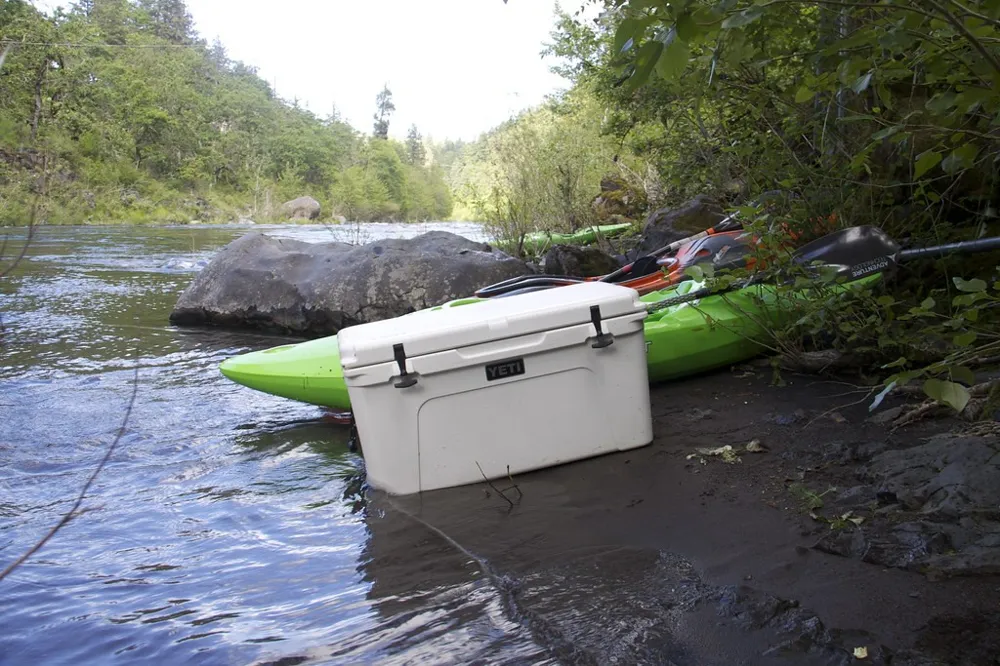
What Makes a Good Kayak Cooler?
A kayak cooler is not just a small cooler. It has to fit a space the kayak maker shaped for something else, stay put when the kayak rolls on a wake, survive spray and sun all day, and be light enough that it doesn't upset the boat's trim. The best choice depends less on brand and more on where it will ride: in the rear tank well of a sit-on-top, strapped behind a frame seat, under the bow bungee, inside a hatch, or towed behind on a line.
This guide covers coolers for kayaks and stand-up paddle boards. If you need a big wheeled cooler for a day on the sand, that's a different job; see our best beach coolers. Product facts below come from maker and retailer listings; capacities, sizes and ice claims change between versions, so check the current listing before you buy.
Perception Splash Seat Back Cooler
Best behind-the-seat cooler
- Made for lawn-chair style kayak seats
- Rides behind you, out of the cockpit
- Soft cooler
YETI Hopper Flip 12
Best compact soft cooler
- Zip-top soft cooler
- Small enough for a deck or hatch
- Carry strap and lash points
Engel 19 Quart Cooler/Dry Box
Best hard cooler for kayaks
- Latched, gasketed lid
- Works as a cooler or a dry box
- Compact 19-quart size
Kayak Coolers Compared
The eight coolers below cover every common spot on a kayak or board. Match the "Where It Rides" column to your own boat first, then narrow by type.
| Cooler | Type | Where It Rides | Best For |
|---|---|---|---|
| Perception Splash Tankwell Cooler | Soft | Rear tank well | Sit-on-top day trips |
| YETI Hopper Flip 12 | Soft, zip-top | Tank well, deck, hatch | Leakproof lunch and drinks |
| Engel 19 Quart Cooler/Dry Box | Hard, latched | Rear tank well | Fishing, longer days, a seat at lunch |
| Perception Splash Seat Back Cooler | Soft, slim | Behind a frame seat | Drinks within reach |
| Seattle Sports Kayak Catch Cooler | Soft, deck bag | Bow or stern deck | Keeping fish cold |
| IceMule Classic Cooler | Soft, roll-top | Hatch, deck, on your back | Sit-insides and carrying to the water |
| Wilderness Systems Orbix Hatch Cooler | Soft, fitted | Inside an Orbix hatch | Owners of Wilderness Systems kayaks with Orbix hatches |
| CreekKooler Floating Cooler | Hard, floating | Towed behind | Group floats on slow rivers and lakes |
The Best Kayak and Paddle Board Coolers
1. Perception Splash Tankwell Cooler
Perception sells this soft cooler specifically for the rear tank well of a sit-on-top kayak. It sits low under the bungee, so it doesn't raise the center of gravity the way a tall box does, and it weighs little enough to carry down to the launch already packed. It's a good fit for recreational sit-on-tops, including Perception's own, but tank wells vary, so compare the listed dimensions with your well before ordering.
Good to Know
- Shaped for tank wells rather than adapted from a picnic bag
- Low profile under deck bungees
- Soft sides squeeze into tapered wells
Watch Out For
- Soft insulation won't hold ice as long as a hard cooler
- Check the listing for the current capacity and size
Not available on Amazon when we checked (November 2026); check Perception dealers and paddle shops.
2. YETI Hopper Flip 12
A compact, zip-top soft cooler from YETI's Hopper line, which YETI markets as leakproof. It's small enough to lash in a tank well, under a bow bungee or on the deck of a paddle board, and it has a carry strap and attachment points for clipping it down. For one or two people on a day paddle it holds lunch and drinks; for a fishing day with catch, look at a bigger hard cooler.
Good to Know
- Marketed as leakproof, so meltwater stays in
- Small footprint fits decks and many hatches
- Lash points make it easy to clip to the boat
Watch Out For
- Leakproof is not the same as submersible; see below
- Premium-priced for its size
3. Engel 19 Quart Cooler/Dry Box
A hard box with latches and a gasketed lid that Engel sells as both a cooler and a dry box, so it can carry ice and drinks one day and a phone, wallet and spare clothes the next. The 19-quart size is compact for a hard cooler and fits the rear well of many fishing and recreational sit-on-tops. A flat, sturdy lid also gives you a table at lunch.
Good to Know
- Doubles as a dry box
- Latched lid stays shut if the kayak tips
- Hard shell takes knocks at the launch
Watch Out For
- Heavier than a soft cooler, even empty
- Rigid shape needs a well that's wide and flat enough
4. Perception Splash Seat Back Cooler
A slim soft cooler that straps to the back of a raised frame (lawn-chair style) kayak seat, so drinks are a reach over your shoulder instead of a twist toward the tank well. It leaves the well free for a crate or dry bags, which makes it a useful partner to a larger cooler on fishing days.
Good to Know
- Keeps the tank well free
- Reachable without turning around much
- Light and flat
Watch Out For
- Only fits frame seats with a suitable back
- Small capacity, mostly drinks
5. Seattle Sports Kayak Catch Cooler
An insulated deck bag sold for keeping fish cold on a kayak. It's long and low to lie on the bow or stern deck under the bungee rather than standing up in a well, which keeps the weight low and leaves the tank well for tackle. Check the listing for the current size and dimensions.
Good to Know
- Made for fish rather than drinks
- Lies flat on the deck
- Rolls or folds small when empty
Watch Out For
- A fish bag is not a leakproof drinks cooler
- Needs a bungee or tie-down points on the deck
Not available on Amazon when we checked (November 2026); check Seattle Sports dealers and fishing shops.
6. IceMule Classic Cooler
A roll-top soft cooler that carries like a backpack, so it's easy to walk to a launch with a kayak on a cart or over your shoulder. The roll-top closure squeezes into odd shapes, which makes it one of the easier coolers to fit into the larger hatch of a sit-inside or touring kayak, or under the bungees on a paddle board.
Good to Know
- Backpack carry to the water
- Flexible shape for hatches and decks
- Comes in several sizes
Watch Out For
- Soft insulation suits day trips rather than overnights
- Roll-top must be closed fully to seal
7. Wilderness Systems Orbix Hatch Cooler
A soft cooler made to drop into the oval Orbix hatch found on several Wilderness Systems kayaks. If your kayak has that hatch, it puts cold drinks inside the hull, out of the sun and out of the way. If your kayak doesn't, skip it: the shape is specific to that hatch.
Good to Know
- Fitted to its hatch
- Cooler rides out of the sun
- Leaves the deck and well free
Watch Out For
- Only for kayaks with an Orbix hatch
- Small capacity
Not available on Amazon when we checked (November 2026); check Wilderness Systems dealers.
8. CreekKooler Floating Cooler
A hard cooler shaped like a small hull that floats and is towed behind a kayak, canoe or tube on a line. It adds no weight to the kayak itself, which matters for small boats close to their capacity, and it works for groups who share drinks on slow rivers and lakes. On moving water with strainers or in boat traffic, a towed cooler is one more thing to snag.
Good to Know
- Adds no weight inside the kayak
- Shared by a group on a lazy float
- Floats by design
Watch Out For
- Towing adds drag and can snag on obstacles
- Not for fast rivers, surf or busy channels
Not available on Amazon when we checked (November 2026); check CreekKooler's site and outdoor retailers.
Soft vs Hard Coolers on a Kayak
This is the first decision, and it usually settles itself once you know where the cooler will ride.
| Soft Cooler | Hard Cooler | |
|---|---|---|
| Weight empty | Light | Heavier |
| Fit | Squeezes into tapered wells, hatches and decks | Needs a flat, wide enough well |
| Ice retention | Shorter; best for day trips | Usually longer, especially rotomolded |
| Durability | Fabric can puncture on hooks and rocks | Takes drags, drops and knees |
| Extra uses | Carries like a bag or backpack | Seat, table, step, dry box |
| Storage at home | Some fold flat | Takes the same space all year |
Choose soft for day paddles, sit-inside kayaks, inflatable kayaks and paddle boards, and anything you'll carry a distance to the water. Choose hard for fishing kayaks with big rear wells, multi-day trips, or when you want the cooler to double as a seat or a casting platform. A large rotomolded cooler built for boats and trucks is usually too heavy and too wide for a kayak; the small sizes of those lines are the ones that fit.
Where a Cooler Fits: Tank Well, Behind the Seat, Deck or Hatch
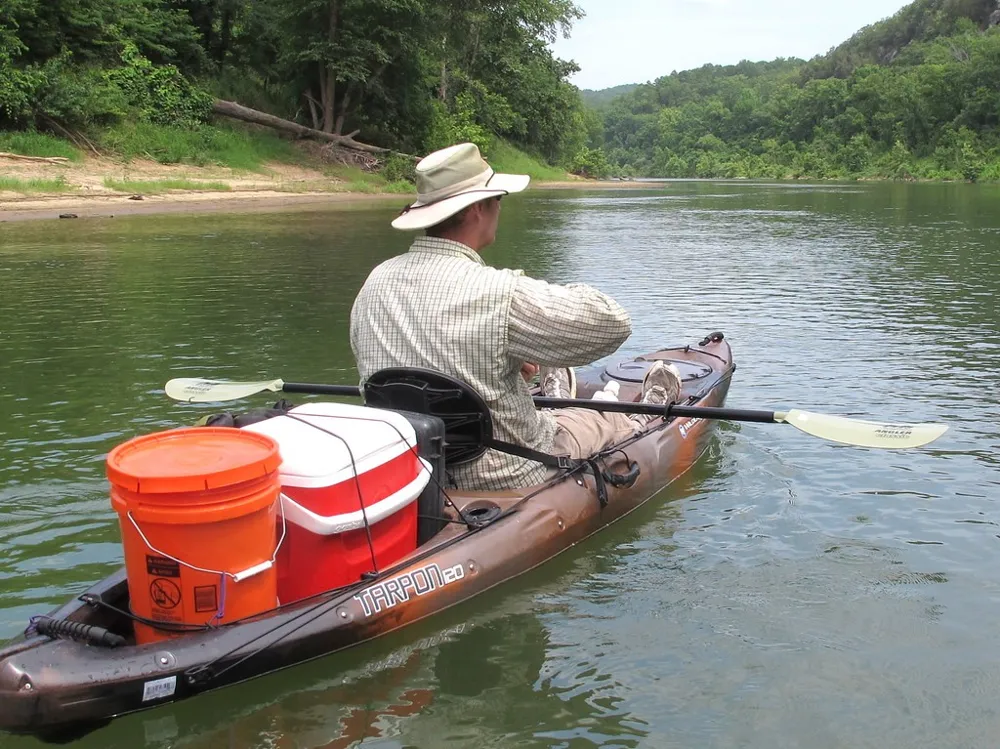
Every kayak has a few places a cooler can go. Each has trade-offs for reach, balance and sun.
- Rear tank well (sit-on-tops): the most common spot. It's a recessed area behind the seat with bungee cord over it. It takes the biggest cooler, keeps the weight low and near the middle, and is reachable on most kayaks with a twist. See sit-on-top kayaks for well sizes on popular models.
- Behind the seat: on kayaks with a raised frame seat, a slim seat-back cooler hangs off the seat itself. It's the easiest to reach and leaves the well free. Check your seat on our kayak seat guide if you're upgrading.
- Bow or stern deck: long, low deck-bag coolers lie flat under the deck bungee. Good for fish bags and small coolers, but the weight is far from the middle, so keep it light.
- Inside a hatch: sit-inside and touring kayaks have hatches instead of wells. A soft cooler inside a hatch stays shaded, but you can't reach it on the water and hatches aren't always watertight. See sit-inside kayaks.
- Between your legs or feet: a very small cooler can ride in the cockpit of a wide sit-on-top, but it must not block your feet from coming free in a capsize.
- Towed behind: a floating cooler on a short line. Fine on lazy rivers and calm lakes; a hazard in current or surf.
How to Measure Your Tank Well
Most "cooler doesn't fit" stories come from measuring the wrong thing. Tank wells taper, have molded drain scuppers and raised ribs, and the bungee sits higher than the well floor. Before you shop:
- Length: measure the flat floor of the well front to back, not the opening at deck level.
- Width at the narrowest point: wells are often narrower at the stern end. A hard cooler has to fit that narrowest width; a soft one can squeeze a little.
- Depth: from the well floor to the deck rim. A cooler that sits much higher than the rim raises your center of gravity and catches wind.
- Bungee reach: check the bungee can stretch over the cooler with room to spare; if not, plan on a cam strap instead.
- Seat clearance: with your seat in its usual position (and reclined, if you recline it), make sure the cooler doesn't hit the seat back or block a rod holder.
- Compare to outside dimensions: makers list outside size for hard coolers; for soft ones, the size loaded matters more than the size empty.
Write the numbers on a strip of tape and keep them in your phone. They'll also tell you whether a fishing crate fits alongside the cooler.
Crate and Cooler Combos
Anglers often want a crate for tackle and rods and a cooler for drinks or fish, and most tank wells won't hold two full-size versions. Common ways to solve it:
- Crate in the well, cooler behind the seat or on the bow: the crate holds rods upright in its holders, and a seat-back or deck cooler handles drinks.
- Soft cooler inside the crate: some crates are sized so a small soft cooler drops inside with tackle boxes around it. Check the inside dimensions of the crate, not just its outside size.
- Hard cooler with rod holders: some kayak-sold cooler boxes come with rod holders or mounting tracks, turning the cooler into the crate. These are heavier, so check the total load.
- Cooler as the seat: on wide fishing kayaks and SUPs, a low, hard cooler with a pad on top becomes a seat for casting while seated. It must be strapped down so it can't slide.
Whatever the combination, clip or strap the crate as well as the cooler; a loose crate in a capsize will take your tackle with it. For full rigging, see fishing kayaks and kayak accessories.
Waterproof vs Leakproof vs Floating
These three words get mixed up in listings, and they mean different things on the water:
| Claim | What It Means | Why It Matters on a Kayak |
|---|---|---|
| Leakproof | Meltwater doesn't leak out when the cooler tips | Keeps your well and seat dry; matters for soft coolers on their side |
| Waterproof / submersible | Outside water doesn't get in, even under water | Protects food in a capsize; few soft coolers claim it |
| Water-resistant | Sheds spray and splash only | Fine for calm days; not for waves or rolls |
| Floats | Stays on the surface if it goes overboard | Makes recovery possible, but a full cooler may sink |
Take each claim only as the maker states it, and don't assume one implies another. A leakproof zipper can still let water in when submerged, and a hard cooler with a gasket is leakproof only while the latches are closed. If a cooler doubles as a dry box for a phone or keys, also put those in a dry bag.
Tie-Downs: Keep the Cooler Aboard in a Capsize
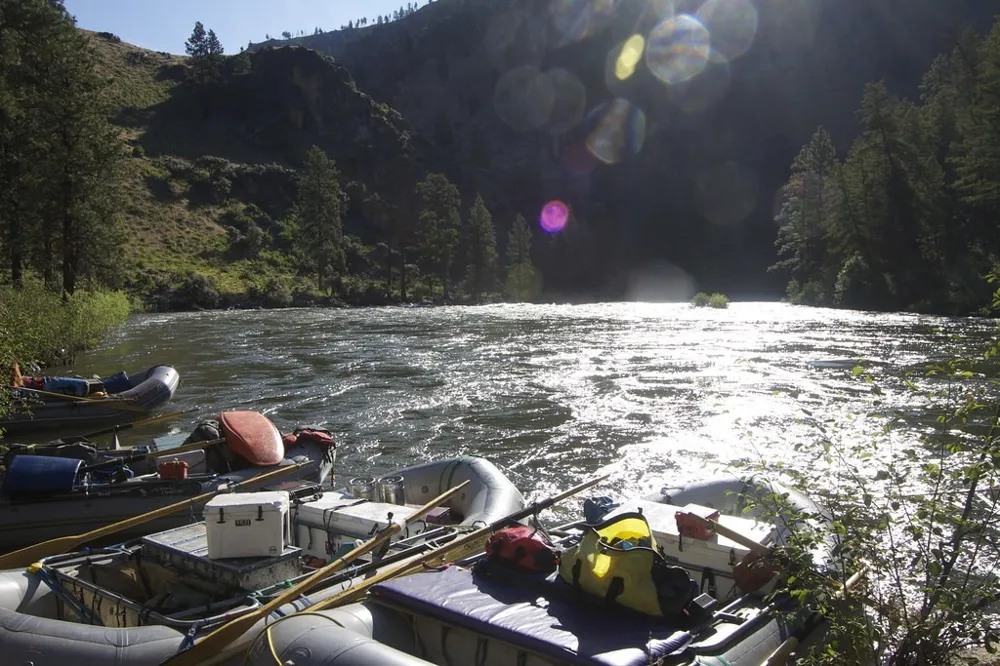
A cooler is one of the heaviest single items on a day kayak, and it's the one most likely to go swimming. Rig it as if you'll flip, because sometimes you will.
- Bungee plus a strap: the factory bungee holds a cooler on flat water, but a cam strap or buckle strap through the cooler's handles or D-rings to the kayak's pad eyes holds it when the kayak rolls.
- Use the cooler's tie-down points: handles, D-rings, daisy chains and lash points are there for this. Coolers without any are harder to secure; a strap all the way around works but is less tidy.
- Add a leash on moving water: a short line from the cooler to the kayak means it stays with the boat if the strap slips.
- Don't tie it to yourself: a cooler tethered to your body or PFD is an entanglement hazard. Tie it to the kayak.
- Keep straps tidy: loose tails and bungees catch paddles, lines and feet. Tuck them away.
- Latches shut: hard-cooler latches should be closed whenever you're moving, not just on the drive.
Cold water and capsize skills matter more than any cooler; see kayak safety before trips on cold or open water.
Ice Retention Claims and Keeping It Cold
Coolers are sold with ice-retention times, but the only meaningful figures are the maker's own, and they're measured in the maker's test conditions, often in shade, with a full load of ice and the lid closed. On a kayak the cooler sits on a hot deck in direct sun and gets opened often, so expect less than the listed figure. Compare claims only between coolers from makers that describe how they tested.
- Pre-chill: put ice or frozen packs in the cooler the night before, or at least an hour before loading, and keep it out of a hot garage or car.
- Block ice lasts longer, cubes chill faster: frozen water bottles work as both ice and drinking water.
- Pack it full: air space warms quickly. Fill gaps with ice or a towel.
- Shade it: a light-colored towel or wet cloth over the cooler cuts sun load; a hatch keeps it out of the sun entirely.
- Open it less: keep drinks for the next hour in a seat-back or deck cooler and the main supply in the tank well.
- Keep meltwater on soft coolers: cold water still keeps things cold; drain hard coolers only when needed.
Coolers on Paddle Boards
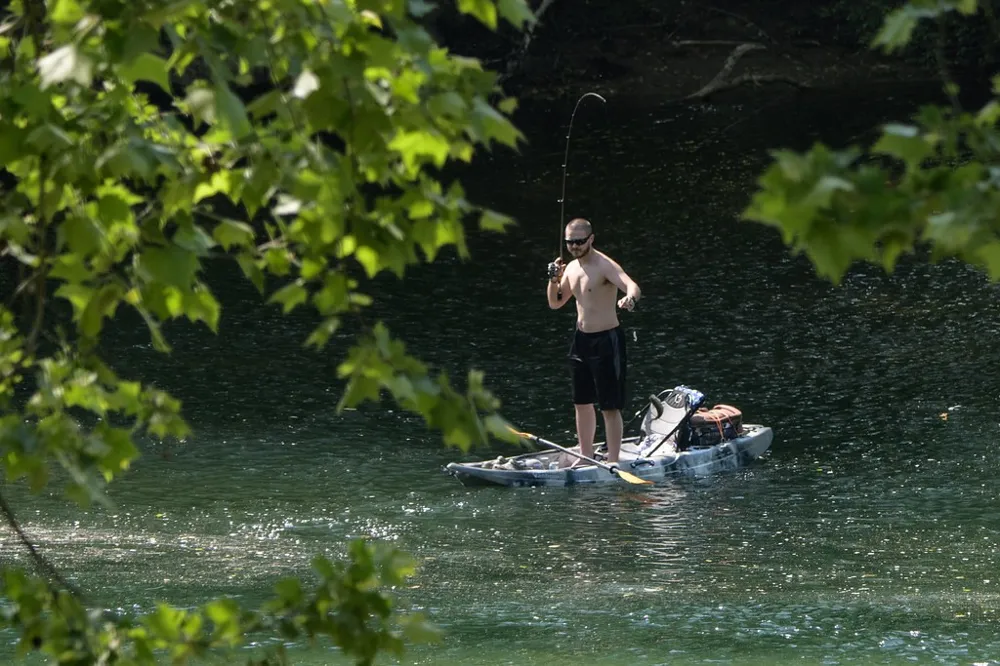
Paddle boards have no tank well, so the cooler rides on deck. Most boards have a bungee net on the nose and often another at the tail, plus D-rings around the deck.
- Small soft cooler under the bungee: the easiest setup for drinks and lunch. Keep it low and flat so it doesn't catch wind.
- Hard cooler behind the standing area: on wide fishing boards, a low, stable hard cooler strapped to D-rings can double as a seat. See fishing paddle boards for boards built to carry one.
- Balance front and back: a heavy cooler on the nose pushes the nose down. Put weight near the middle or balance it with gear at the other end.
- Floating tow coolers: some paddlers tow one on calm lakes; avoid it in wind and current.
For the rest of the deck setup, see paddle board accessories.
Weight, Balance and Capacity
Water is heavy: a gallon weighs a little over 8 pounds, and a cooler full of ice and drinks adds up fast. Count the loaded cooler in your kayak's or board's weight capacity along with you and your gear. A common rule of thumb is to keep the total load to about 60 to 70% of the maximum rating; our kayak weight limit guide explains why.
- Keep heavy items low and near the middle of the boat.
- Balance a rear cooler with gear in the bow on long kayaks so the boat trims level and tracks well.
- On inflatable kayaks and boards, the cooler sits on a soft floor; a flat-bottomed cooler is steadier than a round one.
- Pack the cooler at the launch, not at home, if the walk is long; a kayak cart can carry it too.
Food and Catch Safety
The basics from our beach cooler guide apply on the water: keep perishable food at 40°F (4°C) or below, and USDA guidance is not to leave perishables out for more than two hours, or one hour above 90°F. Keep raw catch separate from food and drinks, in its own fish bag or a second cooler, and put fish on ice soon after landing rather than leaving them in the hull. Check local fishing regulations for size, possession and handling rules before you keep fish. For overnight trips, plan meals around what will still be cold on day two and see our kayak camping gear list.
Frequently Asked Questions
What size cooler fits in a kayak?
It depends on the kayak, not the cooler. Measure the length, the narrowest width and the depth of your tank well or the space behind your seat, then compare those numbers with the cooler's listed outside dimensions. Many recreational sit-on-tops take a small soft cooler or a compact hard cooler; fishing kayaks with large rear wells take more.
Is a soft or hard cooler better for a kayak?
Soft coolers are lighter, squeeze into tapered wells and hatches, and are easier to carry to the launch. Hard coolers usually keep ice longer, can double as a seat or table, and survive being dragged, but they are heavier and need a well big enough to hold them flat.
How do you secure a cooler on a kayak?
Set it low in the tank well or behind the seat, then hold it down with the kayak's bungee plus a cam strap through the cooler's handles or D-rings to the kayak's pad eyes or tie-down points. On moving water or in waves, add a short leash so the cooler stays with the kayak if you capsize.
Do kayak coolers float?
Some do and some don't. A closed, partly empty cooler often floats, but a full one or a soft cooler with an open zip may not. Check what the maker says, and tie the cooler to the kayak rather than relying on it floating.
Can you put a cooler on a paddle board?
Yes. A small soft cooler fits under the nose or tail bungee of most boards, and a low, stable hard cooler can sit behind the standing area on wider fishing boards. Count it in the board's weight capacity and keep it centered so the board stays level.
How long do kayak coolers keep ice?
Only the maker's own figures are meaningful, and they are measured in the maker's test conditions. On a kayak the cooler sits in direct sun on a hot deck, so expect less. Pre-chilling, block ice and a reflective cover all help.
What is the difference between waterproof and leakproof coolers?
Leakproof means meltwater stays inside when the cooler tips. Waterproof or submersible means outside water can't get in, even when the cooler is under water. Most coolers are only one of those, so check which claim the maker actually makes.