Best Dive Watches for Scuba, Snorkeling and Daily Wear (2026)
Eight dive watches from affordable solar and automatic divers to Swiss mid-range models, and a plain guide to ISO 6425, bezels, lume, movements and straps.
What Makes a Real Dive Watch
A dive watch is more than a watch with a high water rating. True divers' watches are built to ISO 6425, the international standard that sets minimum water resistance, a secured timing bezel or display, legibility in the dark and tests for shock, magnetism, salt water and strap strength. Plenty of good watches have a dive-watch look without meeting it, and that's fine for swimming and snorkeling. If you'll actually scuba dive with it, the details matter.
Our picks mix affordable solar and automatic divers with a few mid-range Swiss models. Every spec below comes from the maker's page or the Amazon listing. This page is about dive watches specifically. If you want a tough watch for swimming, surfing and snorkeling, our best waterproof watches guide covers that, and for real-time decompression data see the best dive computers.
Citizen Promaster Dive Eco-Drive (BN0150)
Best overall affordable diver
- Listed as ISO certified, 200m
- Light-powered Eco-Drive, no battery changes
- 44mm steel case, polyurethane strap
Seiko Prospex "Turtle" SRPE93
Best automatic dive watch
- Diver's 200m, screw-down crown
- 4R36 automatic, about 41-hour reserve
- Unidirectional bezel, LumiBrite lume
Mido Ocean Star 200C
Best mid-range Swiss diver
- Swiss automatic, listed 80-hour reserve
- Ceramic bezel, sapphire crystal
- Bracelet with diving extension
Dive Watches Compared
| Watch | Movement | Listed Water Rating | Case | Crystal | ISO 6425 Claim |
|---|---|---|---|---|---|
| Citizen Promaster Dive BN0150 | Eco-Drive solar (E168) | 200m | 44mm steel | Mineral, anti-reflective | Listed as ISO certified |
| Seiko Prospex SRPE93 "Turtle" | Automatic (4R36) | 200m diver's | 45mm steel, 13.4mm thick | Hardlex | Not stated on maker page |
| Mido Ocean Star 200C | Swiss automatic, 80-hour reserve listed | 200m | 42.5mm steel, 12.25mm thick | Sapphire | Not stated |
| Orient Kamasu | Automatic, hand-winding | 200m | 41.8mm steel, 12.8mm thick | Sapphire | Not stated |
| Citizen Promaster Dive BN0200 | Eco-Drive solar (E168) | 200m | 44mm Super Titanium | Mineral | Listed as ISO compliant |
| Tissot Seastar 1000 40mm | Swiss automatic (Powermatic 80) | 300m | 40mm steel | Check listing | Not stated |
| Seiko 5 Sports SRPD | Automatic (4R36) | 100m | 42.5mm steel | Check listing | No, dive-style only |
| Casio Duro MDV106 | Quartz | 200m | Steel | Check listing | No |
Specs are from each maker's page or Amazon listing as of November 2026. Colors and sub-models vary, so confirm the reference number before buying.
The Best Dive Watches
1. Citizen Promaster Dive Eco-Drive (BN0150)
The Promaster Dive is the most straightforward way into a properly specified dive watch. Citizen describes the BN0150-28E as ISO-compliant and rated to 200 meters (20 bar), and the Amazon listing calls it ISO certified. It runs on Citizen's E168 Eco-Drive movement, which charges from any light source and, per Citizen, never needs a battery. That removes the battery changes that can mean opening the case and disturbing the seals.
The 44mm stainless steel case has a rotating bezel, a black dial with luminous hands and markers, a date window and an anti-reflective mineral crystal. It comes on a polyurethane strap with a 20mm lug width, so swapping to a NATO or rubber strap is easy. The listing mentions a 5-year limited warranty.
Good to Know
- Listed as ISO certified, 200m
- Light-powered, no routine battery swaps
- Common 20mm lug width
Watch Out For
- 44mm case wears large on small wrists
- Mineral crystal rather than sapphire
2. Seiko Prospex "Turtle" SRPE93
The Turtle gets its nickname from its rounded, cushion-shaped case. Seiko lists the SRPE93 with "diver's" 200-meter water resistance, a unidirectional rotating bezel, a screw-down crown and a screw case back. Inside is Seiko's 4R36 automatic movement with manual winding, a stop-second (hacking) function, day and date, 24 jewels and about 41 hours of power reserve.
The case is 45mm wide and 13.4mm thick, in stainless steel with a Hardlex crystal, and the watch weighs 124g on its silicone strap (22mm between the lugs). Seiko's LumiBrite covers the hands and indexes. The maker page doesn't mention ISO 6425 by name, so we list it on its stated diver's rating and features.
Good to Know
- Automatic with hand-winding and hacking
- Screw-down crown and case back
- LumiBrite hands and indexes
Watch Out For
- About 41-hour reserve: wind it if it has sat unworn
- Large 45mm case
3. Mido Ocean Star 200C
The Ocean Star 200C is a Swiss-made step up into mid-range territory. Its automatic Mido caliber is listed with an 80-hour power reserve, so it can sit on the dresser over a weekend and still be running on Monday. The listing gives 200 meters (20 bar) of water resistance with a screw-down crown.
The 42.5mm steel case is 12.25mm thick and carries a ceramic bezel insert (blue on this listing). It has a sapphire crystal with anti-reflective treatment on both sides, applied indexes coated with Super-LumiNova, and a steel bracelet with a folding clasp and diving extension so it can open up over a wetsuit sleeve. Band width is 22mm.
Good to Know
- Listed 80-hour power reserve
- Ceramic bezel and sapphire crystal
- Bracelet extension for wetsuits
Watch Out For
- Premium tier compared with the Japanese picks
- No ISO 6425 claim on the listing
4. Orient Kamasu
The Kamasu is one of the few affordable automatic divers with a sapphire crystal. The listing gives a 41.8mm diameter, 47mm lug to lug and 12.8mm thickness, so it fits average wrists better than the larger divers above. It has a screw-down crown, day and date, a 120-click unidirectional bezel, 22mm lugs and an automatic, hand-winding, hacking movement.
It's rated to 200 meters, but note the wording: Orient's Amazon listing describes that rating as suited to "serious surface water sports" rather than diving. Treat it as an excellent dive-style everyday watch for swimming and snorkeling, and confirm with Orient before using it as a scuba backup.
Good to Know
- Sapphire crystal
- More compact 41.8mm case
- Several dial colors
Watch Out For
- Listing does not position it for diving
- The default listing color is red; pick your dial carefully
5. Citizen Promaster Dive Super Titanium (BN0200)
The BN0200-56E takes the Promaster formula and moves it into a 44mm Super Titanium case, which Citizen's listing describes as lightweight, scratch resistant and rust resistant. It uses the same light-powered E168 Eco-Drive movement and 200-meter rating, with a one-way rotating bezel, luminous hands and markers, a mineral crystal and a listing that calls it ISO compliant. Band width is 22mm.
It suits divers who like the Promaster's specs but want a lighter watch on the wrist for long days on a boat or traveling.
Good to Know
- Titanium case
- Listed as ISO compliant
- Solar Eco-Drive
Watch Out For
- Large 44mm case
- Costs more than the steel BN0150
6. Tissot Seastar 1000 40mm
The Seastar 1000 is Tissot's main dive line, and this 40mm version answers a common complaint that dive watches are too big. It runs on Tissot's Swiss Powermatic 80 automatic movement and is listed as water resistant to 300 meters. Tissot's description mentions Super-LumiNova on the hands and hour markers for better visibility in dim conditions, and the steel bracelet closes with a push-button folding clasp with safety.
It's a good fit for smaller wrists or anyone who wants one watch that works under a shirt cuff as well as on a dive boat. Several dial colors are listed.
Good to Know
- 300m rating
- Compact 40mm case
- Swiss automatic movement
Watch Out For
- No ISO 6425 claim on the listing
- Bracelet only on this listing; add a strap for diving if you prefer
7. Seiko 5 Sports SRPD
The Seiko 5 Sports range is a popular way to get the dive-watch look on a budget. The listing gives a 4R36 automatic movement with day and date, LumiBrite hands and markers, a unidirectional rotating bezel, a 42.5mm case and about 41 hours of power reserve. The water rating is 100 meters, which is the ISO 6425 minimum, but this is a sports watch rather than a certified diver.
Wear it for swimming, snorkeling and every day, and use a dive computer for scuba.
Good to Know
- Automatic with unidirectional bezel
- Many dial and strap variants
Watch Out For
- 100m rating; not a certified dive watch
8. Casio Duro MDV106
The Duro is the budget dive-style classic: a quartz analog watch with a stainless steel case, a rotating bezel and a 200-meter rating. It isn't an ISO 6425 certified dive watch, so treat it as a snorkeling, swimming and beach watch. We cover it in more detail in our waterproof watches guide.
Check Price on AmazonWhat ISO 6425 Requires
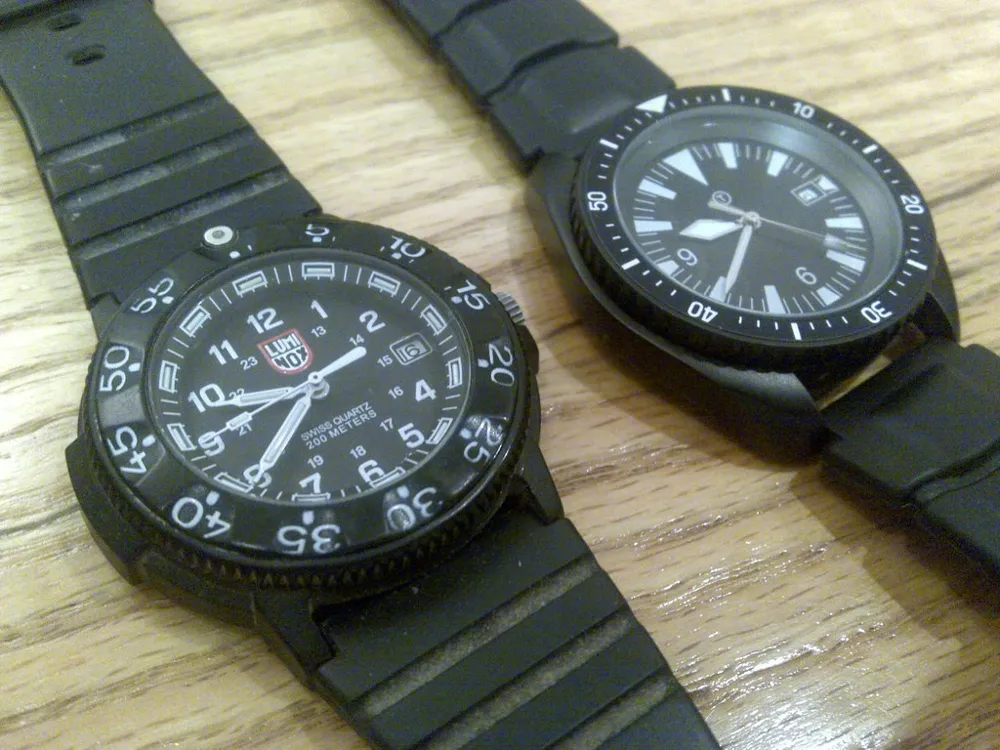
ISO 6425, titled "Horology — Divers' watches," is the international standard for dive watches. The current edition is ISO 6425:2018, which ISO lists as reviewed and confirmed in 2024. ISO says it applies to watches designed to withstand diving to at least 100 meters and equipped with a secured system to show dive time that is visible in darkness. It also covers saturation divers' watches and the markings a maker may put on the watch. Watches that conform can carry the word "DIVER'S" in their markings.
The main requirements and tests, as summarized in the published descriptions of the standard:
| Requirement | What It Means |
|---|---|
| Water resistance | At least 100m. Each watch is tested at 125% of its rating, so a 200m watch is tested to the pressure of 250m. |
| Dive-time indicator | A bezel, digital display or similar that reads elapsed time to 1 minute or better over at least 60 minutes, with clear minute markings. |
| Legibility in the dark | Readable at 25cm in total darkness, plus a sign the watch is running (usually a lumed seconds hand). |
| Magnetic resistance | Keeps accuracy within ±30 seconds a day after exposure to a 4,800 A/m magnetic field. |
| Shock resistance | Survives two hammer shocks (side and crystal) with a limited change in rate. |
| Salt water | 24 hours in a 30 g/L salt solution without damage. |
| Strap strength | Each spring bar or attachment point holds 200 N (about 45 lbf) without damage. |
| Condensation and thermal shock | No water entry or fogging after alternating 40°C and 5°C water baths. |
| Battery warning | Battery-powered watches need an end-of-life indicator, such as a seconds hand that jumps in steps. |
Saturation divers' watches also go through a mixed-gas test, which is why some deep-rated watches have a helium release valve. Recreational divers don't need one.
The key takeaway: a watch marked "200m" without ISO 6425 has only passed its maker's own water test. A watch built to ISO 6425 has passed the full set above. The general water-resistance standard for everyday watches, ISO 2281, doesn't qualify a watch for scuba diving.
Water Resistance Ratings Explained
Ratings are given in meters, bar or ATM, where 1 bar or ATM is roughly 10 meters of water pressure. They're lab pressure figures, not depth limits, and movement in the water, temperature changes and aging gaskets all reduce real-world protection.
| Rating | Good For | Dive Use |
|---|---|---|
| 30m / 3 bar | Rain and splashes | No |
| 50m / 5 bar | Pool swimming | No |
| 100m / 10 bar | Swimming, surfing, snorkeling | Only if certified to ISO 6425 (100m is the minimum) |
| 200m / 20 bar | All surface water sports, skin diving | Yes, if it's a certified or diver's-rated watch |
| 300m and up | Extra margin | Yes, if certified; deeper ratings mainly add durability margin for recreational divers |
Recreational scuba stays far shallower than 100 meters, so a 200m diver isn't "better" for a typical reef dive than a certified 100m one. What matters is that the watch was built and tested as a diver. For swimming and snorkeling ratings in more depth, see our waterproof watches guide, and for how deep recreational divers actually go, see how deep can you scuba dive.
The Unidirectional Bezel and How to Time a Dive
The rotating bezel is the dive watch's built-in timer. On almost all modern dive watches it's unidirectional: it only turns counterclockwise. If you knock it against a rock or boat ladder, it can only make your elapsed time look longer, which means you'd end a dive early, never late. ISO 6425 requires the timing device to be secured against this kind of error.
- At the start of your descent, turn the bezel until its zero marker (usually a lumed triangle or pip) lines up with the minute hand.
- During the dive, read elapsed minutes where the minute hand points on the bezel scale.
- At the end of the dive, the same reading tells you your total bottom time for your log.
Bezels click in fixed steps; the Orient Kamasu, for example, is listed with a 120-click bezel. Insert materials vary too, from aluminum to the ceramic insert on the Mido. Some watches use an internal bezel turned by a second crown instead, and digital divers use an on-screen dive timer.
One limit worth knowing: a bezel only times the dive. It doesn't track depth or nitrogen loading, so it's adequate on its own only for simple, shallow, single-gas dives planned with tables.
Lume and Legibility
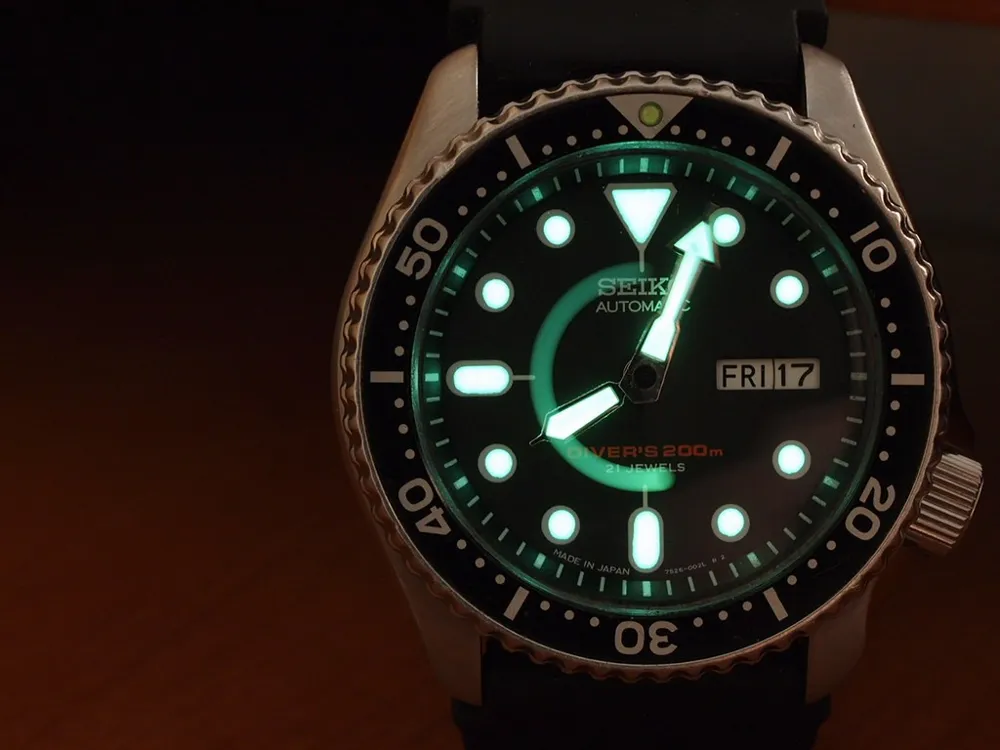
Light fades fast underwater, especially in murky water, at depth, on night dives and inside wrecks. That's why ISO 6425 requires a watch to be readable at 25cm in total darkness and to show it's running. Look for:
- Big, simple hands and markers that contrast with the dial. A distinct minute hand matters most, because that's what you read against the bezel.
- Lumed bezel pip so you can see where you set the start time.
- Lumed seconds hand or tip, which confirms the watch is still running.
Most watches use non-radioactive strontium-aluminate pigments such as Super-LumiNova (used by Swiss brands including Mido and Tissot) or Seiko's LumiBrite. These glow after being charged by light. Some watches use tiny gas-filled tritium tubes instead, which give off their own light. Charge photoluminescent lume with a dive light or in the sun before a dive, and keep a dive light handy anyway.
Automatic vs Quartz vs Solar
| Movement | How It's Powered | Upsides | Things to Know |
|---|---|---|---|
| Automatic (mechanical) | A rotor winds the mainspring as you move | No battery; traditional appeal | Less accurate; stops if unworn long enough; needs periodic service |
| Quartz | Battery | Accurate, affordable, keeps running off the wrist | Battery changes mean opening the case and resealing |
| Solar quartz | Light charges a rechargeable cell | Quartz accuracy without routine battery swaps | Needs regular light exposure; don't leave it in a drawer for months |
All three types can be proper dive watches. Mechanical watches should be worn or hand-wound before a dive so they don't stop mid-dive; the Seiko 4R36 picks list about 41 hours of reserve, while the Mido is listed at 80 hours. Battery quartz divers built to ISO 6425 must warn you when the battery is nearly flat. Solar models like the Citizen Eco-Drive picks sidestep routine battery changes, which is part of why they're popular as low-fuss dive and travel watches.
Straps and Bracelets
A dive watch has to stay on your wrist while you kick, climb ladders and pull off gear, and it has to fit over a wetsuit. ISO 6425 includes a strap-strength test for this reason.
- Rubber, silicone and polyurethane: the classic dive choice. They don't absorb water, they rinse clean and many are long enough for a wetsuit sleeve. The Seiko Turtle and Citizen BN0150 ship on these.
- Steel or titanium bracelet: durable and smart enough for daily wear. Look for a diving extension in the clasp, like the Mido's, which opens out to fit over neoprene.
- Nylon single-pass (NATO-style) straps: secure, because the watch stays on even if one spring bar fails, and cheap to replace. They dry slower than rubber.
- Leather: not for the water. Save it for land.
Check the lug width (20mm on the Citizen BN0150, 22mm on the Seiko Turtle, Orient Kamasu and Mido) before buying a spare strap.
Dive Watch vs Dive Computer

For actual scuba diving, a dive computer is the primary instrument. It tracks depth and time continuously, calculates your no-decompression limits, warns about fast ascents and times safety stops. Dive computers have largely replaced dive watches as primary dive instruments. A watch with a bezel times the dive, but it can't tell you how deep you are or how much nitrogen you've absorbed.
| Dive Watch | Dive Computer | |
|---|---|---|
| Dive time | Yes, with the bezel | Yes, automatically |
| Depth | No | Yes |
| No-deco limits and ascent warnings | No | Yes |
| Dive log | No | Yes |
| Power | Automatic, quartz or solar; runs for years | Battery that needs charging or replacing |
| Everyday wear | Yes | Watch-style models only |
So why wear a dive watch? As a backup timer if your computer fails, for timing surface intervals, and as a durable everyday watch. Divers on planned decompression dives often carry a backup computer instead. If you only buy one instrument for scuba, make it a computer: see our best dive computers, and the full kit list in our scuba diving equipment list. Watch-style computers like the Garmin Descent blur the line between the two, but they need regular charging.
How to Choose a Dive Watch
Decide How You'll Use It
If you scuba dive, prioritize ISO 6425 certification or a clear "diver's" rating from the maker, and wear it alongside a computer. If you mainly swim, snorkel and want the look, a dive-style watch rated to 100 or 200 meters is enough; our waterproof watches guide covers those.
Size and Fit
Dive watches run large. Compare diameter, lug-to-lug length and thickness with a watch you already own. The 40mm Tissot and 41.8mm Orient wear smaller than the 44–45mm Citizens and Seiko Turtle.
Crystal
Sapphire (Mido, Orient) is highly scratch resistant. Mineral crystals (Citizen describes the BN0150's as impact and shatter resistant) and Seiko's Hardlex are common on affordable divers and are less scratch resistant than sapphire.
Crown and Case Back
A screw-down crown is a must for diving. Screw it fully closed before every water session. A screw-down case back adds another seal.
Price Tier
Budget divers (Casio Duro, Seiko 5 Sports, Orient Kamasu) give you the look and a solid rating. Affordable certified or diver's-rated watches (Citizen Promaster, Seiko Prospex) add proper dive credentials. Mid-range Swiss models (Mido, Tissot) add longer power reserves, ceramic bezels or sapphire crystals and more finishing.
Caring for a Dive Watch
- Rinse in fresh water after every salt-water or pool session, turning the bezel to flush out sand and salt.
- Never operate the crown underwater, and check it's screwed down before you get in.
- Avoid hot tubs and saunas, where heat ages the gaskets.
- Have the seals pressure-tested before a dive trip if the watch is a few years old, and every time the case is opened for a battery change.
- Service automatics at the maker's recommended interval.
- Stop using it in the water if you see fog under the crystal, and have it checked.
New to diving? Start with how to get scuba certified and our scuba tips for beginners.
More Scuba Gear Guides
Round out your kit with the best scuba masks, scuba fins, a dive knife or line cutter and dive lights, or browse all our snorkeling and diving guides.
Frequently Asked Questions
What makes a watch a true dive watch?
A true dive watch meets ISO 6425, the international standard for divers' watches. It must be water resistant to at least 100 meters, have a secured way to time a dive that is readable in the dark, and pass tests for shock, magnetism, salt water and strap strength.
Is a 200m dive watch safe to dive to 200 meters?
Recreational scuba limits are far shallower than 200 meters, so the rating is a safety margin rather than a target. ISO 6425 watches are pressure-tested at 125 percent of their rating, but you should still stay within your training and your dive computer's limits.
Do I need a dive watch if I have a dive computer?
No, a dive computer does far more: it tracks depth and time and calculates your no-decompression limits. Many divers still wear a dive watch as a backup timer, or use it for surface intervals.
Why do dive watch bezels only turn one way?
A unidirectional bezel can only turn counterclockwise. If it gets bumped, it can only make your elapsed time look longer, never shorter, so you end a dive early rather than late.
Is an automatic or quartz dive watch better?
Quartz and solar watches are more accurate and keep running when you take them off. Automatics need no battery but can stop if left unworn, so wind or wear them before a dive. Both can meet ISO 6425.
Can I wear a dive watch every day?
Yes. Dive watches are built to be tough and legible, which is why many people wear them daily. Rinse them after salt water and have the seals checked every few years or after a battery change.