How to Paddle Board With Your Dog, Step by Step (2026)
Most dogs that can swim can learn to ride a SUP. The right board, a life jacket with a handle and a slow training plan do most of the work.
Can Your Dog Ride a Paddle Board?
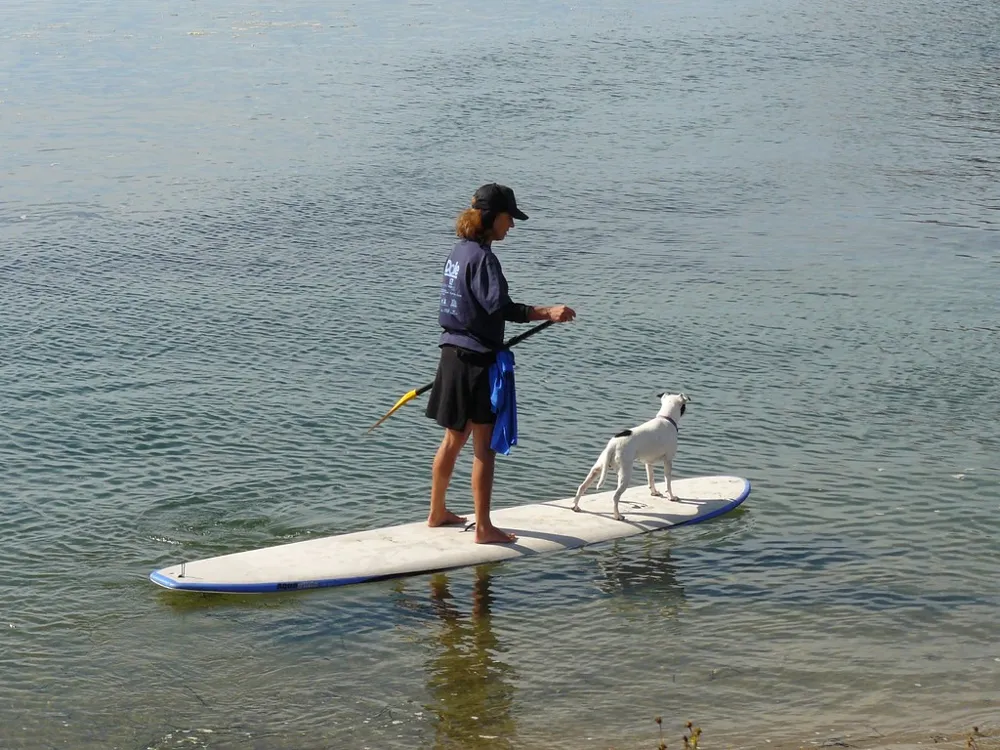
Paddle boarding with a dog is one of the easiest ways to share a day on the water. A paddle board has no cockpit to climb into, so a dog can sit, lie down or stand on the open deck, hop off for a swim and climb back on. According to certified trainer Nicole Ellis, quoted by the American Kennel Club, any dog that is fit enough to swim and climb back on the board with your help can join you.
That said, not every dog is a natural swimmer. The AKC notes that some breeds, including short-legged, long-bodied dogs, find swimming harder and may need a life vest to stay safe, while water breeds like Labradors usually take to it quickly. If your dog is a puppy, a senior, has health problems or is scared of water, check with your vet before you start. This guide covers choosing a board, traction and claws, dog life jackets, land training, getting on and off, where your dog should ride and how to stay safe in heat and cold.
New to SUP yourself? Learn to stand and paddle alone first with our beginner's guide to paddle boarding, then add your dog.
What You Need
The gear list is short. The AKC's checklist covers a board, a life jacket for you, a dog life jacket (ideally with a handle), plenty of drinking water and treats that stay intact when wet.
| Item | Why It Matters |
|---|---|
| Wide, stable paddle board | Room for your dog and a forgiving platform when it moves around |
| Traction or deck pad | Gives paws grip so your dog doesn't slide off |
| Dog life jacket with a top handle | Keeps your dog afloat and gives you something to lift by |
| Your own life jacket | Required by the US Coast Guard on a board used as a vessel |
| Board leash (for you) | Keeps the board close if you fall in |
| Fresh water and a collapsible bowl | Stops your dog drinking lake or seawater |
| Treats in a waist pouch | Rewards on the water without digging through a bag |
| Dog-safe sunscreen (pale noses) | Light-skinned or thin-coated dogs can sunburn |
For the rules on your own life jacket, whistle and light, plus leashes and deck bags, see our paddle board accessories checklist.
Choosing a Board for You and Your Dog
Stability and capacity matter more than speed. A dog shifts its weight without warning, so a wider board gives you a bigger margin for balance.
- Width: Paddling Magazine suggests looking for a board 30 to 34 inches wide. Wider boards are more stable, which helps new human-and-dog teams.
- Length: SUP instructor and trainer Maria Christina Schultz, quoted by Chewy, suggests a board about 11 to 12.5 feet long and 32 inches wide, and a longer, wider board for bigger dogs. Extra length also gives your dog room to lie down in front of you.
- Weight capacity: add your weight, your dog's weight and your gear, then compare it with the board's listed capacity. Paddling near the maximum makes a board sit lower and feel less stable, so leave some headroom.
- Volume: more volume floats more weight. For the volume-per-body-weight rule of thumb and full sizing tables, see our paddle board size chart.
| Step | Example |
|---|---|
| Your weight | 170 lb |
| Your dog's weight | 60 lb |
| Gear (water, bowl, dry bag) | 10 lb |
| Total load | 240 lb |
| What to look for | A board whose listed capacity sits comfortably above 240 lb, not right at it |
If you don't own a board yet, Ruffwear suggests renting or borrowing one for your first try, then buying once you know what works for your dog. Our beginner paddle boards and inflatable paddle boards guides list stable, wide options with their capacities.
Inflatable or Hard Board: Traction and Claws
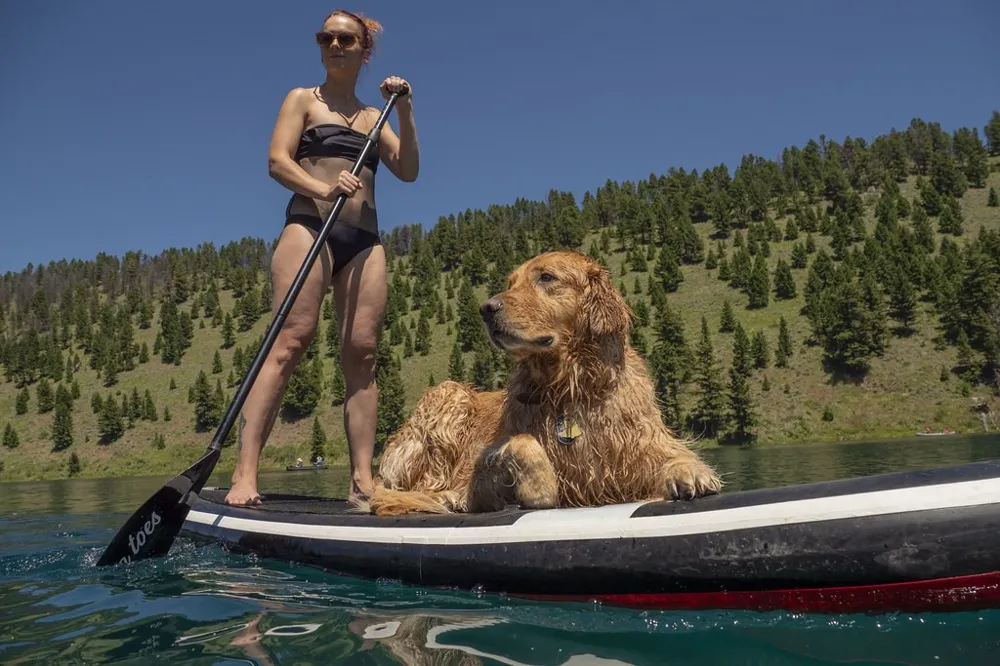
Grip is the difference between a relaxed dog and one that scrambles. The AKC recommends a board with a gripped area so your dog doesn't slide into the water.
- Inflatable boards: Ruffwear recommends inflatables for dogs because they offer better paw grip and stand up to claws. Schultz told Paddling Magazine that dog nails won't puncture an inflatable board. Inflatables are also softer if your dog flops down suddenly.
- Hard boards: many hard boards have a deck pad only where you stand. Paddling Magazine recommends a full-length deck pad on a hard board so your dog has grip in front of you as well, and claws can scratch bare epoxy or plastic.
If your board's pad stops short of the nose, an add-on foam traction pad fills the gap. Trimmed nails are less likely to scuff the pad. For a deeper look at the two board types, read inflatable vs hard paddle board.
Pelican Dog Traction Pad
Pelican's add-on pad is made of EVA foam with a diamond-pattern surface for grip. It comes as four pads that stick on with adhesive tape on the back, and two paw-shaped cutouts can be placed elsewhere on the deck. The maker says the flexible foam can be cut to fit. It's sold for kayaks and other watercraft, so measure the open area in front of your standing spot first.
Good to Know
- Can be trimmed to fit your deck
- Adds grip where a board's pad ends
Watch Out For
- Adhesive is meant to stay; check placement before you press it down
- Marketed for kayaks, so check the size against your board
Dog Life Jackets: What to Look For
Even strong swimmers tire, and a dog that falls off in deep water needs help getting back aboard. The AKC's water-safety advice is to choose a dog life jacket that is durable, adjustable and has a sturdy handle, with a D-ring for clipping on a leash. For paddle boarding, the handle is the key feature: Ellis tells the AKC to always lift by the life jacket, not by the collar.
- Top handle: sturdy and well stitched, positioned so you can lift your dog's weight evenly.
- Fit: measure your dog's chest girth and use the maker's size chart, and adjust the straps so the jacket sits snugly.
- Flotation layout: Ruffwear describes placing foam panels to support a natural swimming position.
- Visibility: bright colors and reflective trim make your dog easier to spot in the water.
Let your dog wear the jacket around the house and on walks before the first paddle, so it's familiar by the time you hit the water.
Ruffwear Float Coat
Ruffwear's Float Coat is a dog life jacket with a rear handle for lifting your dog, a leash clip-in point and reflective trim. Ruffwear designs it to support swimming. Use the size chart on the listing.
Good to Know
- Rear handle for lifting your dog aboard
- Reflective trim and leash attachment point
Watch Out For
- Measure girth carefully; sizes vary between brands
Outward Hound Granby Splash
An affordable dog life jacket with adjustable straps. Check the listing's size chart against your dog's girth and confirm it has a top handle in your size.
Good to Know
- Adjustable straps for a snug fit
Watch Out For
- Check the handle and fit before relying on it to lift a large dog
Your own life jacket matters just as much; see PFDs for paddlers. For a kayak instead of a board, see best kayaks for dogs.
Train on Land First
Every source agrees on this: introduce the board on dry ground before it ever touches the water. Basic cues help a lot, and the AKC recommends sit, down, come and stay.
- Let your dog explore. Lay the board on the floor or lawn with the fins off. Scatter treats on the deck and let your dog sniff and step on.
- Reward all four paws. Praise and treat as soon as all four paws are on the board.
- Add sit and down. Ask for a sit or down on the board and slowly lengthen the stay. Chewy's trainer suggests building up to 2 to 3 minutes.
- Teach an on and off cue. Use a word such as "up" to get on and a release word such as "okay" or "hop off" to get off, and only let your dog leave on the release.
- Add the life jacket. Repeat the steps with your dog wearing its jacket.
- Add you and the paddle. Kneel, then stand on the board with your dog, and practice paddle strokes so the movement isn't a surprise.
- Practice the lift. Use the jacket handle to help your dog onto the board on land, then in shallow water.
This can take a few sessions or several days. Keep each one short and upbeat.
Shallow-Water Practice
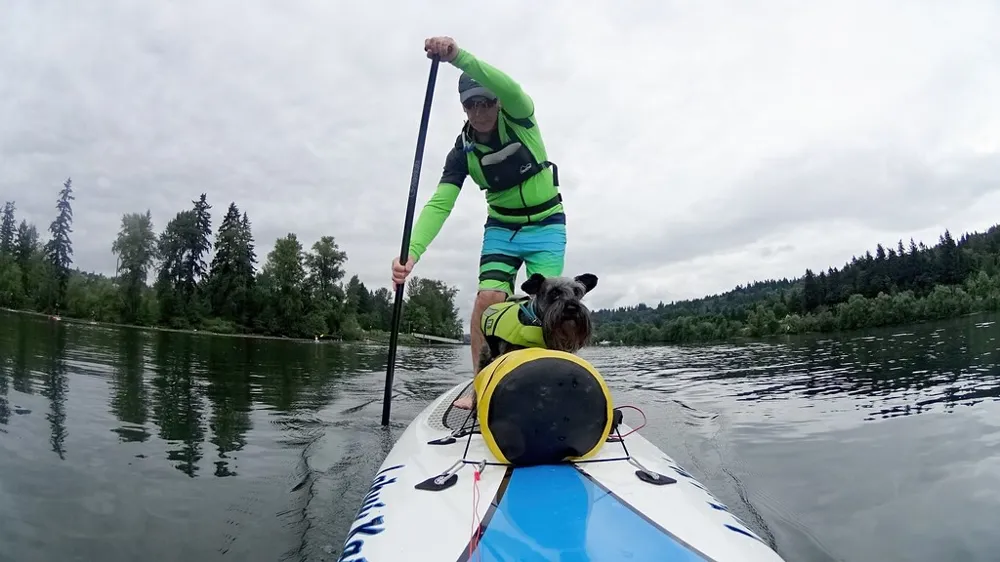
Once your dog is calm on the board at home, move to shallow, calm water where you can stand. Hold the board steady, lure your dog on with a treat or your "up" cue, and ask for a down. The AKC notes that if the down doesn't happen, it's fine to try again another day. When your dog settles, sit or kneel on the board in the shallows, then try standing and paddling a few strokes before heading slightly deeper.
Burn off some energy first. Both Ruffwear and Chewy suggest a walk, a game of fetch or a swim before boarding so your dog is more likely to relax.
Getting On and Off the Board
Getting on: Chewy's trainer suggests getting on first in a kneeling position and then calling your dog aboard. Dogs can step on from a low dock or the shore, or wade out if the water is shallow. Keep the board parallel to shore in water deep enough that the fin doesn't hit bottom.
Getting off: use your release cue at the shore. Coming in, kneel before you reach the shallows so your dog's leap doesn't knock you off balance.
Getting back on from deep water: Ruffwear describes a simple routine for helping a swimming dog back aboard:
- Stay centered on the board, kneeling.
- Bring your dog alongside in front of you, with its body perpendicular to the board's rails.
- Grab the life jacket handle.
- As your dog gets its front paws on, give a slight tug up to help a back leg onto the board.
- Keep holding the handle until all four paws are on.
- Wait for the shake before you stand back up.
- Praise your dog for swimming back, without making a fuss about the fall.
The aim is to assist, not to haul your dog's full weight. Practice this on a warm day before you need it.
Where Your Dog Should Sit or Stand
Keep your dog in the middle of the board, the AKC advises, either between your feet or in front of you. A dog lying down lowers its center of gravity and makes tipping less likely, while a large dog that moves around makes the board rock more.
- Small and medium dogs: usually ride in front of you on the deck pad, facing forward.
- Large dogs: lying down close to your feet keeps their weight near the board's center.
- Personal preference: Ruffwear describes two dogs in the same home that each picked a different spot, one in front and one behind the paddler, so watch where your dog settles.
- Your stance: beginners can kneel to lower their own center of gravity and stand once balance improves.
Paddle smoothly. "Smooth and steady are your keywords," trainer Ali Smith told the AKC.
When Your Dog Jumps or Falls In
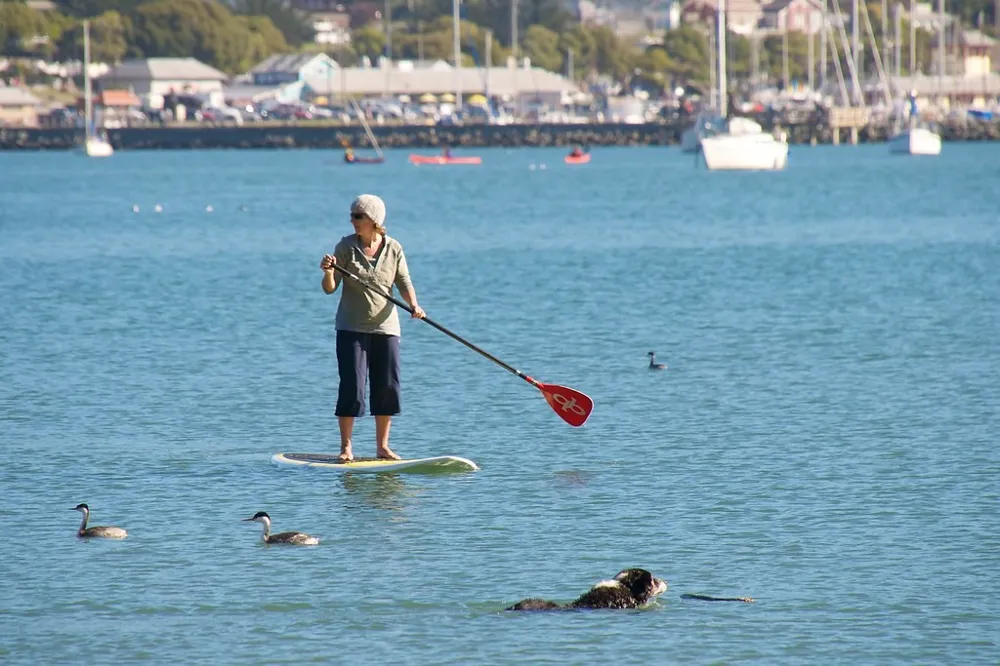
Expect it. A dog spotting a duck or a fish can jump with no warning, and the AKC notes that a sudden leap can tip the board. Stay calm, kneel and help your dog back on.
- If you both go in, Paddling Magazine says to recover the board first, then your dog and then your gear. Your board leash keeps the board close.
- Never tie your dog to the board. A dog leash is optional on flat water for a well-trained dog; if you use one, Schultz suggests a short leash of about four feet clipped to the life jacket, not the collar, and never in current.
- Watch for stress. Whimpering, trembling and pacing are signs to head back to shore, per Chewy.
Heat, Sun and Water Safety
- Heatstroke: the AKC lists heavy panting, a rapid heart rate, heavy drooling and hot skin as warning signs. Glare off the water and a life jacket both add heat, so take shade breaks and head in if you see them. A board deck can also get hot in strong sun.
- Drinking water: bring fresh water and a bowl so your dog doesn't drink from the lake or sea. A few gulps of saltwater can cause diarrhea, and the AKC warns large amounts can be fatal.
- Too much water: though rare, swallowing a lot of water while swimming can lead to water intoxication. The AKC lists bloating, lethargy and vomiting as signs; see a vet right away.
- Sunburn: light-skinned and thin-coated dogs can burn. The AKC suggests a sunscreen made for dogs on the nose.
- Toxic algae: Cornell's College of Veterinary Medicine warns that blue-green algae blooms can be rapidly fatal to dogs and that you can't tell a toxic bloom by looking. Avoid water with scum, foam, mats or an odd smell, check local advisories, and if you suspect exposure, rinse your dog with fresh water and go to a vet immediately.
- Other hazards: the AKC flags baited fish hooks, snakes and snapping turtles, and alligators in some southern areas. Steer clear of fishing lines and boat traffic.
This is general information, not veterinary advice. Ask your vet about your own dog's health and fitness.
Cold Water and Cool Weather
A dog that falls into cold water loses heat quickly, especially a small, thin-coated or young dog. A trainer's guideline shared by the AKC is that the water temperature plus the air temperature should add up to at least 100°F before a dog swims. Cold water can also cause "cold tail" (limber tail), where the tail hangs limp; the AKC says to see a vet right away if your dog shivers or stops using its tail after a cold swim.
- Save deep-water and fall-in practice for warm days.
- Bring a towel and keep spring and fall trips short and close to shore.
- Dress for the water temperature yourself; see wetsuit vs drysuit.
Your First Trip: A Simple Plan
- Pick the spot: a small, calm lake or cove with an easy, gradual entry, little boat traffic and no visible algae. Check that paddle boarding and dogs are allowed there; the AKC notes this helps you avoid danger and fines.
- Pick the day: warm, sunny and glassy, without wind. Avoid the hottest part of a summer afternoon.
- Prepare your dog: a walk or a game of fetch first, life jacket on and checked for fit.
- Keep it short: Chewy's trainer recommends a first paddle of under 15 minutes. Paddling Magazine adds that simply sitting on the board together on the water counts as a good first outing.
- Stay near shore: paddle parallel to the bank so you can land quickly.
- End on a high note: head in while your dog is still relaxed, then build up time and distance on later trips.
Learning time varies a lot. Chewy reports one dog that learned in a week and another that took four months.
Common Mistakes to Avoid
- Skipping land training and launching straight into deep water.
- Lifting by the collar instead of the life jacket handle.
- Choosing a narrow board or loading it near its maximum capacity.
- Bare, slippery decks with no grip in front of your feet.
- Tying the dog to the board or using a leash in current.
- Going too long, too soon, especially on hot or cold days.
- Letting your dog drink lake or seawater instead of bringing fresh water.
Once you're both comfortable, try longer flat-water tours, calm-day paddle board yoga with your dog lying at the nose, or compare options in kayak vs paddle board. More guides are on our paddle boarding hub.
Frequently Asked Questions
Can any dog go paddle boarding?
Trainer Nicole Ellis, quoted by the AKC, says any dog fit enough to swim and climb back on with your help can join you. Dogs that are afraid of water may be happier with a different activity, and it's worth checking with your vet first.
What size paddle board do I need for a dog?
A wide, stable board, often 32 inches or wider and around 11 to 12.5 feet long for a paddler with a medium or large dog. Add your weight, your dog's weight and your gear, and stay comfortably under the board's listed capacity.
Will my dog's claws pop an inflatable paddle board?
Instructor Maria Christina Schultz told Paddling Magazine that dog nails won't puncture an inflatable board, and Ruffwear notes inflatables hold up well to claws. A deck pad still protects the surface and gives paws grip.
Does my dog need a life jacket on a paddle board?
Yes. Pick a dog life jacket with a sturdy top handle so you can help your dog back aboard, and lift by the handle, never the collar. You also need your own life jacket.
Should I leash my dog to the paddle board?
Never tie a dog to the board. Paddling Magazine says a short leash clipped to the dog's life jacket is optional on flat water once your dog reliably stays put, but not in current.
How long does it take a dog to learn to paddle board?
It varies. Chewy reports dogs that learned in a week and others that took four months, so let your dog set the pace.
How old should a dog be to paddle board?
Trainer Ali Smith, quoted by the AKC, suggests waiting until about 18 to 24 months because puppies struggle to focus, though a dog with a solid recall could start at around 6 months in a well-fitted life jacket.