Olympic Canoeing and Kayaking: Sprint, Slalom and Kayak Cross Explained (2026)
Olympic paddling has 16 medal events split between flatwater sprint and whitewater slalom, including the newest one, kayak cross. Here's how each works, who won in Paris and what's set for LA28.
Olympic Canoeing and Kayaking at a Glance
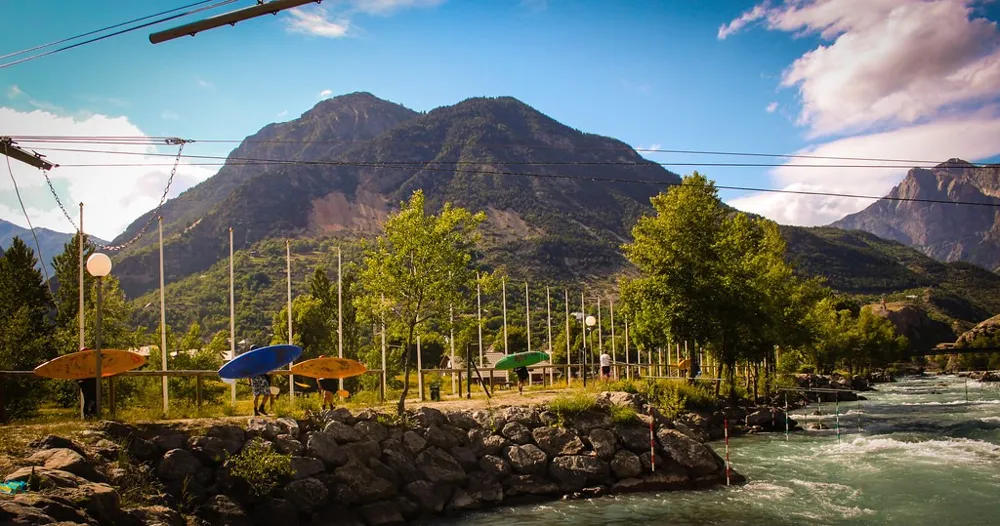
At the Olympics, "canoe" is the umbrella name for both canoes and kayaks. The sport is governed by the International Canoe Federation (ICF) and splits into two disciplines: canoe sprint on flat water and canoe slalom on whitewater, which since Paris 2024 also includes kayak cross. Men and women have the same number of events.
| Discipline | Water | Events | How You Win | Olympic Debut |
|---|---|---|---|---|
| Canoe sprint | Flat water, straight lanes | 10 (5 men's, 5 women's) | First bow across the line | 1936, Berlin (demonstration 1924) |
| Canoe slalom (K1, C1) | Whitewater course with gates | 4 (2 men's, 2 women's) | Lowest time plus penalties | 1972, Munich (held in Augsburg); permanent from 1992 |
| Kayak cross | Whitewater course with gates | 2 (1 men's, 1 women's) | First across without faults, four boats at once | 2024, Paris |
Canoe vs Kayak: What C1, K1 and the Other Codes Mean
Every Olympic paddling event has a short code. The letter is the boat type and the number is how many people are in it: K1 is a single kayak, C2 a two-person canoe, K4 a four-person kayak. Kayak cross is sometimes written KX-1 or X-1.
| Kayak (K) | Canoe (C) | |
|---|---|---|
| Position in sprint | Seated | Kneeling on one knee, other foot forward |
| Position in slalom | Seated, with a spray skirt | Kneeling with both legs tucked under, with a spray skirt |
| Paddle | Double-bladed | Single-bladed, on one side |
| Steering | Sprint kayaks have a small foot-operated rudder; slalom kayaks do not | No rudder; steered with strokes such as the J-stroke |
| Olympic classes | K1, K2, K4 (sprint); K1 and kayak cross (slalom) | C1, C2 (sprint); C1 (slalom) |
Racing boats are nothing like the recreational boats most people paddle. Sprint boats are long, narrow and tippy, built to strict ICF length and minimum-weight rules, while slalom boats are short and flat for quick turns. Under ICF rules cited by Wikipedia, slalom K1 and C1 boats must be at least 3.5 m long, 0.6 m wide and 9 kg. For everyday boats, see our canoe vs kayak comparison and the types of kayaks guide.
Canoe Slalom: How the Gates and Penalties Work
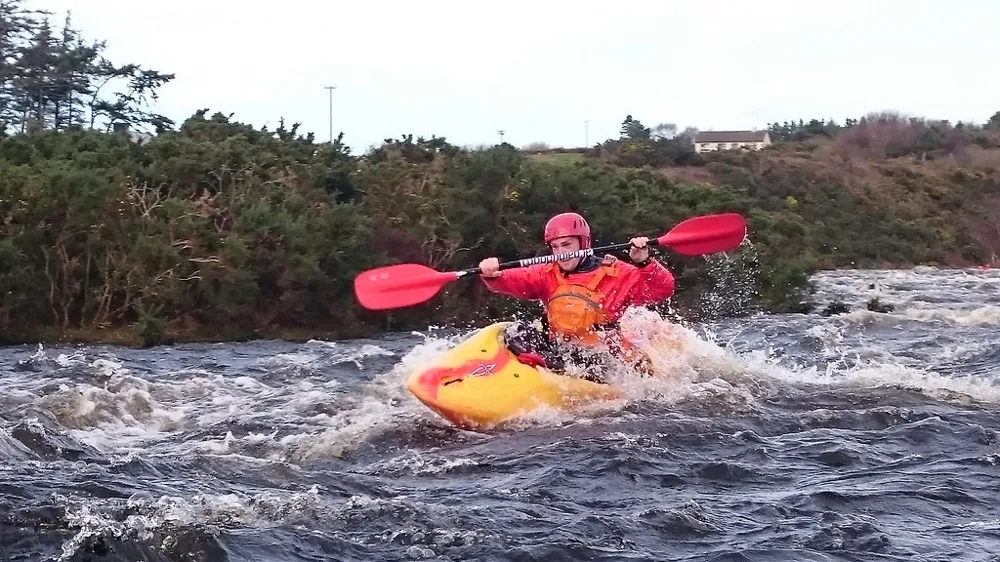
Slalom is a race against the clock. One paddler at a time runs a whitewater course, usually an artificial concrete channel, passing through numbered gates in order. Courses run a few hundred meters (sources give roughly 150 to 400 m) and are designed to take the fastest paddlers about 90 to 110 seconds.
- Gates: 18 to 25 per course, each made of two poles hung over the water. Green-and-white gates are taken going downstream; red-and-white gates must be taken going upstream, usually by turning into an eddy. Courses have at least six upstream gates.
- Clean pass: the paddler's whole head and part of the boat must go through the gate at the same time.
- 2-second penalty: the boat, paddle or body touches a pole.
- 50-second penalty: missing a gate, pushing a pole out of the way on purpose, going through upside down or in the wrong direction, or taking gates out of order.
- One penalty per gate: only the highest penalty at each gate counts.
Score = run time + penalty seconds, and the lowest score wins. A single 50-second penalty almost always knocks a paddler out of medal contention, so athletes study the course carefully before racing. Team Canada's explainer describes the usual format as two qualifying runs (best one counts), then a single semifinal run and a single final run. Slalom paddlers must wear helmets and spray skirts.
The boats and skills overlap with recreational river running; our whitewater kayaks guide covers the gear.
Kayak Cross: The Newest Olympic Paddling Event
Kayak cross (also called extreme slalom) brings a head-to-head element to whitewater. It debuted at Paris 2024, replacing the K1 200 m sprint events on the program.
- Four at once: four paddlers slide off a starting ramp into the water together.
- Same boats: Team Canada describes them as identical plastic creek boats, so equipment differences are small.
- Gates and a roll: racers pass set upstream and downstream gates and must complete a full kayak roll in a marked zone.
- Contact allowed: bumping is part of racing, but dangerous paddling can lead to disqualification.
- Faults, not seconds: paddlers with zero faults are ranked by finishing order, ahead of anyone with a fault. The top two in each heat advance.
At Paris, kayak cross started with a time trial, then moved through rounds, heats, quarterfinals and semifinals to a four-boat final. If you want to learn the roll yourself, start with our guide on how to roll a kayak.
Canoe Sprint: Flatwater Racing in Lanes
Sprint is the older and bigger discipline. Boats race side by side in buoyed lanes on still water, starting from a mechanical gate, and the first bow across the finish line wins. Faster qualifiers are seeded into the middle lanes. Most events run heats, quarterfinals, semifinals and a final.
| Men's Events | Women's Events |
|---|---|
| K1 1000 m | K1 500 m |
| K2 500 m | K2 500 m |
| K4 500 m | K4 500 m |
| C1 1000 m | C1 200 m |
| C2 500 m | C2 500 m |
Key Sprint Rules
- False starts: a boat that moves early gets a warning and the race restarts; a second false start by the same boat means disqualification.
- Five-meter rule: boats may not come within five meters of a neighbor, and leaving your lane leads to disqualification.
- Capsizing means disqualification for that boat.
- Boat weight: boats are weighed, and an underweight boat is disqualified.
- Crew changes are not allowed once the competition has started.
A Short History of Olympic Canoeing
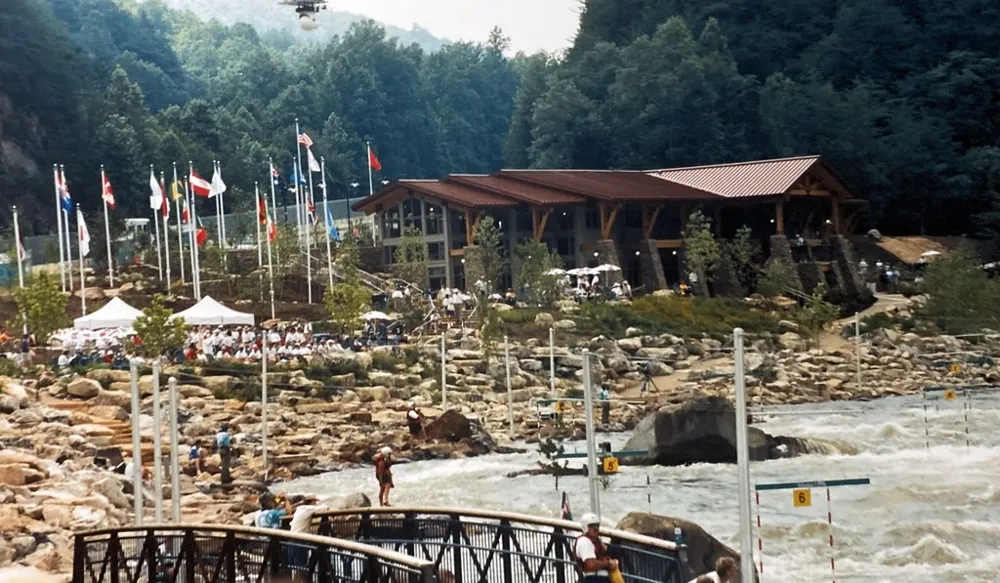
Paddle racing appeared as a demonstration event at Paris 1924 and became a medal sport at Berlin 1936, with nine events that included 10,000 m races and folding kayak events that were never repeated. Women's kayaking joined at London 1948. Slalom debuted at Munich 1972, raced on an artificial channel in Augsburg, then disappeared until Barcelona 1992, when it returned at La Seu d'Urgell and stayed. Every Olympic slalom venue has been an artificial channel except Atlanta 1996, which used the Ocoee River. Read the wider story in our history of kayaking.
| Year | Milestone |
|---|---|
| 1924 | Demonstration event at the Paris Games |
| 1936 | Medal debut in Berlin (9 events) |
| 1948 | First women's paddling event, in London |
| 1972 | Slalom debuts at Munich (in Augsburg) |
| 1992 | Slalom returns at Barcelona; program grows to 16 events, where it has stayed |
| 1996 | Slalom held on a natural river, the Ocoee |
| 2012 | 200 m sprint events added, replacing men's 500 m races |
| 2020 (held 2021) | Women race canoes for the first time; men's C2 slalom dropped and women's C1 slalom added; equal events for men and women |
| 2024 | Kayak cross debuts, replacing K1 200 m; men's K2 and C2 move from 1000 m to 500 m |
Historically, Germany and Hungary have been the powerhouses of sprint, while France and Slovakia top the slalom medal table with eight golds each, according to Wikipedia's all-time tables (checked November 2026).
Paris 2024 Results and Highlights
All 16 events took place at the Vaires-sur-Marne Nautical Stadium: slalom from July 27 to August 5, 2024, and sprint from August 6 to 10. New Zealand topped the canoe medal table with four golds, Australia won three, and Hungary took the most medals (seven) without winning a gold.
- Jessica Fox (Australia) won both the women's K1 and C1 slalom.
- Lisa Carrington (New Zealand) won three sprint golds: K1 500 m (in an Olympic best time), K2 500 m and K4 500 m.
- Katie Vincent (Canada) won the women's C1 200 m by one hundredth of a second, 44.12 to 44.13, over Nevin Harrison of the USA.
- Finn Butcher (New Zealand) and Noemie Fox (Australia) became the first Olympic kayak cross champions.
- The women's K2 500 m ended with a shared bronze between Germany and Hungary.
Slalom and Kayak Cross Medalists
| Event | Gold | Silver | Bronze |
|---|---|---|---|
| Men's C1 | Nicolas Gestin (France) | Adam Burgess (Great Britain) | Matej Beňuš (Slovakia) |
| Men's K1 | Giovanni De Gennaro (Italy) | Titouan Castryck (France) | Pau Echaniz (Spain) |
| Men's kayak cross | Finn Butcher (New Zealand) | Joe Clarke (Great Britain) | Noah Hegge (Germany) |
| Women's C1 | Jessica Fox (Australia) | Elena Lilik (Germany) | Evy Leibfarth (USA) |
| Women's K1 | Jessica Fox (Australia) | Klaudia Zwolińska (Poland) | Kimberley Woods (Great Britain) |
| Women's kayak cross | Noemie Fox (Australia) | Angèle Hug (France) | Kimberley Woods (Great Britain) |
Sprint Gold Medalists
| Event | Men's Gold | Women's Gold |
|---|---|---|
| K1 | Josef Dostál (Czech Republic), 1000 m | Lisa Carrington (New Zealand), 500 m |
| K2 500 m | Germany | New Zealand |
| K4 500 m | Germany | New Zealand |
| C1 | Martin Fuksa (Czech Republic), 1000 m | Katie Vincent (Canada), 200 m |
| C2 500 m | China | China |
LA28: Oklahoma City and Long Beach
The 2028 Games keep the same 16 canoe events, according to the LA28 event list reported by NBC Olympics. The two disciplines will be far apart:
- Canoe slalom (including kayak cross): OKC Whitewater Center, Oklahoma City. LA28's June 2024 venue plan moved slalom (and softball) to Oklahoma City. NBC Olympics lists slalom dates of July 14 to 22, 2028.
- Canoe sprint: Marine Stadium, Long Beach, California. NBC Olympics lists sprint dates of July 25 to 29, 2028 and notes it will be the venue's second Olympics.
Schedules and venue details can change, so check the official LA28 and ICF sites before making travel plans (last checked November 2026). For the other water sport heading to Southern California, see Olympic surfing.
Related Guides
Ready to paddle yourself? Start at our kayaking hub, learn how to paddle a kayak or how to paddle a canoe, and choose a kayak paddle. For other Olympic action sports, read about Olympic BMX and Olympic skateboarding.
Frequently Asked Questions
What is the difference between canoe and kayak at the Olympics?
Kayakers sit and use a double-bladed paddle. Canoeists kneel and use a single-bladed paddle, so they must steer by stroke alone. Race codes use K for kayak and C for canoe, plus the number of paddlers.
What is the difference between canoe sprint and canoe slalom?
Sprint is a side-by-side race in lanes on flat water over 200, 500 or 1,000 meters. Slalom is a solo timed run down a whitewater course through 18 to 25 gates, with time penalties for touching or missing gates.
How do slalom penalties work?
Touching a gate pole with the boat, paddle or body adds 2 seconds. Missing a gate, taking it out of order, upside down or in the wrong direction adds 50 seconds. The lowest total time wins.
What is kayak cross?
Kayak cross is a whitewater race where four paddlers drop off a ramp together, pass set gates and complete a kayak roll. Contact is allowed, and the first paddlers home without faults advance. It debuted at Paris 2024.
When did canoeing become an Olympic sport?
Canoe and kayak racing was a demonstration event at Paris 1924 and became a medal sport at Berlin 1936. Women's paddling followed in 1948, and slalom debuted in 1972.
How many canoe and kayak events are at the Olympics?
There are 16: six slalom events (K1, C1 and kayak cross for men and women) and ten sprint events (five each for men and women). The LA28 lineup listed by NBC Olympics has the same 16.
Where is canoeing at the 2028 Olympics?
Canoe slalom is set for the OKC Whitewater Center in Oklahoma City, and canoe sprint for Marine Stadium in Long Beach, California, according to LA28 plans reported by NBC Olympics. Dates may change.