The History of the Kayak: A Timeline From the Arctic to Today (2026)
The kayak was invented by Arctic peoples as a hunting boat thousands of years ago, long before it became a weekend toy or an Olympic sport. Here's how it developed, what the word means and how the boat changed along the way.
Kayak History at a Glance
The kayak's story has two halves: thousands of years as an Arctic hunting boat, and about 150 years as a sport and recreation craft. The dates below are the milestones most histories agree on; early dates are approximate because skin boats rarely survive.
| Date | Milestone |
|---|---|
| Thousands of years ago | Arctic peoples develop the skin-on-frame kayak for hunting; commonly dated to at least 4,000 years ago |
| 1577 | Reported date of the oldest surviving kayak, now in a Munich museum |
| 1740s | Russian expeditions under Vitus Bering meet Aleut (Unangan) paddlers and their many-chined kayaks |
| Mid-1800s | Kayak-style boats catch on for sport in Europe |
| 1905–1906 | Alfred Heurich builds a workable folding kayak and patents it as the Delphin |
| About 1906–1907 | Johann Klepper starts making folding kayaks commercially in Rosenheim, Germany |
| 1924 | Kayak racing is a demonstration event at the Paris Olympics |
| 1928 | Franz Romer crosses the Atlantic in a sailing folding kayak in 58 days |
| 1931 | Adolf Anderle runs the Salzachöfen Gorge in Austria, often called a birthplace of whitewater kayaking |
| 1936 | Kayak sprint becomes an Olympic medal sport in Berlin, including one-off folding kayak races |
| 1940 | First US National Whitewater Championship on Maine's Rapid River |
| 1948 | First women's Olympic kayak event, in London |
| 1950s | Fiberglass kayaks come into wide use |
| 1972 | Canoe slalom (including kayak slalom) debuts at the Munich Olympics |
| 1973 | First rotomolded plastic kayaks appear |
| 1987 | Ed Gillet paddles a tandem kayak solo from California to Hawaii in 64 days |
| 1992 | Slalom returns to the Olympics at Barcelona and has stayed since |
| 2024 | Kayak cross debuts at the Paris Olympics |
What Does "Kayak" Mean?
"Kayak" comes from the Inuktitut word qajaq. Related words include the Yup'ik qayaq and the Aleut iqyax. Qajaq is usually translated as "hunter's boat" or "man's boat," which fits its purpose: it was a one-person craft built for hunting at sea.
As an English word, a kayak is a small, narrow boat with a covered or closed deck, paddled from a seated position with a double-bladed paddle. That paddle and the low seated position are what separate it from a canoe; see canoe vs kayak for the full comparison.
- Spelling: k-a-y-a-k. It's a palindrome, reading the same in both directions.
- Plural: kayaks. The person is a kayaker, and the activity is kayaking.
- "Eskimo roll": the older name for the kayak roll. Many paddlers now just say "kayak roll," partly because many Inuit and Yupik people consider "Eskimo" an outdated colonial term.
Arctic Origins: How Old Is the Kayak?
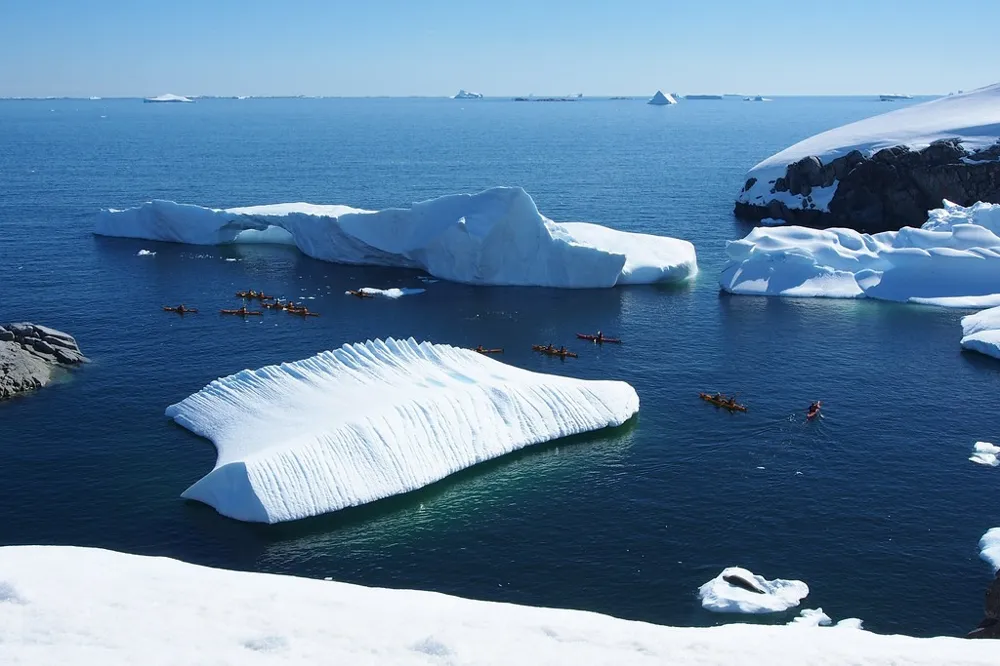
The kayak was developed by the peoples of the Arctic: the Inuit of Greenland and northern Canada, the Yupik of Alaska and Siberia, and the Unangan (Aleut) of the Aleutian Islands, among others. It let hunters approach seals, walrus and whales quietly in cold coastal water and, in some areas, hunt caribou crossing lakes and rivers.
How long ago this began is hard to pin down. Skin and wood decay, so there are few ancient remains to date. Many histories describe the kayak as at least 4,000 years old, while The Canadian Encyclopedia says more cautiously that Inuit used kayaks for over 2,000 years. Both point to the same idea: the kayak is ancient, and it was refined over many generations rather than invented at one moment.
Kayaks worked alongside the umiak (also spelled umiaq), a much larger open skin boat. Umiaks carried families, supplies and groups of hunters; sources give sizes from about 15 to 30 feet and longer, with room for ten or more people. The covered kayak handled rough water better, and the two were often used together during the hunting season.
How Traditional Kayaks Were Built
A traditional kayak is a skin-on-frame boat. Builders stretched and stitched dehaired seal skin, sometimes walrus or caribou skin, over a light frame. In the treeless eastern Arctic, frames often used whalebone; in the western Arctic, builders used wood, much of it driftwood, with willow often chosen for bent ribs. Pieces were lashed with leather, not nailed, which kept the frame flexible.
Seams were sealed with fat or oil from seals, walrus or whales. According to the Smithsonian, that waterproofing lasted only about four to seven days, and skins had to be dried daily, so a kayak needed constant care.
Every kayak was made to fit its owner. Builders used measurements taken from their own bodies, so a boat's length, width and depth matched one paddler. A typical hunting kayak is often described as roughly 17 feet long and 20 to 22 inches wide. Early European visitors who copied the dimensions of one boat struggled to make it work for themselves, because no two were quite the same. Skills were passed down orally, and accounts describe building as shared work, with the skin cover often sewn by women of the household.
Regional Designs: Baidarka and Greenland Kayaks
There was never one "original" kayak. Shapes varied with local water, prey and materials. Three families come up in most histories:
| Design | Region | Features |
|---|---|---|
| Baidarka (Aleut iqyax) | Aleutian Islands and the Bering Sea | Rounded, many-chined hull; often called the oldest design; also built in two- and three-hatch versions |
| West Greenland kayak | West Greenland | More angular, fewer chines, gunwales rising to points at bow and stern |
| East Greenland kayak | East Greenland | Similar to the West Greenland type but a snugger fit and a steeper angle between gunwale and stem |
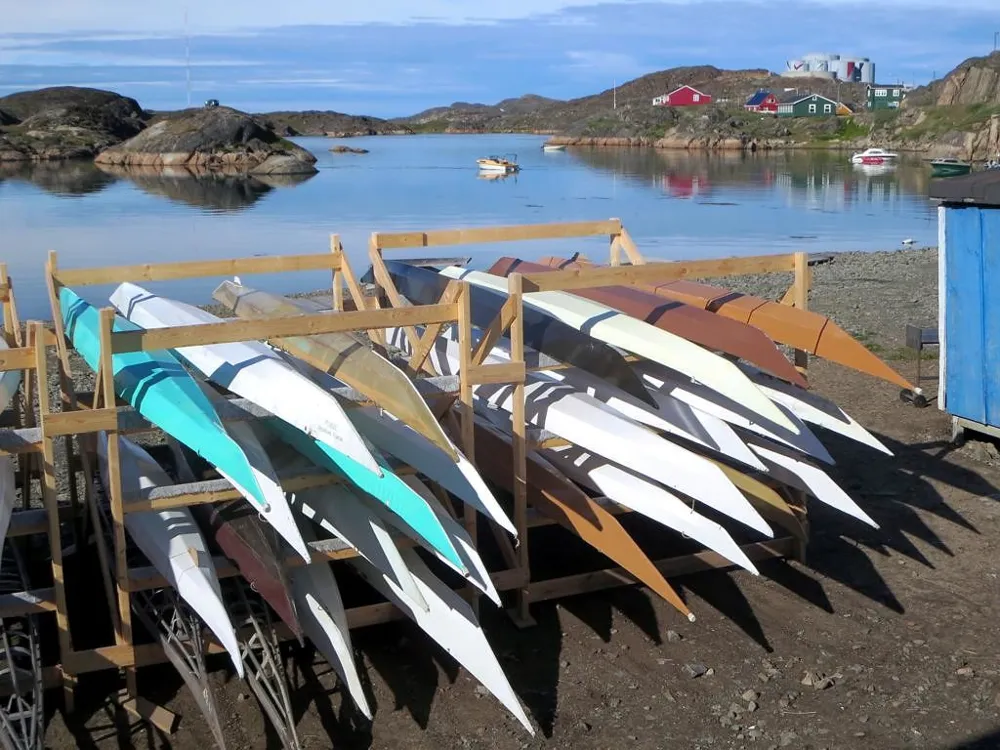
"Baidarka" is the Russian name, used after Russian traders arrived in the region. Boats from the Bering Sea islands and western Alaska also included two- and three-person kayaks, while Greenland kayaks were usually low, narrow one-person boats, the ancestors of today's sea and touring kayaks.
Hunting, the Tuilik and the Kayak Roll
Kayak hunters carried harpoons and throwing boards on deck, and the low profile helped them get close to animals. Many paddled with narrow wooden paddles, and some used single-bladed paddles as well as double-bladed ones.
Capsizing in Arctic water was deadly, so hunters sealed themselves to the boat. In Greenland this was done with the tuilik, a close-fitting waterproof jacket tied around the face, wrists and cockpit rim, traditionally made from seal skin or the intestines of sea mammals. With the jacket and boat sealed together, water stayed out and a capsized hunter could right himself rather than swim. That is the origin of the kayak roll, and Greenland paddlers developed many ways to roll, with or without a paddle. Learn the modern versions in how to roll a kayak.
The tuilik is also the ancestor of the spray skirt and paddling jacket. Today's paddlers use neoprene versions, sometimes still called a tuilik.
Europe Discovers the Kayak (1700s–1930s)
Contact with Europeans came through exploration and trade. In the 1740s, Russian expeditions under Vitus Bering met Aleut hunters, who had several kayak designs and great skill hunting sea otters. That encounter had a harsh side: the newcomers forced some Aleut hunters into their service.
European interest in the boat itself grew in the 1800s. Explorers and collectors brought kayaks home to museums, and by the mid-1800s kayak-style boats were being paddled for sport, especially in Germany and France. Some histories credit Scottish writer John MacGregor with introducing kayak-style boats to Britain and Europe around the 1860s, though accounts differ on the details.
The folding kayak made the sport practical for city dwellers. In 1905, German architecture student Alfred Heurich built a workable folding kayak, paddled it on the Isar River near Munich and patented it the next year as the Delphin. Johann Klepper of Rosenheim turned the idea into a business around 1906–1907, and Klepper's company was reportedly making 90 folding boats a day by 1929. By the mid-1930s, an estimated half-million folding kayaks were in use in Europe, carried by train to rivers and lakes.
Folding boats also made long voyages possible. Franz Romer crossed the Atlantic from the Canary Islands to the Caribbean in a sailing folding kayak in 1928, taking 58 days, and Hannes Lindemann crossed it again in 1956 in a folding Aerius II. During World War II, British commandos used canoes and kayaks in raids such as Operation Frankton against shipping at Bordeaux in 1942. For modern versions, see our folding kayak picks.
Kayaking Becomes an Olympic Sport
Paddle racing was a demonstration event at the 1924 Paris Games and became a full medal sport at the 1936 Berlin Olympics. The Berlin program included folding kayak races over 10,000 meters, which were never held again. Women's kayaking followed at London 1948.
Whitewater racing reached the Games later. Canoe slalom, which includes kayak events, debuted at Munich 1972, dropped out, and returned at Barcelona 1992. Its men's and women's programs were equalized at Tokyo 2020, and kayak cross, where several paddlers race the course at once, debuted at Paris 2024. In race codes, "K" means kayak and "C" means canoe, followed by the number of paddlers, as in K1 or K4.
| Olympic Discipline | Debut | What It Is |
|---|---|---|
| Canoe sprint (kayak events) | 1936, Berlin (demonstration 1924) | Flatwater racing in lanes over set distances |
| Women's kayak sprint | 1948, London | First women's paddling event |
| Canoe slalom (kayak events) | 1972, Munich; permanent from 1992 | Timed runs through gates on a whitewater course |
| Kayak cross | 2024, Paris | Head-to-head whitewater racing with several boats at once |
Whitewater, Fiberglass and Plastic (1930s–1980s)
While racing grew, paddlers also pushed into harder water. In 1931, Adolf Anderle ran Austria's Salzachöfen Gorge, a descent often called a birthplace of modern whitewater kayaking. In the US, the first National Whitewater Championship was held in 1940 on the Rapid River in Maine, and in 1960 Walter Kirschbaum took a fiberglass kayak through the Grand Canyon.
Materials changed everything. Wooden and fabric-on-frame boats, Klepper-style folders included, dominated until the 1950s. Fiberglass boats spread in the 1950s, making stiff, fast, repeatable hulls possible. Then, in 1973, the first rotomolded plastic kayaks appeared. Plastic boats were heavier than composites but tough and cheaper to produce, and they spread widely in the 1980s. Histories credit plastic and inflatable boats with opening whitewater to far more people and helping spark freestyle kayaking. In the US, kayaking went from a fringe pursuit to a mainstream sport around this period.
Today, most kayaks are made from rotomolded polyethylene, alongside thermoformed plastic, composites and inflatables. Our types of kayaks guide compares the materials, and how much a kayak weighs shows what each one weighs.
Kayaking Today
Modern kayaking has split into many forms, most built on cheap plastic hulls:
- Recreational and sit-on-top kayaks for lakes and calm rivers; compare them in sit-in vs sit-on-top kayaks.
- Sea and touring kayaks, the closest descendants of Greenland and Aleut designs. Ed Gillet's 64-day solo paddle from Monterey, California, to Hawaii in 1987 showed how far they can go.
- Whitewater, freestyle and slalom boats, short and maneuverable; see whitewater kayaks.
- Fishing and pedal kayaks, which brought the kayak back to its roots as a way to catch food; see fishing kayaks and pedal kayaks.
- Inflatable and folding kayaks for travel and small homes; see inflatable kayaks.
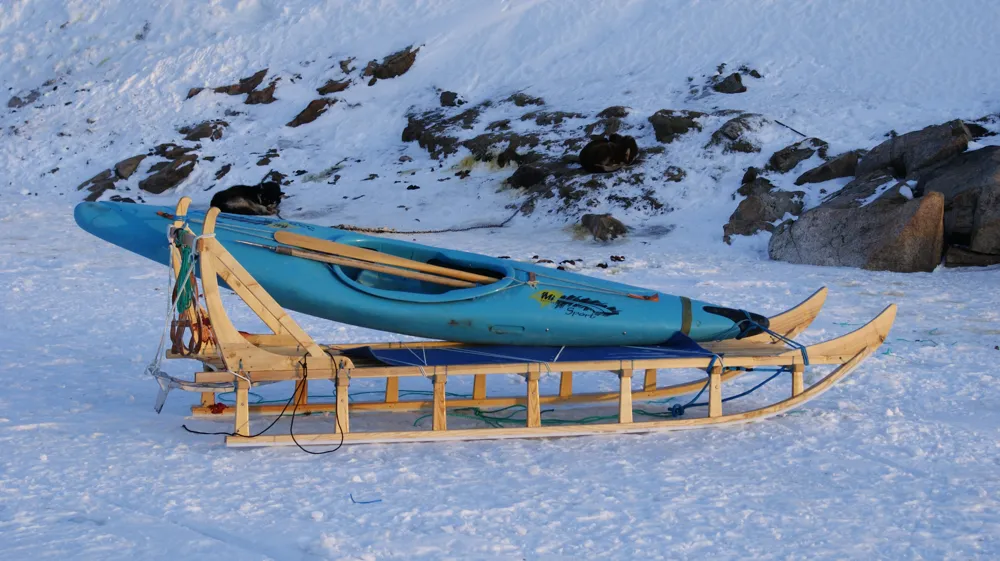
In the Arctic, traditional kayaking continues. The Canadian Encyclopedia notes that few Arctic communities still hunt from kayaks, though the craft remains important to Inuit culture, and in parts of Greenland hunters are reported to still use skin-on-frame boats. In Iqaluit, Nunavut, high school students have built traditional qajaqs under the guidance of elders. Greenland's national kayak championship keeps dozens of traditional rolling and paddling skills alive, and Greenland-style paddling clubs and skin-on-frame building classes now exist far beyond the Arctic.
Where to See Historic Kayaks
Museum collections are the best way to see how traditional kayaks were built. Check each museum's site for current exhibits before you go, as collections rotate and many kayaks are kept in storage (as of November 2026):
- Museum Fünf Kontinente, Munich, Germany: formerly the State Museum of Ethnology, it holds the oldest surviving kayaks, reportedly including one from 1577.
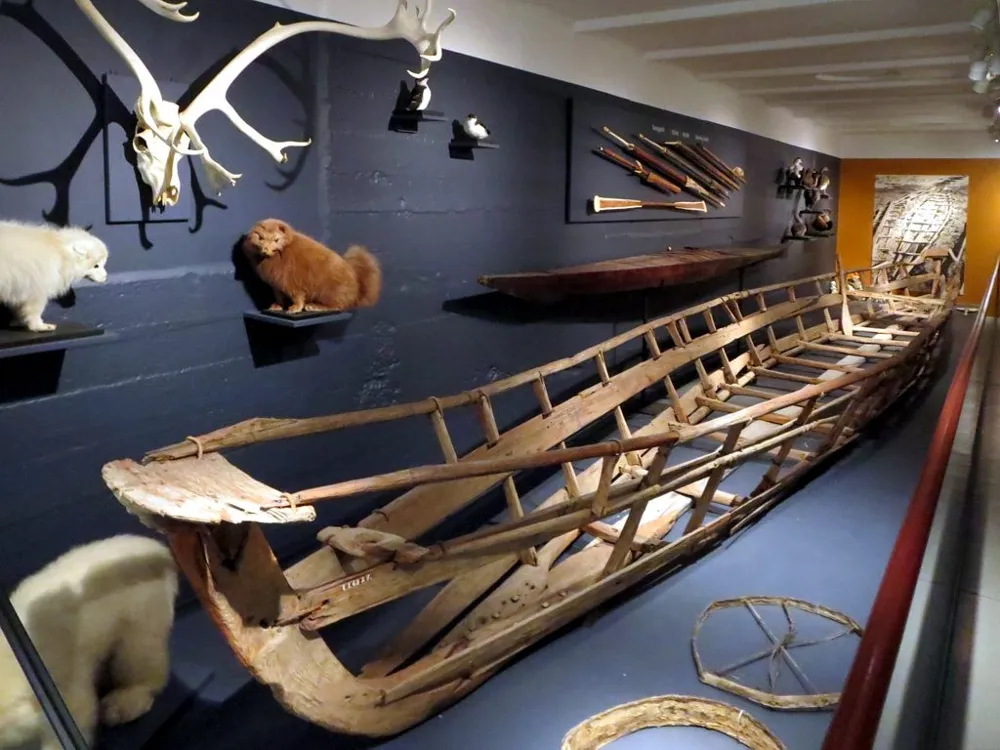
- Greenland National Museum, Nuuk: displays kayaks and umiaks, including the umiak frame shown at the top of this page.
- Nunatta Sunakkutaangit Museum, Iqaluit, Nunavut: displays an authentic sealskin qajaq.
- Smithsonian National Museum of Natural History, Washington, DC: its Arctic collections include kayaks, umiak models and hunting tools, some viewable online.
- Canadian Museum of History, Gatineau, Quebec: holds Arctic skin boats in its collections.
If you'd rather try a kayak than look at one, start with our kayaks for beginners and how to paddle a kayak.
Keep Exploring
Head back to our kayaking guide, learn the parts of a kayak, or read the history of surfing, history of skiing and history of snowboarding.
Frequently Asked Questions
Who invented the kayak?
No single inventor is known. Arctic peoples, including the Inuit, Yupik and Unangan (Aleut), developed kayaks as hunting boats over thousands of years, and designs varied from region to region.
How old is the kayak?
Nobody knows exactly, because skin and wood rarely survive. Kayaks are commonly described as at least 4,000 years old, while some sources say more cautiously that Inuit have used them for over 2,000 years.
What does the word kayak mean?
It comes from the Inuktitut word qajaq (Yup'ik qayaq), usually translated as "hunter's boat" or "man's boat." The Aleut word is iqyax.
How do you spell kayak?
K-A-Y-A-K. It's a palindrome, so it reads the same backwards. The plural is kayaks, and the activity is spelled kayaking.
What were the first kayaks made of?
Seal skin, and sometimes walrus or caribou skin, stretched over a frame of driftwood or whalebone. Seams were sealed with animal fat, and the covers needed regular drying and re-oiling.
When did kayaking become an Olympic sport?
Kayak racing was a demonstration event at the 1924 Paris Games and became a full medal sport at the 1936 Berlin Olympics. Slalom joined at Munich 1972 and returned for good in 1992.
Where is the oldest surviving kayak?
The oldest surviving kayaks are held by the ethnology museum in Munich, Germany, now called Museum Fünf Kontinente; the oldest is reported to date from 1577.
When were plastic kayaks invented?
Rotomolded plastic kayaks first appeared in 1973, according to most histories, and polyethylene boats became common through the 1980s. Most kayaks sold today are plastic.