Choosing the Right Canoe: Length, Layup and Weight (2026)
Solo or tandem, aluminum or Kevlar, 14 feet or 17? Here's how to match a canoe's size, material and weight to the way you'll actually paddle.
How to Choose a Canoe: The Short Answer
Choosing a canoe comes down to four questions: where you'll paddle, how many people and how much gear you'll carry, how far you'll carry the boat, and how much care you're willing to give it. Answer those, and the length, material and hull shape mostly choose themselves.
| If You Mostly... | Look For |
|---|---|
| Paddle calm lakes with family or friends | A stable recreational tandem of about 15–16 ft in polyethylene or aluminum |
| Paddle alone | A solo canoe of about 12–15 ft, or a symmetrical tandem you can paddle solo |
| Go on multi-day trips with portages | A 16–18 ft tripping canoe in Kevlar, carbon or another lightweight composite |
| Run rocky rivers and rapids | A shorter, rockered river canoe in a tough layup such as T-Formex or polyethylene |
| Fish or hunt from the boat | A wide, stable hull; a square stern if you plan to fit a motor |
| Have little storage space | An inflatable or folding canoe, or a short pack canoe |
The rest of this guide goes through each choice. If you already know what you want and just need a shortlist, see the best canoes. Still deciding between boat types? Read canoe vs kayak.
Match the Canoe to Where You'll Paddle
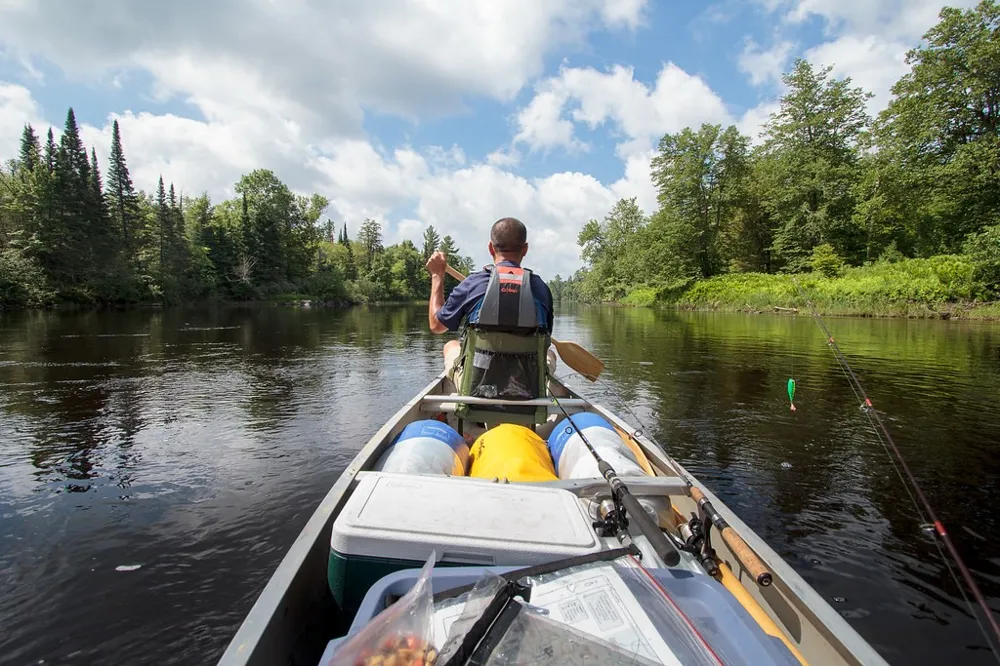
Canoe makers sort their boats by use, and the categories below are broadly the same across brands. Each maker uses its own labels, though, so read the description rather than the name. Paddling.com notes that there are more than 900 canoe models, so start with the job the canoe has to do.
| Canoe Type | Built For | Typical Design |
|---|---|---|
| Recreational | Calm lakes, ponds and slow rivers; fishing, birding, cottage use | Wide and stable, shorter, durable plastic or aluminum |
| Multipurpose (versatile) | Lakes plus easy moving water | Moderate width and rocker; Prospector-style shapes are common |
| Tripping or touring | Multi-day trips, long lake crossings, portages | Longer, deeper, high volume, often lightweight composite |
| River and whitewater | Rapids and rocky rivers | Shorter, lots of rocker, high sides, impact-resistant hull |
| Solo | One paddler | Narrower, often 12–15 ft, single seat near the middle |
| Pack canoe | Light solo trips and easy carrying | Small, very light, low seat |
| Square stern (sport) | Fishing, hunting, small outboard or trolling motor | Flat transom at the stern for a motor mount |
| Inflatable or folding | Travel, apartments, remote trips | PVC, polyester or nylon skins that deflate or fold for storage |
Be honest about what you'll do most often. An 18-foot expedition canoe is a lot of boat for a local pond, and a twitchy whitewater hull is hard work on a windy lake. Paddling Magazine's advice is to buy the size you'll use most, not the one for a once-in-a-lifetime trip. Planning to add a motor? See our canoe trolling motor guide first, and read the registration note below.
Canoe Size Chart: What Length Do You Need?
Length is the biggest single choice. Longer canoes are faster, track straighter and carry more, but they are heavier and harder to turn and store. Shorter canoes turn quickly and are easier to carry, but they are slower and hold less.
| Length | Paddlers | Best For |
|---|---|---|
| Under 12 ft | 1 | Pack canoes, whitewater playboats, ponds; limited capacity |
| About 12–15 ft | 1 (some short tandems) | Solo lake canoes, small rivers, easy transport |
| About 15–16 ft | 2 (some paddled solo) | Day trips, families, mixed lake and river use |
| About 16–17 ft | 2 | Touring, weekend to multi-week trips, families with light gear |
| About 17–18 ft | 2, or 3 with a center seat | Long trips, heavy loads, big open water |
| 18–20 ft and longer | 3–4 | Larger families, heavy backcountry loads, expeditions |
These ranges combine guidance from Paddling Magazine, Trailspace and Bending Branches. Treat them as starting points, because hull width and depth also change how much a canoe carries.
One-Person Canoes
Dedicated solo canoes have one seat near the middle, so the boat sits level with a single paddler. Paddling Magazine reports that most solo buyers don't go above 15 feet and that modern solo lake canoes have shrunk to about 12 to 14 feet. Pack canoes are the smallest: the shortest run about 10 to 12 feet and weigh under 20 pounds. As a real example, Old Town's Discovery 119 solo is 11 ft 9 in long, 32.5 in wide and 50 pounds, with a 450-pound capacity, per Paddling Magazine's spec listing.
You can also paddle a symmetrical tandem solo. Sit on the bow seat facing the stern, which puts you nearer the center, or kneel just behind the middle. A 15- or 16-foot Prospector-style tandem is a popular "do both" boat for this reason.
Two-Person Canoes
Most tandems are 15 to 17 feet. Paddling Magazine says many two-person touring canoes are at least 16 feet, that 14- to 15-foot tandems suit day trips and whitewater, and that 17- to 18-foot tandems suit big lakes and long wilderness trips. For trip planning, the same source estimates that a 16-foot tandem holds about two weeks of well-packed gear, a 17-footer adds room for roughly another two weeks of food, and trips longer than a month call for an 18-footer.
Popular lengths vary by region. Paddling Magazine notes that 15 to 16 feet has become the new sweet spot in the US Northeast, mid-Atlantic and South, while 17 feet is still the norm for lake tandems in the Midwest and central Canada.
Three- and Four-Person Canoes
Some recreational canoes add a center seat for a third paddler or a child. Old Town's Discovery 133, for example, is 13 ft 3 in long and 40.5 in wide with three bench seats and an 800-pound total capacity, according to Old Town. For three adults who all want to paddle, Paddling Magazine suggests 18 feet or more so you don't clash blades, and it recommends 18 to 20 feet for larger families or heavy backcountry loads. For four paddlers, look at big canoes of about 20 feet and up; Trailspace notes these need two or three skilled paddlers.
| Example Canoe (Published Specs) | Length | Width | Weight | Max Capacity | Seats |
|---|---|---|---|---|---|
| Old Town Discovery 119 | 11 ft 9 in | 32.5 in | 50 lb | 450 lb | 1 |
| Old Town Discovery 133 | 13 ft 3 in | 40.5 in | 78 lb | 800 lb | 3 |
| Old Town Saranac 146 | 14 ft 6 in | 36 in | 79 lb | 750 lb | 2 plus center bench |
| Old Town Discovery 158 | 15 ft 8 in | 35.5 in | 87 lb | 1,150 lb | 2 |
Specs are from Old Town's product pages, except the Discovery 119, which comes from Paddling Magazine. Weights are for the assembled boat. Compare these and other models in our canoe picks.
Width, Depth and Weight Capacity
Width (beam) trades stability for speed. Bending Branches uses about 34 inches as a rough dividing line: canoes narrower than that are faster and more efficient but less stable, and wider ones are steadier but slower. Families, anglers and beginners usually prefer the wider side. MEC adds that wider hulls are more affected by wind.
Depth is the height from the bottom to the gunwales. Deeper canoes stay drier in waves and carry more, but they catch more wind. Shallow canoes are easier to paddle in the wind and to reach over.
Capacity is the total weight of paddlers, passengers, pets and gear the maker says the hull can carry. Some makers list both a total and a lower "usable" figure; Old Town, for example, lists the Saranac 146 at 750 pounds total and 671 pounds usable. Loading near the limit leaves little freeboard, the height of the hull above the water. Paddling Magazine gives the example of a 17-foot 6-inch canoe with about 12 inches of freeboard at 300 pounds but only about 6 inches at 1,000 pounds, which one canoe maker it quotes considers acceptable only on the smallest lakes. Leave a healthy margin, especially on big water. For a deeper look at ratings, our kayak weight limit guide covers how makers set them, and the same logic applies to canoes.
Canoe Materials Compared
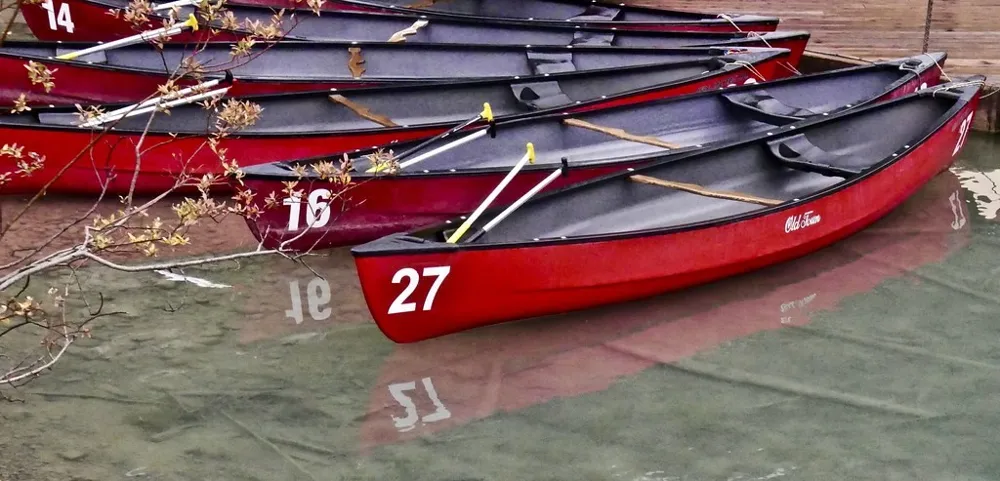
The material, or layup, sets a canoe's weight, toughness, care needs and cost. Here's how the common options compare. Typical weights are rough, because length and outfitting change them a lot.
| Material | Weight | Durability | Care | Cost Tier | Best For |
|---|---|---|---|---|---|
| Polyethylene (single or multi-layer) | Heaviest; Old Town's 14–16 ft tandems are listed at 79–87 lb | Very impact resistant; can deform and fade in sun | Very little; store out of UV | Budget | Families, cottages, beginners, rentals |
| Aluminum | Heavy; about 69–85 lb at 15 ft and 75–99 lb at 17 ft | Lasts decades; UV-proof | Almost none | Budget to mid | Camps, outfitters, hunting, rough handling |
| Royalex (used only) and T-Formex | Mid | Tough on rocks; quieter than aluminum | Low | Mid | Rivers, whitewater, rugged tripping |
| Fiberglass | Mid; about 60 lb at 16 ft, 70 lb at 17 ft | Takes occasional rock hits; easier to repair than metal | Patch worn spots; store indoors | Mid | Lake paddlers who want performance for less |
| Kevlar, carbon and other aramids | Lightest; many tandems roughly 30–45 lb | Less impact resistant; lighter layups are more fragile | Repairable; avoid dragging | Premium | Portaging, tripping, smaller paddlers |
| Wood (cedar strip, wood-canvas) | Varies | Good with care | Regular upkeep and indoor storage | Premium (or DIY) | Traditional paddlers, cottages |
| Inflatable and folding | Often light | Varies by fabric; some rated for whitewater | Dry before storing | Varies | Small homes, travel, fly-in trips |
Polyethylene
Most entry-level and family canoes are rotomolded or thermoformed polyethylene. Better boats use three layers, with a foam core between two solid skins for stiffness and buoyancy. MEC notes that plastic hulls are cheap, durable and impact resistant but can deform over time, suffer from UV and are hard to repair once layered. Paddling Magazine sums up the trade: virtually no maintenance, but heavy.
Aluminum
Aluminum canoes, made famous by Grumman, last practically forever, ignore UV and can be stored outside. Paddling Magazine lists Grumman's 17-foot double-ender at 75 pounds and its 15-footer at 69. The downsides are noise, a hull that gets very hot in the sun and cold on cool days, and riveted seams that make them slower than composites. They're a smart buy used.
Royalex and T-Formex
Royalex, a laminate of vinyl and ABS over a foam ABS core, was the classic tough river material for decades. Production ended in 2014, so you'll find it only on used canoes. Esquif developed T-Formex as a replacement, and makers including Swift and Wenonah have offered canoes in it. Bending Branches places this class in the middle for price and weight, and notes it's quieter than aluminum and not as affected by temperature. A "Lite" version cuts weight further; Esquif's Pocket Canyon Lite in T-Formex Lite is listed at 49 pounds for a 14-foot 6-inch boat, about 10 pounds lighter than standard T-Formex.
Fiberglass
Fiberglass is the middle ground for weight and cost. Paddling Magazine estimates about 60 pounds for a 16-foot fiberglass canoe and 70 pounds for a 17-footer, up to 20 pounds lighter than polyethylene. Its stiffness gives a sharp, efficient entry. It handles the odd rock strike but is less impact resistant than plastic, which flexes before it cracks. It generally takes more hits than Kevlar.
Kevlar, Carbon and Aramid Blends
Composites made with Kevlar or other aramid fibers, often blended with carbon, have the best strength-to-weight ratio. REI says Kevlar is about 25% lighter than fiberglass. The trade-offs are cost and toughness: Paddling Magazine notes that, generally, lighter means less durable, and that lightweight hulls prioritize weight savings over impact resistance. That makes them ideal for lakes and portages and less ideal for bouncing down rocky rivers.
Lightweight Canoes: How Light Is Light?
If you'll lift the canoe onto a car alone or carry it over portages, weight matters more than almost anything else. Paddling Magazine treats a canoe under 50 pounds as lightweight. Bending Branches puts it simply: a 55-pound canoe is far easier to carry than a 95-pound one.
| Lightweight Canoe Example | Length | Listed Weight | Layup |
|---|---|---|---|
| Northstar Pearl | Just under 16 ft | 29 lb | Carbon, Innegra and aramid blend |
| Swift Keewaydin 16 | 16 ft | About 33–41 lb depending on layup | Kevlar Fusion or Carbon Fusion |
| Wenonah Minnesota II | 18 ft 6 in | 34 lb (SuperLite) to 42 lb (Ultralight aramid) | Aramid composites |
| Souris River Quetico 17 | 17 ft 3 in | 44 lb | Kevlar with epoxy resin |
| Nova Craft Prospector 14 | 14 ft | About 35 lb (Aramid Lite) to 48 lb (TuffStuff Expedition) | Aramid, or basalt and Innegra |
| Esquif Pocket Canyon Lite | 14 ft 6 in | 49 lb | T-Formex Lite |
Weights are as listed in Paddling Magazine's lightweight canoe guide. Check the maker's current spec sheet, since layups and weights change.
What You Give Up for Less Weight
- Cost. Ultralight layups sit at the premium end. Paddling Magazine notes that a midweight fiberglass canoe can save a lot of money but adds about 10 to 15 pounds.
- Toughness. The lightest layups are built for lakes. If you run rocky rivers, a slightly heavier, tougher layup or T-Formex is a better fit.
- Availability. Most Kevlar and carbon canoes are sold through paddling dealers and the makers themselves rather than big online marketplaces, so plan to buy from a dealer or used.
Cheaper ways to save weight include a shorter canoe, a solo or pack canoe instead of a tandem, a used composite canoe, or a cart for the walk to the water. Our boat weight guide compares canoe and kayak weights side by side, and lightweight kayaks covers the kayak side.
Hull Shape, Rocker and Keel
Hull shape decides how a canoe feels. Here's what to choose for each kind of paddling; for what each term means, see parts of a canoe.
| Feature | Choose More of It If... | Choose Less of It If... |
|---|---|---|
| Flat bottom (initial stability) | You're a beginner, fish, or paddle with kids and dogs on calm water | You paddle in waves and wind, where a flat hull can feel unsettled |
| Shallow arch or shallow V (secondary stability) | You want efficiency and steadiness when the canoe leans in waves | You want the steadiest feel when sitting still |
| Rocker | You run rivers and need quick turns | You cross lakes and want the canoe to track straight |
| Keel | You paddle open lakes and want help tracking in wind | You paddle rivers, where a keel catches rocks and slows turns |
| Tumblehome | You want an easy reach to the water, especially solo | You paddle rough water, where flared sides stay drier |
| Asymmetry | You want lake efficiency in a dedicated touring hull | You want to paddle the canoe backward-solo from the bow seat |
REI describes four broad bottom shapes, from flat to shallow arch, shallow V and rounded. MEC notes that whitewater canoes have lots of rocker and touring canoes have little.
Seats, Yoke and Other Features
Small details make a big difference on long days.
- Seat type and height. Seats come in web, cane and molded plastic. REI notes seats should be low enough for stability but high enough to kneel comfortably with your feet tucked under. Some recreational canoes add molded seat backs or a center bench.
- Kneeling. Kneeling lowers your center of gravity and gives more control in wind and rapids. Knee pads help.
- Yoke. If you'll ever carry the canoe alone, make sure it has a carrying yoke at the balance point, or that one can be added. Learn the lift in how to portage a canoe.
- Gunwales. Wood looks great and is quiet but needs oiling; vinyl and aluminum need little care.
- Flotation and handles. End flotation tanks or bags keep a swamped canoe afloat, and grab handles make carrying and rescues easier.
- Motor mount. A square stern or a side-mount bracket is needed for a trolling motor.
Most canoes don't come with a seat back. A clip-on back is an easy upgrade if you sit for long stretches.
GCI Outdoor SitBacker
A folding seat back that attaches to canoe seats and bench seats, with a portage lock and a shoulder strap for carrying. It folds flat when you don't need it. More seat options are in kayak and canoe seats.
Check Price on AmazonRemember the paddle, too. A well-sized, light paddle makes any canoe easier to move; see the best canoe paddles for sizing.
Transport and Storage
Canoes are long, and most are close to 3 feet wide in the middle. Before you buy, check three things:
- Can you lift it? Compare the listed weight with what you, or you and a partner, can lift overhead onto a car roof.
- Can your vehicle carry it? Most canoes ride upside down on roof-rack crossbars or foam blocks, with straps over the hull and bow and stern lines to the bumpers. See our car-top transport guide; the same methods work for canoes.
- Where will it live? A garage or covered rack is ideal. Keep plastic and composite hulls out of direct sun. Paddling Magazine warns that a tarp wrapped tight over a canoe outside can trap moisture and rot wooden parts. Aluminum is the one material that doesn't mind living outdoors. Racks are covered in kayak and canoe storage racks.
Seattle Sports Sherpak Foam Blocks
A non-skid foam block carrier kit for car-topping a boat on a vehicle without a dedicated carrier.
Check Price on AmazonFor the walk from car to launch, a cart helps with heavy plastic canoes; see kayak and canoe carts.
New, Used or Rented? Test Before You Buy
Canoes last a long time, so the used market is big, especially for aluminum, polyethylene and older Royalex boats. Paddling Magazine suggests looking on local classifieds and gear-swap sites, and paddling clubs and outfitters often sell off older fleet boats.
- Check the hull. Look for cracks, soft spots, deep gouges through the outer layer and, on composites, exposed cloth. Scrapes are normal.
- Check the ends and gunwales. Look for cracked stem plates on aluminum, which Paddling Magazine names as the main leak risk, and rot in wooden gunwales and seats.
- Look at the shape. MEC notes that plastic hulls can deform over time, so sight down the hull for dents and sags, especially on boats stored in the sun.
- Test paddle. Paddling.com and Paddling Magazine both recommend trying several canoes on the kind of water you'll use, ideally empty and loaded. Demo days and rentals are good ways to compare.
If you'll only canoe once or twice a year, renting from an outfitter may make more sense than buying, especially for wilderness trips.
Life Jackets, Registration and Safety
Whatever canoe you choose, the safety basics are the same. Federal rules require at least one wearable, properly sized life jacket for each person on board, and life jackets that aren't worn must be readily accessible. Under federal rules, children under 13 must wear one while the boat is underway, though states can set their own age rules. Pick one from our paddling life jacket guide.
Registration rules for canoes vary by state. Some states require registration or a launch permit even for unpowered canoes, and many require registration once any motor is fitted, including a small electric trolling motor. Check your state boating agency before you buy or add a motor; our kayak and canoe registration guide has a state-by-state overview. Last checked November 2026. This is general information, not legal advice.
- Keep your weight low and centered, and step into the middle of the canoe.
- Pack a bailer, whistle and dry bag, and tell someone your plan.
- Avoid big open water in strong wind until you're confident, and dress for the water temperature, not the air. See paddling safety.
Keep Exploring
Ready to shop? Compare models in the best canoes. Learn the strokes in how to paddle a canoe, get to know the boat in parts of a canoe, and explore more guides in our kayaking and canoeing hub.
Frequently Asked Questions
What size canoe do I need for two people?
Most two-person canoes run about 15 to 17 feet. A 15- or 16-foot tandem suits day trips and families, while 17 feet or more suits long lake trips with lots of gear.
What is the best canoe material for beginners?
Polyethylene and aluminum are the usual beginner choices because they are durable and need little care. They are heavy, so check you can lift and car-top the boat.
How much does a lightweight canoe weigh?
Paddling Magazine treats canoes under 50 pounds as lightweight. Kevlar, carbon and other aramid tandems are often listed at roughly 30 to 45 pounds, and some small pack canoes weigh under 20 pounds.
Is a Kevlar canoe worth it?
It is if you carry the canoe a lot, on portages or onto a roof rack. Kevlar costs more and takes hard rock impacts less well than plastic, so it suits lakes more than rocky rivers.
Can one person paddle a tandem canoe?
Yes. A symmetrical tandem, such as a 15- or 16-foot Prospector-style canoe, can be paddled solo from the bow seat facing the stern, so you sit closer to the middle. Kneeling near the center works too.
How many people fit in a canoe?
Most canoes are built for one or two paddlers. Three-seat canoes exist, and boats of about 18 feet or longer give three or four people room to paddle without hitting each other's blades. Always stay within the maker's capacity rating.
Are aluminum canoes good?
They last a long time, shrug off UV and need almost no maintenance, which is why camps and outfitters use them. They are also heavy, noisy and slower than composite canoes, and they get hot or cold with the weather.