The Best Light Kayaks to Lift, Load and Launch Solo (2026)
Folding, inflatable, thermoformed and plastic kayaks from about 7 to 40 pounds, with the maker's weight for each and how to move any kayak on your own.

What Counts as a Lightweight Kayak?
A kayak's weight decides how often you'll actually use it. If you have to lift it onto a roof rack, carry it down a steep path or haul it up an apartment stairwell, every pound counts. Most one-person recreational kayaks weigh about 30 to 55 pounds, and fishing kayaks can run well past 60. In this guide, lightweight means a one-person boat at or under about 40 pounds. Folding, inflatable and packraft designs can weigh much less than that.
We list each boat's published weight from the maker or a major retailer, and we say whether that number covers the hull only or the whole packed kit. For weights across every kayak type, see how much a kayak weighs.
Oru Inlet
Best overall lightweight kayak
- Folding hard-shell, listed at 22 lb by REI
- Assembles in under 5 minutes (Oru)
- Packs into a box for closets and car trunks
Pelican Argo 100X
Best light hard-shell sit-inside
- 10 ft, listed at 36 lb
- Thermoformed Ram-X polyethylene
- No assembly or inflation
Sea Eagle 370 Pro
Best light inflatable
- 32–33 lb hull weight (Sea Eagle)
- Rated up to Class III water
- Paddles solo or with a partner
Lightweight Kayaks Compared
| Kayak | Type | Length | Published Weight | What the Weight Covers | Capacity |
|---|---|---|---|---|---|
| Advanced Elements PackLite+ | Packraft | 7 ft 3 in | 7 lb / 13.4 lb | Raft only / complete assembly | 1 person |
| Oru Lake Sport | Folding | 9 ft | 18 lb | Boat | 250 lb |
| Oru Inlet | Folding | 9 ft 8 in | 22 lb | Boat (REI listing) | 275 lb |
| Sea Eagle 370 Pro | Inflatable | 12 ft 6 in | 32–33 lb | Hull only, without paddles, seats or pump | 3 persons / 650 lb |
| Eddyline Sky 100 | Thermoformed sit-inside | 10 ft | 34 lb | Boat (REI listing) | 250 lb |
| Pelican Argo 100X | Thermoformed sit-inside | 10 ft | 36 lb | Boat (retailer listing) | 275 lb |
| Lifetime Lotus | Polyethylene sit-on-top | 8 ft | About 36.5–39 lb | Listings differ; check the label | 250 lb |
| Old Town Heron 9XT | Rotomolded sit-inside | 9 ft 6 in | 40 lb | Assembled boat | 300 lb total / 260 lb usable |
Specs are from Oru, Sea Eagle, Old Town and Advanced Elements, plus REI, Academy and Target listings where the maker's page gave no figure. Makers update models, so check the current listing before you buy. For what capacity numbers mean, see kayak weight limits.
The Best Lightweight Kayaks
1. Oru Inlet
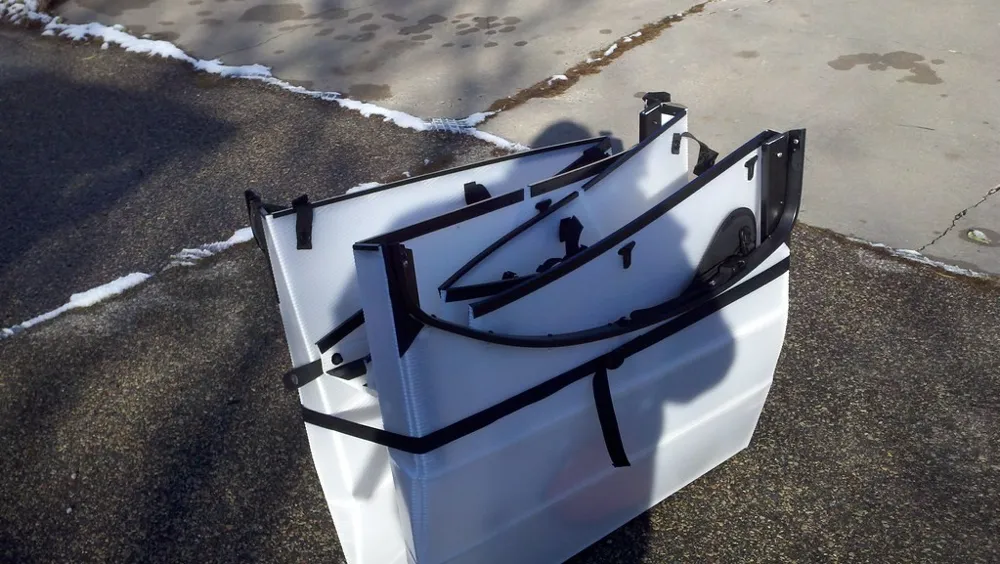
The Inlet is Oru's compact folding kayak, made from 5mm double-layer polypropylene that folds out of a box into a sit-inside hull. REI lists it at 9 ft 8 in, 22 lb and a 275 lb capacity, and Oru says it assembles in under 5 minutes. Folded, it fits in a closet or a car trunk, so you need no roof rack at all. That's why it's our top pick for anyone whose main problem is lifting and storing a boat. It suits calm lakes, ponds and slow rivers. Compare it with the rest of the Oru range in our folding kayak guide.
Good to Know
- No roof rack needed
- Hard-shell feel without inflation
- Quick setup for short outings
Watch Out For
- Premium price tier for its size
- Folds and hinges need careful handling
- Calm water only
2. Pelican Argo 100X
For a conventional hard-shell boat that stays light, Pelican's Ram-X kayaks are a common choice. Ram-X is a thermoformed, multi-layer polyethylene, and it keeps weight down compared with standard rotomolded plastic. The Argo 100X is listed at 10 ft long and 28 in wide, weighing 36 lb, with a 275 lb maximum capacity. It has an adjustable padded Ergofoam backrest, molded footrests and a small cockpit table with a bottle holder. There's nothing to assemble or inflate, so it's ready to paddle as soon as it's off the car. Learn more about the brand in our Pelican kayaks review.
Good to Know
- Light for a 10 ft hard-shell
- Stable, beginner-friendly width
- Budget-to-midrange price tier
Watch Out For
- Large open cockpit takes on water in waves
- Short hull, so limited speed and gear space
3. Sea Eagle 370 Pro
The 370 is Sea Eagle's entry-level sport kayak. Sea Eagle lists a hull weight of 32–33 lb for the 12 ft 6 in boat. That figure covers the hull only, so the accessories in the package add weight to the bag you carry. It's built from 36-gauge PolyKrylar, rated for 3 persons or 650 lb, rated up to Class III water and NMMA certified. Deflated, it packs to about 31 × 18 × 7 inches, and Sea Eagle lists about 8 minutes to inflate. Paddle it solo for lots of gear space, or with a partner. If you want a lighter solo inflatable, Sea Eagle's smaller SE330 is listed at a 26 lb hull weight.
Good to Know
- Solo or tandem
- Very high capacity for its weight
- Stores in a closet
Watch Out For
- Slower and more wind-affected than a hard-shell
- Needs drying before storage
4. Oru Lake Sport
The Lake Sport is Oru's lightest everyday folding kayak. Oru and REI list it at 18 lb, 9 ft long and 32 in wide, with a 250 lb capacity and a 6 ft 4 in maximum paddler height. Oru gives the assembly time as 1 to 3 minutes. Its 66 × 24 in cockpit is roomy, and the Sport version adds footrests and an upgraded adjustable backrest over the basic Lake. It's wider and slower than the Inlet but steadier, which suits photographers, anglers with light gear and casual paddlers.
Good to Know
- One of the lightest hard-hull options
- Wide and stable
- Very fast setup
Watch Out For
- Not for wind, waves or rocky rivers
- Limited gear storage
5. Old Town Heron 9XT
If you want classic, tough rotomolded plastic and still need to lift the boat yourself, the Heron 9XT is about as light as that construction gets. Old Town lists an assembled boat weight of 40 lb for the 9 ft 6 in, 28.5 in wide hull, which is made from single-layer polyethylene. Old Town quotes capacity two ways: 300 lb total, including the boat, and 260 lb usable for you and your gear. The 39.5 × 19 in cockpit is easy to get in and out of, and Old Town says all its hulls are rotomolded in Maine. It shrugs off scrapes on gravel launches better than folding or inflatable boats.
Good to Know
- Abrasion-resistant polyethylene
- Easy-entry cockpit
- Budget-to-midrange price tier
Watch Out For
- Heaviest pick here
- Short hull with limited glide
6. Lifetime Lotus
The Lotus is a short, simple sit-on-top: 8 ft long, made from UV-protected high-density polyethylene, with a 250 lb maximum capacity. Listings disagree slightly on weight, giving between about 36.5 and 39 lb, so check the label if every pound matters. It has a flat bottom with chine rails, tracking channels, a rear tank well with bungee lacing, an adjustable seat back, multiple footrest positions, self-bailing scupper holes, front, rear and center carry handles, and a paddle in the box. It also stands on its end for storage. Lifetime lists a 5-year limited warranty. It suits small adults, warm-water play and short trips close to shore.
Good to Know
- Budget price tier
- Easy to climb back onto
- Paddle included
Watch Out For
- Short, so it zig-zags and stays slow
- Small capacity for larger paddlers
7. Eddyline Sky 100
Eddyline builds its kayaks from thermoformed ABS (sold as Carbonlite), which is lighter than polyethylene and has a glossy, stiff finish. REI lists the 10 ft Sky 100 at 34 lb with a 250 lb capacity. That makes it one of the lightest rigid sit-inside kayaks of its size that needs no folding or pumping. It's sold mainly through paddling shops and REI rather than Amazon, so there's no Amazon link here. See our kayak brands guide for Eddyline's other models.
8. Advanced Elements PackLite+ Packraft
Packrafts are the lightest boats you can paddle, made to ride in a backpack to remote lakes and rivers. The retailer listing for the PackLite+ (AE3037) splits its weight three ways: 7 lb for the raft only, 8.4 lb with seats and 13.4 lb as a complete assembly. It's made from 210D nylon with TPU and has a drop-stitch floor. It measures 7 ft 3 in by 39 in and folds to about 16 × 15 × 5 inches. Like most packrafts, it's short and wide, so it's slow on open water. It's sold through outdoor retailers. Other packraft makers such as Kokopelli also sell through REI; REI lists the 10 ft Kokopelli Platte at 23 lb 12.8 oz with paddle.
Types of Lightweight Kayaks
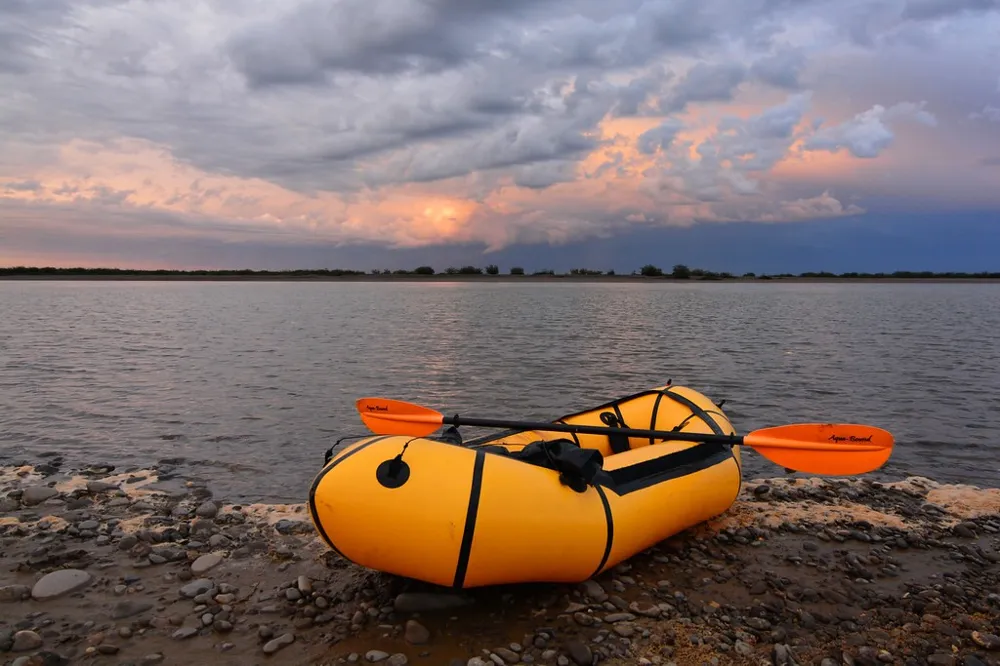
The material and construction decide most of a kayak's weight. REI's kayak guide puts it plainly: materials drive price and are "the biggest factor in the weight and durability" of a boat. Here's how each type gets light, and what it gives up. For a full tour of kayak styles, see types of kayaks.
Rotomolded Polyethylene Under About 40 lb
Most recreational and fishing kayaks are rotomolded polyethylene. REI calls it inexpensive and abrasion-resistant but "the heaviest option." To land near 40 lb in polyethylene, a boat has to be short and simple, like the 9 ft 6 in Heron 9XT or the 8 ft Lotus. Longer plastic boats quickly climb past 50 lb.
Thermoformed Plastic (ABS and Ram-X)
Thermoformed kayaks are made by heating sheets of plastic and forming them over a mold. REI says thermoformed ABS costs slightly more than polyethylene and has similar durability, but it's slightly lighter and more UV-resistant. Pelican's Ram-X is a thermoformed, multi-layer polyethylene, and Eddyline's Carbonlite is a thermoformed ABS. This is the sweet spot for a rigid kayak that's light without being fragile.
Composite (Fiberglass, Kevlar and Carbon)
Composite kayaks, mostly touring and sea kayaks, are the lightest rigid hulls of their length. REI describes fiberglass and carbon boats as "a huge leap in performance and price." They resist UV well, but a hard hit on rock can crack them, and repairs take more skill. When a design comes in both plastic and composite, compare the listed weights of each version. Our touring kayak guide covers longer boats.
Inflatable Kayaks
Inflatables trade rigidity for portability. Basic vinyl models are cheap but less tough. Multi-layer PVC and drop-stitch floors add stiffness and some weight, and better models are rated for moving water. NRS's 11 ft Akamai 110 is listed by REI at just 17 lb. See our inflatable kayak reviews and 2-person inflatables.
Folding Kayaks
Origami-style folders such as Oru's are made from a single sheet of polypropylene that folds into a hull. Skin-on-frame folders stretch a fabric skin over a frame. REI notes that a folding kayak won't be as rugged as a hard-shell, but it can handle like one. Folders need no pump, and they store in a closet.
Packrafts
Packrafts are small, tough inflatables made from coated nylon fabrics, built for hike-in trips and river crossings. The PackLite+ weighs 13.4 lb complete, and the raft alone weighs 7 lb. They're short and slow on flat water, but nothing else gets a boat as far from a road.
Weight vs Durability vs Cost
Every lightweight kayak trades something. REI sums up the catch: "lightweight materials can make a kayak cost significantly more." Here's how the trade-offs line up in general terms.
| Construction | Weight | Durability | Price Tier | Main Trade-Off |
|---|---|---|---|---|
| Rotomolded polyethylene | Heaviest | Very tough, abrasion-resistant | Budget to midrange | Light only when short |
| Thermoformed ABS / Ram-X | Lighter | Similar to polyethylene | Midrange | Costs a little more |
| Composite | Lightest rigid hull | Strong but can crack on rock | Premium | Price and repair skill |
| Inflatable (vinyl or PVC) | Light | Varies widely; punctures repairable | Budget to premium | Speed, tracking, setup time |
| Folding | Very light | Less rugged than hard-shell | Midrange to premium | Calm water, careful handling |
| Packraft | Lightest overall | Tough fabrics; repairable | Midrange to premium | Slow on flat water |
A quick rule: if you'll scrape over gravel and rocks, a slightly heavier plastic boat often beats a lighter one. If you'll lift the boat onto a tall SUV alone, saving even 10 pounds can matter more than toughness. If you're on a tight budget, see budget kayaks for what you give up at the low end.
Lightweight Sit-on-Top and Fishing Kayaks
Sit-on-tops are the hardest kayaks to make light. REI notes they're typically heavier than comparable sit-in kayaks, because the hull is sealed top and bottom and is usually wider. The lightest hard-shell sit-on-tops are short recreational boats such as the 8 ft Lotus. Once you add length, width, rod holders and a frame seat, weights rise fast. The Perception Pescador Pro 10.0 fishing kayak is listed at 62 lb, and pedal kayaks run near or past 100 lb rigged.
If you want a lightweight fishing kayak, you have three realistic routes:
- A short recreational sit-on-top with a couple of add-on rod holders, for ponds and calm water.
- An inflatable fishing kayak with a drop-stitch floor, which can be lighter than any hard-shell angler and fits in a trunk. See inflatable fishing kayaks.
- A full fishing kayak plus a cart, which is more stable but needs a cart or trailer. See fishing kayaks and pedal kayaks.
Sit-on-top or sit-inside? Our sit-in vs sit-on-top comparison and sit-on-top picks go deeper.
Hull Weight vs Packed Weight: Read the Spec Right
Two kayaks with the "same" weight can feel very different on your shoulder, because makers measure in different ways:
| Term | What It Includes | Example |
|---|---|---|
| Hull weight | The boat alone | Sea Eagle 370: 32–33 lb hull |
| Assembled boat weight | Boat with its fitted seat and parts | Old Town Heron 9XT: 40 lb |
| Complete or packed weight | Boat plus seats, fins or other parts, sometimes paddles, pump and bag | PackLite+: 7 lb raft only, 13.4 lb complete |
| Rigged weight | Hull plus pedal drive, rudder and seat | Common on pedal fishing kayaks |
With inflatables, check whether the figure covers the hull alone or the whole package. A pump, two paddles and seats can add several pounds to the bag you carry. With hard-shells, a removable seat or drive is worth taking out before you lift. Our kayak weight guide covers this in more detail.
How to Choose a Lightweight Kayak
- Start with how you'll move it. No roof rack, small car or apartment storage points to folding or inflatable. If you have a rack and a garage, a thermoformed hard-shell works.
- Be honest about your lift. Paddling guides often treat roughly 35 to 50 pounds as manageable for many adults carrying solo. If you have back or shoulder concerns, aim lower, or plan on a cart.
- Check capacity, not just weight. Light boats are often short, with lower capacities. Add your body weight and gear, and keep the total well under the maximum. Our weight limit guide shows the math.
- Match length to water. Short boats are light and easy to turn but slow. Longer boats glide and track better. Use the kayak size chart to match length to your height and the water you paddle.
- Think about tracking. Many short or inflatable kayaks wander with each stroke. A skeg, tracking fin or keel line helps.
- Look for certification on inflatables. Some inflatables carry NMMA certification, which Sea Eagle lists for the 370 and SE330.
- Consider setup time. A folding or inflatable kayak adds minutes at both ends of every trip. If you paddle often from the same spot, a rigid boat may be easier.
If you're new to paddling, our best kayaks for beginners covers stability and fit in more depth.
How to Carry a Kayak by Yourself
REI's lifting advice works for any kayak, and it's much easier with a light one:
- Stand beside the cockpit on the side you want to carry from, and squat with your back straight.
- Pull the near edge of the cockpit up onto your thighs.
- Reach across and grip the underside of the far cockpit edge.
- Stand up using your legs, and roll the boat so the cockpit rim rests on your shoulder.
- Shift until the kayak balances front to back, then walk. Switch shoulders on long carries.
Wearing your PFD pads your shoulder. Sit-on-tops have no cockpit rim, so carry them at your side by the center handle or with a shoulder strap if they're light enough. Folding and inflatable kayaks travel best in their backpack or bag. With two people, each person takes an end handle and both face the direction of travel. To keep your back safe, bend your knees, keep the boat close and don't twist while lifting.
Loading a Kayak Onto a Car Solo

The overhead lift is where most solo paddlers struggle. REI describes three ways to avoid lifting the boat's full weight above your head:
- Towel or blanket method (lowest cost): lay a towel or blanket over the back of the car, rest the bow on it, then lift the stern and push the kayak up and forward onto the rack.
- Rolling-wheel racks: set the bow in a rear cradle with rollers, then roll the kayak forward into the front cradle.
- Lift-assist racks: the carrier slides down the side of the vehicle so you load at waist or chest height, then it raises onto the roof. They work well but are expensive.
Once it's up, center the kayak between the crossbars and strap it down with two cam straps. Tighten until snug but not crushing: REI warns that too much tension can deform plastic hulls and crack fiberglass. Add bow and stern lines for highway speeds or wind, and stop to check the straps after about 15 minutes of driving. A light kayak also opens up options beyond the roof. Folding and inflatable boats ride in the trunk, and a short hard-shell may fit in a pickup bed. Full instructions are in our kayak transport guide, and rack picks are in kayak roof racks.
Kayak Carts and Other Ways to Move a Boat
Even a 35 lb kayak gets heavy over a long walk from the parking lot. A two-wheeled kayak cart lets you roll the boat instead. Strap-on carts cradle the hull from below and suit most kayaks. Scupper carts fit through the drain holes of sit-on-tops. Wide balloon wheels roll better on sand. Choose a cart rated well above your boat's weight, and pick one that folds small enough to carry in the kayak once you launch. Compare models in the best kayak carts.
Other helpers include padded shoulder straps for sit-on-tops and wall or freestanding storage racks at a comfortable lifting height.
Caring for a Lightweight Kayak
- Folding kayaks: rinse out sand, dry the boat before folding it away and follow the maker's folding sequence to protect the creases and fittings.
- Inflatables and packrafts: rinse and dry fully before rolling up, store out of direct sun, inflate only to the listed pressure and keep the repair kit in the bag. An electric or high-volume pump cuts setup time.
- Thermoformed and composite hulls: avoid dragging over rocks or concrete, launch from the water's edge and store the boat supported on its sides or upside down on padded cradles.
- All kayaks: keep UV off plastic with a cover or shade, and don't overtighten straps on a roof rack.
Pair your boat with a light kayak paddle; a lighter shaft makes a noticeable difference over a long day. Before your first trip, read up on kayak safety.
Frequently Asked Questions
What is considered a lightweight kayak?
There's no official cutoff, but most paddling guides treat a one-person kayak at or under about 40 pounds as light. Typical recreational kayaks run about 30 to 55 pounds, and fishing kayaks are often heavier.
What is the lightest kayak you can buy?
Packrafts are the lightest boats you can paddle. Advanced Elements lists its PackLite+ at 7 lb for the raft alone and 13.4 lb fully assembled. Among kayaks with a solid hull, folding models such as the 18 lb Oru Lake Sport are the lightest common choices.
What is the lightest tandem kayak?
Inflatables are the lightest tandems. The Driftsun Rover 220 is listed at 28 lb and the Sea Eagle 370 at a 32–33 lb hull weight; hard-shell tandems usually weigh far more.
Are lightweight kayaks durable?
It depends on the material. Thermoformed ABS and Ram-X are roughly as tough as rotomolded plastic, while folding, composite and inflatable kayaks need more care around rocks, oyster beds and rough launches.
Can one person load a kayak onto a car?
Yes. Lift-assist racks, rolling-wheel racks or a towel over the back of the car let one person slide a kayak onto the roof without lifting its full weight overhead. A lighter boat makes every method easier.
What is the lightest touring kayak?
Folding tourers are among the lightest. REI lists the 16 ft 2 in Oru Coast XT at 32 lb, and composite sea kayaks are lighter than most plastic boats of the same length.
Is a lighter kayak faster?
A little, because it sits higher and gets moving with less effort, but length and hull shape matter more for speed. A short, wide light kayak is still slower than a long, narrow heavy one.