Ski Backpacks That Carry the Whole Day, In Bounds or Out (2026)
Resort, touring and avalanche airbag packs from Deuter, Dakine, Mammut, Black Diamond, Osprey, CamelBak and BCA, with a guide to volume, ski carry, avy pockets, hydration and fit.
What Makes a Ski Backpack Different
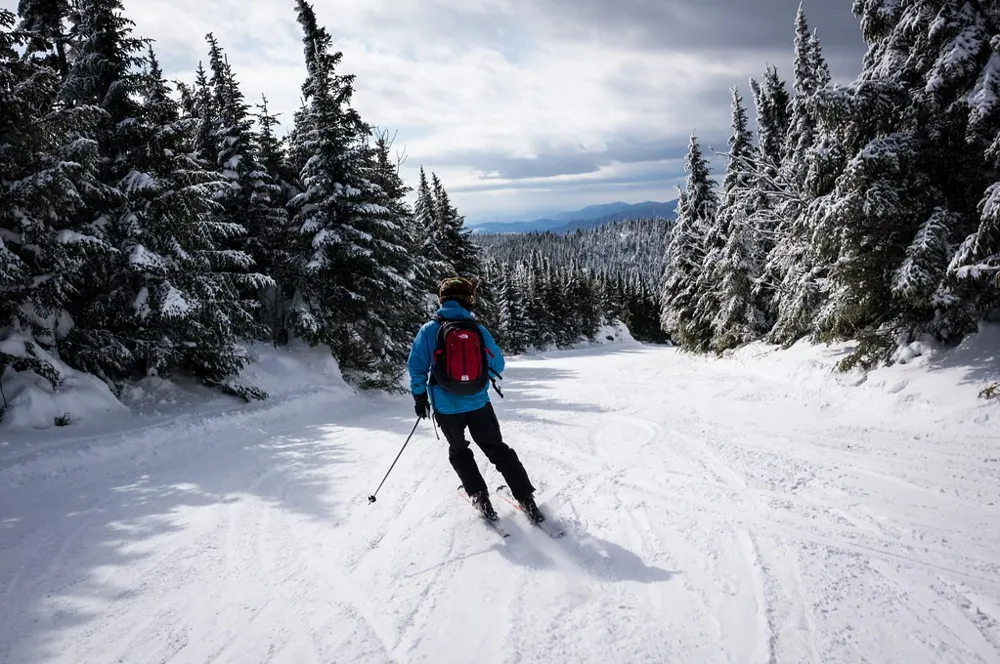
A ski backpack looks like a daypack until you put it next to one. It is built from snow-shedding fabric, it carries skis or a snowboard on the outside, and on most models a separate pocket keeps a shovel and probe away from your lunch and layers. Resort packs stay small and slim so they don't snag on the chairlift. Touring packs add back-panel access, helmet carry and room for skins. Avalanche airbag packs add an inflatable airbag system on top of all that.
This guide covers all three types. The specs come from each maker's product page, and we say where something varies by version or size. Choose the type first, then the volume, then the carry system, and the right pack usually becomes obvious.
Deuter Freerider 30
Best for day touring
- 30 liters, listed at 1,000 g
- A-frame and diagonal ski carry
- Rear opening and front avy pocket
Dakine Heli Pro 24L
Best for resort and sidecountry
- Snow tool pocket with sleeves
- Diagonal or A-frame ski carry
- Back panel zippered access
Mammut Pro 35 Removable Airbag 3.0
Best removable airbag pack
- Removable Airbag System 3.0
- Top and back-panel access
- Separate orange safety pocket
Ski Backpacks Compared
| Pack | Type | Volume | Ski Carry | Listed Weight |
|---|---|---|---|---|
| Deuter Freerider 30 | Day touring | 30 L | A-frame and diagonal | 1,000 g |
| Dakine Heli Pro 24L | Resort and sidecountry | 24 L | Diagonal or A-frame | 0.99 kg (2.17 lb) |
| Mammut Pro 35 Removable Airbag 3.0 | Airbag | 35 L | Ski or snowboard straps | See maker |
| Black Diamond Dawn Patrol 32 | Day touring | 32 L | Diagonal | 1.17 kg |
| Osprey Kamber 30 / Kresta 30 | Day touring | 30 L | A-frame and diagonal | See maker |
| CamelBak SnoBlast 22 | Resort hydration | 22 L | A-frame | 750 g |
| BCA Float 32 Avalanche Airbag 2.0 | Airbag (cylinder) | 32 L | A-frame and diagonal | 2,942 g with full cylinder |
| Dakine Poacher 32L | Touring and splitboard | 32 L | Diagonal or A-frame | 1.79 kg (3.98 lb) |
Weights are as listed by each maker in November 2026 and can change between model years. "See maker" means we could not confirm a current figure from the maker's page.
The Best Ski Backpacks
1. Deuter Freerider 30
A light, full-featured touring pack. Deuter lists 30 liters at 1,000 g, with a back length range of 38 to 54 cm and a recommended load of 4 to 8 kg. Its LiteSnow back system uses snow-shedding fabric so snow doesn't stick to the padding. A rear opening with a U-shaped zipper lets you reach the main compartment with skis still strapped on, and a front pocket for avalanche equipment keeps the shovel and probe separate. Skis go on the sides (A-frame) or diagonally, and a snowboard straps to the front. You also get a detachable mesh helmet holder, a fleece-lined goggle pocket, an ice axe attachment, zippered hip fin pockets and a hydration sleeve for up to a 3-liter reservoir. A women's-fit Freerider 22 SL is also listed.
Good to Know
- Light for a 30-liter touring pack
- Both A-frame and diagonal ski carry
- Back opening keeps gear reachable
Watch Out For
- Lighter back system carries heavy loads less well than framed packs
- Check the back length range against your torso
2. Dakine Heli Pro 24L
Dakine says its Heli pack line goes back more than 30 years, and the Heli Pro 24L is sized for lift-served sidecountry and short tours. Dakine lists 24 liters at 2.17 lb (0.99 kg) in recycled polyester, with a snow tools/shovel pocket with sleeves, back panel zippered main access, a large fleece-lined goggle pocket, an external quick-stash pocket and a deployable helmet carry. It carries skis diagonally or A-frame and snowboards vertically or horizontally, and it takes a two-way radio handset or an insulated hydration setup. The hip belt is 38 mm and padded. Dakine also lists a women's Heli Pro 24L, and the newer Heli 2.0 Pro (20L and 26L) adds a RECCO reflector, so check which version a listing is selling.
Good to Know
- Sized for resort days and short tours
- Every common ski and board carry option
- Women's version available
Watch Out For
- Too small for long tours or ski mountaineering
- Two generations are on sale at once
3. Mammut Pro 35 Removable Airbag 3.0
A 35-liter touring pack built around Mammut's Removable Airbag System 3.0. Mammut says it is designed for mountain guides and other experts. The main compartment opens from the top and through a zipper on the back, safety gear goes in a separate high-visibility orange compartment, and pull straps carry skis or a snowboard. Mammut lists a 3D-molded back panel, side compression straps, a helmet holder, loops for poles and an ice axe, and PFC-free construction with recycled outer fabric and lining. Because the airbag system is removable, the same pack can be used without it. We could not confirm a weight on Mammut's product page, so check the airbag weight with the retailer before you buy, and read the airbag section below before choosing any airbag pack.
Good to Know
- Airbag can be removed for non-avalanche days
- Top and back access
- Room for a full touring day
Watch Out For
- Airbag packs are heavier than standard packs
- Premium price tier
- Travel rules depend on the airbag system
4. Black Diamond Dawn Patrol 32
Black Diamond's all-day touring pack. It lists 32 liters at 1.17 kg, a separate, easily accessed snow safety pocket, an oversized insulated shoulder pocket for a hydration tube, soft flask or radio, zippered back-panel access and snow-shedding fabric on a form-fitting suspension. Skis carry diagonally and a snowboard carries vertically; Black Diamond does not list A-frame carry for this model. It comes in S/M (16 to 19 in torso) and M/L (18.5 to 21.5 in torso), and Black Diamond also makes 15- and 25-liter Dawn Patrol versions. The main body fabric is 100% recycled.
Good to Know
- Two torso sizes
- Insulated shoulder pocket for a hose or radio
- Smaller 15L and 25L versions
Watch Out For
- Diagonal ski carry only
5. Osprey Kamber 30 and Kresta 30
Osprey's men's Kamber and women's Kresta are touring packs with a deep feature list. Osprey lists A-frame ski carry and a quick diagonal ski carry, horizontal snowboard carry on the front, avalanche safety kit storage with shovel handle and probe sleeves behind a large front J-zip, backpanel access to the main compartment, an insulated hydration sleeve, a dual-position stow-away helmet carry and a single ice tool loop. Materials are bluesign-approved recycled fabrics with a PFC-free water-repellent finish. Osprey has offered the Kamber in more than one size over the years, so check the volume and torso fit on the listing.
Good to Know
- Men's and women's fits
- Both ski carry styles
- Insulated hydration sleeve
Watch Out For
- Older and newer versions are sold side by side
- Weight not listed on the page we checked
Not found on Amazon in the 30-liter size when we checked (November 2026); check Osprey and ski shops.
Women's Kresta on Amazon6. CamelBak SnoBlast 22
A resort pack for skiers who want water on the lift. CamelBak lists a 2-liter Crux reservoir and a Therminator harness in which the drinking tube zips into an insulated sleeve in the shoulder strap to keep it from freezing. A tri-zip lets you open the top or unzip the side to reach gear at the bottom, an expansion panel adds space, and a Lift Access QR harness helps you swing the pack around on the chair. External straps carry skis A-frame style or a snowboard. CamelBak lists 750 g and 46 x 25 x 25 cm. There is no dedicated avalanche tool pocket, so this is an in-bounds pack.
Good to Know
- Reservoir included
- Insulated hose in the shoulder strap
- Light for its size
Watch Out For
- No avalanche tool pocket
- Not built for backcountry use
7. BCA Float 32 Avalanche Airbag 2.0
BCA calls this its best-selling Float airbag. It has 32 liters of space, a dedicated rescue tools compartment, vertical snowboard, diagonal ski and A-frame ski carry, a fleece-lined goggle sleeve, a hip belt pocket and a hydration sleeve. The 150-liter airbag is powered by the Float 2.0 compressed air cylinder, which is sold separately, and BCA says it has about 200 authorized refill locations worldwide. BCA lists 6.4 lb / 2,942 g for the full system with a full cylinder and 3.8 lb / 1,704 g for the pack alone, a torso range of 17.5 to 20.5 in, and 330D/420D PU-coated nylon. BCA also sells the supercapacitor-powered Float E2 electric line.
Good to Know
- Widely refillable cylinder system
- Both ski carry styles
- Pack-only weight listed separately
Watch Out For
- Cylinder sold separately
- Cylinder air-travel rules are strict
8. Dakine Poacher 32L
Dakine's full-day backcountry pack, with features for splitboarders. Dakine lists 32 liters at 3.98 lb (1.79 kg) in recycled nylon, with back panel zippered main access, a snow tools/shovel pocket with sleeves, diagonal or A-frame ski/splitboard carry, vertical snowboard carry, splitboard pole and ice axe loops, a dual-position helmet carry and a 38 mm padded hip belt with a side pocket. It is compatible with Dakine's Impact Spine Protector (sold separately) and takes a radio handset or an insulated hydration setup.
Good to Know
- Splitboard-friendly carry and loops
- Spine protector compatible
- Big zippered top pocket
Watch Out For
- Heavier than most 30-liter touring packs
Types of Ski Backpacks: Resort, Touring, Ski Mountaineering and Airbag
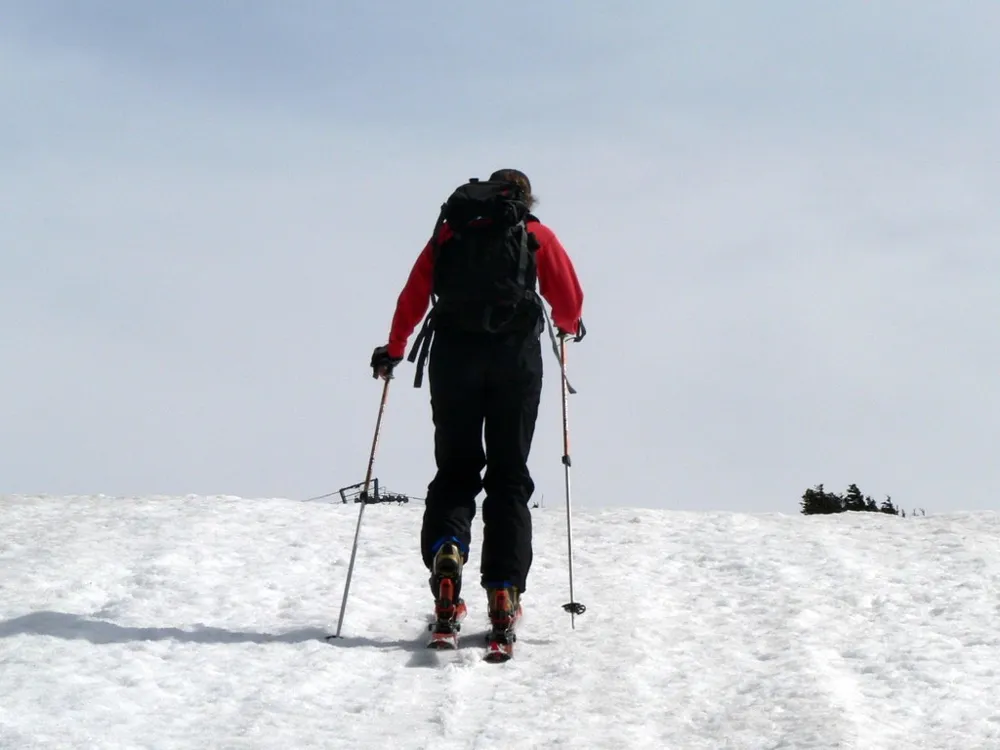
Most gear guides split ski packs into four groups. They overlap, but the split tells you which features matter.
| Type | Typical Volume | What It's For | Key Features |
|---|---|---|---|
| Resort | About 10–22 L | Lift-served days, water, snacks, a spare layer | Slim profile, few loose straps, hydration, goggle pocket |
| Day touring and sidecountry | About 20–35 L | Backcountry day tours and gate-accessed terrain | Avalanche tool pocket, back-panel access, ski and board carry, helmet carry |
| Ski mountaineering | About 35–50 L | Technical routes, glaciers, hut trips | Ice axe and crampon carry, rope strap, lighter fabrics, roll-top or lid |
| Avalanche airbag | About 12–45 L | Avalanche terrain, heli and cat skiing, touring | Inflatable airbag, trigger on the shoulder strap, rescue tool pocket |
Resort packs are about comfort on the chair. A small pack that sits close to your back lets you ski without noticing it. If you ever hike for terrain inside the boundary, look for ski or board straps.
Touring packs are built for the climb-and-ski rhythm of a backcountry day. You stop often to strip skins, add layers and eat, so fast access matters more than anything. If you are building a first setup, our backcountry skis and climbing skins guides cover the rest of the kit.
Ski mountaineering packs trade padding for weight savings and add places to carry an ice axe, crampons and a rope. See ski mountaineering for what those days involve.
Airbag packs add an avalanche airbag to a touring or freeride pack. They are covered in their own section below.
If you just need to carry boots and a helmet from the car to the lodge, that is a different product: see our ski boot bags.
What Size Ski Backpack Do You Need?
Volume is listed in liters, and makers measure it slightly differently, so treat the numbers as a guide. Think about what you carry on a typical day, then add room for the layer you take off on the way up.
| Day | Suggested Volume | What Fits |
|---|---|---|
| Resort day, back to the car for lunch | 10–15 L | Water, snacks, spare gloves, goggle lens, phone |
| Full resort day or a family pack | 15–22 L | Add a puffy jacket, lunch and extra layers |
| Sidecountry laps or a short tour | 20–26 L | Shovel, probe, skins, a layer, water and food |
| Full backcountry day | 28–35 L | Rescue gear, skins, puffy, shell, first aid, repair kit, more food |
| Ski mountaineering or hut trip | 35–50 L+ | Technical gear, overnight layers, sleeping kit for huts |
Bigger isn't always better. A half-empty large pack shifts around on the descent, and most people fill whatever space they have. Compression straps help a larger pack ride small on short days. If you are between two sizes, pick the one that suits the days you do most often.
Avalanche Tool Pocket, Access and Organization
For backcountry use, the avalanche tool pocket is the most important feature on the pack. It is a separate compartment, usually on the front, with sleeves for a shovel blade, shovel handle and probe. Keeping the rescue gear separate means you can reach it in seconds without unpacking layers and food. Check three things:
- It fits your gear. Large shovel blades and long probes don't fit every pocket. Check the pocket against your own rescue kit.
- It opens wide. A long zipper that opens the whole pocket is quicker than a narrow slot, especially with gloves on.
- You can reach it with skis strapped on. If the carry straps cover the pocket, you lose time when it matters most.
Your beacon never goes in the pack. Wear it on your body in its harness, as our avalanche beacon guide explains, so it stays with you if the pack is torn off.
Back-Panel Access
A zipper around the back panel (the side against your back) opens the whole main compartment like a suitcase. You can reach anything without unstrapping skis from the front, and the side that touches your back stays out of the snow when you lay the pack down. Deuter, Dakine, Black Diamond, Osprey and Mammut all list back or rear access on the touring packs above. Top-loaders and roll-tops are simpler and lighter but make it harder to reach things at the bottom.
Other Pockets Worth Having
- Fleece-lined goggle pocket for a spare lens or your goggles on the climb.
- Hip belt pockets for snacks, lip balm and a phone you can reach without stopping.
- Helmet carry, a mesh sling or deployable net, so your helmet rides outside on the way up.
- Radio harness or shoulder pocket if your group uses two-way radios.
- Internal mesh or key pocket for small items that would otherwise get lost.
Keep your climbing skins warm between laps by folding them inside your jacket or in the main compartment close to your back, not in an outside pocket. Cold glue sticks badly.
Ski and Snowboard Carry: A-Frame, Diagonal and Vertical
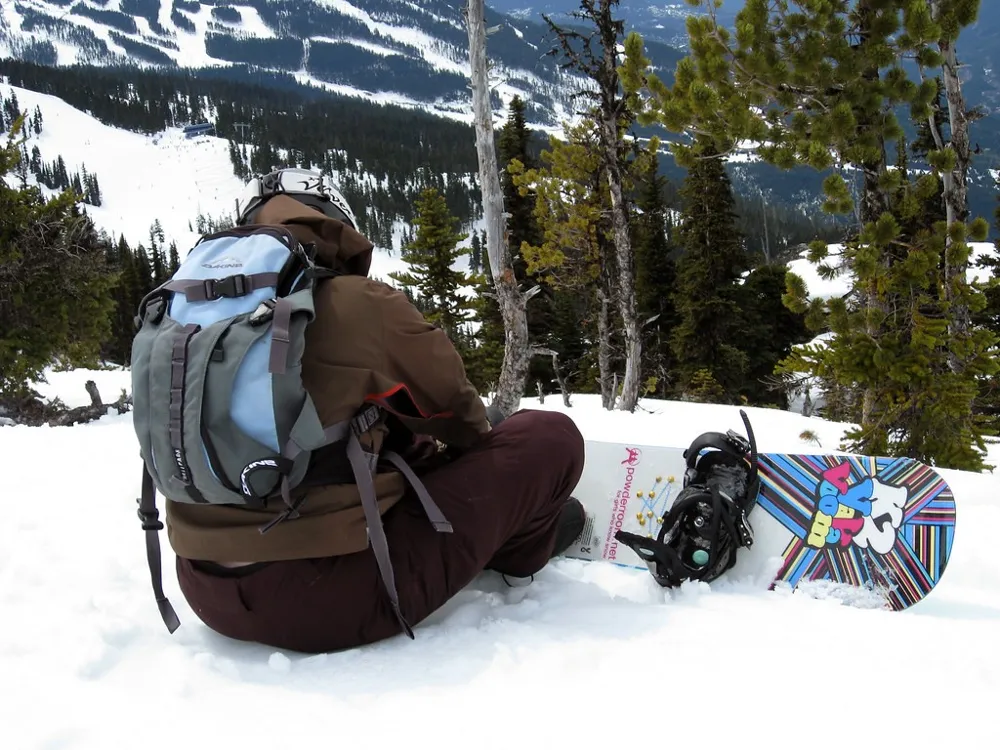
Every ski backpack straps gear to the outside, but the systems differ, and some packs offer only one.
| Carry | How It Works | Best For | Trade-Off |
|---|---|---|---|
| A-frame | One ski on each side, tips strapped together above your head | Long bootpacks, heavier skis, steady balance | Slower to set up; tips can catch on branches or a low ceiling |
| Diagonal | Both skis across the back, tails in a bottom loop and tips in a top strap | Quick transitions and short hikes | Weight sits off-center; wide skis may not fit the loop |
| Vertical snowboard | Board straps upright against the back of the pack | Most snowboard hikes | Can catch the wind; may cover the front pocket |
| Horizontal snowboard | Board straps across the pack | Short carries, narrow paths | Wide profile on narrow trails |
Diagonal carry is usually quicker to set up. A-frame carry spreads the weight evenly and is often preferred for long, steep bootpacks, as our ski mountaineering guide describes. Splitboarders can carry the two halves like skis, so look for packs that list splitboard carry and loops for collapsible poles, such as the Dakine Poacher.
Before buying, check that the pack lists the carry you want. In the lineup above, the Black Diamond Dawn Patrol 32 lists diagonal ski carry only, while the CamelBak SnoBlast 22 lists A-frame. If you ride fat powder skis, check that the diagonal loop will take your ski's width.
Hydration in the Cold
Water in a hose freezes quickly on a cold lift, so ski packs handle hydration differently from summer packs. Look for an insulated shoulder sleeve or insulated hose cover. CamelBak's Therminator harness zips the tube into the shoulder strap, and Black Diamond's Dawn Patrol has an insulated shoulder pocket for a hose or soft flask. Most touring packs also have a hydration sleeve inside for the reservoir itself.
- Clear the hose after drinking. Blowing the water back into the reservoir leaves less in the tube to freeze.
- Start with warm water and keep the reservoir close to your back.
- Carry a backup. On very cold days many skiers carry an insulated bottle or thermos inside the pack as well.
Some packs list the hydration sleeve as a radio pocket or laptop sleeve too, so read the feature list to see what it is built for.
Fit, Torso Length, Weight and Materials
A pack that fits stays put when you make quick turns. Sizing follows your torso length, not your height. Black Diamond explains how to measure it: from the bony bump at the base of your neck (the C7 vertebra) down to the top of your hip bones (the iliac crest). Compare that number with the maker's size chart. Black Diamond's Dawn Patrol, for example, comes in S/M (16 to 19 in) and M/L (18.5 to 21.5 in).
- Women's and short-torso versions have shorter backs, narrower shoulder straps and shaped hip belts. Osprey's Kresta, Deuter's SL models and Dakine's women's Heli Pro are examples.
- Load lifters and a padded hip belt carry heavy touring loads better. A thin webbing belt is fine for resort packs.
- Weight ranges from about 750 g for a small resort pack to almost 3 kg for an airbag pack with a full cylinder. Lighter packs usually have less padding.
- Fabric is often listed by denier (D): higher numbers are tougher and heavier. Packs commonly use tougher fabric where ski edges rub. Look for water-repellent fabric, coated zippers and snow-shedding back panels.
If you can, load the pack with your real gear and walk around before committing. An empty pack always feels fine.
Avalanche Airbag Packs: How They Work
An avalanche airbag is a large bag stored in the pack that you inflate by pulling a trigger on the shoulder strap. BCA says its airbag creates buoyancy that helps you stay near the surface, decreasing burial depth, and protects the head and neck. Its 150-liter Float airbags and 162-liter Float E2 airbags are examples of the size involved. BCA states plainly that the Float system does not guarantee survival in an avalanche. No airbag replaces avalanche education, rescue gear and careful terrain choices.
| System | How It Inflates | Re-Use | Air Travel |
|---|---|---|---|
| Compressed gas cylinder (for example BCA Float 2.0) | Pressurized cylinder fills the bag | Cylinder must be refilled or exchanged after each pull | Strict rules; BCA says US travelers should fly with the cylinder empty and the head unscrewed |
| Electric (for example Alpride E2 in BCA Float E2) | Stored energy powers a fan or compressor | Supercapacitor stores the energy; BCA lists extra deployments with AA batteries installed | BCA says the E2 is a capacitor of 10 Wh or less and not subject to dangerous goods rules |
A few points from the makers' own pages:
- Cylinder systems need a refill or exchange after every deployment, including practice pulls. BCA lists about 200 refill locations and says refills are mainly available in the US, Canada, Chile and Argentina, with exchanges in Europe and rentals in Japan.
- BCA's E2 system uses supercapacitors. BCA says two AA alkaline batteries add one extra deployment and lithium AAs add three, and that the batteries help keep the system charged.
- Weight goes up. BCA lists the Float 32 at 3.8 lb for the pack alone and 6.4 lb as a full system with a full cylinder.
- Removable systems, like Mammut's Removable Airbag 3.0, let you use the same pack without the airbag on low-risk days.
- Flying: rules differ by system, airport and airline, and change over time. Check the maker's travel page, the FAA rules and your airline before every trip (last checked November 2026). Our ski trip packing list covers flying with other ski gear.
Practice deploying your airbag at home as the maker's manual describes, so the trigger pull becomes automatic.
Avalanche Safety Gear and Training
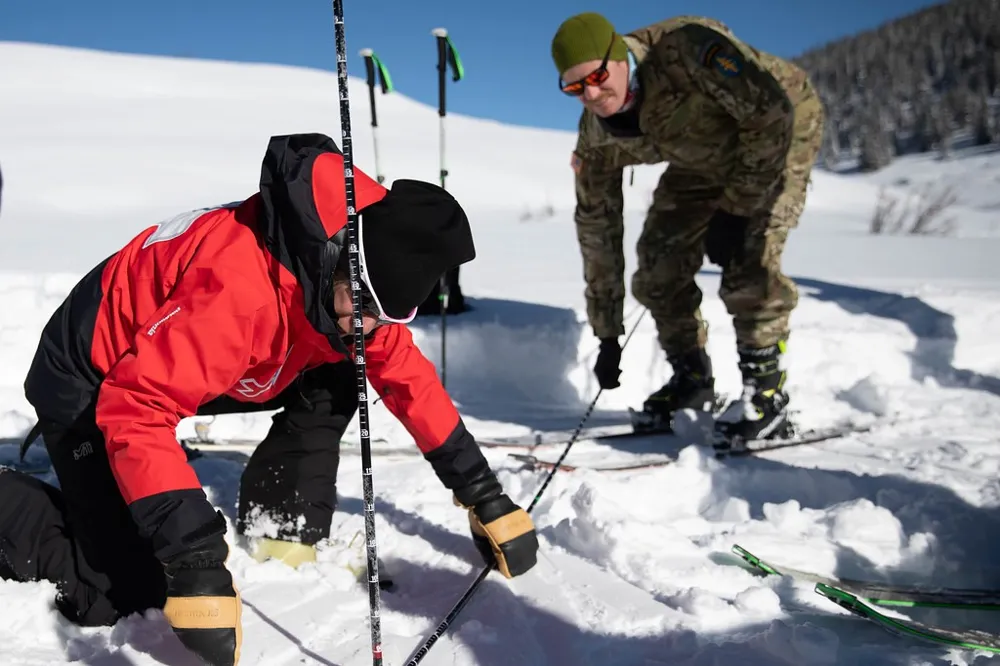
A pack carries your rescue gear, but it doesn't make you safe. Everyone in a backcountry group needs an avalanche beacon, a probe and a metal-blade shovel, plus the training to use them. This page is a gear guide, not avalanche training.
- Take a course. The American Avalanche Association describes a course progression from a short Avalanche Awareness class to Recreational Level 1 and an Avalanche Rescue course. AIARE runs a widely used version through guide services and schools. Our backcountry skis guide outlines each step.
- Read the forecast. In the US, avalanche.org links to the regional avalanche forecast centers. Check it before every tour.
- Practice rescues each season with your regular partners, and check beacons at the trailhead.
- Hire a certified guide if you are new to the backcountry or to an area.
Our backcountry skiing for beginners guide explains how a first season usually unfolds.
Riding Lifts With a Backpack
Backpacks are a common sight on chairlifts and gondolas, but loose straps can snag on the chair. Common practice is to:
- Loosen or unclip the waist belt and sternum strap before loading.
- Swing the pack onto one shoulder or onto your lap so you can sit back on the chair.
- Tuck away dangling straps, ski-carry straps and the helmet net.
- Follow lift staff and posted rules, which vary by resort.
Small packs with clean outsides, like the CamelBak SnoBlast with its quick-release harness, are easiest on lifts. Larger touring packs are fine too if you tidy the straps. A pack also changes how a fall feels, so keep it light and snug on busy groomers.
Packing and Caring for a Ski Backpack
Pack heavy items close to your back and in the middle, with light layers on top and the rescue tools in their own pocket. Keep food, sunscreen and a spare layer where you can reach them quickly. A basic list for a backcountry day: shovel and probe, skins, a puffy and a shell, spare gloves or mittens, water, food, a first aid kit, a repair kit, a headlamp and sun protection.
After each day, empty the pack, open the zippers and let it dry indoors. Brush grit out of zippers now and then, and store the pack dry. For airbag packs, follow the maker's manual for storage, battery care and regular test deployments, and send the pack for service if anything looks damaged.
Related Gear Guides
- Best avalanche beacons and the full rescue kit
- Best backcountry skis and climbing skins
- Best ski boot bags for travel and the parking lot
- What to wear skiing and ski jackets
- Ski trip packing list
Frequently Asked Questions
What size backpack do I need for skiing?
For resort days, about 10 to 22 liters holds water, snacks and a spare layer. Most backcountry day tours fit in roughly 25 to 35 liters, and ski mountaineering or hut trips usually need 35 liters or more.
Can I use a regular backpack for skiing?
At the resort, a small regular backpack works if it rides close to your back and has a waist strap. For the backcountry, a ski-specific pack is better because it has a separate pocket for your shovel and probe and straps to carry skis or a board.
What is A-frame ski carry?
A-frame carry straps one ski to each side of the pack so the tips meet above your head. It spreads the weight evenly and suits long bootpacks. Diagonal carry runs both skis across the back and is quicker to set up for short hikes.
Do ski backpacks fit on a chairlift?
Most do. Many skiers loosen the waist and sternum straps and swing the pack onto one shoulder or onto their lap before loading. Packs with few loose straps are less likely to snag, and some resorts post their own rules, so follow lift staff.
Do I need an avalanche airbag pack?
An airbag is extra protection, not a replacement for a beacon, probe, shovel, trained partners and good decisions. BCA states that its airbags do not guarantee survival. Take an avalanche course and read the forecast first, then decide whether an airbag fits how you ski.
Can you fly with an avalanche airbag backpack?
It depends on the system. BCA says US travelers should empty its compressed air cylinder and carry it through security with the head unscrewed, while its Alpride E2 electric system is classed as a capacitor of 10 Wh or less. Check your maker's guidance, the FAA rules and your airline before you fly.
Should my beacon go in my ski backpack?
No. Wear your avalanche beacon in its harness, close to your body, so it stays on your body if you lose your pack. The shovel and probe go in the pack's avalanche tool pocket.