Ski Slope Difficulty Ratings, From Green Circles to Red Pistes (2026)
Trail symbols tell you how hard a run is compared with the rest of that mountain. Here's what every North American symbol and European color means, plus how Japan, Scandinavia and terrain parks do it.
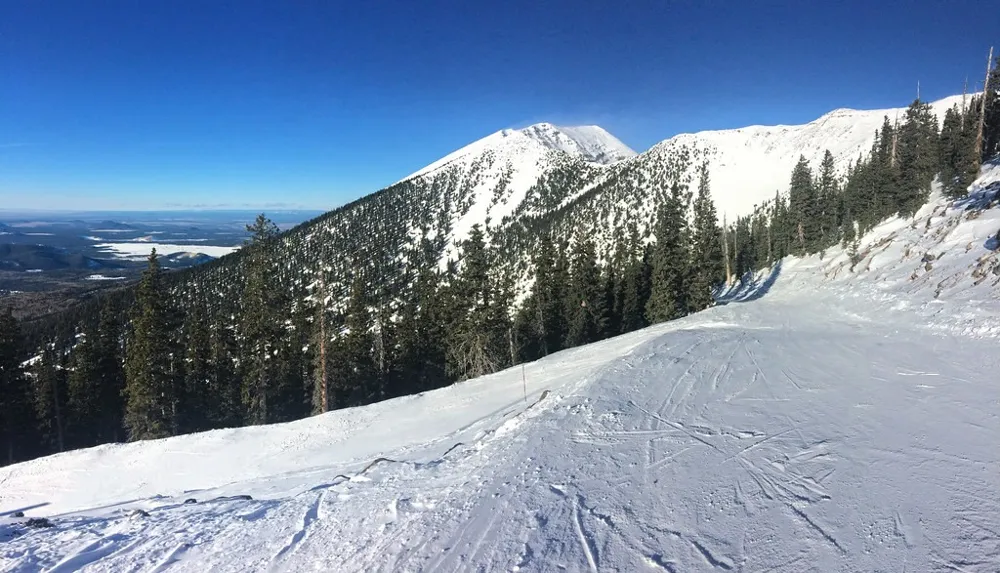
How Ski Trail Ratings Work
Every run at a ski resort carries a difficulty rating, shown on the trail map, on signs at the top of the run and often on signs at the lift base. The rating tells you how hard that run is compared with the other runs at the same resort. It is not a universal scale.
North America, Australia and New Zealand use colored shapes (green circle, blue square, black diamond). Most of Europe uses colors (blue, red, black and, in some countries, green). Japan uses colors without shapes. The quick version is below, with each system explained in the sections that follow.
| Level | North America | Most of Europe | Japan |
|---|---|---|---|
| First-timer | Green circle (bunny slope or learning area) | Green where used; otherwise unrated learning area | Green |
| Beginner | Green circle | Blue (green in some countries) | Green |
| Intermediate | Blue square | Red | Red |
| Advanced | Black diamond | Black | Black |
| Expert | Double black diamond | Black, orange (Austria, Switzerland) or marked ski routes | Black |
| Freestyle | Orange oval (terrain park) | Varies by resort | Varies by resort |
The rows line up only roughly. Use them as a starting point, then judge each run with your own eyes.
North American Trail Symbols
The North American system pairs a color with a shape. State law in some places spells it out. Colorado's ski safety statute, for example, says a ski area's least difficult trails get a green circle and the word "easiest", trails between green and black get a blue square and "more difficult", the hardest get a black diamond and "most difficult", and freestyle terrain gets an orange oval.
| Symbol | Sign Wording | What to Expect | Who It Suits |
|---|---|---|---|
| Green circle | Easiest | Wide, gentle, usually groomed; sometimes long cat tracks or summer roads | Beginners who can turn and stop with a wedge |
| Blue square | More difficult | Steeper pitches, usually groomed; may have rollers, moguls or narrower sections | Intermediates who can link turns and control speed |
| Black diamond | Most difficult | Steep; may be ungroomed, with moguls, trees, ice or deep snow | Advanced skiers comfortable on steeps and variable snow |
| Double black diamond | Experts only | Very steep, often narrow, with cliffs, chutes, rocks, tight trees or wind exposure | Experts with strong technique in all conditions |
| Orange oval | Freestyle terrain | Jumps, rails, boxes, halfpipes; features sized separately | Riders building freestyle skills, starting small |
The easiest greens near the base are often called the bunny slope or learning area. They are short, very gentle and usually served by a conveyor (magic carpet) or a surface lift. Our how to ski guide covers what to do there on day one.
In-Between and Extra Symbols
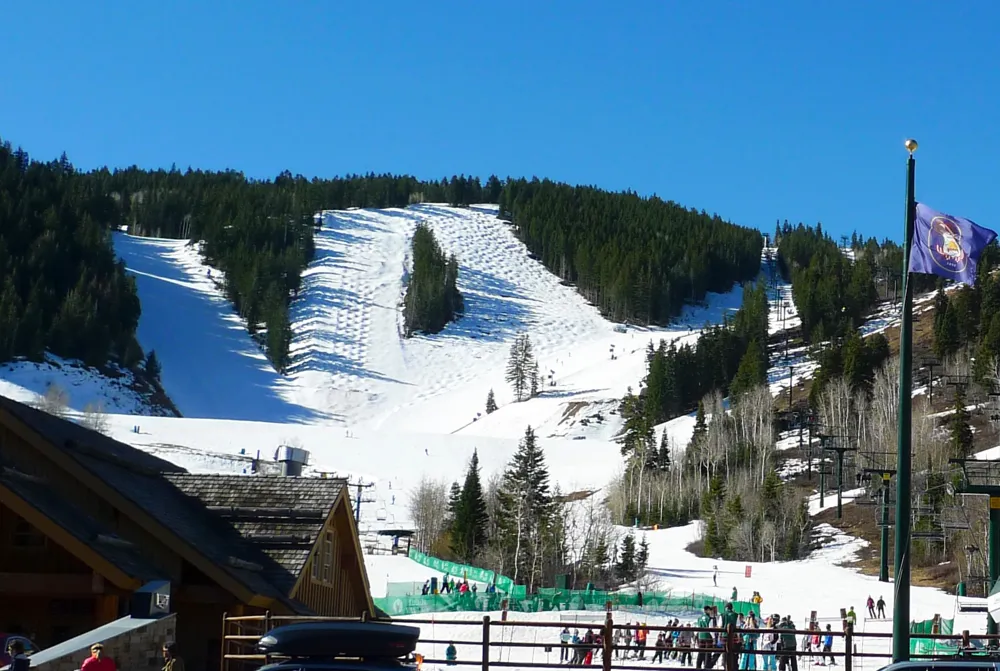
Four basic symbols don't cover every run, so some resorts add their own variations. You'll see these on trail maps at a minority of North American resorts:
- Green-blue: a green circle inside or beside a blue square, for an easy intermediate run. Jiminy Peak in Massachusetts is one resort reported to use it.
- Blue-black: a black diamond over a blue square, for runs between intermediate and advanced. It's reported at some eastern and Colorado resorts.
- Triple black diamond: used at a few resorts, such as Smugglers' Notch in Vermont and Big Sky in Montana, for their most extreme runs.
- Double black with "EX": Colorado law describes "extreme terrain" signs as two black diamonds containing the letters E and X. Many Colorado resorts use it for their steepest, most consequential terrain.
Because these symbols aren't used everywhere, always read the legend on that resort's trail map. A triple black at one mountain may be no harder than a double black at another.
Terrain Park Signs and Feature Sizes
Terrain parks are marked with an orange oval (some maps draw it as an orange rounded rectangle). The sign tells you that the trail ahead contains freestyle features such as jumps, rails, boxes or halfpipes. Many parks are next to a regular run, so you can often ski past the features if you don't want to hit them.
Inside the park, the size of each feature matters more than the trail color. Colorado Ski Country USA notes that some resorts list feature sizes as XS, S, M, L and XL, and suggests starting in XS parks. Treat the trail rating under a park as a guide to the slope, not to the features: a blue-rated park can still hold jumps that are far too big for a blue-level rider.
The Park SMART message from the National Ski Areas Association and Burton gives five rules: Start small, Make a plan, Always look, Respect the features and other users, and Take it easy. Our ski tricks for beginners and snowboard tricks for beginners guides cover the first park features to try.
Why Ratings Are Relative to Each Resort
There is no single body that rates every run in North America. Each resort rates its own trails, comparing each one only with its other trails. Colorado's statute makes this explicit: the green circle goes on "the ski area's least difficult trails and slopes," not on trails that meet a set steepness.
That has three practical effects:
- Small hills vs big mountains. A black diamond at a small eastern or Midwest hill can be shorter and gentler than a blue at a large western resort with steep terrain. The easiest runs at a steep mountain can be harder than the easiest runs elsewhere.
- A run is rated by its hardest part. A long green with one steep pitch is often rated by that pitch, and a black may be steep for only a short section.
- Conditions change the difficulty. Ice, crud, deep powder, poor visibility and crowds can make a familiar run feel a full level harder.
The safe habit is the same everywhere: on your first run at a new resort, pick one level easier than you would at home, then move up once you've seen how that mountain grades its terrain.
European Piste Colors
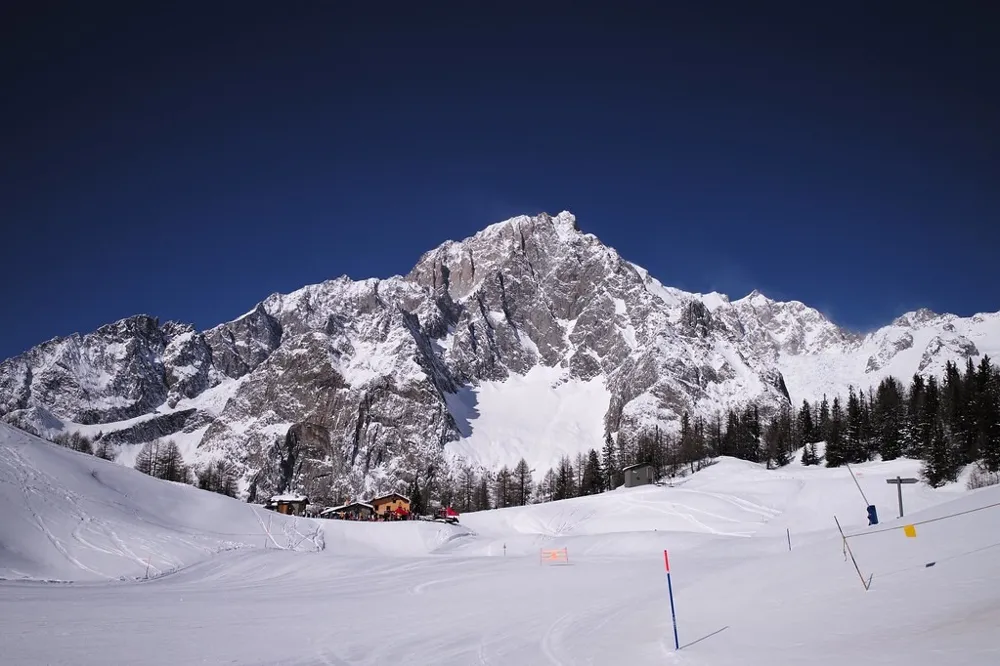
European resorts mark pistes by color, and shapes are often left off. National standards such as Germany's DIN 32912 and Austria's ÖNORM S 4610 build on the same basic colors.
| Color | Level | Notes |
|---|---|---|
| Green | Beginner | Used in some countries, including France, Spain, Poland, Bulgaria and the UK; often a wide, gentle area near the base |
| Blue | Easy | Almost always groomed; the easiest marked piste in countries without green |
| Red | Intermediate | Steeper or narrower than blue, usually groomed |
| Black | Advanced | Steep; a broad category, from a little harder than red to very steep runs. Often groomed in Austria, Italy and Switzerland, but often left ungroomed in France |
| Orange | Harder than black | Used in Austria, Switzerland and a few other areas |
| Yellow or marked route | Off-piste route | Called a ski route, itinéraire or freeride route; marked but not groomed. How it is patrolled and protected varies, so check locally |
European grading is less tied to steepness than North America's. Narrow sections, the speed a run demands, off-camber slopes and exposed rock can all push a run up a grade. The French boundary between red and black is also reported to sit higher than in other countries, so a French red can feel stiff.
Comparing with North America: a European blue is closest to a green circle, a red to a blue square (often a firm one) and a black to a black diamond. If you're planning a trip abroad, our guide to planning a ski trip covers lessons and lift passes.
Japan, Scandinavia and Other Systems
Outside North America and the Alps, the same colors appear with local twists:
| Region | Ratings | Good to Know |
|---|---|---|
| Japan | Green (beginner), red (intermediate), black (expert), usually without shapes | Red covers most runs at most areas. Some resorts popular with overseas visitors use North American or European symbols instead |
| Norway, Sweden, Finland | Green circle, blue square, red rectangle, black diamond; some areas add double or triple black | Combines European colors with shapes and gives angle limits for each grade (below) |
| Australia, New Zealand | Green circle, blue square, black diamond, double black | Same color and shape system as North America |
Japan has more than 1,000 ski areas, many of them small and family-oriented, so a black at one area may be mild compared with a black at a large, steep resort. As everywhere, ratings are relative to that resort.
What Makes a Run Harder
Steepness is the biggest factor, but it isn't the only one. Resorts weigh:
- Gradient of the steepest section
- Width, because a narrow run leaves less room to turn and slow down
- Grooming, since groomed snow is far easier than moguls or crud
- Obstacles such as trees, rocks, cliffs and drop-offs
- Turns and fall line, including sharp corners and runs that slope sideways
- Exposure to wind, ice and avalanche terrain
Typical Slope Gradients
No universal steepness rule applies in North America, but commonly cited figures (including in the Wikipedia "Piste" article) put greens at about 6 to 25% grade, blues at about 25 to 40% and blacks at 40% and up. In Europe, the same source says blue pistes normally don't exceed about 25% and reds about 40%, except for short, wide sections. Treat these as rough guides, not rules.
| System | Easiest | Intermediate | Hardest Common Grade |
|---|---|---|---|
| North America (approximate) | Green: about 6–25% | Blue: about 25–40% | Black: about 40% and up |
| Europe (approximate maximums) | Blue: about 25% | Red: about 40% | Black: no set maximum |
| Scandinavia (stated limits) | Green: up to 9° (16%); blue: up to 15° (27%) | Red: up to 25° (47%) | Black: over 25° (47%) |
Grade and angle aren't the same thing. A 100% grade drops one foot for every foot forward, which is a 45-degree slope, so a 40% grade is only about 22 degrees. It feels much steeper than that from the top.
Other Signs on the Mountain
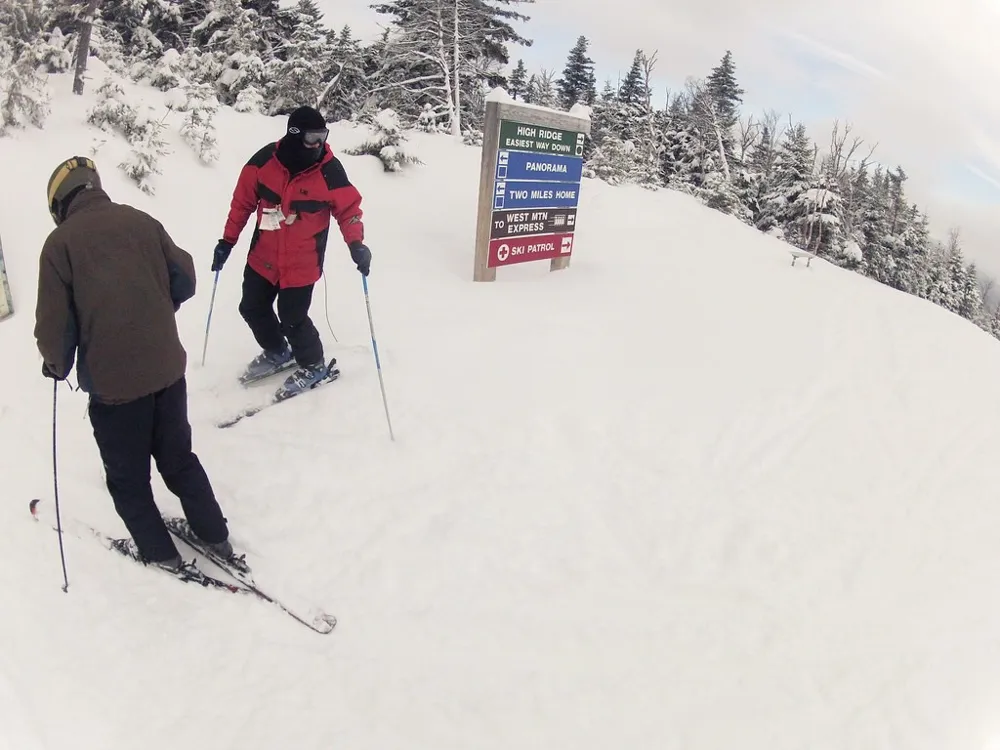
Difficulty symbols sit alongside other signs you need to obey. Point 6 of the National Ski Areas Association's Your Responsibility Code (updated in 2022) tells skiers and riders to "read and obey all signs, warnings, and hazard markings," and point 7 says to keep off closed trails and out of closed areas.
- Closed: Colorado's statute describes an octagonal sign with a red border, a skier figure crossed by a black band and the word "Closed." Ropes or fences may be used instead.
- Slow zone: high-traffic areas, such as busy intersections and lift lines, where you must slow down.
- Lift warnings: some lifts carry a sign at loading saying they serve only "more difficult" or "most difficult" terrain. If there's no green way down, choose another lift.
- Boundary and hazard markers: show the edge of the ski area and mark hazards along the way.
- Route signs: some resorts sign an "easiest way down" from the top of a lift for lower-level skiers.
Our snow sports hub summarizes the code, and the full text is on the NSAA's safety page. Signs and rules can vary by resort and state, so check local postings (last checked November 2026).
How to Use Ratings to Choose Runs
- Grab a trail map or open the resort's app before you ride up. Maps are posted at the base and at lift tops, and some lifts show them on the safety bar.
- Check the way down from each lift. A lift can serve one easy run and several hard ones.
- Warm up one level easier, especially at a new resort or after fresh snow, ice or a long break.
- Move up when you're ready. Try blues once you can link controlled turns and stop on demand on any green. Try blacks once you can ski every blue in control, including steeper and bumpier ones.
- Watch the run first. Many blacks can be seen from a lift. If you can't see the whole run, ask a lift attendant, instructor or patroller.
- Ski with someone on expert terrain and in trees, and stay within your limits.
Lessons speed up every step. If you're still choosing where to learn, see our best ski resorts for beginners, which compares how much easy terrain each resort has.
A Short History of Trail Ratings
The North American system was refined in 1968 by the National Ski Areas Association, drawing on research by the Walt Disney Company, which was then planning a ski resort at Mineral King in California. The double black diamond came later and is reported to date from the 1980s. For more on how the sport grew, see our history of skiing.
Frequently Asked Questions
What are the ski trail difficulty levels?
In North America they are the green circle (easiest), blue square (more difficult), black diamond (most difficult) and double black diamond (experts only). Some resorts add in-between symbols, triple black diamonds or extreme-terrain signs, and terrain parks use an orange oval.
Is a European red run the same as a black diamond?
Not exactly. A red piste is Europe's intermediate grade and is often compared with a harder North American blue or an easy black. Because ratings are set by each resort, the only reliable test is to look at the run or ask locally.
Is a green run in Europe the same as in the US?
Green is a beginner grade in both, but many European countries don't use green at all. Where green is missing, blue is the easiest marked piste, so a European blue is closer to a North American green.
Are ski trail ratings the same at every resort?
No. Each resort rates its own runs compared only with its other runs, so a black diamond at a small hill can be easier than a blue at a big, steep mountain. Start a level easier at any new resort.
What does a double black diamond mean?
Experts only. It marks terrain steeper or more hazardous than a black diamond, such as narrow chutes, cliffs, tight trees, exposed rock or wind-blown slopes.
What is the hardest ski run rating?
In North America it's usually the double black diamond, but some resorts add triple black diamonds or double diamonds marked EX for extreme terrain. In Austria and Switzerland, orange marks runs harder than black.
What does an orange oval mean on a ski trail sign?
It marks a terrain park or freestyle area with jumps, rails, boxes or a halfpipe. Many parks also label features by size, from XS to XL, so start on the smallest.
How steep is a black diamond?
Ratings aren't based on steepness alone. Commonly cited guides put greens below about 25% grade, blues at about 25 to 40% and blacks above about 40%, but resorts also weigh width, grooming, obstacles and turns.