How to Freedive Safely: A Step-by-Step Beginner Guide (2026)
Freediving is diving on a single breath. Here's how it works, the safety rules that matter most, how to train and the technique you'll learn in a first course.
What Is Freediving?
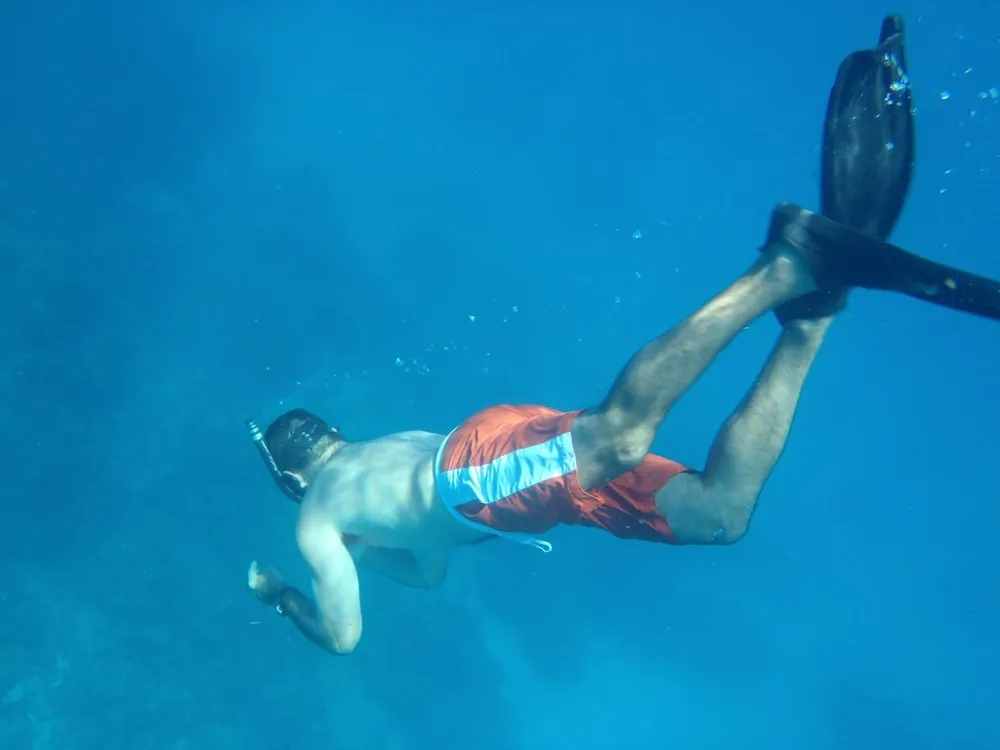
Freediving is diving underwater on a single breath, with no tank. You breathe at the surface through a snorkel, take one last breath, dive down and return to the surface to breathe again. People freedive to explore reefs, take photos, spearfish or train for depth and distance.
Freediving vs snorkeling comes down to what you do with your breath. A snorkeler mostly floats at the surface and breathes through the snorkel, maybe ducking down a meter or two. A freediver leaves the surface on purpose, using trained breathing, equalization and safety routines to go deeper and stay down longer. If you're brand new to the water, start with how to snorkel. If you're weighing tanks against a single breath, see scuba diving vs freediving.
| Snorkeling | Freediving | |
|---|---|---|
| Where you spend time | At the surface | Diving below the surface on a breath-hold |
| Typical gear | Mask, snorkel, short fins, often a vest | Low-volume mask, snorkel, long fins, wetsuit, weight belt |
| Training | None required | A certified course is strongly recommended |
| Main risk | Fatigue, currents, boat traffic | Blackout from low oxygen |
| Buddy | Recommended | Essential on every dive |
This guide explains how freediving works and what you'll learn. It is not a substitute for a course with a certified instructor. Talk to a doctor before you start, especially if you have heart, lung, ear or sinus conditions.
Freediving Safety Rules: Read This First
Holding your breath underwater can make you lose consciousness without warning. The Divers Alert Network (DAN) calls avoiding solo diving and avoiding hyperventilation two of the most important rules in breath-hold diving. These are the basics every course drills:
The non-negotiables
- Never freedive alone. Every dive needs a trained buddy whose only job is watching you, in the pool and in open water.
- One up, one down. One diver dives while the other watches from the surface. Swap only after the diver has fully recovered.
- Never hyperventilate. Fast or forced breathing before a dive lowers carbon dioxide and delays the urge to breathe, so oxygen can run out before you feel it. DAN warns that hyperventilation alone can cause a blackout.
- Watch the surface. Blackouts are most likely in the last few meters of the ascent or just after surfacing. DAN advises watching a diver for at least 30 seconds after they surface.
- Do recovery breaths after every dive, even if you feel fine.
- Never practice breath-holds in water alone, including in a bathtub or pool. Dry breathing exercises belong on land.
- Use a float and dive flag in open water and stay away from boat traffic.
- Stop if anything hurts, especially your ears or sinuses, and end the session if you feel cold, tired or stressed.
Blackout and Samba
A blackout is a loss of consciousness from low oxygen. A samba, or loss of motor control (LMC), is a milder warning: shaking, poor posture control, confusion or trouble speaking after a dive. Divers who have a samba often don't know it happened until their buddy tells them. In both cases the buddy keeps the diver's airway out of the water and supports them until they recover. Rescue is a hands-on skill you learn on a course, not from an article. For more on the physiology, see shallow water blackout.
Surface Protocol and Recovery Breathing
When you surface, hold the line or buoy, clear your snorkel or take it out, and start recovery breaths: a quick passive exhale followed by a fast, full inhale, repeated several times. Many courses then add a simple signal, such as an OK hand sign and a short "I'm OK," so your buddy can confirm you're fully aware. Rest at the surface between dives; a common rule of thumb is at least two to three times as long as your dive, and longer for deeper dives.
Freediving Disciplines
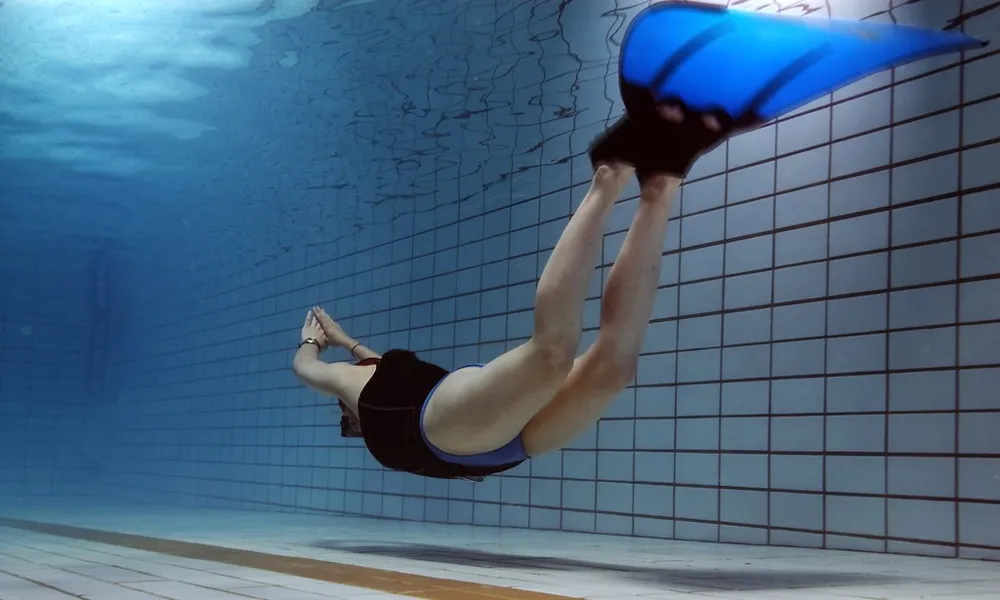
Competitive freediving is split into disciplines, which international bodies such as AIDA and CMAS use for courses, competitions and records. You'll practice simple versions of several of them on a beginner course.
| Discipline | Where | What It Is |
|---|---|---|
| Static apnea (STA) | Pool | Holding your breath while floating face-down at the surface, measured in time |
| Dynamic apnea (DYN, DYNB) | Pool | Swimming horizontally underwater for distance, with a monofin (DYN) or bi-fins (DYNB) |
| Dynamic no fins (DNF) | Pool | Horizontal distance swimming with a breaststroke-style technique and no fins |
| Constant weight (CWT, CWTB) | Open water | Diving down and back up a line with fins, without pulling on it or dropping weight |
| Constant weight no fins (CNF) | Open water | Diving down and up without fins or pulling on the line |
| Free immersion (FIM) | Open water | Pulling yourself down and up the line by hand, without fins |
| Variable weight and no limits | Open water | Sled-assisted descents for experienced specialists only; not part of beginner training |
Records change every year and depend on the organization, so we keep them on diving world records rather than here.
How to Learn: Freediving Courses
A course is the safest way to start. It teaches breathing, equalizing and technique, and, most importantly, how to watch and rescue a buddy. All the major agencies combine theory, pool or confined water sessions and, at entry level, open water dives. Expect a medical questionnaire before you begin; some answers need a doctor's sign-off.
| Agency | Entry Course | Minimum Age | Course Targets or Depth Limit |
|---|---|---|---|
| AIDA | AIDA 2 | 18, or 16–17 with parental consent | 2:00 static, 40 m dynamic, 12 m constant weight |
| PADI | PADI Freediver | PADI lists 12 on its current course page; older PADI materials say 15 | 90 s static, 25 m dynamic, 10 m (30 ft) constant weight |
| SSI | SSI Freediver | Check with your center | Certifies buddy dives to 20 m (65 ft) |
| Molchanovs | Wave 1 (Lap 1 is pool only) | Check with your center; junior courses exist | 1:30 static, 30 m dynamic with bi-fins, 12–20 m depth |
Shorter taster courses also exist: PADI Basic Freediver (pool only, from age 12, to 6 m/20 ft) and SSI Basic Freediver (from age 10, to 5 m/15 ft). Most entry courses also ask for a swim test, typically 200 m without stopping or 300 m with mask, fins and snorkel. Requirements are set by each agency and change over time, so confirm current levels, ages and prerequisites on the agency site or with your instructor.
Freediving Gear for Beginners
You don't need much to start, and many courses provide gear. The PADI course page notes that you may be able to start with snorkeling gear you already own. Here's what freedivers use and why.
| Gear | Why It Matters |
|---|---|
| Low-volume mask | Less air to equalize at depth, so less effort and less mask squeeze |
| Simple snorkel | Relaxed breathing at the surface; taken out or left to hang before each dive |
| Long-blade fins | Move more water per slow kick, saving energy and oxygen |
| Wetsuit | Warmth and protection; being cold makes it much harder to relax |
| Weight belt | Rubber belt worn low on the hips with a quick release, to offset wetsuit buoyancy |
| Buoy, line and dive flag | A resting point, a depth reference and visibility to boats |
| Lanyard | Clips you to the line in deeper training, with a one-hand quick release |
| Freediving computer (optional) | Tracks depth, dive time and surface intervals |
For detailed picks, see best freediving fins, best freediving masks and freediving wetsuits. Two common starting points:
Cressi F1 Frameless Mask
A frameless, single-lens, low-volume mask with a soft silicone skirt, used by freedivers, snorkelers and scuba divers.
Check Price on AmazonCressi Gara 3000 LD Fins
Long-blade, full-foot freediving fins with a softer blade that takes less leg effort, a classic first freediving fin.
Check Price on AmazonHow to Breathe Up and Relax
The "breathe-up" is the calm breathing you do at the surface before a dive. The goal is to relax and lower your heart rate, not to load up on air. DAN's advice is to keep normal, relaxed breathing until your final breath.
- Float face-down on the buoy or at the surface, breathing through your snorkel, with your body loose.
- Breathe slowly from the belly. Many instructors teach exhales about twice as long as inhales, such as roughly 4 seconds in and 8 seconds out.
- Stay calm, not fast. If your buddy can hear you breathing hard through the snorkel, you're probably hyperventilating. Slow down before you dive.
- Take a final breath. Exhale fully, then fill your lungs from the belly up to the chest without straining. Don't force extra air in.
Relaxation is a skill in itself. Stress uses oxygen, so many freedivers use visualization or simple mental cues. If you can't settle, have a longer rest or do an easier dive. For land-based breathing practice, see how to hold your breath longer.
How to Equalize for Freediving
As you descend, water pressure squeezes the air spaces in your ears, sinuses and mask. You need to equalize by adding a little air to your middle ears, and by breathing a little air from your nose into your mask.
- Valsalva: pinch your nose and gently blow against it. It's easy to learn but uses your breathing muscles, gets harder head-down and as your lungs compress, and doesn't work beyond a certain depth for most people. DAN warns against blowing hard or holding pressure for more than about five seconds.
- Frenzel: pinch your nose, close the back of your throat and use your tongue like a piston to push air up, a bit like saying "K." It uses less effort and oxygen and works head-down, which is why freediving courses teach it.
- Mouthfill: an advanced technique for deeper dives, where you store air in your mouth and use it to equalize as your lungs compress. Learn it from an instructor once your Frenzel is reliable.
Equalize early and often, before you feel pressure, and never force it. If your ears won't clear, turn around and come up. Diving with a cold or congestion makes equalizing harder and riskier. For step-by-step drills, see how to equalize your ears when diving.
How to Freedive Step by Step
This is the sequence you'll practice on a course, usually on a line under a buoy, with your buddy watching.
1. Prepare and Breathe Up
Agree on the plan with your buddy: target depth or time, who dives first and the turn signal. Breathe up calmly, take your final breath and remove your snorkel from your mouth.
2. Duck Dive
A clean duck dive gets you under with almost no effort:
- Start about a body length from the line, face-down and relaxed.
- Reach both arms forward and down and bend at the hips to a right angle.
- Lift both legs straight up together, so their weight pushes you under.
- Sweep your arms back to your sides once, then bring a hand to your nose to equalize.
- Start kicking only when your fins are underwater, so you don't splash air.
3. Fin Efficiently
Kick from the hips with long, nearly straight legs and pointed toes. Avoid bending your knees into a bicycle kick, and keep kicks narrow and smooth. With bi-fins, arms usually stay by your sides or one hand stays ready to equalize. Look at the line, not at the bottom, so your neck stays relaxed and straight.
4. Freefall
Below your neutral buoyancy depth, water pressure compresses your lungs and wetsuit, and you start to sink on your own. This is freefall: stop kicking, keep a streamlined, relaxed position and keep equalizing. Freefall saves a lot of oxygen, which is one reason correct weighting matters.
5. Turn and Ascend
Turn at your planned depth or as soon as you feel any discomfort or urge to breathe that you didn't expect. Kick steadily up, look at the line and slightly up, and avoid racing to the surface. The last 10 meters are where blackouts most often happen, so your buddy should meet you on the way up as you progress deeper.
6. Recover
Grab the buoy or line, do your recovery breaths and give your OK signal. Your buddy keeps watching you for at least 30 seconds, then you rest before swapping roles.
Weighting: How Much Weight Do You Need?
A wetsuit floats, so freedivers wear a little weight to offset it. The aim is to stay slightly positive at the surface, floating without effort, so that if you black out near the surface you'll float rather than sink. Being overweighted makes the ascent harder, which is the opposite of what you want.
- Surface check: float upright without moving after a normal breath. You should stay comfortably afloat.
- Neutral depth: PADI describes several approaches, such as neutral at about a third of your maximum depth (or 5 m, whichever is deeper), at half your maximum depth or at a fixed 10 m. Your instructor will set this for you.
- Adjust in small steps, using small weights spread evenly on a rubber belt that sits low on the hips and has a quick release.
Wetsuit thickness changes how much weight you need, so recheck when you change suits or move between fresh and salt water. If you're unsure what to wear under it, see what to wear under a wetsuit.
Progression, Drills and Dry Training
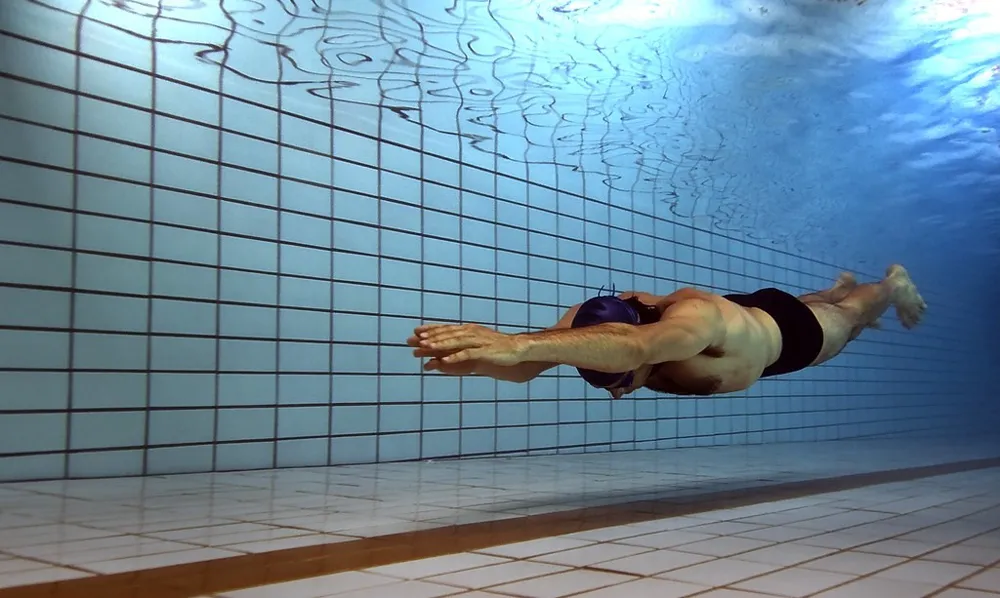
Progress in freediving should be slow and incremental. Increase depth a couple of meters at a time, and only when the current depth feels easy, your equalization is reliable and you're surfacing relaxed. Repeat a depth several times before moving on. If your buddy notices your lips turning dark when you surface, go back to easier dives.
In-Water Drills (Always With a Buddy)
- Duck dive and first few meters: repeat until it's smooth and splash-free.
- Free immersion on the line: pulling down hand over hand is a relaxed way to practice equalizing without kicking.
- Dynamic in the pool: short horizontal swims to work on finning technique, under supervision.
- Buddy and rescue drills: practice your role as safety diver as often as you dive.
Dry Training on Land
Many freedivers use CO2 and O2 tables: timed breath-hold schedules done sitting or lying down. A CO2 table keeps the breath-hold time fixed and shortens the rest between holds; an O2 table keeps the rest fixed and gradually lengthens the holds. Instructors suggest one or two table sessions a week at most, not on the same day as other hard training.
Do tables only on dry land, seated or lying somewhere safe, never in water, never while driving and never standing. They're demanding even though they look easy. Stop if you feel unwell, and ask an instructor to set times that suit you. General fitness, flexibility and yoga-style breathing practice also help.
Common Beginner Mistakes
- Diving alone or with a buddy who isn't watching.
- Hyperventilating or taking big "cleansing" breaths before a dive.
- Forcing equalization instead of turning around.
- Too much weight, which makes the ascent hard and dangerous.
- Bicycle kicks with bent knees, which waste energy.
- Lifting the head to look down, which tenses the neck and spoils streamlining.
- Chasing depth or numbers instead of comfort and relaxation.
- Skipping recovery breaths or rushing back down without enough rest.
- Freediving soon after scuba; ask your instructor about safe intervals.
Where to Practice Freediving
Start in a pool or calm, clear, sheltered water with a freediving school or club. Clubs often run supervised pool sessions and line-diving trips, which is the best way to keep practicing after your course. In open water, check tides, currents, swell and boat traffic, plan your entry and exit, and always fly a dive flag from your buoy. Good visibility and warm water make the first open water dives far easier. For spot ideas, see the best places to snorkel in the world, many of which are also popular for freediving.
What to Learn Next
After your first course, the next agency levels add deeper targets, longer breath-holds and more rescue training. Freediving also opens up other activities: spearfishing builds directly on these skills, and many divers combine freediving with underwater photography. If you're curious about tanks too, see how to get scuba certified. For more guides, browse snorkeling and diving.
Frequently Asked Questions
Can you teach yourself to freedive?
You can practice relaxation and dry breathing exercises on your own, but freediving itself should be learned on a course with a certified instructor. Courses teach the buddy and rescue skills that prevent blackouts from becoming drownings.
How deep can a beginner freedive?
Entry courses train to modest depths. SSI Basic Freediver is limited to 5 m (15 ft), the AIDA 2 open-water target is 12 m and SSI Freediver certifies divers to 20 m (65 ft) with a buddy. Your safe depth is set by your training, equalization and buddy, not by a number.
Is freediving dangerous?
It can be. The main risk is blackout from low oxygen, often near or at the surface, which can lead to drowning without a trained buddy. Training, never diving alone and never hyperventilating reduce the risk.
What is the difference between snorkeling and freediving?
Snorkelers mostly float at the surface and breathe through a snorkel. Freedivers hold their breath and dive down, using trained breathing, equalization and safety skills to go deeper and stay down longer.
How long can a beginner hold their breath?
It varies a lot. Course targets give an idea: the PADI Freediver course aims for a 90-second static breath-hold and AIDA 2 for 2 minutes, both practiced with an instructor watching.
Do I need a medical check to freedive?
Agencies ask you to complete a medical questionnaire, and some answers require a doctor's sign-off. Heart, lung, ear and sinus conditions, and anything affecting consciousness, should be checked by a doctor before you start.
What is a samba in freediving?
A samba, or loss of motor control (LMC), is a short episode of shaking or loss of control caused by low oxygen, usually just after surfacing. It is a warning sign of a near blackout, and your buddy must support you until you recover.