Real Flying Hoverboards: Maglev, Jet and Fan Boards Explained (2026)
Marty McFly's board still isn't in stores, but engineers have built boards that levitate over magnets, lift off on fans and fly on jet turbines. Here's what each one could really do, and what you can actually buy.
The Short Answer
Yes, real flying hoverboards exist, but none is a product you can pick up at a store and ride down the street. Engineers have built boards that levitate a few centimeters over magnets, boards that lift off on dozens of electric fans, and a jet-turbine board that has flown across the English Channel. Each one has a catch: magnetic boards only work over a special metal or magnet surface, fan boards fly for minutes at a time, and jet boards burn kerosene and need serious training. The "hoverboards" sold in stores are something else entirely: two-wheeled self-balancing scooters that never leave the ground.
This guide covers each real attempt, how it worked, what happened to it as of November 2026, and what you can actually buy today. If you want the wheeled kind, see how hoverboards work and the best hoverboards.
Real Hoverboards at a Glance
| Board | Year Shown | How It Lifts | Where It Works | Status (as of November 2026) |
|---|---|---|---|---|
| Hendo (Arx Pax) | 2014 | Spinning magnets that create eddy currents | Over copper or aluminum surfaces only | Kickstarter-era development board; never mass-produced |
| Lexus Slide | 2015 | Liquid-nitrogen-cooled superconductors over permanent magnets | Over a purpose-built magnetic track only | Prototype; Lexus said it would not be sold |
| Omni Hoverboard | 2015 | Propellers | Open air (record set over a lake) | Record-setting homebuilt prototype |
| ArcaBoard (ARCA) | 2015 | 36 electric ducted fans | Flat ground, about 30 cm up | Offered for order in 2016; deliveries unconfirmed; no current sales found |
| Flyboard Air (Zapata) | 2016 | Kerosene-fueled jet turbines | Open air | Demonstration and military-development machine; not sold to the public |
| Water Flyboard (Zapata and others) | Early 2010s | Water jet fed by a hose from a personal watercraft | Over water, tethered | Water jet boards are widely offered as rental rides |
Why Self-Balancing Scooters Are Called Hoverboards
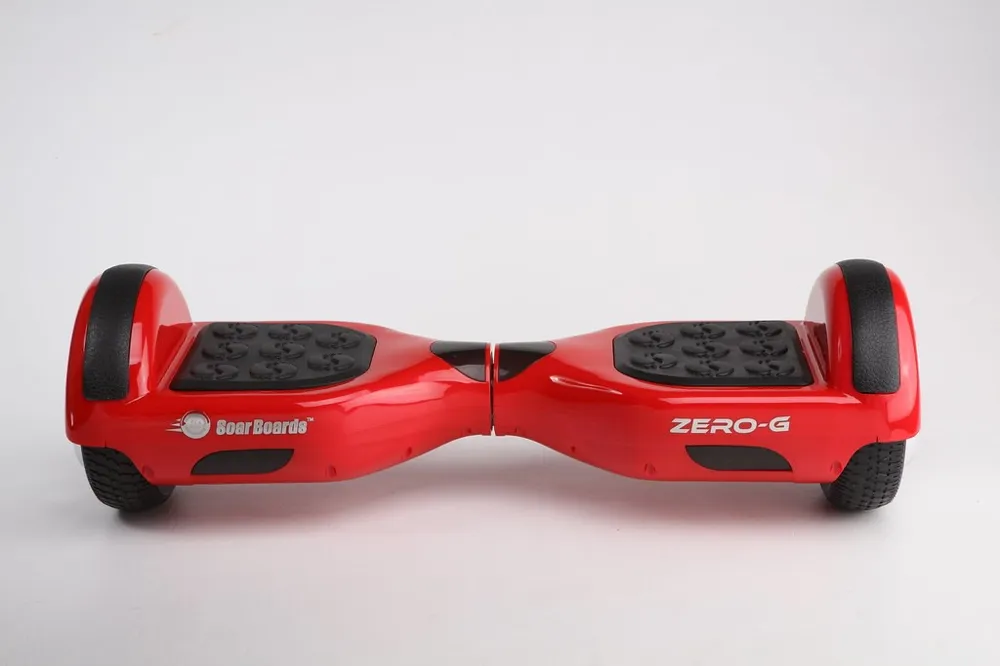
The word is older than any of these machines. Author M. K. Joseph described hoverboards in a 1967 science fiction novel, and the idea went mainstream in Back to the Future Part II (1989), where Marty McFly escapes a gang on a Mattel-branded board in a version of 2015. In the 1990s, director Robert Zemeckis fueled rumors that real hoverboards existed; those rumors were debunked.
When two-wheeled self-balancing boards took off around 2015, sellers borrowed the famous name, and it stuck, helped by the fact that 2015 was the year the film had imagined. Those boards roll on wheels and balance with gyroscopes and motors, as explained in how hoverboards work. Guinness World Records, by contrast, defines a hoverboard as an autonomously powered personal levitator, which is why its records go to boards that actually leave the ground.
Mattel has also sold licensed replicas of the film's board, first announced in 2012 according to news reports, and replicas have been offered again since. They look like the movie prop, but they don't hover.
Maglev Hoverboards: Hendo and the Lexus Slide
The boards that look most like Marty's are the magnetic ones. They float silently a little way above the ground and can carry a standing rider, but only over the right surface.
Hendo (2014)
In October 2014, American inventor Greg Henderson and his company Arx Pax showed the Hendo and launched a Kickstarter campaign. The board used four hover engines built on the electrodynamic wheel principle, in which rotating magnets interact with a metal surface below. According to reported specs, it could carry up to about 140 kg (300 lb) and hovered about 2.5 cm (1 inch) up, but only over a non-ferromagnetic metal such as copper or aluminum, so it could not float over ordinary ground. Reports say the Kickstarter was funded and that some boards went to backers, but the Hendo never went into mass production. Henderson's company mainly used it to promote its magnetic technology.
Lexus Slide (2015)
Lexus teased its hoverboard on June 24, 2015, as part of its "Amazing in Motion" campaign, then released a film on August 4–5, 2015, showing skaters riding it at a purpose-built "hoverpark" in Cubelles, near Barcelona, Spain. It was developed with IFW Dresden, a German materials research institute, and its subsidiary evico.
According to Lexus, the board held two cryostats, reservoirs of superconducting material cooled to −197°C in liquid nitrogen. Up to 200 meters of permanent-magnet track was shipped from Dresden and laid under the park's surface. As the superconductors cooled over the track, the magnetic field was effectively "frozen" into them, holding the board at a set height firmly enough for a rider to stand and even jump. The track under the park also let the board cross a stretch of water, a stunt that looked like free flight but wasn't. Lexus stated that the hoverboard "remains a prototype and will not be on sale."
Why Magnetic Hoverboards Need a Special Track
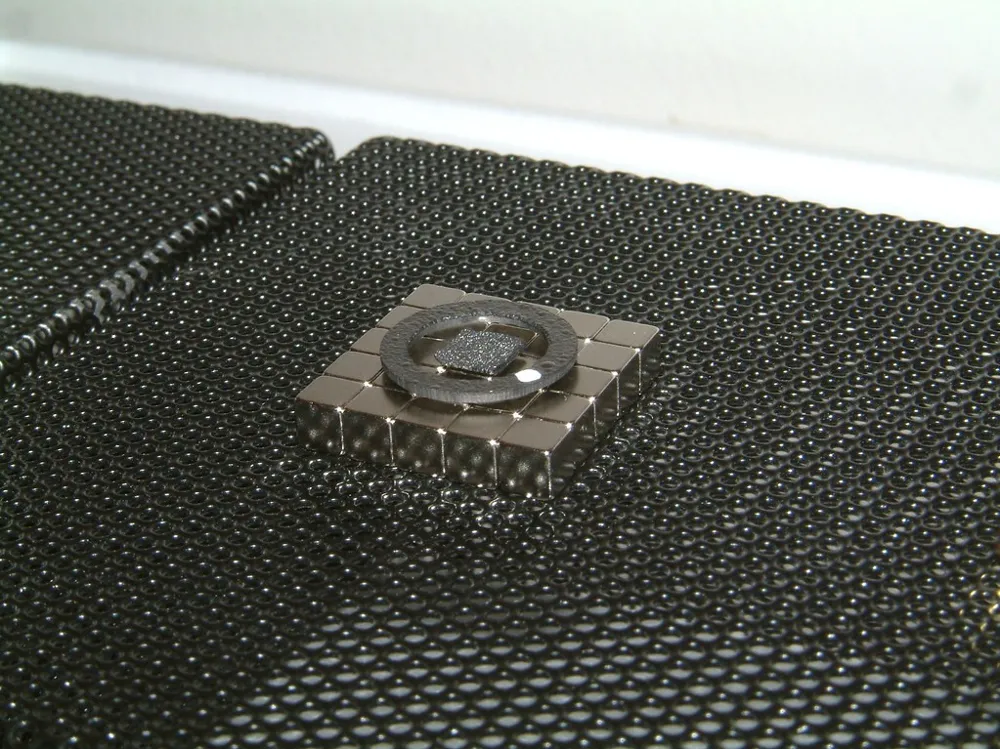
Magnetic levitation needs something to push against, and ordinary ground isn't magnetic or conductive enough. The two maglev boards solved that in different ways.
| Hendo | Lexus Slide | |
|---|---|---|
| What's in the board | Electric hover engines with spinning magnets | Superconductors in liquid-nitrogen cryostats |
| What's in the ground | A sheet of conductive, non-magnetic metal (copper or aluminum) | A track of permanent magnets |
| How lift happens | Moving magnets induce eddy currents in the metal, and those currents make an opposing magnetic field that pushes back | The cooled superconductor locks in the track's magnetic field and holds its height |
| Main limits | Needs constant power; useless over concrete, grass or water | Coolant boils off and must be refilled; useless off the track |
This is the same family of physics used by maglev trains, which also run on special guideways. Neither board could float over a normal street, which is the biggest gap between real maglev boards and the movie version. Other teams have since built similar demonstrations, such as a 2021 board from Hacksmith Industries that carried a rider over aluminum plates using electrodynamic wheels, but all of them depend on the same kind of special surface.
Fan and Propeller Hoverboards: ArcaBoard and Omni
To fly over any surface, a board has to push air down hard enough to lift a person. That takes a lot of power, which is why these boards have short flight times.
Omni Hoverboard (2015)
Canadian inventor Cătălin Alexandru Duru built a propeller-lifted board himself over about a year. In May 2015, Guinness World Records recognized his flight of 275.9 m (about 905 feet) at heights of up to 5 m over Lake Ouareau, Quebec, as the farthest hoverboard flight at that time. Duru steered by shifting his feet. In a 2021 interview he reportedly said he hoped to develop a commercial version; we found no product on sale as of November 2026.
ArcaBoard (2015)
ARCA Space Corporation announced the ArcaBoard on December 24, 2015, and offered it for order. It is a flat, rectangular board with 36 electric ducted fans. Listed specs:
- Hover height of about 30 cm, held by onboard sensors
- Speed limited to 20 km/h (about 12 mph)
- Flight time of up to about 3 minutes (Enhanced Thrust version, riders up to 110 kg) or up to 6 minutes (Long Endurance version, riders up to 90 kg)
- Board weight of up to 82 kg depending on version, with a separate charging dock
Shipping was scheduled to begin in April 2016, but we could not confirm how many, if any, reached customers, and we found no current sales listing as of November 2026. Treat it as a historical curiosity rather than something you can order.
Jet-Powered: Zapata's Flyboard Air
The most capable flying board so far comes from French inventor and former jet ski racer Franky Zapata. His Flyboard Air, unveiled in April 2016, is a small platform lifted by kerosene-fueled jet turbines (reports describe four on the 2016 version and five on later ones). The pilot stands on the platform and flies it standing up, with no seat or cockpit.
- Record: on April 30, 2016, at Sausset-les-Pins, France, it flew 2,252.4 m (about 7,388 feet), which Guinness World Records recognized as the farthest flight by hoverboard, beating the Omni's record.
- Bastille Day: on July 14, 2019, Zapata flew a turbine-powered board over the military parade in Paris.
- Channel crossing: after a failed attempt on July 25, 2019, he crossed the English Channel on August 4, 2019, covering about 35 km in roughly 20 to 22 minutes, with a refueling stop at a boat halfway across.
- Flight time: reported at about 10 minutes per tank, and published top speeds vary by source and version.
The board was developed partly for military use, under names such as EZ-Fly, and Zapata's company received a development grant from the French armed forces in December 2018. It has never been sold to the public. As of November 2026, Zapata's own website shows the Flyboard Air as a signature invention while the company focuses on the AirScooter, a hybrid-electric single-seat personal aircraft it says will be available in 2027, and a flight center near Las Vegas with a public opening listed for 2027. Those are company plans, so check the official site for updates.
Water Flyboards: The Hose-Powered Version
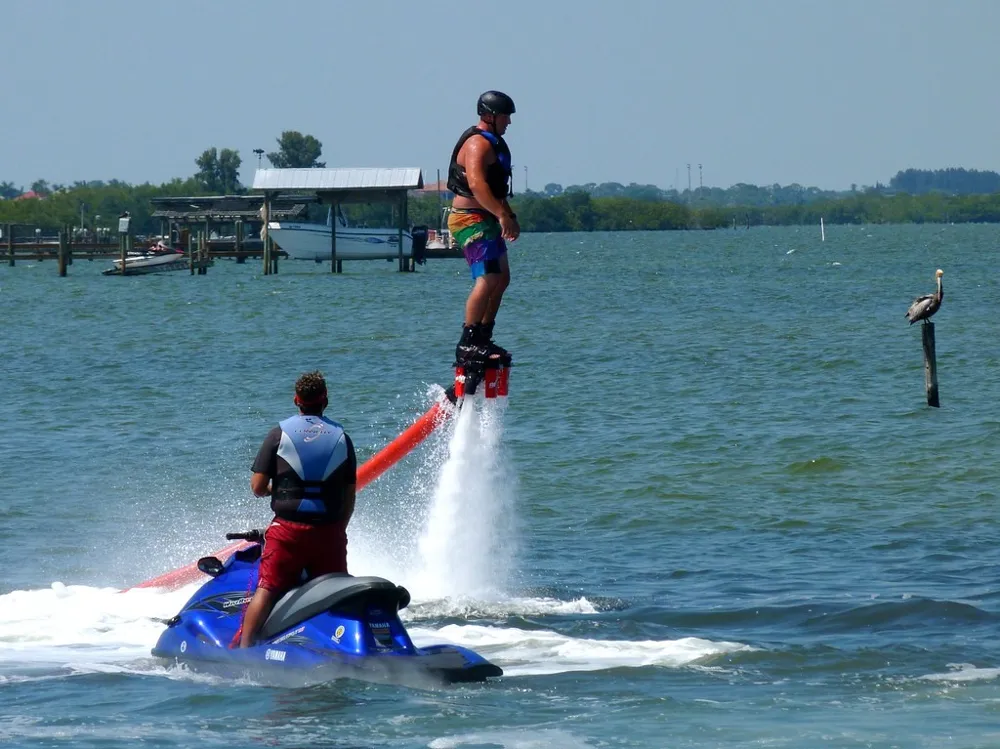
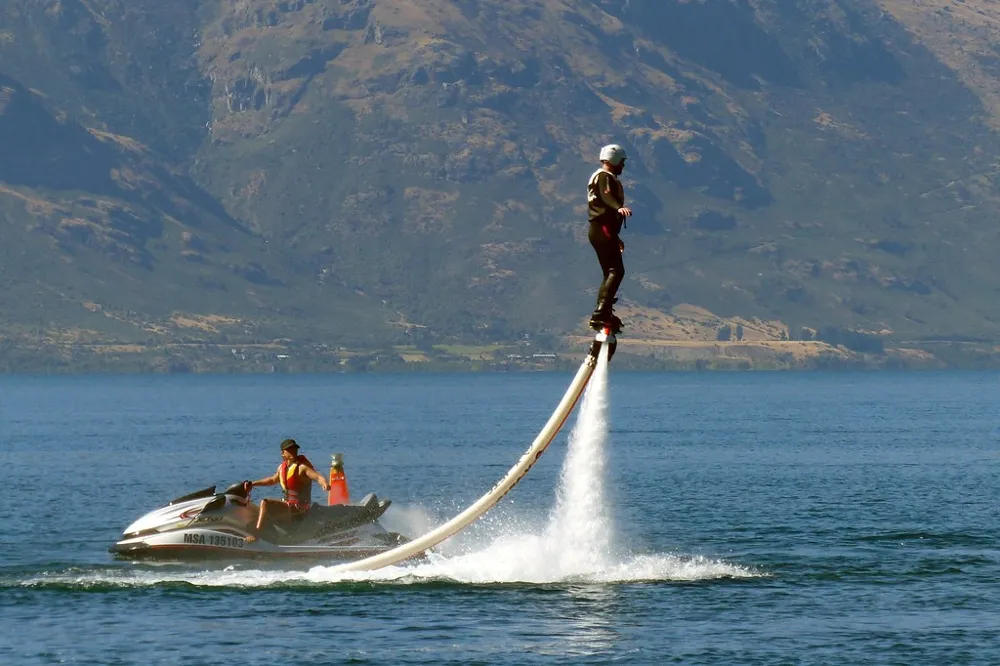
Before the Flyboard Air, Zapata became known for the water Flyboard. Rather than carrying its own engine, it takes the jet of water from a personal watercraft (a jet ski) and sends it up a long hose to nozzles under the rider's feet. The thrust lifts the rider out of the water to dive, spin and flip, while the watercraft follows along. Because the hose has to stay connected, the rider is tethered and stays over water; reports put the original's height limit at about 30 feet.
Zapata's company says it designed, built and sold water products, including the Flyboard, from 2011 to 2019. Water jet boards of this kind are commonly offered as guided rental rides in many lake and beach vacation areas (availability varies), which makes them the closest most people will get to flying on a board. Operators usually require a life jacket and a short briefing, and local boating rules apply. If you like board sports on the water, wakeboarding is a more traditional place to start.
Hoverboard Timeline
| Year | Milestone |
|---|---|
| 1967 | M. K. Joseph describes hoverboards in a science fiction novel |
| 1989 | Back to the Future Part II makes the hoverboard famous |
| 2011–2019 | Zapata's company makes and sells water products, including the water Flyboard (per the company) |
| 2012 | Mattel announces a non-hovering replica of the film's board (reported) |
| 2013 | A patent is filed for the two-wheeled self-balancing board later sold as the "hoverboard" |
| October 2014 | Hendo maglev hoverboard and Kickstarter campaign |
| May 2015 | Omni Hoverboard sets a Guinness record of 275.9 m |
| June–August 2015 | Lexus teases and then shows the Slide at its Barcelona-area hoverpark |
| 2015 | Self-balancing "hoverboards" boom as many companies sell similar boards |
| December 2015 | ARCA announces the ArcaBoard |
| April 2016 | Flyboard Air unveiled; sets a 2,252.4 m Guinness record on April 30 |
| July–August 2019 | Zapata flies at the Bastille Day parade and crosses the English Channel |
| 2021 | Hacksmith Industries demonstrates a rideable board over aluminum plates |
| 2027 (planned) | Zapata lists its AirScooter aircraft and Las Vegas-area flight center for 2027 |
Can You Buy a Real Hoverboard?
Not one that flies, as of November 2026. Here's what's realistically available:
| Option | Does It Hover? | Can You Get One? |
|---|---|---|
| Self-balancing hoverboard | No, two wheels | Yes, widely sold; choose a UL 2272 certified board |
| Water jet board ride | Yes, over water, on a hose | Yes, as a rental or guided session in many resort areas |
| Movie replica board | No | Collectible replicas have been sold; check current listings |
| Maglev board (Hendo, Lexus) | Yes, over special surfaces | No; prototypes and early development boards only |
| Fan or jet board (ArcaBoard, Flyboard Air) | Yes | No current consumer sales found |
Be wary of listings that call a product a "flying hoverboard" or "hovering hoverboard." In nearly every case it's a wheeled self-balancing board with lights, or a toy. For a wheeled board, start with the best hoverboards or hoverboards for kids, check our guide to hoverboard safety, and learn to ride with how to ride a hoverboard. If what you want is a board that feels like gliding, an electric skateboard is another option worth a look.
More Hoverboard Guides
Curious how far and fast the wheeled kind can go? See how fast hoverboards go and hoverboard weight limits, or compare a hoverboard with a scooter in hoverboard vs electric scooter. Browse everything in our scooter guides.
Frequently Asked Questions
Is there a real hoverboard that flies?
Yes, but only as prototypes and one-off machines. Franky Zapata's jet-powered Flyboard Air set a Guinness record for the farthest hoverboard flight in 2016 and crossed the English Channel in 2019, but it has not been sold to the public.
Can you buy a hoverboard that actually hovers?
Not as a consumer product, as of November 2026. The Lexus Slide was never sold, the Hendo was a Kickstarter-era development board, and we found no current sales of the ArcaBoard. The boards sold in stores as hoverboards are self-balancing scooters with wheels.
Why does a magnetic hoverboard need a special surface?
Magnetic levitation needs something to push against. The Hendo needed a non-magnetic metal surface such as copper or aluminum, and the Lexus Slide needed a track of permanent magnets, so neither could float over normal concrete, grass or water.
Did the Lexus hoverboard really work?
Yes, it levitated, but only over a track of permanent magnets built under a special skatepark near Barcelona. It used superconductors cooled with liquid nitrogen, and Lexus said it would remain a prototype and not go on sale.
Why are self-balancing scooters called hoverboards?
Mostly marketing and pop culture. The name comes from science fiction and Back to the Future Part II, and it stuck to two-wheeled self-balancing boards when they became popular around 2015, even though they roll on wheels.
How long can a flying hoverboard stay in the air?
Not long. The ArcaBoard was rated for about 3 to 6 minutes depending on version, and the Flyboard Air for roughly 10 minutes per flight, which is why its Channel crossing needed a refueling stop.
Is a water Flyboard a real hoverboard?
It is a real flying board, but it is not free-flying. It is lifted by water thrust sent up a hose from a personal watercraft, so it stays tethered over water.