How to Water Ski, From Deep-Water Start to One Ski (2026)
Everything a first-timer and their boat crew need: the right skis, the deep-water start, speeds by skier weight, hand signals, crossing the wake and getting up on one ski.
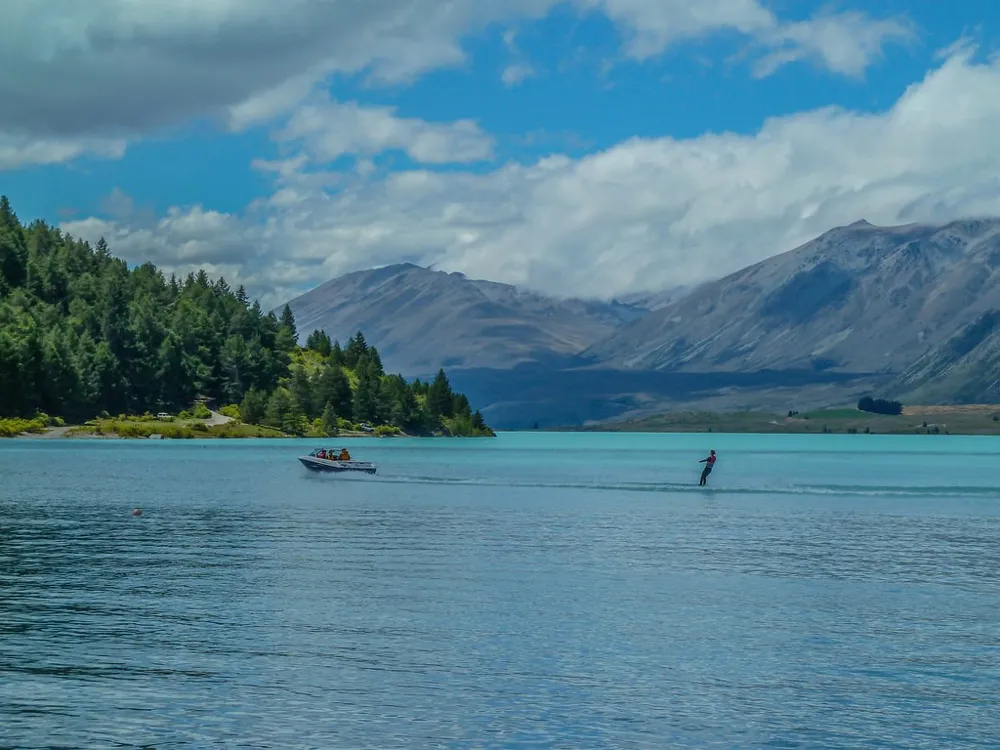
What You're Learning
Water skiing means being towed behind a boat on two skis, or eventually one, while standing in a balanced, slightly crouched position. Nearly everyone learns the same way: a deep-water start on two skis, riding inside the wakes, steering and crossing the wake, and only then dropping a ski to try slalom. USA Water Ski & Wake Sports, the US governing body, structures its beginner program as a ladder of levels in exactly that order, from a land drill to a one-ski deep-water start.
This guide follows that order. If you've ridden a wakeboard before, much of the boat setup will be familiar from how to wakeboard; the start and body position are different.
Combo Skis vs a Slalom Ski
The first gear decision is how many skis you start on.
| Combo Skis (Pair) | Slalom Ski (Single) | |
|---|---|---|
| Setup | Two skis, one foot on each | One ski with a front binding and a rear binding |
| Rear binding | Nearly all combos have a rear toe plate on one ski so it can be skied alone | Rear toe plate, open-toe "hybrid" rear, or a second boot |
| Feel | Wider and longer for stability and lift at low speed | Narrower and faster; carves harder turns |
| Tow speed | Lower | Higher (see the speed table below) |
| Best for | First-timers, families, casual skiing | Skiers who can already ride two skis and cross the wake |
Bart's describes combo skis as designed for beginners, prioritizing stability and low-speed comfort, and notes that the extra rear binding lets you use one of the pair as an entry-level slalom ski. That's why a combo pair is the usual first purchase: it covers both your first rides and your first one-ski attempts. Kids can start on trainer skis; see our best water skis guide for combos, slalom skis and trainers.
Gear, Boat and Crew Checklist
Skis Sized to Your Weight
Ski length follows skier weight and boat speed: heavier skiers need longer skis. Discover Boating puts typical adult skis at about 63 to 72 inches, and Overton's size chart starts at 59–63 inches for 60–100 lb skiers. Use the chart for the exact ski you're buying, because widths and shapes vary.
Rope and Handle
- Ski rope: Overton's gives 75 feet as the average length. Use a low-stretch rope in good condition, with no frayed sections or broken bridles.
- Handle: typically 11–13 inches wide. For one-ski starts, Discover Boating suggests a deep-V handle that lets you hold the ski straight in front of you.
- Grip: USA Water Ski recommends a knuckles-up grip on two skis and a baseball grip (one palm up, one down) on one ski.
Life Jacket and Clothing
- US Coast Guard-approved life jacket. Many states require one for towed riders; for example, California requires a Type I, II, III or V USCG-approved life jacket, and inflatable life jackets aren't approved for towing. Impact vests are not always Coast Guard approved.
- It should fit snugly, cover your chest, abdomen and back, and not ride up when you fall.
- A wetsuit in cool water; gloves help your grip.
The Boat
Any runabout with enough power to pull a skier up and hold a steady speed will do. Overton's notes a ski boat should reach about 20 knots (23 mph) quickly; Discover Boating says recreational skiing is often done around 30 mph, with competition slalom at 36 mph.
The Crew
You'll need a driver and a spotter (observer) who watches the skier and relays signals so the driver can watch ahead. Many states require an observer; California, for example, requires one aged 12 or older in addition to the driver. Discover Boating notes that a driver plus an observer is much safer than a driver with only a ski mirror.
Hand Signals
Agree on these before anyone gets in the water. These are the signals in USA Water Ski's learn-to-ski brochure:
| Signal | Meaning |
|---|---|
| Thumbs up | Speed up |
| Thumbs down | Slow down |
| OK sign | Speed or path is good |
| One finger circling overhead, then pointing | Turn, in the direction pointed |
| Pat on top of the head | Back to the dock |
| Hand drawn across the neck | Stop or cut the motor (skier, driver or observer) |
| Both hands clasped over the head | I'm OK, after every fall |
Practice the Start on Land
A few minutes on the beach or dock saves a lot of swallowed water. Put the skis on (or just sit on the ground), pull your knees into a cannonball with your arms straight outside your knees, and have a partner hold the handle and pull gently. Let the pull bring you up into a chair-like crouch, then bring your hips under your shoulders before you straighten. USA Water Ski starts its beginner ladder with exactly this drill. The habit to build is letting the rope lift you instead of standing up with your legs or pulling with your arms.
The Deep-Water Start, Step by Step
- Put the skis on in the water and float on your back with your life jacket supporting you.
- Get into the cannonball. Knees tucked to your chest and together, skis pointing at the boat with the tips poking out of the water.
- Rope between the skis. Hold the handle with straight arms, the rope running between the ski tips toward the boat.
- Signal when you're ready. Wait until the slack is out of the rope and the area ahead is clear, then call "hit it" or give the agreed signal.
- Let the boat do the work. Stay compact with arms straight while the boat pulls you up. The water pushes against the skis; don't fight it.
- Wait until you're on top of the water. Don't try to stand until the backs of the skis are planing on the surface.
- Rise slowly. Bring your hips forward under your shoulders and straighten your legs part of the way, keeping your knees bent.
If the skis drift apart or cross, or you're getting dragged, let go and try again. The boat will circle back.
Body Position Once You're Up
- Head up, eyes on the horizon or the boat, not your skis.
- Arms straight but not locked, with light downward pressure on the handle.
- Knees bent and flexible to soak up chop.
- Weight centered over the skis, hips under your shoulders, back fairly straight.
Stay inside the wakes, where the water is smoothest, until you can ride relaxed for a while. USA Water Ski's second level is simply a deep-water start and holding the proper two-ski position.
Boat Speed by Skier Weight
The single biggest driver mistake is the wrong speed. USA Water Ski publishes suggested towboat speeds by skier weight in its learn-to-ski material:
| Skier Weight | Two Skis | One Ski |
|---|---|---|
| Under 50 lb | About 13 MPH | About 16 MPH |
| 50–100 lb | About 16 MPH | About 20 MPH |
| 100–150 lb | About 18 MPH | About 24 MPH |
| 150–180 lb | About 21 MPH | About 27 MPH |
| Over 180 lb | About 24 MPH | About 32 MPH |
Source: USA Water Ski & Wake Sports learn-to-ski brochure. Its learn-to-slalom brochure lists somewhat higher speeds for skiers who are progressing, so treat these as starting points and adjust with thumbs up or down. Children often start slower still: in one Boating Magazine example, a young child of about 50 lb skied two skis at about 10 mph. Our kids' wakeboards guide has more on towing young riders.
For the driver: idle forward until the rope is tight, accelerate smoothly (not a jerk), and hold the speed steady in a straight line once the skier is up.
Turning and Crossing the Wake
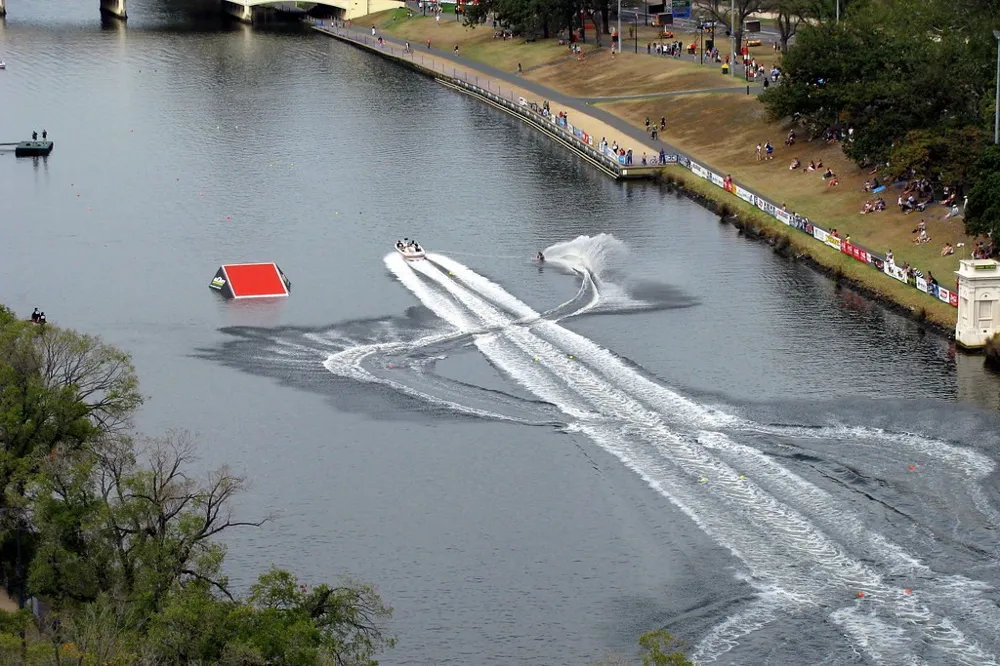
Steering Inside the Wakes
To turn, press on the inside edge of the ski opposite the way you want to go: to move right, lean right and press on the left ski. Releasing pressure on one ski while loading the other steers you. USA Water Ski says the most common mistake is pulling on the handle; keep your arms straight and knees bent.
Crossing the Wake
- Turn both skis toward the wake at a sharp angle, not a shallow one.
- Keep pressure on the ski nearest the boat until you're well over the wake.
- Bend your knees to absorb the bump, and keep your arms straight.
- Ride out into the smoother water outside the wake, then cross back.
Going over the wake slowly, or letting one ski cross at a shallow angle, is what causes most wake-crossing falls. USA Water Ski's later two-ski levels build up to seven crossings in 60 seconds or less, a good sign you're ready for one ski.
Getting Up on One Ski
Once you can cross the wakes confidently on two skis, you can start slalom. First, find your front foot: stand with your feet together and have someone give you a light push from behind. The foot you step forward with first generally goes in the front binding.
Dropping a Ski
Dropping a ski while already up is the easiest route to one ski. Use a combo ski with a rear toe plate (or a slalom ski) on your front foot and set the other ski's binding as loose as possible.
- Do a normal two-ski start and settle into the smooth water between the wakes.
- Shift your weight onto your front foot.
- Lift the heel of your other foot out of its binding, push down with your toes and let the ski slide off backward. Keep it in the water; don't kick it up.
- Drag your free foot briefly for balance if you need to.
- Bring that foot up to the calf of your front leg, then lower it onto the ski behind your front foot and slide it into the rear binding, eyes on the boat, not your feet.
Boating Magazine suggests dropping the ski close to shore and out of boat traffic, with the driver running a straight line so the skier stays centered. Note where the ski lands so the boat can collect it, and allow for current on a river.
The Deep-Water Slalom Start
- Put your front foot in the front binding. Some skiers have more control with the back foot in the rear binding from the start; others drag it until they're up. Try both.
- Bend your ski knee until it's nearly at your chest, with the ski upright in front of you.
- Keep the rope on the inside of the ski (between the ski and your free leg). A deep-V handle helps hold the ski straight.
- If your back foot is free, drag it behind you as a stabilizer to keep the tip pointing at the boat.
- As the boat pulls, bring your shoulders slowly up and slightly back to keep your weight over the ski. Don't shove the ski out in front of you; let the water push the ski to you.
- Stay low until you're planing, then stand gradually and put your back foot in if it's free.
Expect many tries. One-ski starts need more speed (see the one-ski column above) and more strength than two-ski starts.
Slalom Body Position
Arms straight, shoulders up and hips close to the handle. To turn, lean with your shoulders to the side rather than forward or back, point the ski tip toward the wake and bend your knees to absorb it.
How to Fall Safely
- Let go of the handle as soon as you know you're falling.
- Fall backward or to the side if you can. USA Water Ski notes that a forward fall increases the chance of hitting a ski.
- Give the "I'm OK" signal (hands clasped over your head) after every fall.
- If you fall where other boats are running, lift one ski partway out of the water so you're visible.
- Never put any part of your body through the handle or wrap the rope around yourself.
- Stop before you're exhausted; tired skiers fall harder.
Common Mistakes and Fixes
| Problem | Likely Cause | Fix |
|---|---|---|
| Pulled over the front on the start | Standing too early, bent arms | Stay in the cannonball until you're planing; arms straight |
| Falling back on the start | Leaning back, legs pushed out straight | Knees tucked, hips forward under shoulders as you rise |
| Skis spreading apart | Knees drifting apart on the start | Keep knees together in the cannonball until you're up |
| Skis crossing | Uneven weight, looking down | Head up, weight centered, let go and restart if they cross |
| Falling on the wake | Crossing slowly or at a shallow angle, pulling the handle | Sharper angle, more commitment, arms straight, knees bent |
| Can't get up on one ski | Pushing the ski forward, too little speed | Let the water bring the ski to you; check speed against the chart |
Driver and Observer Rules
USA Water Ski's safety rules for skiers and crews include:
- Always have an observer in the towboat.
- Turn the motor off whenever a skier is getting into or out of the boat, and stay away from the exhaust at the stern.
- Don't start until the skier signals, the slack is out and the path is clear.
- Stay well away from docks, pilings, other boats and swimmers, and out of shallow water.
- Never tow a skier directly in front of another boat; use equal-length ropes when two people ski at once.
- Ski only in daylight.
- Return to a fallen skier promptly and approach slowly on the driver's side, with the engine in neutral near them.
State laws add their own requirements, which can cover observers, approved life jackets, ski flags and towing hours. Florida, for example, bans towing from a half hour after sunset to a half hour before sunrise. Check your state boating agency before you go (last checked November 2026). This is a summary, not legal advice.
Teaching Kids to Water Ski
Children learn the same deep-water start, but on shorter trainer skis and at lower speeds. Many kids' trainer skis are sold with a trainer bar or rope system, such as HO's Hot Shot trainers and O'Brien's trainer bar. Boating Magazine also describes a two-handle rope, where an adult on the swim platform holds one handle and lets go if the child falls. Federal law requires children under 13 to wear a Coast Guard-approved life jacket while a recreational boat is underway, and many states set their own ages. See our kids' wakeboards guide for life jacket sizing and youth towing tips.
What to Learn Next
- Run slalom turns outside the wakes, then work on a shorter rope.
- Learn a dock start or a one-foot start once deep-water slalom starts are consistent.
- Try other tow sports with the same boat: wakeboarding, wakesurfing or towable tubes.
- Look up a USA Water Ski & Wake Sports club or a ski school for coaching and courses.
Related Guides
Pick your gear with the best water skis, tow ropes and life vests, or browse more water sports guides, including types of water sports.
Frequently Asked Questions
Is water skiing hard to learn?
Getting up is the hardest part. Most beginners need a few attempts on two skis, and the usual cause of a fall is standing up too early or pulling on the handle. Once you're up, riding in a straight line comes fairly quickly.
How fast should a boat go for a beginner water skier?
It depends on weight. USA Water Ski's beginner brochure suggests about 16 mph for a 50–100 lb skier on two skis, 18 mph for 100–150 lb, 21 mph for 150–180 lb and 24 mph above 180 lb. Treat these as starting points and adjust with hand signals.
How long should a water ski rope be?
Overton's gives 75 feet as the average ski rope length, and that is a common length for recreational skiing. Slalom ropes have colored sections so experienced skiers can shorten the line.
Is water skiing easier than wakeboarding?
Neither is objectively easier. Two skis give a stable, separate platform for each foot, while a wakeboard start uses a single wide board turned sideways. Many people try both; see our wakeboarding guide for that start.
Which foot goes forward on a slalom ski?
Usually your dominant foot. Stand with your feet together and have someone give you a light push from behind: the foot you step forward with first generally goes in the front binding.
Do you need a spotter to water ski?
USA Water Ski says to always have an observer in the towboat, and many states require one. California, for example, requires an observer aged 12 or older in addition to the driver. Check your state's rules.
How deep does the water need to be for water skiing?
Overton's advises a minimum depth of at least 6 feet. Also stay clear of docks, swimmers, shallow areas and anything floating or submerged.
What should I wear to water ski?
A snug, US Coast Guard-approved life jacket is the essential. Add a wetsuit or shorty in cool water, and many skiers wear gloves for grip.