Paddle Board Motors: Fin Kits, Mounts and the Rules (2026)
Electric fins and clip-on motor kits from Aqua Marina, Bixpy and Boost Surfing, a trolling motor mount option, and what changes legally once your board has a motor.

Can You Put a Motor on a Paddle Board?
Yes. A paddle board motor is a small electric drive that pushes the board while you stand, sit or paddle alongside it. Most riders use one to get home against a headwind, cover more water on a long tour, hold position while fishing, or give a tired passenger a break. You can still paddle normally with most setups, and the motor switches off when you don't need it.
There are three ways to add power:
- Electric fins and fin-box motors replace or clip onto the center fin. The battery sits on deck or inside the fin, and you steer and change speed with a wireless remote.
- Clip-on outboard kits use a small motor on an adapter that fits your fin box, plus a separate deck battery. Some of these kits move between a SUP, a kayak and a small dinghy with different adapters.
- Trolling motor mounts clamp a conventional electric trolling motor to the tail of the board. It's the heaviest option, but it uses common motors and batteries.
Complete motorized boards with a built-in drive also exist; we cover those below. Whichever route you take, a motor changes the rules: in many states a paddle board with any motor has to be registered, and the battery decides whether it can fly with you.
Aqua Marina BlueDrive S Power Fin
Best for easy cruising
- Fits most boards with a fin box
- Two speeds, wireless remote
- Battery and control box on deck
Boost Surfing Fin
Best compact fin
- Electric fin with remote
- Slide-in, US box and stick-on adapters
- Modes for assist and trolling
Paddle Board Motors Compared
Specs below are what each maker or retail listing publishes as of November 2026. Runtime and speed always depend on rider weight, board size, wind and current, so treat them as best-case figures.
| Motor | Type | Mounting | Battery | Listed Speed or Thrust | Listed Runtime |
|---|---|---|---|---|---|
| Aqua Marina BlueDrive S | Electric fin | Fin box | 11.1V, 8.8Ah Li-ion in a deck control box | Up to 6 km/h (about 3.7 MPH) | Up to 60 minutes |
| Bixpy K-1 Outboard Kit | Clip-on outboard | Adapter sold separately (US fin, slide-in, glue-on and more) | 384 Wh LiFePO4 PP-384 pack | 33 lb thrust | About 75 minutes at top speed, up to 10 hours slow |
| Boost Surfing Fin | Electric fin | Adapters for slide-in, US box and stick-on boxes | Listed at 3,500 mAh | Not published in the listings we checked | Listed up to 100 minutes in SUP assist |
| Brocraft SUP Motor Mount | Trolling motor mount | Clamp on track bar, glue-on pads | Separate 12V battery (not included) | Depends on the motor you add | Depends on the battery you add |
The Best Paddle Board Motors
1. Aqua Marina BlueDrive S Power Fin
An electric fin that slides into the board's fin box in place of the center fin. Aqua Marina says it fits nearly all watercraft with a fin box and lists a 12V DC, 240W motor, two speeds (up to 4 km/h on low and 6 km/h on high) and up to 60 minutes of runtime. Power comes from an 11.1V, 8.8Ah lithium-ion pack inside a control box that straps to the deck; the pack weighs 2.8 lb and the whole kit 9.4 lb with the control box. The box contains the fin unit, the control box with battery, an elastic rope buckle, a wireless remote and a charger. On paper the pack works out to just under 100 Wh (11.1V x 8.8Ah), which is the carry-on threshold for lithium batteries; check the rating printed on the battery before you fly.
Good to Know
- Simple swap for the center fin
- Light kit for an inflatable
- Battery size suits air travel limits on paper
Watch Out For
- Short runtime at high speed
- Gentle top speed; it assists rather than races
- Confirm your fin box type before ordering
2. Bixpy K-1 Outboard Kit
A small outboard motor and deck battery that Bixpy sells for kayaks, SUPs and other small craft. Bixpy lists 33 lb of thrust with the PP-384 power pack, 12 forward and 3 reverse speeds, about 75 minutes at top speed and up to 10 hours at slower speeds. The pack is a 25.6V, 15Ah LiFePO4 battery rated at 384 Wh and IP67, and it charges from the wall in about 5.5 hours or from an optional solar panel. The motor weighs 2.8 lb and the pack 8 lb. The kit includes a wireless remote and a magnetic kill switch on a floating leash, but no mounting adapter: for a paddle board you add a fin adapter such as the US Fin, Slide and Lock, Flip and Lock or Glue-On Fin Box version. The same motor then moves to a kayak, pedal drive or transom with other adapters; for kayak setups, see our kayak trolling motor guide.
Good to Know
- Much longer range than small fin motors
- Kill switch included
- One motor, many boats
Watch Out For
- Adapter costs extra; check the right one for your board
- 384 Wh pack is too big for passenger flights
- Heavier deck battery to strap down
The Bixpy listing was unavailable on Amazon when we checked (November 2026); check Bixpy or paddle retailers.
3. Boost Surfing Fin
A compact electric fin sold for surfboards, SUPs and kayaks, with a wireless remote. Retail listings describe a 3,500 mAh battery and runtimes of up to about 100 minutes in SUP assist mode, about 70 minutes in trolling mode and about 40 minutes when pushing against wind or current. Boost sells it in bundles with a slide-in (SUP) adapter, a US fin box (longboard) adapter or a stick-on fin box adapter for boards without a compatible box, and some board makers sell their own adapters for it. It's the smallest option here, which makes it the easiest to pack for a trip.
Good to Know
- Very small and light to carry
- Adapters for most common fin boxes
- Also works on surfboards
Watch Out For
- Listings don't publish thrust or top speed
- Check the battery's Wh rating before flying
- Order the bundle that matches your fin box
4. Brocraft Inflatable Kayak and SUP Motor Mount
A clamp-on bracket for adding a small electric trolling motor to a paddle board or PVC inflatable. It uses an adjustable aluminum track bar and a nylon-protected clamp to fit different hull widths, and it attaches with two glue-on pads; the glue is not included, so use the adhesive your board maker recommends. The mount gives you the whole range of standard trolling motors and 12V batteries to choose from. The trade-off is weight: a trolling motor plus a deep-cycle battery is far heavier than a fin kit, so it suits wide fishing boards with plenty of capacity.
Good to Know
- Uses common trolling motors
- Adjusts to different board widths
- Good for wide fishing SUPs
Watch Out For
- Motor and battery sold separately
- Glue-on pads are semi-permanent
- Much heavier than a fin motor
Not on Amazon but worth knowing: ePropulsion's Vaquita is a dedicated SUP motor that fits a US fin box, and several board makers sell their own Bixpy or Boost bundles matched to their fin boxes. Check the maker's compatibility list before you buy any motor.
Fin-Box Motors vs Trolling Motor Mounts

The biggest choice is where the motor attaches. Fin-box motors are built for paddle boards; trolling motor mounts borrow from kayak fishing.
| Factor | Fin-Box Motor or Electric Fin | Trolling Motor on a Mount |
|---|---|---|
| Attachment | Slides into the fin box or a fin adapter; no glue on most boards | Clamps to a bracket glued or strapped to the tail |
| Weight added | A few pounds for the motor plus a small deck battery | Motor, shaft and a 12V deep-cycle battery; much heavier |
| Steering | Wireless remote; you steer with your paddle or body weight | Tiller handle at the tail, so you usually sit or kneel near it |
| Draft | Sits under the board like a fin; can hit bottom in shallows | Shaft depth is adjustable; prop sits lower than a fin |
| Paddling feel | Close to a normal board; slight drag when off | Board feels tail-heavy; paddling with the motor up is awkward |
| Best for | Cruising, touring, travel, all-around inflatables | Fishing boards with high capacity and a seat |
If your board has no fin box at all, glue-on fin box adapters are available for some motors. Gluing anything to an inflatable is permanent enough to affect a warranty, so read the board maker's guidance first. Our inflatable paddle board guide explains US, slide-in and click-in fin boxes.
Complete Motorized Paddle Boards
A motorized paddle board, or e-SUP, has the drive built in: usually a fin motor or a small jet in the tail and a battery in a deck pod or inside the board. Makers such as Sipaboards have sold inflatable boards with an integrated drive. They're tidy because nothing needs fitting, but the motor and board are tied together, so if one wears out you may replace both. A separate motor kit can move to your next board, and you can choose the board on its own merits. For most riders who already own a board, a kit is the simpler path. If you're still choosing a board, our paddle board size chart and fishing paddle board guide will help you pick one with room for a motor and battery.
How to Choose a Paddle Board Motor
Fin Box Compatibility
Look underneath your board. A US box is a long slot with a screw and plate; slide-in and click-in boxes take tool-free fins and are often brand-specific. Match the motor or adapter to that box, or plan for a glue-on adapter. This single check prevents most returns.
Battery Size and Runtime
Battery capacity in watt-hours (Wh) is the best guide to range. Multiply volts by amp-hours if the label doesn't show it. Bigger packs run longer but weigh more and can't fly. Plan your trip on the lower end of any listed runtime and keep enough charge, or energy to paddle, to get back against the wind.
Speed and Thrust
Fin motors are built to assist, not to plane. Published speeds run from walking pace to a brisk cruise. Thrust figures, where makers give them, help you compare motors on the same board; a heavier rider or loaded fishing board needs more.
Weight and Board Capacity
Add the motor, battery and mount to your body weight and gear. The total should sit comfortably under the board's listed capacity, or the board will ride low and the motor will work harder.
Controls and Safety Features
Look for a wireless remote that floats or straps to your wrist, a kill switch or safety leash that stops the motor when you fall, a shrouded or guarded propeller, and a reverse gear if you'll maneuver near docks.
Charging and Travel
Check the charge time, whether solar charging is offered, and the battery's Wh rating if you plan to fly. A small electric fin is easier to pack than a kit with a large deck battery.
Batteries: Charging, Care and Lithium Travel Rules
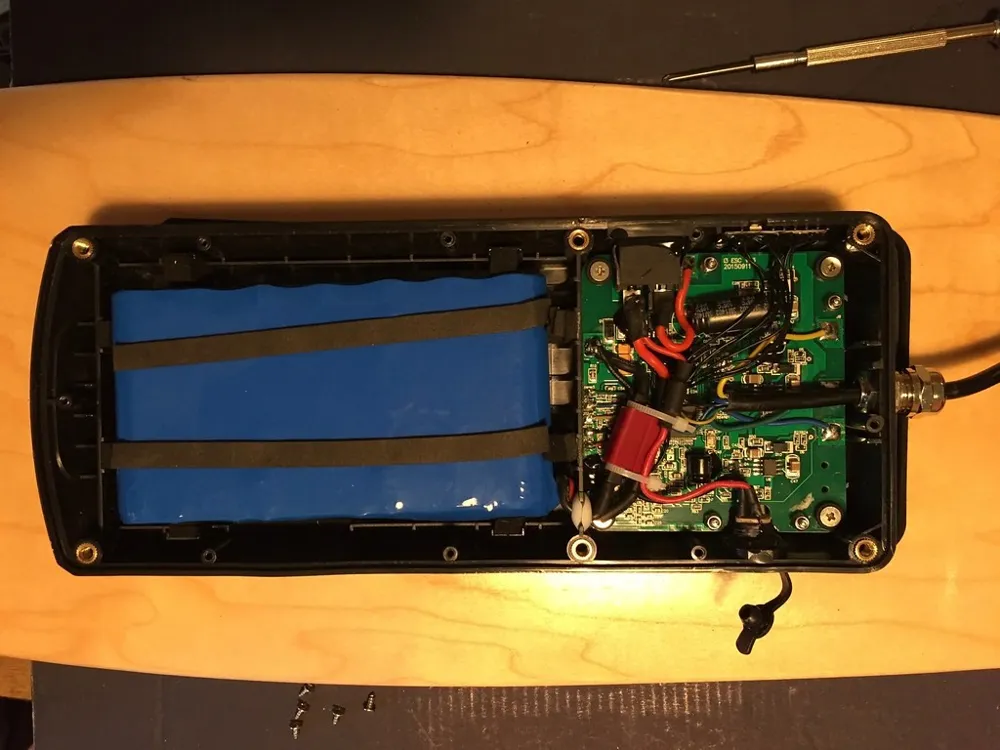
Most paddle board motors use lithium-ion or lithium iron phosphate (LiFePO4) packs. Treat them like any large lithium battery:
- Charge on a hard, non-flammable surface with the supplied charger, away from heat, and don't leave a pack charging unattended overnight.
- Keep the pack out of direct sun on the deck when you can, and rinse and dry connectors after saltwater use.
- Store it part-charged in a cool, dry place over winter and top it up every few months, following the maker's instructions.
- Stop using a pack that swells, smells, leaks or gets hot.
Flying with a motor battery. Under FAA rules, spare lithium-ion batteries have to travel in carry-on bags, not checked luggage. Batteries up to 100 Wh are allowed, and batteries from 101 to 160 Wh need airline approval, with a limit of two per person. Terminals must be protected from short circuits, and airlines can set stricter limits, so check with your carrier first (as of November 2026). Larger packs, such as a 384 Wh motor battery, fall outside those limits, so plan to ship it, rent locally or bring a smaller flight-sized pack. Some trips also cross borders with their own rules. For more general battery care, see our e-bike battery guide, since the chemistry is the same.
Do You Have to Register a Motorized Paddle Board?
Often, yes, and this surprises many paddlers. The US Coast Guard already treats a paddle board as a vessel outside swimming, surfing and bathing areas, which is why you need a life jacket and whistle (see paddle board accessories for the full carriage rules). Adding a motor can also make the board a motorboat under state law.
Texas is a clear example. Texas Parks and Wildlife says all motorized vessels must be registered regardless of length, and that adding an outboard or trolling motor to an otherwise exempt canoe, kayak or similar craft removes the exemption. Many other states follow the same pattern: unpowered paddle craft are exempt, but any motor, electric included, triggers registration numbers and decals. A few states also require registration or launch permits for unpowered boats.
| What Can Change With a Motor | What to Check |
|---|---|
| Registration and decals | Whether your state counts electric motors and fin motors as motors, and where numbers must be displayed on a board |
| Title | Some states title motorized vessels; check the length and value thresholds |
| Boater education | Some states require a boater education card to operate any motorized vessel, often tied to age or horsepower |
| Navigation lights | A powered board may be treated as a power-driven vessel at night, which can call for more than a handheld white light |
| Where you can go | Some lakes, reservoirs and parks ban motors or allow electric only |
Check your state. Rules vary by state and change over time. Before your first motorized trip, read your state boating agency's registration page or call them, and check local rules for the lake or park. Last checked November 2026; this is a summary, not legal advice. Our kayak registration laws guide covers paddle craft rules state by state, and the canoe trolling motor guide applies the same registration note to canoes.
Safety: Kill Switch, Leash and Propeller

A motor adds speed and a spinning propeller to a craft you can easily fall off. A few habits keep it safe:
- Use the kill switch or safety leash every time. Bixpy includes a magnetic kill switch on a floating leash; retail descriptions of the Aqua Marina kit list a safety leash that stops the motor when you fall. Clip it to your wrist, ankle or life jacket so the motor stops if you go in, and the board doesn't motor away from you.
- Keep your board leash too. The motor kill cord and the board leash do different jobs. On flat water a coiled board leash keeps the board close; on rivers use a quick-release leash at the waist.
- Wear a life jacket. Faster travel means you can end up farther from shore. A worn life jacket is the safest choice, and inflatables only count when worn.
- Respect the propeller. Switch the motor off before climbing back on, before touching the fin, and whenever anyone is swimming near the tail. Shrouded props are safer, but none is finger-proof.
- Watch the depth. Fin motors sit lowest under the board. Turn off and paddle in shallow, sandy or weedy water to avoid striking the bottom or wrapping weeds around the prop.
- Plan for a dead battery. Always carry a paddle and keep enough strength in reserve to paddle home. Turn back at half your expected runtime if you're heading upwind.
- Follow the rules of the road. As a vessel operator, keep clear of channels and larger boats and watch your wake near other paddlers.
For cold water, weather and rescue skills that apply to every paddler, see our paddling safety guide.
Fitting and Using a Fin Motor
- Charge first. Fully charge the battery and the remote, if it has its own battery, the night before.
- Inflate and fit on land. Pump the board to its recommended pressure, then remove the stock center fin and slide the motor or adapter into the fin box. Tighten any screw or lock as the manual says.
- Secure the battery. Strap the battery or control box to the deck bungees or D-rings, and route the cable so you won't step on it.
- Pair and test. Pair the remote, attach the kill switch leash and run the motor briefly in knee-deep water with no one near the tail.
- Start slow. Begin kneeling on the lowest speed until you know how the board responds, then stand. Steer with small paddle strokes or by shifting your weight.
- Finish clean. Switch off before landing, remove the motor before you deflate or carry the board, and rinse everything in fresh water.
New to the board itself? Learn to stand and turn first with our beginner's guide to paddle boarding.
Care and Maintenance
- Rinse the motor, propeller, adapter and battery case with fresh water after every session, especially in salt water, then let them dry before storing.
- Check the propeller and shroud for fishing line, weeds and nicks, and replace a damaged prop with the maker's part.
- Inspect the cable, connectors and seals for cracks or corrosion and keep connector caps on when unplugged.
- Store the motor and battery indoors, out of hot cars and freezing garages.
- Recheck the fin box screws and glue-on pads at the start of each season.
Rounding out your setup? Our paddle board accessories checklist covers leashes, life jackets and dry bags, and the paddle board pump guide helps you inflate an iSUP to the right pressure before fitting a motor. Back to the paddle boarding hub.
Frequently Asked Questions
How fast does a paddle board motor go?
Most fin motors push a board at roughly a relaxed paddling pace or a little faster. Aqua Marina lists the BlueDrive S at up to 4 km/h on low and 6 km/h on high (about 2.5 and 3.7 MPH). Rider weight, board shape, wind and current all change the real number.
Do I need to register a paddle board with a motor?
Often, yes. Many states exempt unpowered paddle craft but require registration once any motor is added; Texas, for example, says adding an outboard or trolling motor removes the exemption. Rules vary by state, so check your state boating agency. Last checked November 2026; this is not legal advice.
Can I take a paddle board motor battery on a plane?
Only if it is small enough. The FAA limits spare lithium-ion batteries to carry-on bags, allows up to 100 Wh per battery, and allows 101 to 160 Wh only with airline approval. Larger packs, such as a 384 Wh motor battery, are not covered by those limits and usually have to be shipped or left at home.
Can you put a trolling motor on a paddle board?
Yes, with a clamp-on mount made for SUPs or inflatables. You also carry a separate 12V battery, so check the combined weight against your board's capacity and keep the propeller clear of your feet and leash.
How long does a paddle board motor battery last?
It depends on the battery size and how fast you run. Aqua Marina lists up to 60 minutes for the BlueDrive S, while Bixpy lists about 75 minutes at top speed and up to 10 hours at slow speeds for the K-1 with its 384 Wh pack.
Can you still paddle with a fin motor fitted?
Yes. A fin motor replaces or sits in place of the center fin, so you can paddle normally, use the motor for assist, or switch it off. Expect a little more drag than a plain fin when the motor is off.